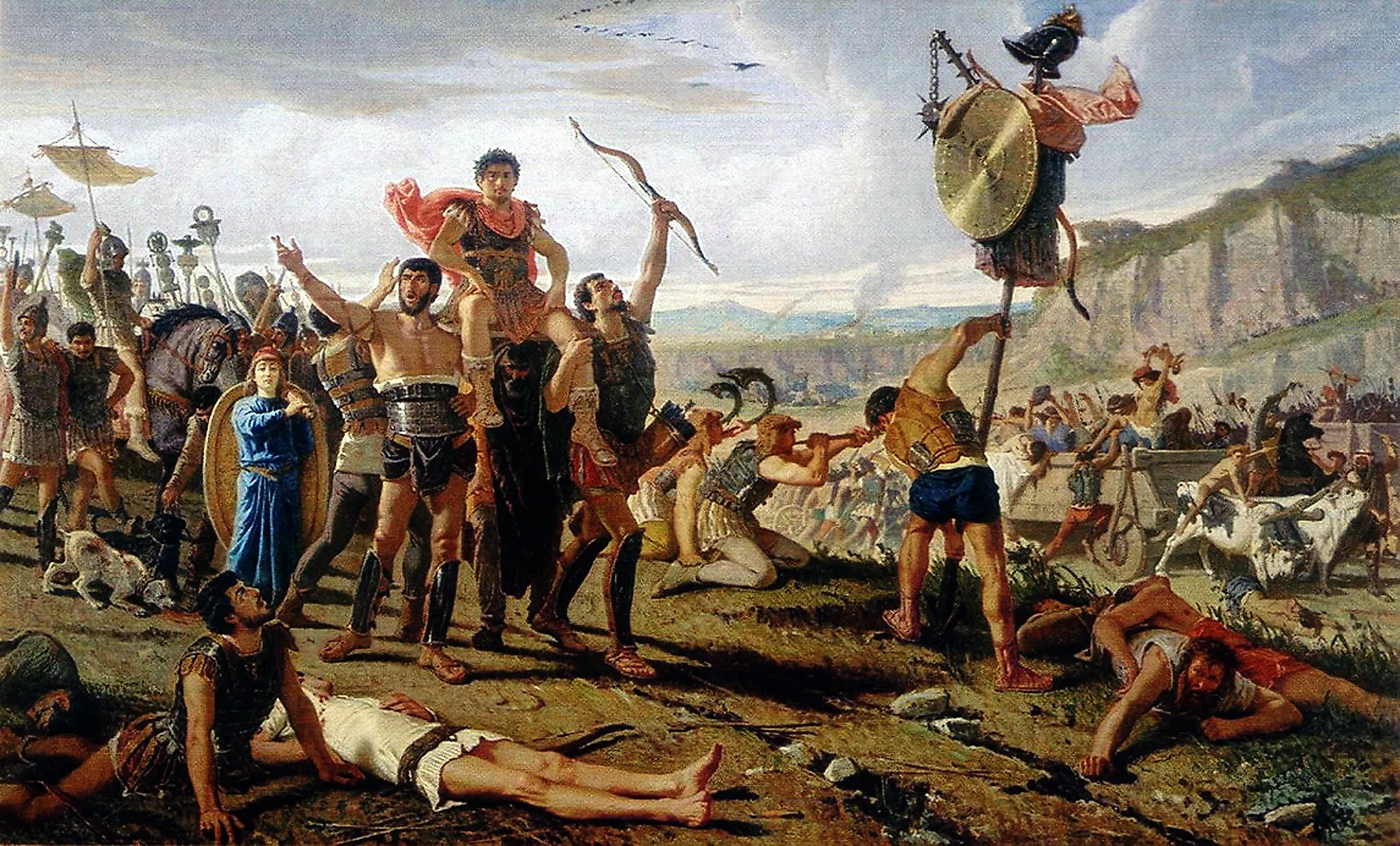
Who Were The Most Underrated Roman Generals?
Several Roman generals loom large in popular memory. Scipio Africanus is often credited with defeating Hannibal in the Second Punic War, and Julius Caesar drove the transformation of the Roman Republic into an empire. However, many military leaders also deserve recognition but often go unnoticed. Exploring the most underrated Roman generals is, therefore, a useful way to gain a more fully formed understanding of one of the most important states of the ancient world.
Quintus Fabius Maximus (280 to 203 BCE)

In 218 BCE, Carthaginian general Hannibal Barca invaded Italy from the north after marching over the Alps with his army. This completely caught the Romans off guard, and they lost battle after battle to start the Second Punic War. Some notable defeats included the Battle of Trebia in 218 BCE and the Battle of Lake Trasimene in 217 BCE. An all-out catastrophe then occurred in 216 BCE at the Battle of Cannae, in which between 50,000 and 75,000 Romans were killed out of an initial fighting force of between 80,000 and 86,000.

Traumatized, the Romans knew they needed a different strategy. This is where Quintus Fabius Maximus stepped up. A veteran politician and general, he was made dictator after the Battle of Lake Trasimene. Fabius knew that Hannibal's strength lay in his ability to defeat the Romans on the battlefield. Therefore, he proposed a strategy that avoided major battles and instead emphasized guerrilla warfare and winning via attrition. Known as the Fabian Strategy, this approach was widely hated by many Romans, who perceived it as cowardly and antithetical to their values. It was nonetheless highly effective. Hannibal eventually ran out of resources and was forced to return to North Africa after the Romans invaded it.
Marcus Claudius Marcellus (270 to 208 BCE)

This isn't to say that no generals took the fight to Hannibal during the Second Punic War. Perhaps the clearest example of one (who wasn't Scipio Africanus) was Marcus Claudius Marcellus. Born into a prestigious family, he served as consul five times and had previously achieved military success against the Gauls at the Battle of Clastidium in 222 BCE.

After Hannibal invaded Italy in 218 BCE, Marcellus took a different approach from Fabius. Knowing that the Romans couldn't hide behind their defenses forever, he aimed to fight Hannibal, but only when he had the advantage. Doing so allowed him to achieve several victories that culminated in the Siege of Syracuse, which began in 213 BCE. After the Sicilian city allied with Carthage, Marcellus organized a blockade. He then besieged Syracuse for roughly two years, until it eventually fell. A major blow for Hannibal, it permanently weakened the Carthaginians. Marcellus was eventually defeated and killed in 208 BCE. Regardless, his consistent victories up to that point had earned him the nickname the "Sword of Rome". The information he learned about Carthaginian tactics also proved crucial in Scipio Africanus' eventual decisive defeat of Hannibal.
Gaius Marius (157 to 86 BCE)

Gaius Marius is one of the most controversial figures of the late Roman Republic. Born in 157 BCE to a relatively well-off but non-elite family, Marius was forced to build his career through military ability and political alliance-building rather than pre-existing connections. After cutting his teeth in the Numantine War in Spain, he was made consul in 107 BCE and given command of the Jugurthine War against Numidia, which had been going disastrously up to that point. Marius recruited additional troops and strengthened discipline among existing soldiers. He also relied heavily on a talented young general named Lucius Cornelius Sulla. Sulla ended up getting credit for the victory against Numidia, sowing the seeds of a bitter rivalry between the two men.
Marius was elected consul seven times during his career, more than any other person in Roman history. This allowed him to shape the military for decades to come. On the battlefield, he achieved victory after victory. Perhaps the most notable accomplishment was defeating the Teutones and Cimbri at the Battles of Aquae Sextiae and Vercellae, respectively. Doing so prevented a potentially catastrophic Gallic invasion of Italy.

Marius' legacy becomes more complicated when we consider his role in domestic affairs. He's often credited with the so-called "Marian reforms", which abolished property requirements for serving in the army and opened recruitment to poor, landless people. While modern-day historians think this change likely occurred over decades and cannot be attributed to a single person, Marius certainly expanded recruitment. This created a situation in which soldiers became loyal to their general, since that's who paid them, rather than to the Roman state. When combined with Marius' eventual civil wars against Sulla, which normalized the use of armies to resolve domestic political disputes, some argue that he helped create the conditions that led to the end of the Roman Republic. There is some truth to this claim. Even so, Marius was an effective general with an undeniable impact on Roman history, and he deserves a place in discussions about Rome's greatest commanders.
Flavius Aetius (390 or 391 to 454 CE)

During the 4th and 5th centuries CE, the Western Roman Empire was slowly collapsing. This makes it easy to forget that there were still many great generals deserving of recognition. Consider Flavius Aetius. Born in the early 390s CE, he spent much of his early life in Visigothic and Hunnic captivity. The diplomatic skills from these experiences, paired with the overall instability of the time, allowed Aetius to rise through the military ranks. By the 430s CE, he was one of the most powerful men in the Western Roman Empire and its most senior military commander.

Aetius spent the next two decades fighting countless wars on many fronts. His greatest achievements were in Gaul (modern-day France, Belgium, and Luxembourg). The province had become divided and overrun by various barbarian groups. Aetius knew he couldn't defeat them all, so he instead played them against each other. Eventually, he faced his biggest challenge when the Huns, led by Attila, invaded Gaul in 451 CE. Knowing that the Roman army alone was insufficient to defeat them, Aetius built a coalition of Romans, Visigoths, Franks, and other Germanic tribes. The climactic engagement was the Battle of the Catalaunian Plains, where the coalition forces managed to fend off a Hunnic invasion.
In 452 CE, Attila invaded Italy, which Aetius also managed to repel. Regardless, the now weakened Western Roman Army was unable to defeat Attila once and for all. Aetius had also gotten too powerful for Emperor Valentinian III. Concerned that he would eventually threaten his position, Valentinian had Aetius killed. This was an extraordinary miscalculation, and the Western Roman Empire struggled to find generals of Aetius' quality for the rest of its existence.
Why These Reputations Faded
Roman memory rewarded the decisive victory, which is part of why a commander who won by refusing battle was mocked in his own lifetime, and a commander killed on his emperor's orders was easy to leave out of the record. These four commanded across more than six centuries and under three very different Roman states, yet each was overshadowed by a contemporary whose story was simpler to tell. Reading them back in does more than settle a ranking argument. It shows how much of Rome's military success rested on attrition, coalition-building, and administrative reform rather than on the single battlefield triumph that later writers preferred to remember.

.jpg)
.jpg)


