How Roman Generals Won Impossible Battles
The Roman Empire had some of the greatest generals in history. However, the reasons why they were great may be different than what you expect. They did, in fact, have access to some of the best armies in the ancient world. Nevertheless, even when faced with seemingly insurmountable odds, people like Quintus Fabius Maximus Verrucosus and Julius Caesar still prevailed. A willingness to change tactics, extensive preparation, and superior logistics were just some of the reasons why these generals won impossible battles.
They Were Willing To Change Tactics

Roman military doctrine wasn't dogmatic. Rather than sticking to one rigid style of warfare, the Romans adapted to the enemy. When fighting the Greeks, they adopted siege techniques. When fighting the Numidians, they incorporated cavalry tactics. When fighting Carthage, they built up their navy to become a rival sea power.
Perhaps the clearest example of Roman flexibility came in the Second Punic War (218 to 202 BCE). After Carthaginian general Hannibal Barca surprised them by marching over the Alps, rather than attacking by sea, the Romans suffered defeat after defeat. Following the disaster at Lake Trasimene in 217 BCE, Rome appointed Quintus Fabius Maximus Verrucosus dictator, and he refused to meet Hannibal in open battle. Known as the Fabian Strategy, his approach emphasized avoiding decisive defeats and instead wearing the enemy down over time. It was deeply unpopular, but the consuls who abandoned it lost between 50,000 and 70,000 men at the Battle of Cannae in 216 BCE, out of a force of roughly 86,000. Rome returned to Fabius's methods afterward, and the Carthaginians were eventually forced to retreat from Italy.
They Won Battles Before They Began

Roman generals prepared extensively before a battle. Doing so allowed them to choose advantageous positioning, control supply lines, muster defenses, and set the terms of the engagement. Julius Caesar demonstrated the advantage of extensive preparation during his campaign to take Gaul (modern-day France, Belgium, and Luxembourg) between 58 and 50 BCE. His main opponent during this campaign was Vercingetorix. A chieftain of the Arverni tribe, he managed to unite the previously divided Gauls and rebel against the Romans.
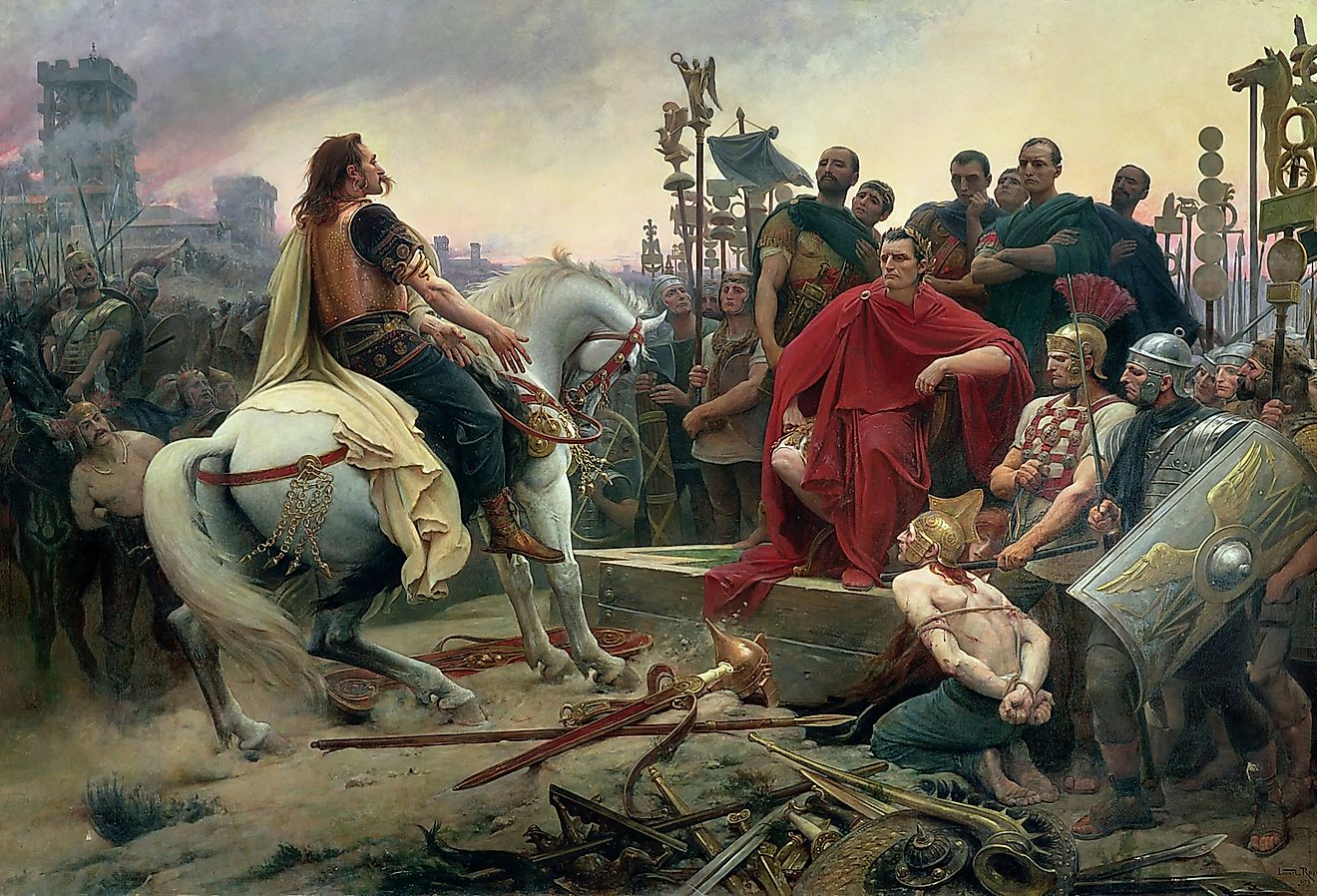
All seemed lost for Caesar when Vercingetorix retreated to the hilltop fort of Alesia. Soon afterward, a massive Gallic relief army began to approach, threatening to surround Caesar's troops. Rather than surrendering, Caesar prepared his defenses. He ordered the construction of two massive walls, one facing inwards to contain Vercingetorix and another facing outwards to defend against the relief force. This plan worked perfectly. The Gallic Army was unable to penetrate the outer wall. Vercingetorix was also forced to surrender since supplies were unable to enter the fort, leading to disease and famine. Ultimately, through ample preparation, Caesar ensured that he'd win the battle before it even began.
Superior Logistics

The Roman army had superior logistics to nearly all of its opponents. Rome's sophisticated road network helped armies travel quickly from one place to another. This was crucial in the event of an invasion, since it ensured that a relief force never took long to arrive. These roads also gave the Romans strong supply lines and provided places to set up camps and forts. A well-rested and fed army almost always outlasted a hungry and tired one. This reality helped the Romans win the aforementioned Second Punic War. Finally, standardized rations and equipment introduced an element of predictability. Soldiers generally ate the same high-calorie, grain-based diet, which allowed them to reliably participate in long marches and heavy combat. Their uniform equipment also made their repairs quick and easy.
Deception

Deception is often a vital tool in warfare. Roman generals understood this and frequently used it to their advantage. Common tactics included fake retreats, hidden reserves, night marches, and ambushes. Arguably, the most dramatic example of Roman audacity occurred during Caesar's Gallic Campaign. In 55 BCE, he reached the Rhine River. The Germanic tribes on the other side believed that the river protected them from the Romans. They were wrong. Rather than ferrying across and leaving his army exposed, Caesar ordered his engineers to build a timber bridge over the river, and they finished it in ten days. This shocked the Germanic tribes and left them exposed. Even though Caesar only briefly campaigned on the other side of the Rhine, this show of strength discouraged invasions of Northern Gaul and paved the way for future Roman expeditions into Germania.
Psychological Warfare

Perhaps more than anything else, psychological warfare helped Roman generals achieve decisive victories. Consider again Rome's wars against Carthage. After the Second Punic War, Carthage was left a shell of its former self. Despite no longer being a real threat, many Roman politicians wanted to eliminate it once and for all. They finally got an excuse to do so when Carthage retaliated against Numidian raids on its territory in supposed violation of its peace terms with Rome. Therefore, between 149 and 146 BCE, the Romans besieged Carthage. After finally taking it, they razed the city to the ground and sold the 50,000 survivors into slavery. Many more died in the fighting itself, though ancient casualty figures for the siege are disputed. Despite not being necessary from a purely strategic standpoint, this act of brutality demonstrated to all other states that Rome was now the undisputed power in the Mediterranean.
Caesar also used brutality as a means of psychological warfare. He purposefully annihilated entire Gallic tribes like the Eburones and the Veneti to discourage resistance from the other Gauls. His own dispatches reported enormous casualty figures, and later writers such as Plutarch put the Gallic dead at more than a million, with a similar number enslaved. Those totals cannot be verified, and modern estimates vary widely, but the death toll was undoubtedly very high. The reporting served a propagandistic purpose of its own: submit to Rome, or die.
Impact And Legacy
None of these advantages worked in isolation. Rome's roads and standardized supply are what made a strategy of delay survivable in the first place, since an army that could be fed indefinitely could afford to refuse battle for years. The same engineering capacity that raised two rings of fortifications at Alesia threw a bridge over the Rhine in ten days, and both feats did as much psychological damage as any pitched battle. What separated Roman commanders from their opponents was rarely tactical genius in the field. It was an institutional machine that let a general lose Cannae and still win the war, and a reputation for consequences severe enough that many opponents chose not to fight at all.