The Largest Lakes West Of The Rockies
West of the Rocky Mountains, the largest lakes trade the alpine postcard for something stranger. A few are saltier than the ocean, one sits directly on an active earthquake fault, and several sit so far north that polar bears pass along their shores. Their surface areas swing by hundreds of square miles as rivers rise and fall. Together they hold freshwater seals, the world's largest sockeye run, and fish that live nowhere else on Earth. The following list ranks natural lakes only by surface area.
Great Salt Lake

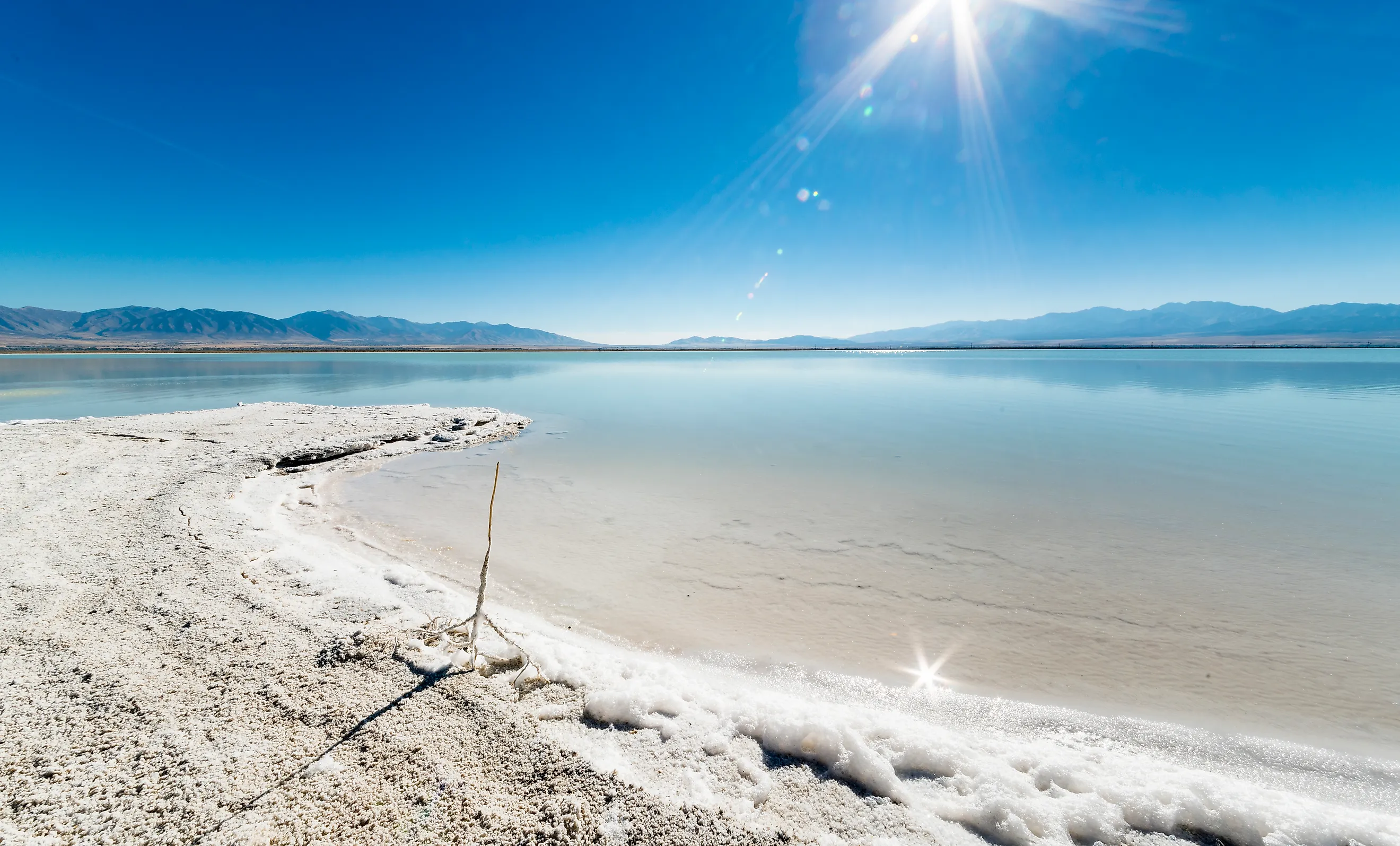
The Great Salt Lake is hard to categorize because its size fluctuates so greatly from year to year. The lake has no outlet and is a generally shallow body of water, reaching a maximum depth of 35 feet (11 meters). Its surface area depends on rainfall, evaporation, and the flow of the Bear, Weber, and Jordan Rivers, which feed it. At its historic high in the mid-1980s, the surface area covered 3,300 square miles (8,547 square kilometers), compared with just 888 square miles (2,300 square kilometers) in 2022. In an average year, the Great Salt Lake covers 1,700 square miles (4,400 square kilometers), larger than Rhode Island and Delaware. It is the largest saltwater lake in the Western Hemisphere.
Iliamna Lake

Iliamna Lake is the largest lake entirely within Alaska. It covers an area of 1,150 square miles (3,000 square kilometers). The Tanaina named it, and by legend a giant blackfish in its depths would bite holes in the bottom of canoes. In reality, its waters produce the largest returns of Sockeye salmon of any lake on Earth, and hold the only freshwater seal population in the United States. Along its shorelines, small communities of Alaskan Natives have lived off the land and waters for hundreds of years.
Becharof Lake

Becharof Lake also lies on the Alaska Peninsula, near Iliamna Lake, and its surface area stretches 453 square miles (1,170 square kilometers). It is the largest lake in the National Wildlife Refuge System. Like Iliamna Lake, Becharof feeds a large sockeye run bound for Bristol Bay. Unlike Iliamna Lake, it has no communities on its shores. The abundance of fish and the absence of people draw a very large population of brown bears to the lake. As many as 300 bears gather at the eastern portion of the refuge in June, when the salmon run begins.
Selawik Lake

Selawik Lake is a remote brackish lake in northwest Alaska, just above the Arctic Circle. Its waters flow into the Hotham Inlet and then into Kotzebue Sound. The Selawik and Tuklomarak Rivers feed it. Arctic tundra, boreal forest, and wetlands surround its 404 square miles (1,050 square kilometers) of surface. Despite the remote setting and extreme climate, the surrounding waterways and wetlands hold habitat for a wide variety of migratory and resident birds. The surrounding area supports the largest herd of caribou in Alaska, roughly 500,000 animals.
Salton Sea

The Salton Sea is the largest lake in California. It is an inland saline lake in southern California, in the Colorado Desert, a subregion of the greater Sonoran Desert. Beneath its roughly 350-square-mile (900 square kilometer) surface runs a network of active tectonic faults responsible for some of the largest earthquakes in California's history. The lake was formerly a salt-covered depression, created when diversion controls on the Colorado River broke a few miles below California's shared border with Mexico around 1905. Floodwaters rushed north and filled the depression. The lake is a crucial stop on the Pacific flyway for several species of migratory birds.
Teshekpuk Lake

Teshekpuk Lake is the largest lake in Arctic Alaska, with a surface area of 320 square miles (830 square kilometers). It is the largest lake north of the Brooks Range, in northern Alaska, roughly six miles from the Beaufort Sea. Melting permafrost in the surrounding area fills the lake, making it a thermokarst lake, the largest in the world. A diverse range of animals uses it, including up to 90,000 geese that nest in the summer, a resident caribou herd of about 64,000 that calves and migrates across the surrounding tundra, and even polar bears. Many ecologists count Teshekpuk Lake among the most important wetland complexes in the Arctic.
Lake Tahoe

Lake Tahoe encompasses 193 square miles across the border of California and Nevada, in the northern Sierra Nevada Mountains. It is the largest alpine lake in North America, and it reaches a maximum depth of 1,645 feet (501 meters). That depth still ranks second in the United States, behind Crater Lake in Oregon. Unlike many of the extremely remote lakes on this list, roughly eight million people live less than a half-day's drive from the Lake Tahoe Basin. Several tracts of the national forests around the lake have also been developed into resorts. The Truckee River drains Lake Tahoe across the border to Pyramid Lake.
Pyramid Lake

Pyramid Lake is one of the oldest and largest natural lakes in North America, a remnant of the ancient and much larger Lake Lahontan. It dates to the Pleistocene Epoch, the last Ice Age, between 2.6 million and 11,700 years ago. Pyramid Lake is the deepest terminal saline lake in the Western Hemisphere. It covers an area of 188 square miles (490 square kilometers) in western Nevada, flanked by the Lake Range and the Virginia Mountains. Its endemic species, found nowhere else, include the endangered cui-ui fish and the Lahontan cutthroat trout.
Utah Lake

Utah Lake is the largest freshwater lake in Utah, covering approximately 150 square miles (390 square kilometers). Like Pyramid Lake, it is the remnant of a much larger prehistoric lake, Lake Bonneville, which once covered much of western Utah. The Provo, Spanish Fork, and American Fork Rivers feed Utah Lake, and the Jordan River drains it north into the Great Salt Lake. More than 600,000 people live in its watershed, with Provo immediately east of the lake and Salt Lake City to the north. Over time, human impact has stressed the lake's ecosystem and its native fish populations.
Upper Klamath Lake

Upper Klamath Lake is the largest freshwater lake in Oregon, covering an area of 96 square miles (249 square kilometers). The Williamson and Sprague Rivers feed it, and the headwaters of the Klamath River originate at its outflow. The lake sits in southern Oregon, east of the Cascade Mountains, at an elevation of 4,139 feet (1,261 meters). Despite its size, the maximum depth is just over 50 feet (15 meters), and the rest of the lake is shallower than 20 feet (6 meters). Development is absent from its shorelines because of massive summer blooms of blue-green algae.
Beyond the Rockies
The largest lakes west of the Rockies are strikingly diverse. Surface area measures their size, but the landscapes around them and the wildlife within them define most of these lakes. Lake Tahoe proves that alpine lakes exist well outside the Rockies. Pyramid Lake is prehistoric and holds fish found nowhere else on Earth. Taken together, they show how wild and varied the water beyond the Rocky Mountains can be.