What Lives At The Bottom Of Crater Lake
During scientific dives in 1988 and 1989, the one-person submersible Deep Rover discovered and sampled moss growing on caldera walls and slopes at depths of about 85 to 460 feet below the surface in Crater Lake. Separate dives investigated the much deeper lake floor and its hydrothermal features.
That discovery raised the question of how a photosynthetic plant could survive so deep underwater. By about 330 feet, only around one percent of the sunlight reaching the lake's surface is still available for photosynthesis. Yet researchers have documented living moss as deep as 459 feet, among the deepest known moss beds ever recorded. Crater Lake's exceptional clarity allows enough light to reach the moss, and light probably sets its lower depth limit. Major unanswered questions instead concern how the moss obtains nutrients and how its living and dead layers develop.
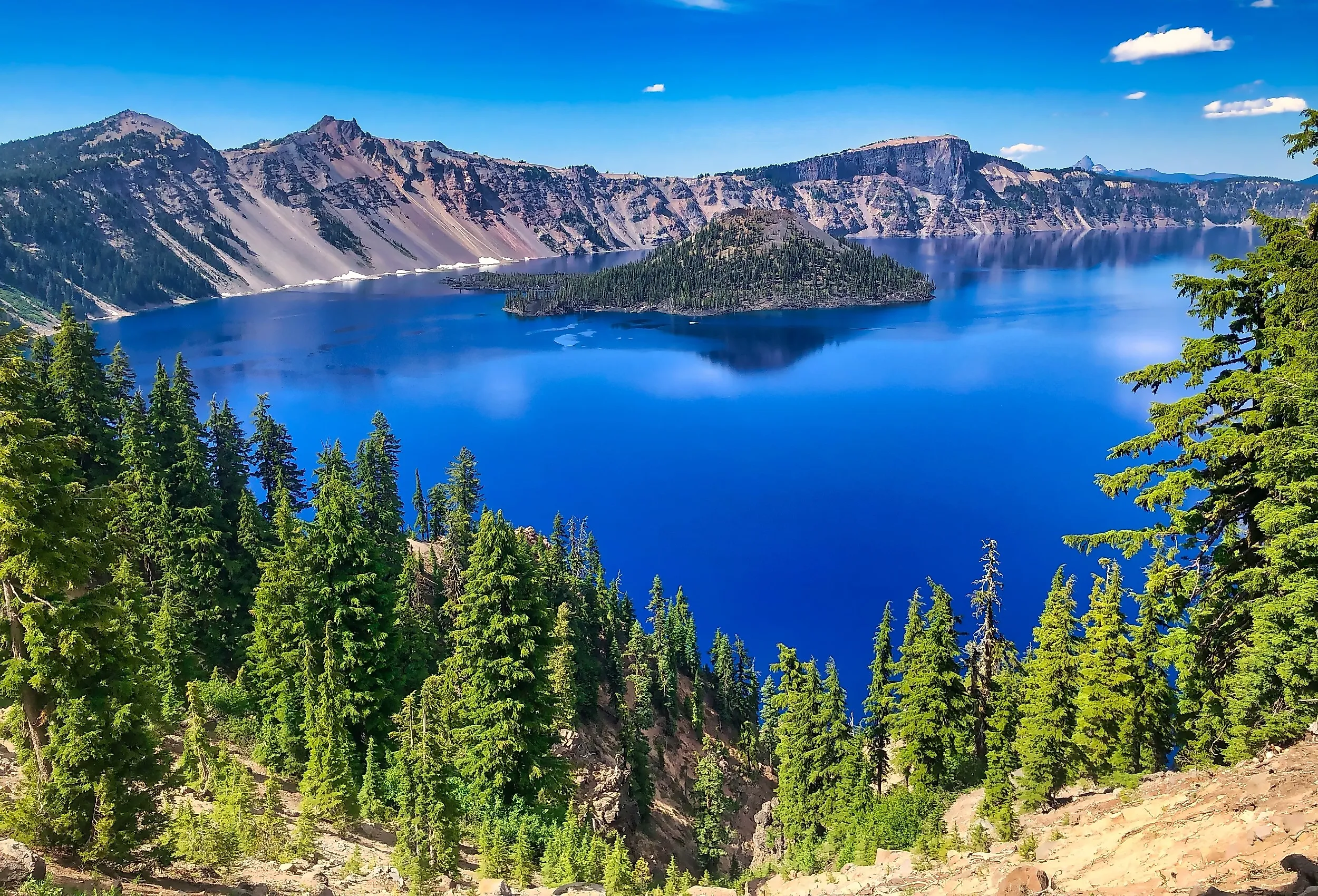
The moss wasn't the only surprise. At 1,949 feet, Crater Lake is the deepest lake in the United States. Instead of giant fish or mysterious monsters, its depths are home to a sparse ecosystem created by volcanic activity, extraordinary water clarity, and thousands of years of isolation.
Long before researchers sent submersibles into the lake, the Klamath people were already telling a story about how Crater Lake came to exist. In many ways, that story closely matches what geologists later discovered.
Why Crater Lake Is So Empty

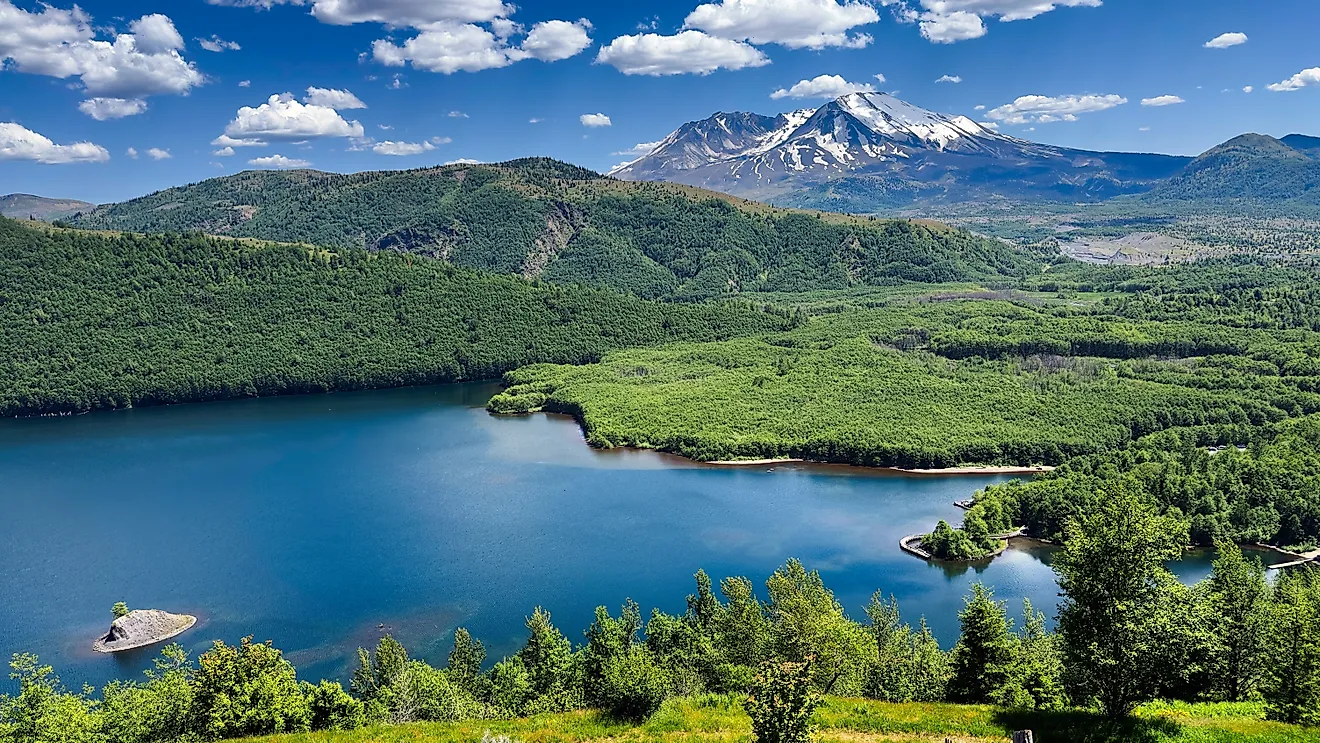
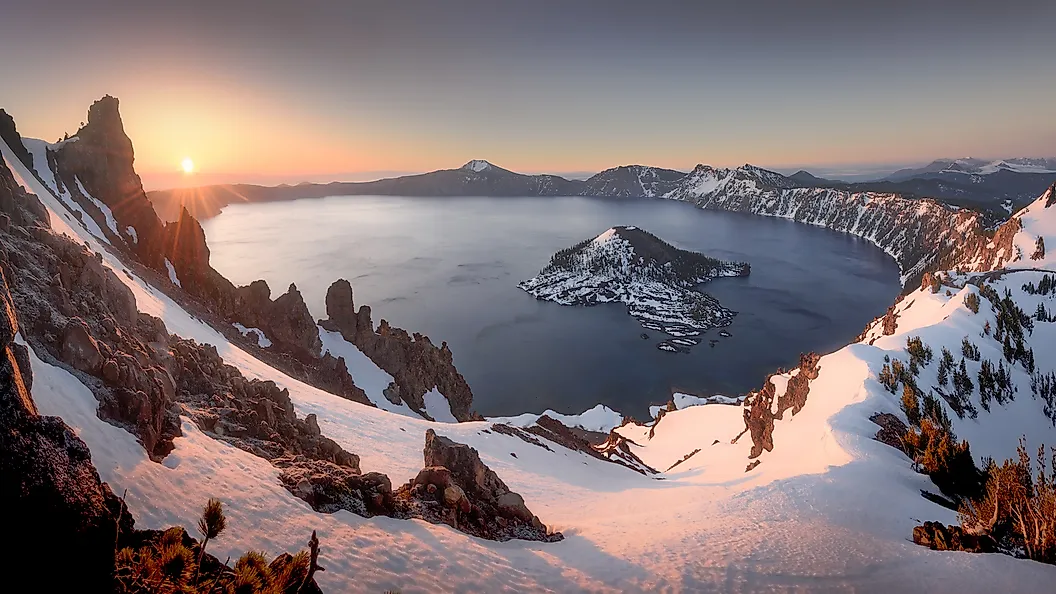
Crater Lake has no permanent surface streams flowing into or out of it. It gains water primarily from precipitation and loses water through evaporation and underground seepage. It occupies the caldera left behind when Mount Mazama collapsed about 7,700 years ago, and most of its water comes from rain and snowmelt. That isolation explains why Crater Lake never had native fish. For thousands of years after it formed, it was fish-free.

The kokanee salmon and rainbow trout found there today were introduced in the late 1800s. The lake's isolation and low nutrient levels help explain its remarkable clarity. With very little algae or dissolved organic matter in the water, sunlight penetrates much deeper than it does in most lakes.
Researchers have lowered a black-and-white Secchi disk to about 143 feet before it disappeared from view, one of the greatest water-clarity measurements ever recorded for a lake. That exceptional clarity is one reason researchers think moss can survive hundreds of feet below the surface.
The Klamath Story of Crater Lake
Klamath families maintain multiple traditions about giiwas. One widely circulated version published by the National Park Service names the opposing spirits Llao and Skell, while a Klamath Tribes account uses the names monadalkni and gmok'am'c. After Llao attacked the Klamath people, the two spirits fought a violent battle. Fire and molten rock filled the sky, the mountain collapsed, and rain eventually filled the newly formed basin.
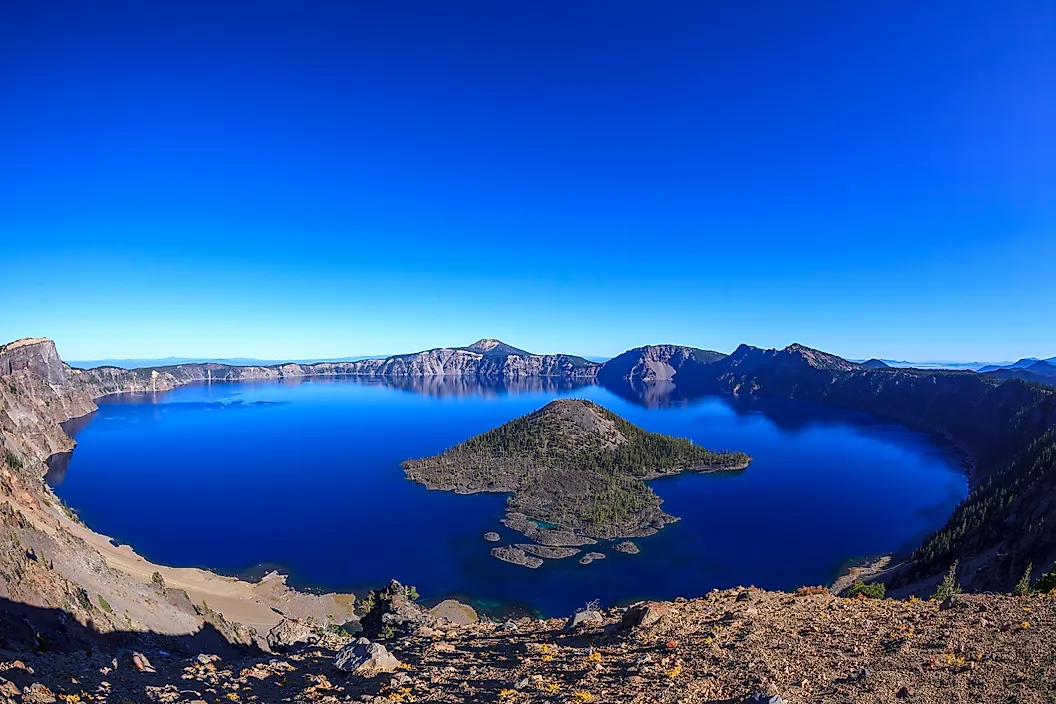
A violent eruption, the mountain's collapse, and the later filling of the caldera all parallel the geological reconstruction. The traditions carry cultural and spiritual meanings, though, rather than functioning as scientific accounts. About 7,700 years ago, Mount Mazama erupted catastrophically before collapsing into its own magma chamber, leaving behind the caldera that slowly filled to become Crater Lake.
Archaeological discoveries beginning in 1938, including sandals beneath Mazama ash that were later radiocarbon-dated, demonstrate human presence in the broader region before the eruption. They do not by themselves prove that people occupied Mount Mazama at the moment it erupted. Their story may be one of the few oral traditions in North America to preserve memories of that eruption for thousands of years.
Crater Lake is deeply significant to the Klamath Tribes. Known as Giiwas, it has long been regarded as a sacred place associated with powerful spirits.
How People Changed Crater Lake

Every fish in Crater Lake was introduced by people.
In 1888, conservationist William Gladstone Steel introduced the first trout as part of his campaign to establish Crater Lake as a national park. Congress created the park in 1902, and fish stocking continued for more than 50 years. By the time it ended in 1941, managers had introduced six species.
Only two of those species became established: kokanee salmon and rainbow trout. Although neither has been stocked since 1941, both continue to reproduce naturally. Kokanee, the landlocked form of sockeye salmon, are the more abundant species, feeding mainly on zooplankton. Rainbow trout feed primarily on aquatic insects and can reach about 6.5 pounds.
Fish weren't the only animals people introduced.
In 1915, about 15,000 signal crayfish were released as food for the stocked fish. They spread slowly for decades, but systematic surveys since 2008 have documented a major expansion, and park scientists link their increasing abundance and spread partly to warmer winters and longer summers. They now occupy roughly 95 percent of the lake's 22 miles of shoreline, and in invaded areas the biomass of bottom-dwelling insects has fallen by more than 90 percent.
Those insects are also the main food source for the Mazama newt, a salamander found nowhere else on Earth. The newt lives along the rocky shoreline rather than in deep water. As crayfish spread, they compete with the newts for food and may also eat their eggs and young. After a 2023 petition and subsequent lawsuit, the U.S. Fish and Wildlife Service agreed in 2026 to decide by October of that year whether the Mazama newt warrants Endangered Species Act protection.
Life in the Deep Waters of Crater Lake

The deepest water supports relatively sparse but diverse microbial and invertebrate communities adapted to cold, nutrient-poor conditions. The temperature stays close to 38 degrees Fahrenheit year-round, nutrients are scarce, and the stocked fish spend most of their lives much higher in the water column.
At the actual lake floor, researchers have found bacteria and archaea as well as worms, insect larvae, and tiny crustaceans. Hydrothermal seeps locally support iron-oxidizing bacterial mats.
The most surprising residents are the deep-water moss beds. The living moss can form a green surface layer several feet thick, but the much thicker deposits beneath it consist largely of dead, peatlike moss accumulated over hundreds or thousands of years. They are an unusually deep freshwater moss community, with a maximum recorded depth similar to that reported at Lake Tahoe. They survive on only a tiny fraction of the sunlight reaching the lake's surface.
The lakebed is a volcanic landscape of lava flows and hydrothermal features. In the late 1980s, the submersible Deep Rover discovered small hydrothermal vents on the caldera floor. These warm seeps support bacterial mats that get their energy from iron in the hydrothermal fluids instead of sunlight. Scientists also found inactive silica spires more than 30 feet tall, left behind by ancient hydrothermal activity.
The 2000 multibeam survey mapped volcanic cones, lava flows, and landslide deposits on the lake floor nearly to the shoreline. Hydrothermal features and moss beds were documented through separate heat-flow, sonar, ROV, and submersible studies.
No credible evidence indicates that Crater Lake contains sharks, giant catfish, or other large unidentified predators, although lake-floor mapping itself was not designed to prove such animals absent. The bull trout, sometimes mentioned in park literature, live in streams outside the caldera, not in the lake itself.
The Old Man of the Lake
Not everything famous about Crater Lake lives at the bottom. Its best-known resident floats on the surface. The Old Man of the Lake is a mountain hemlock log about 30 feet long that has floated upright since at least 1896, with about 3 feet of weathered wood above the water. Carbon dating suggests the tree is more than 450 years old, and no one knows exactly why it floats vertically instead of on its side.

In 1938, a commissioned study of its travels tracked it drifting more than 62 miles between July and October. It also inspired one of Crater Lake's best-known legends: that the Old Man controls the weather. According to park lore, storms and even August snow followed after researchers tied the log to shore in 1988, and its subsequent release was credited with restoring the weather.
Crater Lake is oligotrophic, with low biological productivity in much of its open water, but it supports substantial moss biomass and diverse microbial and invertebrate communities. Moss grows hundreds of feet below the surface, bacteria thrive around hydrothermal vents without sunlight, and the lake's volcanic past still influences the ecosystem nearly 8,000 years after Mount Mazama collapsed. Scientists continue studying how the moss obtains nutrients, grows so slowly, and produces the thick deposits of dead moss beneath its living surface.