Major Turning Points In Ottoman History
A few key moments and periods defined the Ottoman Empire. Its founding and the conquest of Constantinople help us understand the empire’s rise to power. The Battle of Lepanto and the Siege of Vienna then represented a turning point in Ottoman and European competition. Finally, the failure of the Tanzimat reforms and World War I contributed to the end of the Ottoman Empire. Read on if you want to learn more about these major turning points in Ottoman history.
The Founding Of The Ottoman State (Late 1200s to Early 1300s)

The Ottoman Empire was founded around 1299 by Osman (anglicized as Ottoman). One of many beyliks (states) on the Anatolian peninsula, Osman’s state quickly gained power. Its founding myth, that Osman saw a vision of himself leading an empire that stretched across several continents, provided a basis around which people formed a strong shared identity. The Ottoman state’s position between a weakened Byzantine Empire and a divided Anatolia also gave it ample opportunity to exploit its neighbours’ weaknesses. Finally, Osman and his successors wisely focused most of their efforts on fighting the Byzantines. Doing so ensured that they did not get caught fighting multiple wars on multiple fronts.
The Conquest Of Constantinople (1453)

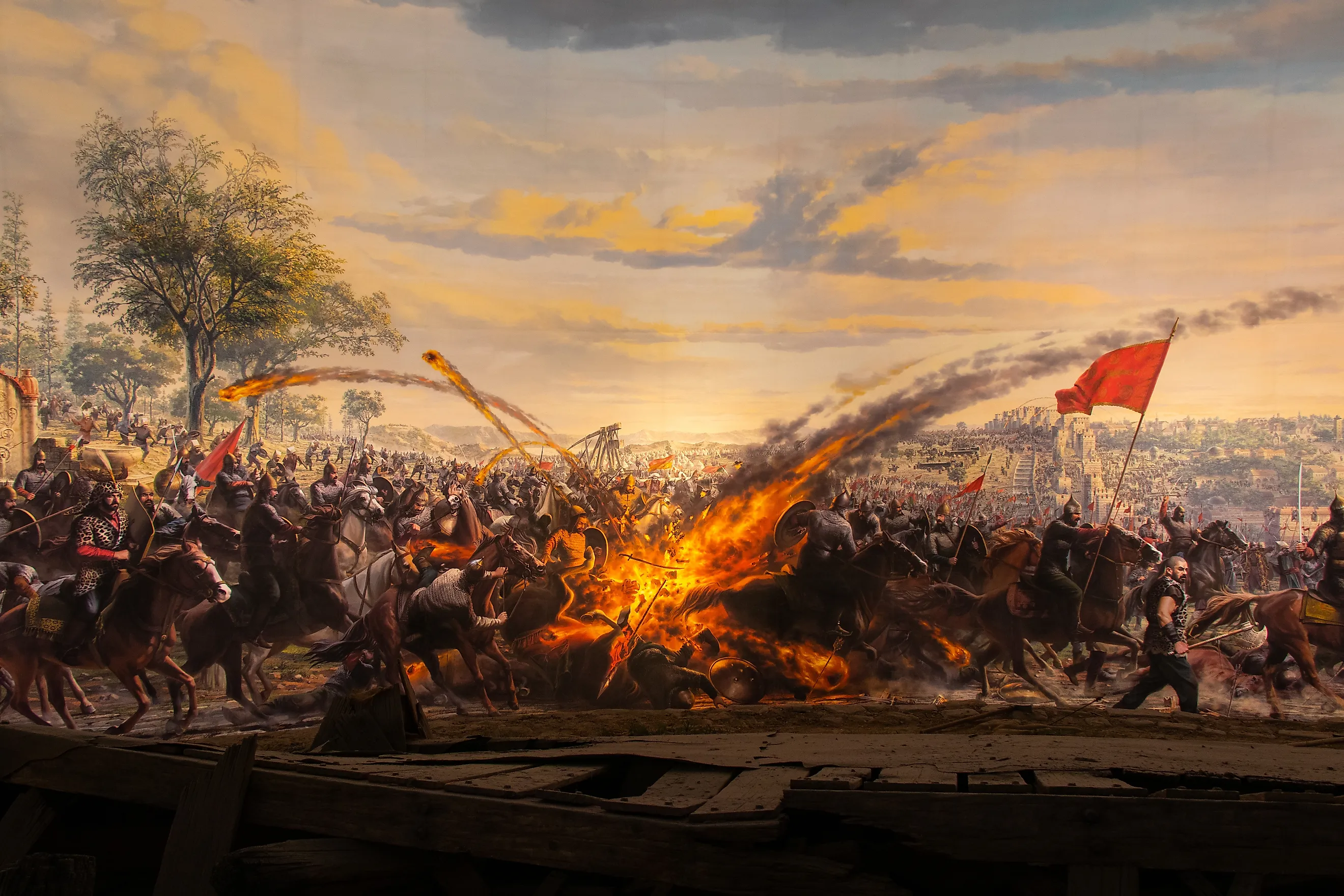
The conquest of Constantinople was arguably the biggest turning point in the Ottoman Empire’s history. As the Byzantine capital, it represented the last vestiges of the Roman Empire and had survived over a thousand years of attacks from the Persians, Arabs, Bulgars, and Rus. This made it even more surprising when, through a combined arms approach involving infantry, artillery, and navy, the Ottomans took the city on May 29th, 1453. The subsequent exodus of scholars from Constantinople to Europe jump-started the Renaissance. As for the Ottomans, beating the Byzantines meant that they were now the undisputed power in Anatolia and the Balkans. It also gave them further military and trade leverage, since Constantinople was positioned on the Bosphorus and Dardanelles Straits, the only waterway between the Black Sea and the Mediterranean Sea.
The Battle Of Lepanto (1571)

The Ottomans racked up victory after victory in the following century. This progress was temporarily halted in the Battle of Lepanto in 1571. One of the largest naval battles in history, the Ottomans lost to a coalition of Catholic states called the Holy League. 30,000 Ottoman sailors were killed, and hundreds of their ships were captured or destroyed. Admittedly, this loss was minor. The Ottomans rebuilt their fleet within a year and retained control of Cyprus, the primary objective of the conflict. Nevertheless, the Battle of Lepanto was a major boon to European morale, since it challenged the myth of Ottoman invincibility.
The Failed Siege of Vienna (1683)

This myth was shattered by the second Ottoman siege of Vienna in 1683. The first, which occurred in 1529, failed due to overstretched supply lines, heavy rain and mud, and strong Viennese defenses. But, it still shocked Europe by showing how powerful the Ottoman Empire had become.
The circumstances surrounding the second siege were very different. Facing internal problems and a growing list of military defeats, the Ottomans needed to prove that they were still a force to be reckoned with. Therefore, under the leadership of Grand Vizier Kara Mustafa Pasha, they gathered an army of 150,000 to siege the city gates. Lasting for about two months, conditions within Vienna became desperate as food shortages and disease spread. Regardless, the siege ultimately failed when a coalition army of Habsburg, German, and Polish troops beat the Ottomans. Over the next few decades, the Ottomans were pushed out of Central Europe, and the empire gradually lost territory for the rest of its existence.
The Tanzimat Reforms (Mid-1800s)

By the mid-1800s, constant military defeats, a stagnant economy, and growing nationalist movements had the Ottoman Empire labeled the “Sick Man of Europe”. To help change this trajectory, the government enacted a series of reforms known as the Tanzimat. A core component was centralization. Whereas in centuries past, provinces acted autonomously, the government established state ministries, tax collection systems, and a sophisticated bureaucracy to help Istanbul properly govern all regions of the empire. Legal reforms were also part of the Tanzimat, with Jews and Christians gaining more rights as secular, European-style courts were adopted. Other reforms occurred in the realms of education, the military, and infrastructure.
While somewhat successful in modernizing the Ottoman state, the Tanzimat reforms had notable weaknesses. First, they were expensive and forced the Ottomans to take out massive loans from European banks at exorbitant rates. Second, the reforms were applied unevenly, often working better in cities than in rural areas. Finally, the Tanzimat did not stop the spread of nationalism within the empire, and many countries like Serbia, Greece, Romania, and Bulgaria declared independence throughout the 1800s and early 1900s.
World War I (1914 to 1918)

World War I was the death blow for the Ottoman Empire. Entering the war on the side of the Central Powers (Germany and Austria-Hungary), the Ottomans fought on four fronts for over four years. However, they were ultimately pushed back by Allied forces in places like the Sinai Peninsula, Arabia, and Mesopotamia. After being defeated in 1918, the Ottoman Empire was divided between European powers, with Britain controlling Iraq, Transjordan, and Palestine, and France running Lebanon and Syria. Anatolia was also supposed to be occupied, but an independence war launched by Turkish nationalists prevented this. The Ottoman Empire officially ended in 1922, with Turkey emerging as its main successor state.