Roman Siege Weapons That Terrified Their Enemies
Rome did not conquer the ancient world on the strength of courage alone. Behind every famous victory, such as the fall of Carthage and the encirclement of Alesia, stood an arsenal of mechanical devastation that ancient armies had rarely encountered at such scale or sophistication. Roman siege technology combined Greek engineering inheritance with Roman discipline and logistics, producing weapons so psychologically overwhelming that historians and eyewitnesses alike recorded the terror they inspired. The five engines detailed below were not merely tools of destruction; they were instruments of calculated dread.
The Ballista

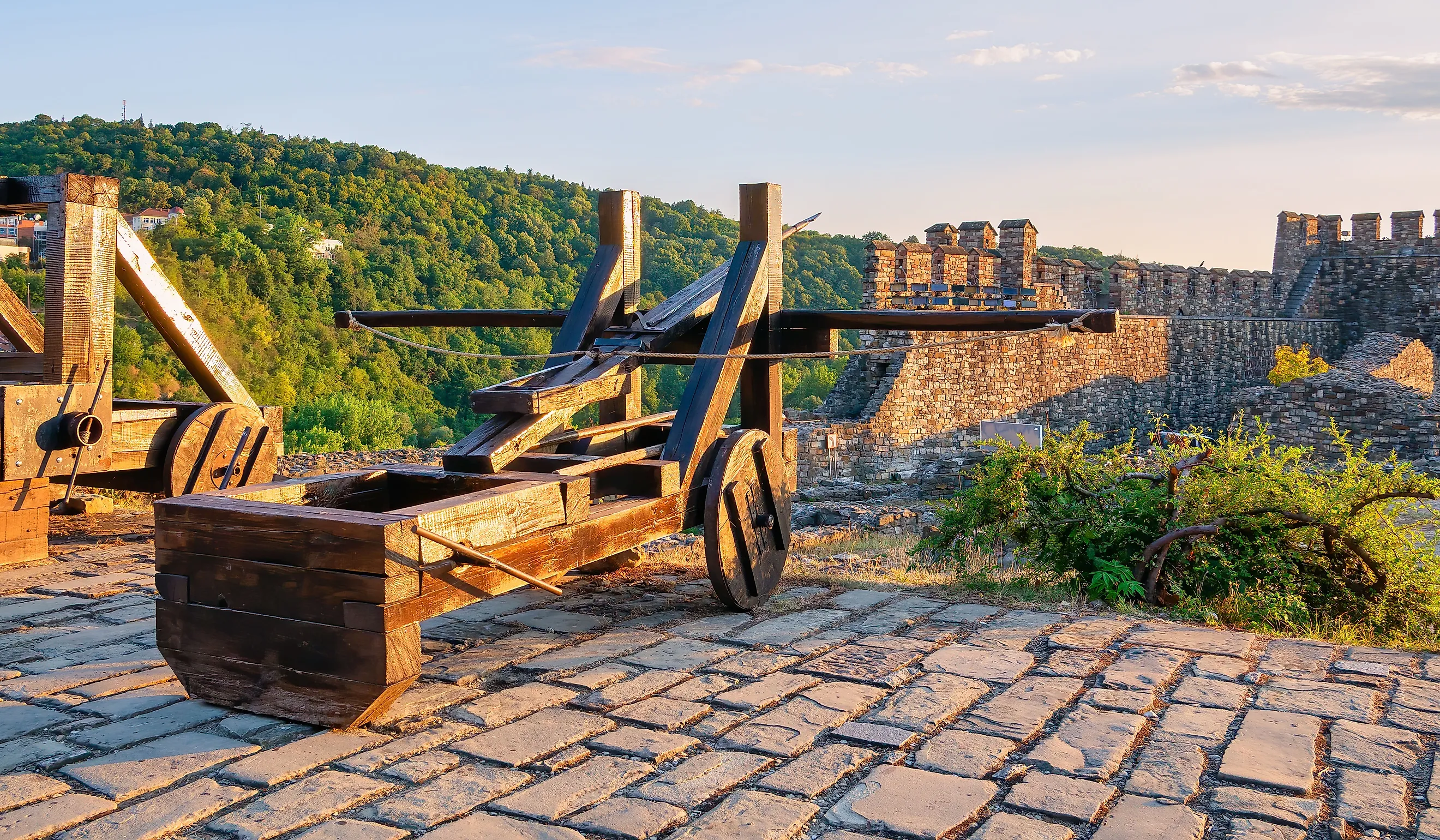
The ballista was among the most admired weapons in the Roman military inventory, and for good reason. Derived from Greek artillery, it operated on the same mechanical principle as a giant crossbow: two lines of twisted sinew or rope stored enormous elastic energy, which drove a pair of arms forward to launch either iron-tipped bolts or heavy stone balls. The weapon came in many sizes, from compact bolt-throwers used as field artillery to large stone-throwing variants used in siege work. The largest stone-throwing ballistae could hurl a 60-pound projectile nearly 500 yards in a high arc, suitable for breach work and area suppression rather than aimed shooting. Smaller bolt-throwing variants, by contrast, were precise enough to single out individual soldiers on a rampart.

Julius Caesar deployed ballistae during his conquest of Gaul and his two expeditions to Britain beginning in 55 BC. At the siege of Alesia in 52 BC, ballistae provided suppressive fire against both the trapped Gauls within and the relief army pressing from outside. Much smaller versions called carroballistae were mounted on carts and traveled with legions into open battle, giving Roman commanders a flexible artillery arm unmatched in the ancient world.
The Onager

The onager took its name from the furious, bucking recoil it produced when fired, a kick so violent it required a specially built platform timber to absorb. As a single-armed torsion catapult, it worked differently from the two-armed ballista. The onager consisted of a single stout arm surrounded by thick twisted cords. When the arm was winched down, locked, and released, it swung upward with tremendous force, flinging the sling's contents in a high arc over walls or into massed formations.

The writer Ammianus Marcellinus, composing in the 4th century AD, left the most detailed surviving technical description of the onager. The weapon required a crew of eight and was less precise than the ballista, but what it sacrificed in accuracy it compensated for with raw destructive force against walls and gates.
The Siege Tower

If any single Roman weapon was designed to shatter morale before it broke stone, it was the siege tower. These multi-level wooden structures, iron-plated on their exposed faces, mounted on wheels or rollers, and sometimes reaching 75 feet in height, combined the functions of a moving fortress, an artillery platform, and a psychological weapon in one staggering package. Ancient sources record that the mere sight of a tower advancing toward a city's walls was enough to inspire panic among defenders.

Josephus recorded that the Roman towers at Jotapata during the First Jewish War stood 50 feet high and were iron-plated to resist fire. At Masada in 73 or 74 AD, Roman engineers under governor Lucius Flavius Silva first constructed a siege ramp against the western face of the plateau, then hauled the tower laboriously up the incline until its battering ram could reach the fortress walls. Caesar used similar towers at the siege of Massilia in 49 BC, and Vitruvius described the engineering principles in his De Architectura, noting that their wheeled bases allowed repositioning as the tactical situation demanded.
The Battering Ram

The battering ram was among the oldest siege tools in the ancient world, but the Romans refined it into something far more formidable than a gang of men heaving at a gate. In its most developed form, the aries consisted of a massive timber beam tipped with an iron head cast in the shape of a ram's skull. The beam was suspended on chains from a heavy A-frame, allowing a crew of soldiers to swing it repeatedly with accumulating momentum against the same point on a wall or gate.
The psychological dimensions of the ram were as significant as its physical ones. Roman convention held that if a city's walls had been struck by the ram and the defenders still refused surrender, they forfeited all rights of clemency and would receive no mercy when the walls finally fell. This convention meant that the first blow of iron against stone was not merely a structural assault; it was also a death sentence, announced in advance. The ram operated under the protection of a testudo or moveable shed, which shielded the crew from fire, stones, and javelins dropped from the walls above.
The Scorpion

Smaller than the ballista but faster to operate, the scorpion was a compact, two-armed torsion weapon that functioned much like a heavy mounted crossbow. It fired iron-tipped bolts with sufficient velocity to penetrate armor at close range, and its compact size made it versatile enough to deploy on walls, in towers, and even in the field without a cart. Soldiers operated it from a standing position behind a shield, making it as much a sniper's instrument as an artillery piece.

Ammianus Marcellinus noted the weapon's earlier name, scorpion, derived from the raised "sting" of its projecting arm, and the name stuck in popular usage even as technical writers distinguished it from the onager. Caesar deployed scorpions during the Gallic campaigns, and their effectiveness was recorded in dispatches that reached Rome.
The Psychology of Roman Siege Weapons
Taken together, these weapons amounted to something greater than the sum of their mechanical parts. The Romans understood that siege warfare was as much about psychology as physics. An army that could promise, reliably, to breach any wall given sufficient time and resources changed the entire strategic calculus of resistance. Cities that might have held out for years against starvation surrendered at the first sight of a Roman siege train. The historian Polybius, writing in the 2nd century BC and witnessing Roman siege methods firsthand, marveled at the systematic efficiency with which Roman engineers transformed landscape and labor into an unstoppable force.
The legacy of this arsenal extended well beyond Rome's borders. Many of these technologies survived the Western Empire's collapse, migrated into Byzantine and Islamic warfare, and shaped European siege practice. The machines are gone, but the ramp at Masada still stands. It is a silent measure of what Rome was willing to build and what enemies were willing to die for to resist the empire.