The Rise Of The Ottoman Empire After The Fall Of Byzantium
The rise of the Ottoman Empire occurred for many reasons. However, perhaps more than any other factor, its ascent was buoyed by the simultaneous weakness of the Byzantine Empire. This was further exacerbated by the complete collapse of Byzantium in 1453, after which the Ottoman Empire experienced a rapid period of growth. Therefore, exploring this period and how the fall of the Byzantine Empire influenced it is a worthwhile endeavour.
Background

In the late 1200s and early 1300s, the Ottoman Empire began in a small northwestern Anatolian state. Led by a man named Osman, he (supposedly) had a vision of himself leading an empire that stretched across three continents. Despite this likely being untrue or heavily exaggerated, it provided a strong founding myth around which people in his state unified. The Ottoman state's position at the crossroads of the Byzantine Empire and many different Turkic states also allowed it to control key trade routes. Finally, early Ottoman leaders focused most of their efforts on conquering the Christian Balkan states and the Byzantine Empire, which provided an impetus for Muslims across Anatolia to join them. All these advantages and strategic decisions enabled the Ottoman Empire to rapidly acquire territory over the first century and a half of its existence.

During this same period, the Byzantine Empire faced significant problems. The legacy of the Fourth Crusade in 1204 had left it fragmented. Civil wars in the 1300s, one from 1321 to 1328, and another from 1341 to 1347, further weakened Byzantium. The Black Death also hit the empire around 1350. Despite these problems, Byzantium survived, with diplomacy and an Ottoman civil war at the beginning of the 1400s resulting in a roughly two-decade period of peace. However, by the 1420s, the Ottomans had returned to full strength and recommenced their expansion into Byzantine territory.
The Fall Of Constantinople

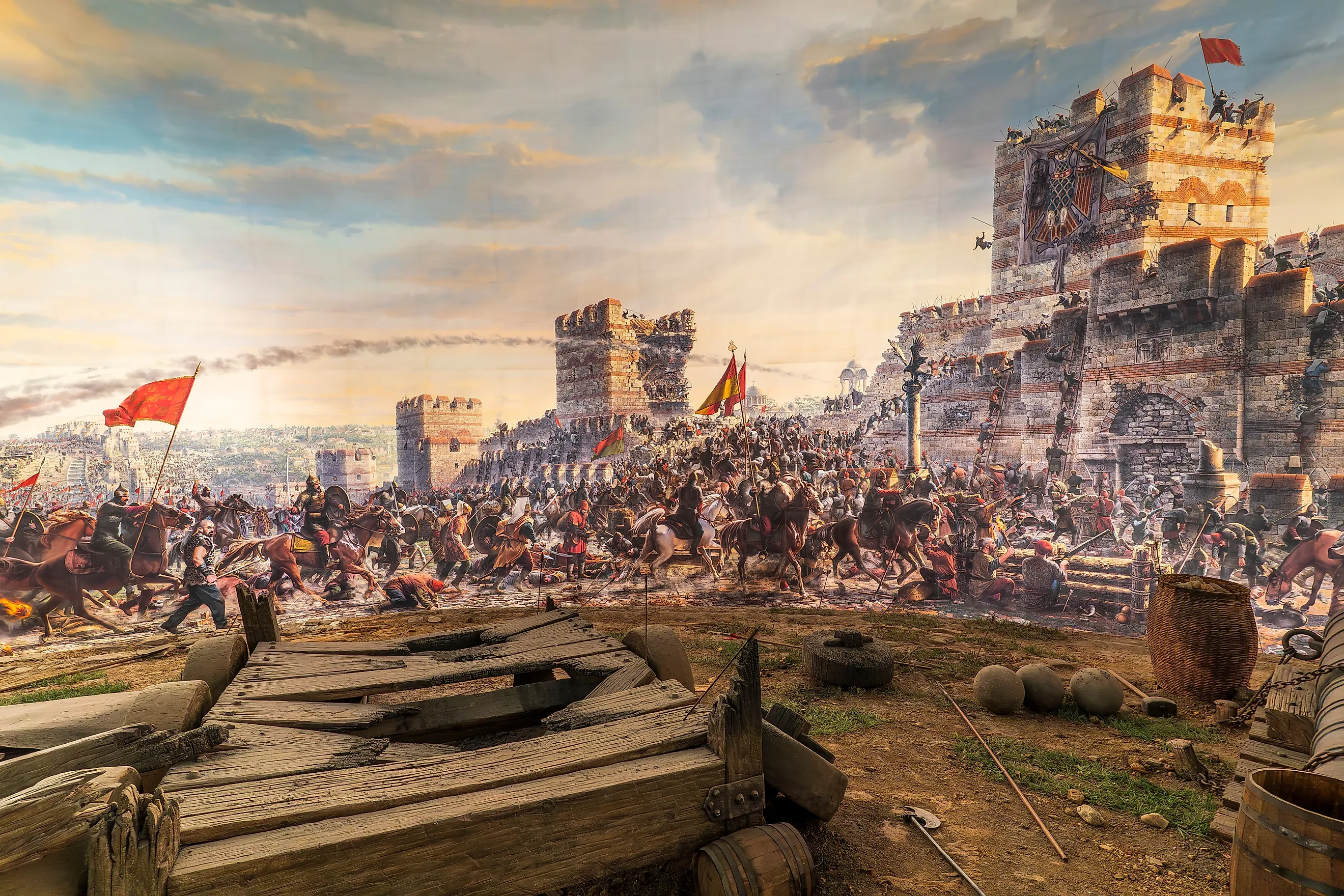
The Ottoman-Byzantine conflict came to a climax in 1453 when the Ottomans began to besiege the Byzantine capital of Constantinople. The Byzantines defended the city by putting a giant chain in the Golden Horn waterway, which prevented the Ottoman navy from fully encircling it. However, the Ottomans responded by creating a road of greased logs and then carrying about 70 ships over land. They then launched them back into the water, behind the chain. This maneuver, paired with the superiority of the elite Ottoman infantry unit called the Janissaries, were two of the main reasons why they were able to take the city in late May 1453. With this, the Byzantine Empire ended, and the Ottomans were now the main power in Anatolia and Southeastern Europe.
Rapid Expansion

Soon after the fall of Byzantium, the Ottoman Empire rapidly expanded. Now that they controlled Constantinople, the Ottomans also held the Dardanelles and Bosphorus Straits (the only waterway between the Black Sea and the Mediterranean). By now controlling a major trade route between Europe and Asia, the empire rapidly grew economically in the second half of the 1400s.

Moreover, with the Byzantines defeated, the Ottomans could focus their military aspirations elsewhere. They therefore spent the rest of the 1400s consolidating control over the Balkans. Thereafter, the Ottomans expanded into North Africa and the Arabian Peninsula. This resulted in them defeating the Mamluks near Cairo in 1517, which caused the collapse of the entire Mamluk Empire. The Ottomans came to control most former Mamluk territory, including Mecca and Medina, the holiest cities in Sunni Islam. With this, the empire became one of the world's predominant Islamic empires.
The Golden Age Of The Ottoman Empire

This territorial expansion was followed by the Golden Age of the Ottoman Empire from 1520 to 1570. Indeed, under the reign of Suleiman the Magnificent, the empire made significant legal and cultural advances. Ottoman law was formalised as a dual system, with Islamic law (Sharia) being utilised for private affairs, and Sultanic law (Kanun) in the public sphere. As for cultural developments, Ottoman architecture, literature, and poetry all flourished during this period.

The Ottoman Empire also continued to accumulate territory. For instance, it expanded into Central Europe and became a direct rival with the predominant European power at the time, the Habsburgs. The Ottomans also made further incursions into North Africa by utilising their navy to capture key cities along the coastline. Finally, Suleiman's reign saw the Ottomans come into direct competition with the Safavid Empire, consolidating control over Eastern Anatolia and capturing Baghdad in 1534.
Legacy And Importance
The fall of Byzantium was a crucial factor in the expansion of Ottoman power and its Golden Age. By capturing Constantinople, the Ottomans dramatically expanded their economic capacity, allowing them to fund further territorial expansion and cultural investments. Furthermore, the defeat of the Byzantines let the Ottomans focus their attention on places like North Africa, Central Europe, and Mesopotamia. In short, the rise of the Ottomans as a major global power can be directly linked back to the fall of Byzantium.