The States With The Most Farmland Per Person
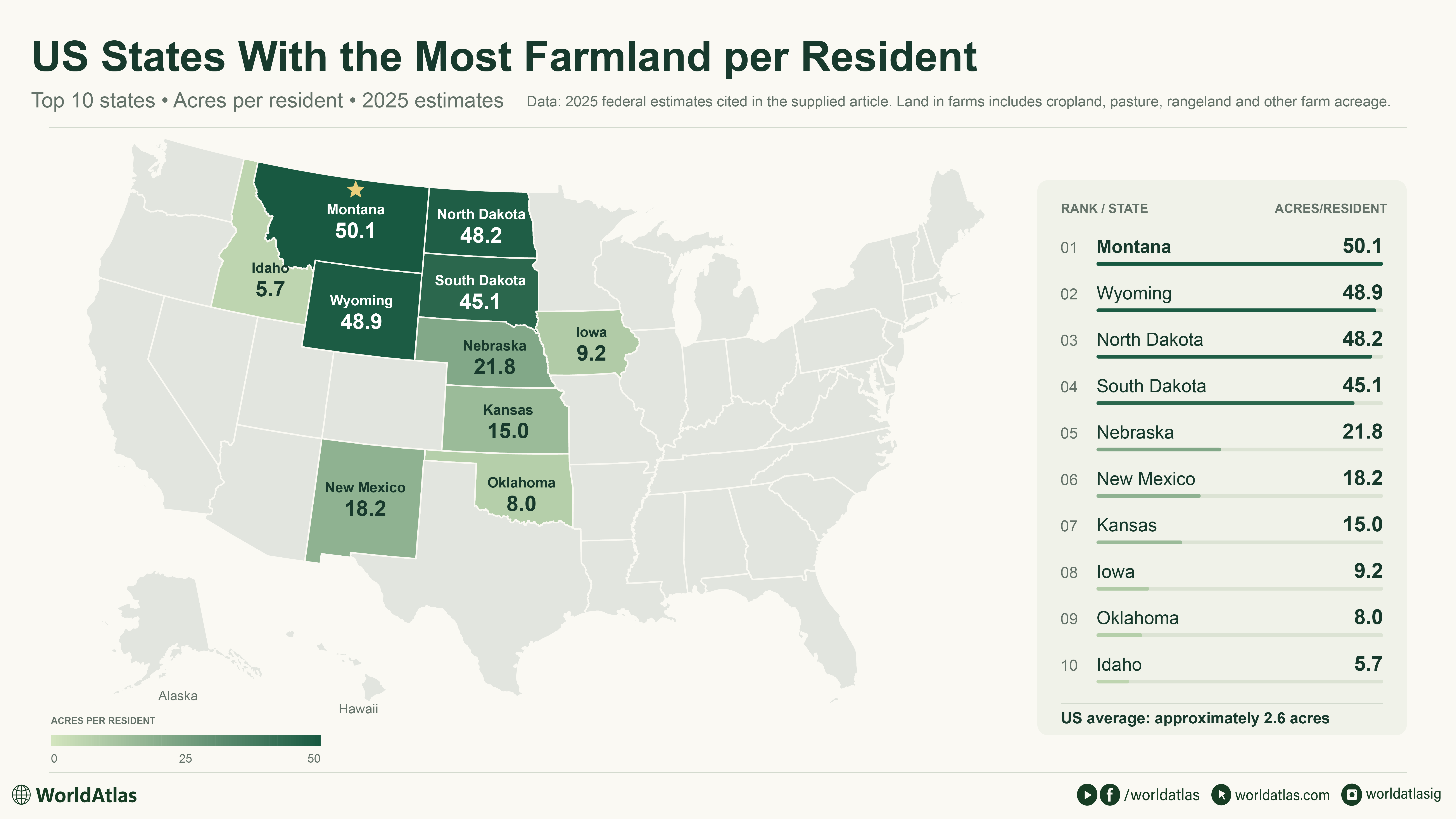
Montana has enough farmland to provide roughly 50 acres for every resident, the highest ratio in the United States. Wyoming, North Dakota, and South Dakota follow closely, each with more than 45 acres per person. Across the country, however, the average is only about 2.6 acres, and 20 states exceed that figure. Some rely on enormous grazing areas, while others devote millions of acres to crop production. Using 2025 federal estimates, this ranking examines the 10 states with the most farmland per resident, measured by USDA land in farms, and includes a look at other states that exceed the national average.
Montana

No state has more farmland per resident than Montana, which leads the country with approximately 50.1 acres per person. Its farms and ranches occupied 57.3 million acres in 2025, set against a population of 1,144,694, nearly 20 times the national average. Most of that land is grazed rather than planted. The 2022 Census of Agriculture recorded 38.2 million acres of permanent pasture and rangeland and 16.1 million acres of cropland, and cattle ranching stretches across the broad grasslands of eastern Montana.
Crop production matters most in the state's northern and central regions. Wheat grew on nearly 5.2 million acres in 2022, and lentils on more than 463,000. The scale of individual operations is just as striking: Montana farms averaged 2,374 acres that year, and Big Horn County alone reported approximately 3.2 million acres of land operated by farms, the largest county total in the state. Vast ranching territory and a relatively small population explain Montana's place at the top.
Wyoming

With 588,753 residents, Wyoming has the smallest population of any US state, which is what puts it second, at approximately 48.9 acres of farmland per resident. Its farms and ranches spanned 28.8 million acres in 2025, far less than Montana, yet the per-person figure is nearly as high. Ranching dominates. The 2022 Census of Agriculture counted approximately 25.6 million acres of permanent pasture and rangeland against just 2.3 million acres of cropland.
Limited precipitation, high elevations, and short growing seasons restrict crop cultivation across much of the state, so its grasslands and mountain valleys instead support cattle and sheep. Sheep ranching remains important alongside cattle, with 306,174 sheep and lambs reported at the end of 2022. Hay, the leading crop by harvested acreage at more than 1 million acres, provides an important source of winter feed for that livestock. Carbon County had the largest area of farmland, at approximately 2.9 million acres.
North Dakota

North Dakota ranks third, at approximately 48.2 acres of farmland per resident, close to Wyoming's figure, but its land does very different work. The state's 38.5 million acres of farms in 2025, serving a population of 799,358, lean heavily toward crops. The 2022 Census of Agriculture recorded 26.3 million acres of cropland and 10.8 million acres of pasture and rangeland, and crops accounted for 87% of agricultural product sales that year.
Wheat was the largest crop by harvested area, at approximately 6.2 million acres, followed by soybeans at 5.6 million acres, corn at 2.7 million acres, and canola at 1.7 million acres. The state is particularly important to US production of spring wheat, durum wheat, and canola. Farmland is spread across many counties of the prairie rather than concentrated in a few, and McKenzie County led with approximately 1.36 million acres of farmland in 2022.
South Dakota

In South Dakota, the cattle-grazing country of the west gives way to productive cropland on the eastern plains. The state ranks fourth, with approximately 45.1 acres of farmland per resident, based on 42.2 million acres of land in farms in 2025 and a population of 935,094. Its 28,299 farms averaged 1,495 acres each, and Meade County had the largest land area in farms, at approximately 2.2 million acres in 2022.
The farm economy is more balanced between crops and livestock than North Dakota's, with crops generating 59% of agricultural product sales in 2022. That year, the Census of Agriculture reported approximately 22.3 million acres of pasture and rangeland and 18.5 million acres of cropland. Soybeans edged out corn, at nearly 4.9 million acres to about 4.8 million, while wheat grew on approximately 1.4 million acres and sunflowers on 589,221.
Nebraska

Nebraska had more agricultural land than South Dakota in 2025, at 43.9 million acres, but its population of 2,018,006 drops it to fifth, with approximately 21.8 acres per resident. That land was almost evenly divided in 2022, with approximately 21.2 million acres of cropland and 21.5 million acres of pasture and rangeland. Irrigation supports crop production in parts of western and central Nebraska where rainfall alone would be insufficient.
Corn led all crops at more than 8.6 million acres, followed by soybeans at approximately 5.4 million. Livestock is equally significant, and farms and ranches reported approximately 6.4 million cattle and calves at the end of 2022. Cherry County, in the grasslands of the Sandhills region, recorded nearly 3.8 million acres of farmland, the largest county total among the states in this top 10, a sign of how Nebraska accommodates both intensive crop production and large cattle operations.
New Mexico

A dry climate defines farming in New Mexico, which ranks sixth with approximately 18.2 acres per resident. Farms and ranches occupied 38.6 million acres in 2025 against a population of 2,125,498, but little of that land is suited to crops. The 2022 Census of Agriculture classified approximately 33.7 million acres as permanent pasture and rangeland, with farm woodland adding another 2.7 million and cropland accounting for only 2.1 million.
Agriculture here depends heavily on livestock grazing, particularly cattle and sheep, and livestock and livestock products accounted for about 70% of agricultural sales in 2022. Crops grow where irrigation and suitable conditions allow. Hay feeds livestock; pecan orchards spanned 59,854 acres in 2022, particularly in southern New Mexico, and chile peppers are a specialty closely associated with the Rio Grande Valley. McKinley and San Juan counties each reported approximately 2.4 million acres of farmland.
Kansas

With 44.6 million acres of farmland in 2025, Kansas is among the largest agricultural states by total acreage, but a population of 2,977,220 places it seventh, at approximately 15.0 acres per resident. Cropland dominates. The 2022 Census of Agriculture recorded approximately 28.3 million acres of it, compared with 14.7 million acres of pasture and rangeland, and growing conditions shift from drier western areas to more humid eastern counties.
Wheat is grown on more than 6.6 million acres, and Kansas is especially well known for hard red winter wheat, widely used in bread flour. Corn and soybeans each topped 4.5 million acres, while grain sorghum, valued for its tolerance of relatively dry conditions, reached approximately 2.6 million acres. Farmland is also spread across many counties rather than a handful of huge ranching ones. Finney County reported 821,433 acres of land in farms in 2022, only narrowly ahead of Butler County.
Iowa

Iowa ranks only eighth, at approximately 9.2 acres per resident, yet its highly productive cropland makes it one of the country's most important agricultural producers. Its farms occupied 29.9 million acres in 2025 for a population of 3,238,387. The 2022 Census of Agriculture recorded approximately 25.9 million acres of cropland and just 1.7 million acres of permanent pasture and rangeland, with fertile soils and agricultural infrastructure supporting intensive production.
Corn harvested for grain spanned more than 12.6 million acres, and soybeans approximately 9.5 million. Hog farming adds a major livestock industry, with approximately 23.8 million hogs and pigs reported at the end of 2022. Agricultural product sales reached $43.9 billion that year, exceeding Texas despite Iowa's far smaller farm acreage. Iowa's 86,911 farms averaged 345 acres, and Kossuth County recorded the largest farm acreage, at 584,543 acres.
Oklahoma

Ranked ninth at approximately 8.0 acres per resident, Oklahoma had 32.8 million acres of farms and ranches in 2025 and a population of 4,123,288. Its agriculture shifts from cattle ranching and wheat fields in the west to more diverse farming operations in the east. The 2022 Census of Agriculture reported approximately 18.7 million acres of pasture and rangeland, 10.9 million acres of cropland, and another 2.5 million acres of woodland on farms.
Livestock was responsible for approximately 81% of agricultural product sales in 2022, a larger share than in Wyoming. Hay was the leading crop by harvested area, at approximately 2.8 million acres, with wheat close behind at nearly 2.6 million, much of it grown in western and north-central Oklahoma. The state also stands out for its number of farms, 70,378, more than either Kansas or Nebraska. Osage County led with approximately 1.3 million acres of farmland, followed by Texas County at nearly 1.3 million.
Idaho

Idaho rounds out the top 10 with approximately 5.7 acres of farmland per resident. Its 11.5 million acres of farmland in 2025 are substantially fewer than those of most states on this list, but a comparatively small population of 2,029,733 lifts its per-person figure to one of the highest in the country. The 2022 Census of Agriculture recorded approximately 5.6 million acres of cropland and 5.0 million acres of permanent pasture and rangeland.
The state is particularly famous for its potatoes, grown on 301,157 acres in 2022, and much of its intensive crop farming depends on irrigation across the Snake River Plain. Hay led all crops at more than 1.4 million acres, followed by wheat at 1.2 million and barley at nearly 539,000, while vegetables occupied approximately 337,000 acres. Farms also reported approximately 2.5 million cattle and calves at the end of 2022. Bingham County had the most farmland, at 897,796 acres, and Idaho farms generated $10.9 billion in sales in 2022.
Other States Above The National Average

Beyond the top 10, several states still have substantial agricultural acreage relative to their populations. Colorado's extensive ranchlands and irrigated farms put it just outside the leading group, while Arkansas and Minnesota have nearly identical amounts of farmland per resident despite their different agricultural economies. Minnesota is known for corn and soybean production, while Arkansas combines major rice-growing areas with poultry farming. Missouri also exceeds the national average, supported by its mixture of cropland and pasture. Texas is especially notable because it has more farmland than any other state, yet its much larger population leaves it below the top 10 on a per-person basis.
Farther down the ranking, Oregon's agricultural lands extend from the Willamette Valley to the ranching country of eastern Oregon. Mississippi's farmland supports a mix of crop production and livestock agriculture, while Arizona's extensive rangelands contribute heavily to the state's total agricultural output despite the state's desert climate. Utah also exceeds the national average, with grazing lands accounting for much of its agricultural acreage. Kentucky completes the group of 20, supported by its farms across the Bluegrass region and other agricultural areas.
Together, these states demonstrate why farmland per resident is a different measure from agricultural output. A state can have an enormous farming industry without ranking among the leaders, particularly when its population is large relative to its agricultural land.