The 10 Largest Iron Ore Mines in the World
The iron in every steel beam was forged inside dying stars and locked into Earth as the planet formed. Today it is the most-used metal on the planet and the backbone of steel, and we dig up staggering amounts of it: in 2023, miners produced roughly 2.5 billion tonnes of usable iron ore worldwide.
Almost all of the biggest supply comes from two places. Brazil's Carajás region holds some of the highest-grade ore anywhere, while Western Australia's Pilbara is studded with enormous open-pit operations run by mining giants BHP, Rio Tinto, and Fortescue. Between them, these two regions are home to every one of the ten largest iron ore mines on Earth. Here they are, ranked by how much ore each produced in 2023, based on GlobalData estimates.
1. Serra Norte Mining Complex (Brazil) - 102.8 Million Tonnes

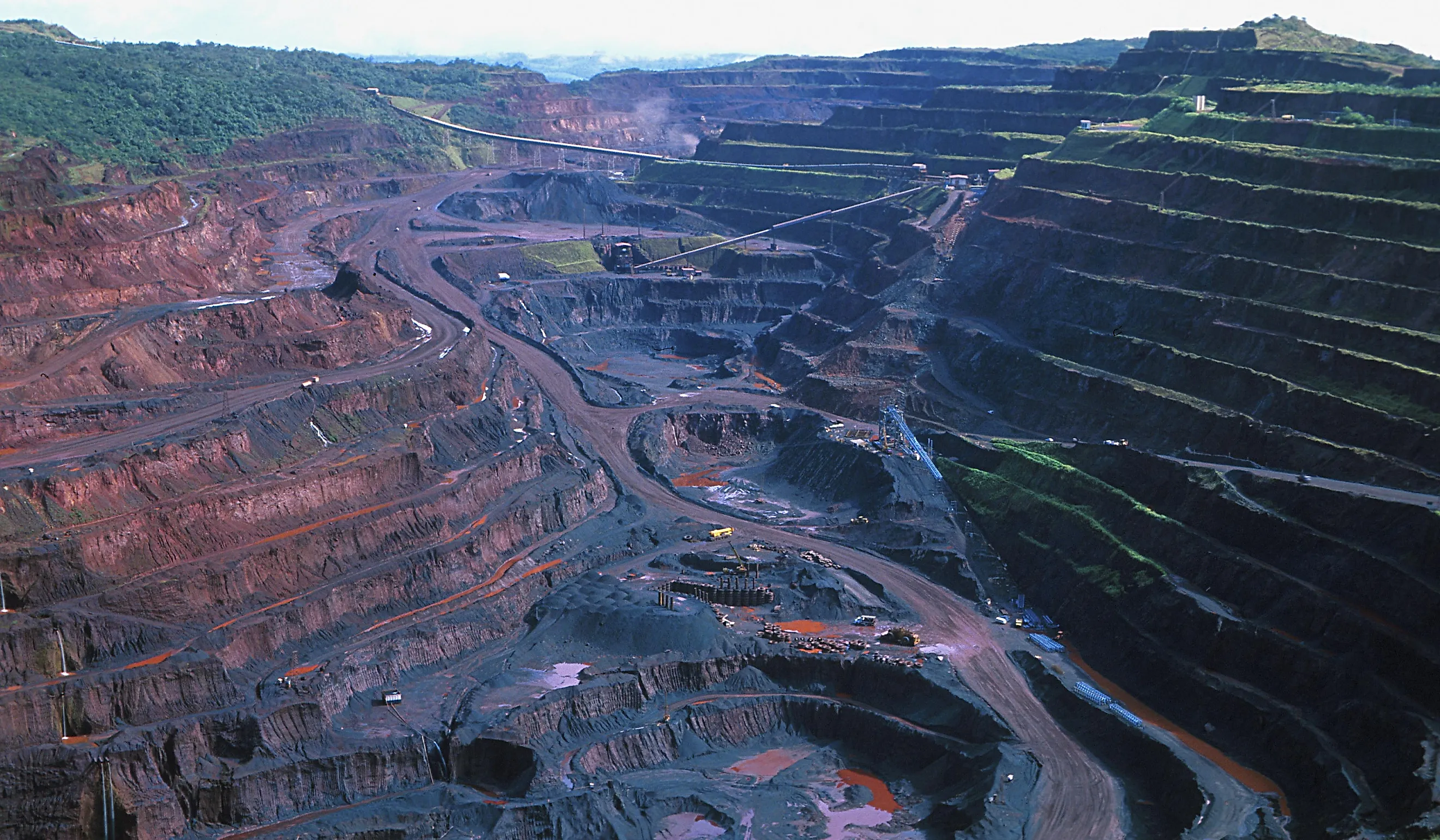
No mine on Earth digs up more iron ore than Vale's Serra Norte complex in Pará, Brazil. In 2023 it produced 102.8 million tonnes, roughly a third more than the next-biggest operation. Serra Norte has been running since 1984, and its edge is quality as much as scale: the ore here grades around 66% iron, among the richest mined anywhere, which lets it compete with Australian rivals despite sitting nearly 900 kilometers inland.
The complex pulls ore from a cluster of open pits in the Carajás mountains and is slated to keep producing until 2038, with new pits planned to extend its life. It is the anchor of Carajás, the single most productive iron ore district in the world.
2. Carajás Serra Sul S11D Project (Brazil) - 76.67 Million Tonnes

Vale's second Carajás giant, the Serra Sul S11D project, is the priciest iron ore mine ever built, backed by a roughly $19.5 billion investment. It started up in December 2016 and produced 76.67 million tonnes in 2023, making it the world's second-largest iron ore mine.
S11D's signature is its "truckless" design: instead of hauling ore in diesel trucks, it feeds it onto some 37 kilometers of conveyor belts, slashing fuel use. Sitting on one of the planet's richest undeveloped iron deposits, it is built to run until 2059, giving Vale decades of high-grade supply.
3. Mt Newman Joint Venture (Australia) - 66.99 Million Tonnes

Brazil's lead ends here. The Mt Newman Joint Venture in Western Australia's Pilbara is the largest of Australia's iron ore mines, producing 66.99 million tonnes in 2023. It is operated by BHP, with Japanese firms Mitsui and Itochu as partners, and forms the backbone of the company's vast Pilbara network of mines, rail, and port.
Newman is classic Pilbara: giant open pits carved into iron-rich rock, feeding a heavy-haul railway that runs hundreds of kilometers to the coast at Port Hedland. BHP expects the operation to keep producing into the 2050s.
4. Jimblebar Hub (Australia) - 66.8 Million Tonnes

Just behind Mt Newman, and also run by BHP, the Jimblebar Hub produced 66.8 million tonnes in 2023, a gap of less than 1% between the two. Jimblebar lies about 40 kilometers east of the town of Newman and has been mining since 1989.
The hub feeds into the same BHP rail-and-port system as Newman, and the company has invested heavily to expand it over the years. With a long reserve life, Jimblebar is expected to keep operating until around 2060, one of the longest horizons on this list.
5. Area C Mine (Australia) - 58.47 Million Tonnes

BHP's Mining Area C, deep in the Pilbara, produced 58.47 million tonnes in 2023. It opened in 2003 in partnership with South Korean steelmaker POSCO and has grown into a cluster of open-cut pits, ore-processing plants, and a rail load-out that connects to BHP's main line to Port Hedland.
Its output has been boosted by the neighboring South Flank project, and together the two are central to BHP's plan to sustain Pilbara production for decades to come.
6. South Flank Project (Australia) - 56 Million Tonnes

South Flank is BHP's newest Pilbara mine, and in 2023 it produced 56 million tonnes while still ramping toward full capacity. The roughly $3.6 billion project poured its first ore in 2021 and was built to replace BHP's aging Yandi mine, sustaining the company's output rather than adding to it.
Designed to run at about 80 million tonnes a year once fully ramped up, South Flank is set to become one of the largest single iron ore mines in Western Australia.
7. Greater Tom Price Mine (Australia) - 51.62 Million Tonnes

The list's first Rio Tinto operation, the Greater Tom Price mine, produced 51.62 million tonnes in 2023. Unlike the BHP joint ventures, it is wholly owned by Rio Tinto and ranks among the oldest and most storied mines in the Pilbara.
The mine is tied to the purpose-built town of Tom Price, home to a few thousand people, most of whom work in or around the operation. It is a reminder that these remote mega-mines often come with entire communities built to run them.
8. Kings Valley Mine (Australia) - 51.29 Million Tonnes

Fortescue's largest mine on this list, Kings Valley, produced 51.29 million tonnes in 2023 as part of the company's Solomon Hub. Fortescue built it quickly after first production in 2013 and linked it to its private rail network with a new 127-kilometer line.
The Solomon Hub sits on the traditional land of the Yindjibarndi people, and the project drew a long-running native-title dispute over compensation. After a 17-year legal battle, the High Court of Australia ruled in favor of the traditional owners in 2020.
9. Yandicoogina Mine (Australia) - 51.1 Million Tonnes

Rio Tinto's Yandicoogina mine produced 51.1 million tonnes in 2023, nudging just behind Kings Valley. Operating since 1998, it is one of Rio Tinto's lowest-cost mines, thanks to simple, shallow ore and an efficient on-site processing and rail setup that carries the product to the coast.
With ample reserves to match, Yandicoogina is expected to keep running until at least 2039, a steady workhorse in Rio Tinto's Pilbara portfolio.
10. Christmas Creek Mine (Australia) - 47.01 Million Tonnes

Rounding out the world's ten largest, Fortescue's Christmas Creek mine produced 47.01 million tonnes in 2023. It is part of the company's Chichester Hub, alongside the flagship Cloudbreak mine, and began producing in 2009 after a roughly $360 million build.
Christmas Creek's ore is trucked and railed to port through Fortescue's own network, and the mine is currently scheduled to run until 2031, the nearest closure date of any operation on this list.
What's Next for the World's Iron Ore
One pattern dominates this list: eight of the ten biggest mines sit in Western Australia's Pilbara, and the other two anchor Brazil's Carajás region. That concentration is both a strength and a vulnerability. These deposits are colossal, but they are finite, and several already have firm closure dates on the books, with the earliest, Christmas Creek, set to wind down in 2031 and the newest, S11D, running until 2059.
To stretch what remains, miners are leaning hard on technology: autonomous haul trucks, driverless trains, and conveyor systems that cut fuel use and make lower-grade ore worth digging. Demand for iron shows no sign of fading, so the challenge now is to work the world's richest deposits more efficiently and to find the next Carajás or Pilbara before today's giants run dry.