The Top Semiconductor States In America
Texas exported $19.7 billion in semiconductors and related electronic components in 2025, more than any other state. Yet California employs the most semiconductor workers, while Arizona is home to some of the most advanced chipmaking facilities in the country. America's semiconductor industry is spread across several distinct manufacturing and research centers, each contributing a different piece of the technology found in everything from smartphones to fighter jets. Oregon develops the processes needed to manufacture increasingly smaller chips, while New York is preparing for a $100 billion investment in memory-chip production. These five states lead the industry through their existing operations, specialized capabilities, and plans for expansion as of 2026.
California

California ranks first in the nation for semiconductor employment, with approximately 61,000 industry jobs. Silicon Valley, a term first used by journalist Don Hoefler in 1971, remains the center of the state's chip-design and equipment industry. Major companies include Nvidia and AMD in Santa Clara, Apple in Cupertino, Lam Research in Fremont, and Qualcomm in San Diego. California also accounted for $18 billion in semiconductor venture capital investment between 2021 and 2025, representing approximately 80% of the national total. Semiconductor exports reached $8.7 billion in 2025, placing California third nationally.
The state's role extends beyond designing the chips used in computers and smartphones. On October 12, 2026, Applied Materials unveiled its $5 billion Equipment and Process Innovation and Commercialization (EPIC) Center in Sunnyvale. The 600,000-square-foot facility brings together chip manufacturers, equipment suppliers, and university researchers to develop semiconductor production technologies. Applied Materials identifies it as the world's largest collaborative semiconductor equipment and process research facility.
California is also expanding its physical manufacturing capacity. In Roseville, Bosch is investing up to $2 billion to convert an existing semiconductor factory into a facility producing silicon-carbide chips. These chips can handle higher voltages and temperatures than conventional silicon components, making them suitable for electric vehicles and industrial applications. Sample production was underway by July 2026, with commercial production targeted for later in the year.
Texas

Texas led the United States in semiconductor manufacturing exports in 2025, shipping $19.7 billion worth of chips, or approximately 27.6% of the national total. More than 51,500 people work in the state's semiconductor industry, concentrated around Austin and the Dallas-Fort Worth metropolitan area. Texas also has a place in semiconductor history. In 1958, Texas Instruments engineer Jack Kilby developed one of the first integrated circuits, combining electronic components on a single piece of semiconductor material.
Texas Instruments continues to expand its manufacturing operations in Sherman, north of Dallas. The company began production at its SM1 fabrication plant in December 2025, approximately three and a half years after breaking ground. The facility uses 300-millimeter silicon wafers to manufacture analog and embedded processing chips. Texas Instruments has outlined a potential $40 billion investment in as many as four connected fabs at the Sherman site, with the project expected to support approximately 3,000 company jobs when fully developed.
Samsung represents another substantial investment in the state. The South Korean company has manufactured chips in Austin since 1996 and is developing additional semiconductor facilities in Taylor, northeast of the city. Its announced regional investment exceeds $37 billion, covering new fabrication capacity, research facilities, and expansion of existing operations. As of October 2026, the Taylor development remains an expansion project rather than an established source of commercial production.
Arizona

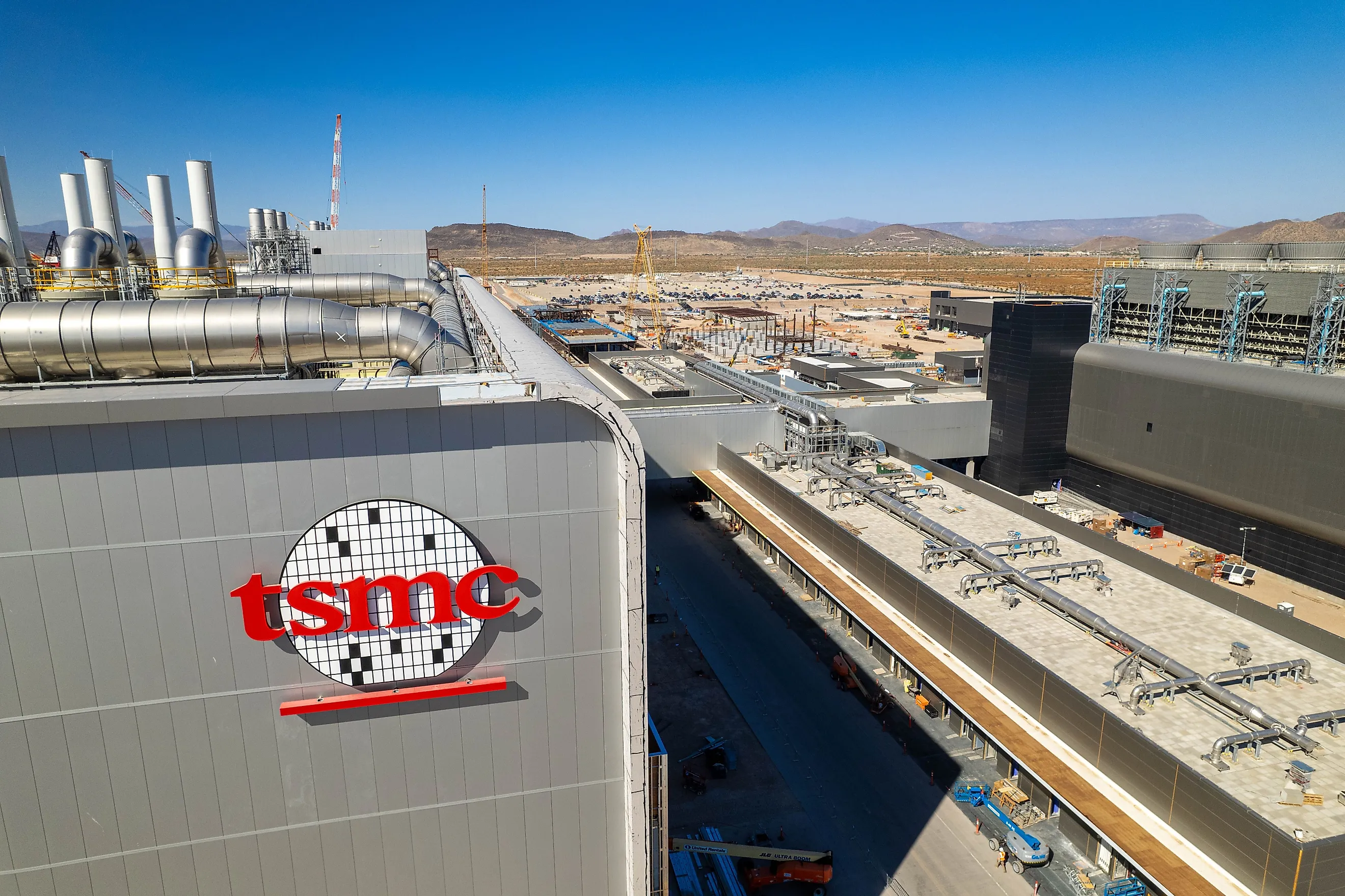
Arizona is becoming a center for some of the most advanced semiconductor manufacturing processes available in the United States. Taiwan Semiconductor Manufacturing Company (TSMC) selected the Phoenix area for its first Arizona facility in 2020. That plant began high-volume production using 4-nanometer technology in the fourth quarter of 2024. A second fab is scheduled to begin volume production using 3-nanometer technology in the second half of 2027, with additional facilities under development.
TSMC announced another $100 billion in planned Arizona investment in July 2026, bringing its total announced commitment to $265 billion. The expanded program includes plans for ten fabrication plants, two advanced packaging facilities, and a research and development center. This figure describes the company's long-term investment program, rather than money already spent or factories already operating.
Intel also maintains substantial operations in Chandler, where its Ocotillo campus includes Fab 52. The plant was operational by October 2025 and manufactures processors using Intel's 18A process technology, which incorporates new transistor and power-delivery designs.
Another development is taking shape in Peoria, northwest of Phoenix. In September 2026, Amkor Technology expanded its planned investment in an advanced packaging and testing campus to approximately $12 billion. Semiconductor packaging connects chips with other components and prepares them for installation in electronic devices. Once operating, Amkor's facility will add a local packaging capability to Arizona's established wafer-manufacturing industry.
Oregon

Oregon's Silicon Forest, centered around Hillsboro and Washington County, is one of America's established semiconductor manufacturing regions. The state exported $9.2 billion in semiconductors in 2025, ranking second nationally behind Texas. Intel is the state's largest private-sector employer and operates semiconductor manufacturing facilities at Gordon Moore Park in Hillsboro and its Aloha campus. Oregon's regional semiconductor industry also includes specialized materials suppliers, equipment manufacturers, and engineering firms.
Intel's D1X development factory at Gordon Moore Park is particularly important to the company's research into smaller and more efficient semiconductor components. In April 2024, Intel completed the assembly of the industry's first commercial High Numerical Aperture Extreme Ultraviolet lithography scanner, manufactured by Dutch equipment company ASML. The machine weighs approximately 165 tons and uses highly precise optics to project circuit patterns onto silicon wafers. Its improved resolution allows manufacturers to produce smaller semiconductor features.
Research at the site continued advancing in 2026. In September, Intel and ASML reported that more than one million wafers had been processed using High-NA EUV equipment across testing, research, and selected production applications. The technology was already being used on certain layers of Intel's Core Ultra Series 3 processors.
New York

New York has more than 156 semiconductor and supply-chain businesses employing over 34,000 people, according to Empire State Development. Much of the state's industry follows the corridor connecting Albany, the Mohawk Valley, and Syracuse. The Hudson Valley also has a long history of semiconductor research, particularly through IBM, where engineer Robert Dennard invented dynamic random-access memory (DRAM) in 1966. Today, New York hosts semiconductor manufacturers alongside research institutions working on advanced fabrication technologies.
GlobalFoundries operates an established semiconductor manufacturing complex in Malta, Saratoga County. On October 14, 2026, the company announced plans to operate two additional fabrication plants at the site under a U.S.-Japan investment initiative providing up to $21 billion in funding. The first facility is expected to begin operating in 2029, eventually adding approximately 900,000 wafers of annual production capacity. An additional plant could add a comparable amount. The existing Malta manufacturing operation remains active while these projects move forward.
Further west, Micron Technology broke ground in January 2026 on its planned $100 billion memory-chip manufacturing complex in Clay, near Syracuse. The project could eventually include four fabrication plants, producing advanced DRAM for computing and artificial intelligence applications. Micron reached its first concrete-pouring milestone in July 2026, although commercial chip production has not yet begun.
America's Semiconductor Manufacturing Geography
The leading semiconductor states contribute different capabilities to the national industry. California has the largest workforce and a concentration of chip-design and equipment companies. Texas leads in semiconductor exports, while Arizona is expanding advanced fabrication capacity. Oregon specializes in semiconductor process development, and New York is building on established manufacturing with new memory-chip and fabrication projects.
These distinctions matter because manufacturing the chips inside a smartphone or computer involves several stages. A processor may be designed in California, fabricated in Arizona, and assembled with memory or other components manufactured elsewhere. The investments announced through 2026 will expand those capabilities over the coming years, although much of the projected production depends on facilities still under construction.