The Busiest Cargo Ports
More than half of the cargo moving through America’s 150 busiest water ports passes through the Gulf Coast. In 2023, those 150 ports handled about 2.6 billion short tons, and 52% of that tonnage moved through Gulf ports. The concentration is even sharper at the top: half of all tonnage passed through just 10 ports. As of 2026, the latest nationally consistent federal ranking uses 2023 cargo data from the U.S. Army Corps of Engineers Waterborne Commerce Statistics Center.
Port Houston

No state comes close to Texas at the top of the federal port ranking. Port Houston handled 309.5 million short tons in 2023, making it the busiest U.S. water port by total tonnage. Corpus Christi added another 189.8 million tons that year, while Beaumont moved 87.9 million, illustrating how much Texas cargo is spread among several major Gulf ports.
Houston’s weight comes largely from the petroleum, chemical, and industrial trade surrounding the Houston Ship Channel, although its public terminals also handle containers and steel. The port remains active at enormous scale in 2026: through July, the wider Houston Ship Channel region had already moved 155.6 million short tons of foreign waterborne cargo, while Port Houston’s public terminals handled nearly 3 million TEUs through August.
Port of South Louisiana

The Port of South Louisiana handled 217.5 million short tons under the federal definition in 2023, second only to Houston. Its location along 54 miles of the Mississippi River places more than 40 liquid and dry-bulk terminals within the port district. Grain, petroleum products, chemicals, and other bulk commodities account for much of the traffic.
This port is also a good example of why one source must be used consistently for a national ranking. The Port of South Louisiana reported 248.3 million short tons of total trade for 2025 under its own accounting boundaries, considerably above the 217.5-million-ton federal figure from 2023. Both can be accurate because they measure somewhat different areas and movements.
Port of New York and New Jersey

The Port of New York and New Jersey handled 132.3 million short tons in 2023, making it the highest-ranked port outside the Gulf Coast. Because the federal port spans both states, splitting its tonnage between New York and New Jersey would create an artificial result. It is therefore treated as one interstate entry here.
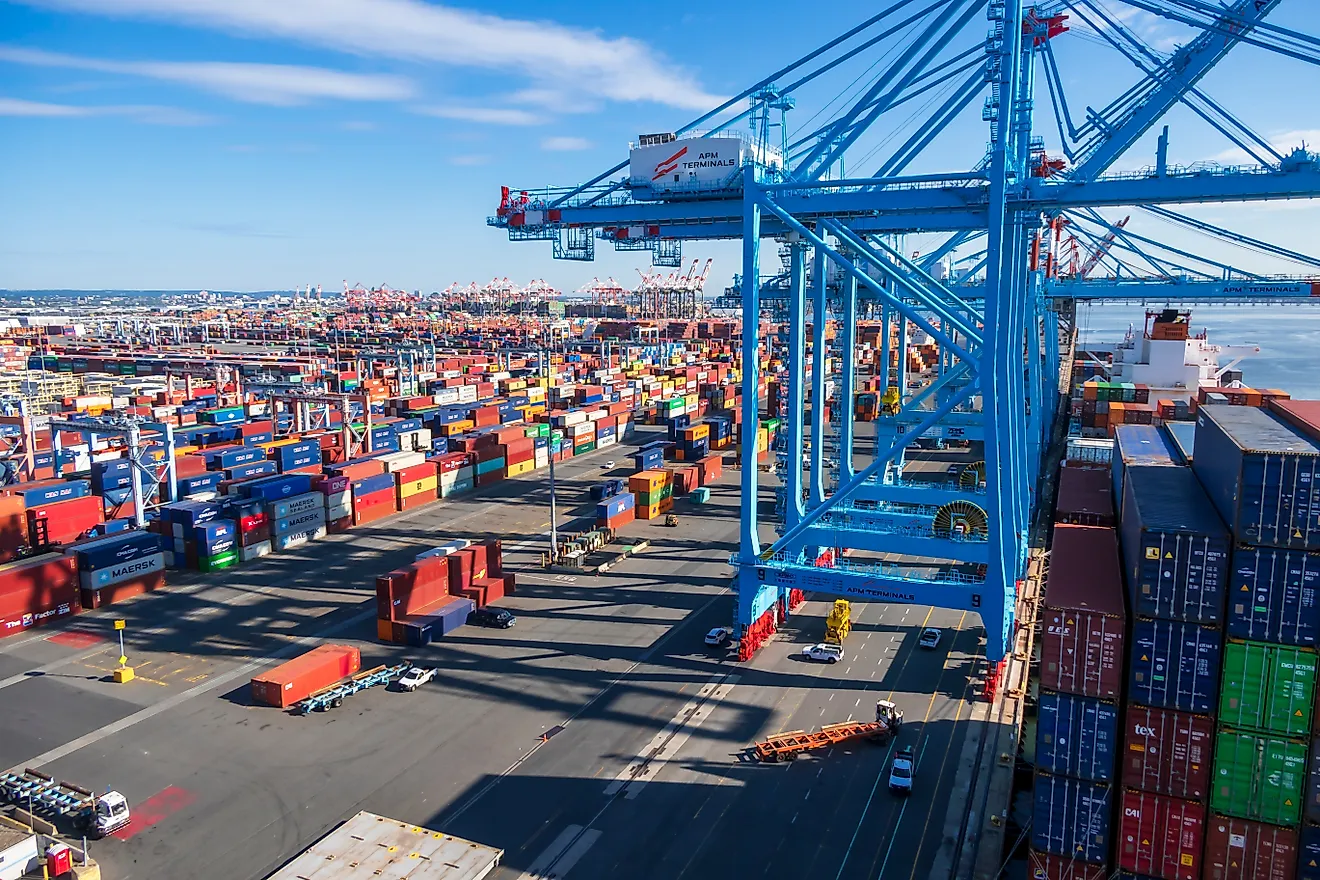
Unlike Houston and South Louisiana, New York-New Jersey is particularly important for containerized consumer goods. Its facilities include Port Newark, Elizabeth, Port Jersey, and Howland Hook. The Port Authority’s 2025 budget described a system moving roughly 5 million physical containers through its docks each year, while continued capital spending through 2026 is expanding rail and terminal capacity.
Port of Long Beach

California’s highest-tonnage entry is Long Beach, which moved 85.3 million short tons in 2023. That placed it sixth nationally in the federal ranking, ahead of neighboring Los Angeles at 55.4 million tons.
Tonnage does not fully capture the role of the San Pedro Bay ports because so much of their cargo consists of relatively light, high-value containerized goods. Long Beach handled a record 9.9 million TEUs in 2025, compared with its 85.3-million-short-ton federal total in 2023. The difference illustrates why a port can rank differently depending on whether the measurement is total weight or containers.
Port of Virginia

Virginia’s Hampton Roads port complex handled 68.8 million short tons in 2023, ranking ninth among all U.S. ports. Coal is a major reason for the high weight total, while container traffic forms another large part of the port’s business.
In calendar year 2025, Hampton Roads handled 63.4 million short tons of total cargo, including about 34.1 million tons of coal loadings and 3.24 million TEUs. Infrastructure also changed in 2026, when the Port of Virginia completed a $450 million project that deepened its commercial shipping channel to 55 feet.
Port of Mobile

The Port of Mobile handled 52.2 million short tons in 2023, placing Alabama ahead of every remaining state on this list. Its cargo mix includes coal, forest products, steel, containers, and other bulk and breakbulk shipments.
Mobile’s navigation channel reached a depth of 50 feet in October 2025 following a $366 million modernization project. Another $131 million container-berth project announced later that month is designed to raise berth capacity to 1.4 million TEUs annually after completion. Operations continued expanding in 2026, including construction of a new export facility projected to add about 60,000 TEUs of annual capacity.
Port of Baltimore

Baltimore handled 49.9 million short tons in the federal 2023 ranking, placing it 14th nationally and first in Maryland. Its location on Chesapeake Bay combines bulk terminals with container, automobile, and roll-on/roll-off facilities.
The port’s 2025 figures show how quickly cargo volumes recovered following the 2024 Francis Scott Key Bridge collapse and temporary shipping-channel closure. Public and private terminals handled about 50 million tons in 2025, including 1.1 million TEUs, 728,225 automobiles, and 848,628 tons of roll-on/roll-off farm and construction machinery.
Port of Savannah

Only about 638,000 short tons separated Savannah from Baltimore in the 2023 federal ranking. Savannah handled 49.2 million short tons, making it Georgia’s busiest port by tonnage and 15th nationally.
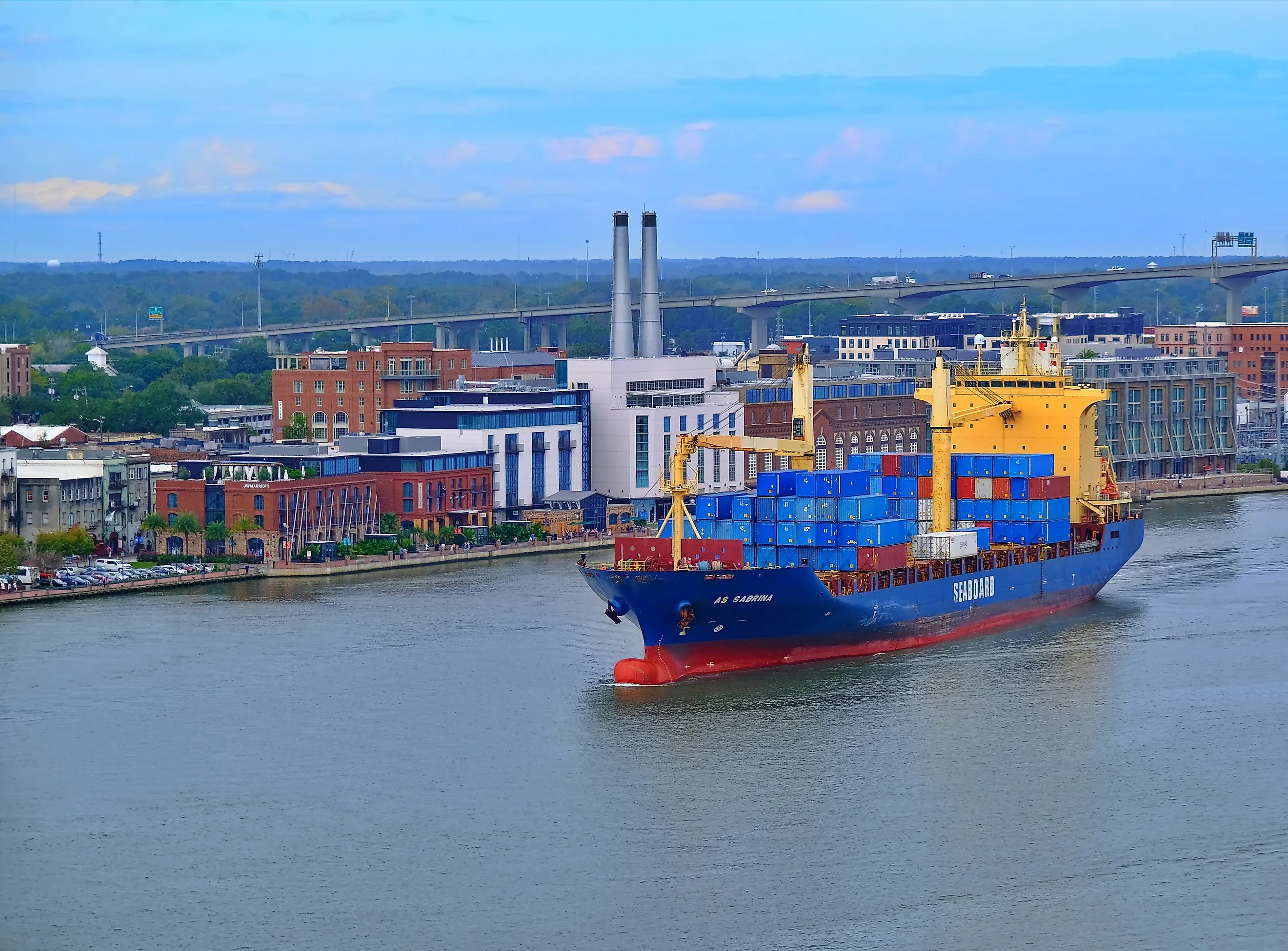
Containers are the more familiar measure of Savannah’s activity. The Georgia Ports Authority reported nearly 5.7 million TEUs in calendar year 2025, the port’s second-highest annual total. Savannah also handled 545,214 containers by rail during 2025 and averaged between 14,000 and 16,000 truck moves on weekdays.
Oil and Big Boxes
The accelerated development of ports in the United States during the 20th century centered around two primary features: mobilizing oil and the invention of the modern container. In the South and West, oil has been king from the start of the 20th century as the primary driver bringing in waves of fortune seekers.
The 2023 federal figures reveal two different versions of a busy American port. By weight, petroleum, coal, grain, ores, and other bulk cargo push Gulf Coast and industrial ports toward the top. Houston alone moved 309.5 million short tons in 2023, almost six times Savannah’s 49.2 million. Container rankings tell a different story. Los Angeles led the country with 5.73 million loaded TEUs in 2023, followed by New York-New Jersey at 5.40 million and Long Beach at 5.09 million. Savannah ranked fourth at 3.77 million loaded TEUs despite sitting only 15th in the tonnage table.