How Many State Parks Charge An Entry Fee?
If you are planning a trip to a state park in the US, you will likely have to pay an entry fee. As of 2026, most states charge an entrance, parking, or day-use fee at least somewhere in their park systems. Eight states (Illinois, Iowa, Kentucky, Missouri, Ohio, Pennsylvania, Tennessee, and West Virginia) do not charge a general entrance or vehicle fee at their state parks. However, visitors may still pay for camping, tours, swimming areas, and other amenities. Every state runs its park system differently, meaning admission policies vary dramatically.
Some parks charge per person, while others charge per vehicle or collect only a parking fee. Prices may also depend on residency, season, day of the week, or the area of the park being visited. Because states classify parks, recreation areas, monuments, and historic sites differently, there is no standardized national count of individual state parks that charge an entry fee. Here are the fee structures visitors are most likely to encounter at several major state-managed parks across the country.
States With No General Entrance Fee for State Parks

If avoiding entrance fees is part of your travel budget, some states make planning especially straightforward. Illinois, Iowa, Kentucky, Missouri, Ohio, Pennsylvania, Tennessee, and West Virginia do not charge a general entrance or vehicle fee at their state parks.
Visitors can enter major destinations such as Hocking Hills State Park in Ohio, Ricketts Glen State Park in Pennsylvania, Fall Creek Falls State Park in Tennessee, and Johnson's Shut-Ins State Park in Missouri without paying an admission fee.
That does not mean every park-related experience is free. Campgrounds, cabins, marinas, golf courses, guided tours, swimming facilities, boat rentals, and other optional amenities frequently carry separate charges. Fishing and hunting may also require the appropriate state license, even when park admission is free.
The reasons these states offer free general access vary. Missouri helps fund its award-winning park system through a dedicated parks, soils, and water sales tax approved by voters. Voters reaffirmed the one-tenth-of-one-percent tax again in August 2026, approving it with roughly 82 percent support and carrying every county. That funding supplies about three-quarters of the park system budget and allows all 57 state parks and 36 state historic sites to remain free to enter.
Pennsylvania keeps admission free across its 125 state parks, charging instead for services such as camping, boat rentals, and facility reservations. Tennessee has also long treated free park access as public policy, relying on state funding and encouraging voluntary donations rather than collecting admission at the gate.
Illinois, Iowa, Kentucky, Ohio, and West Virginia likewise allow visitors to enter their state parks without paying a standard general admission or vehicle fee, although park-specific activities and services may still cost extra.
States That Vary Their Entrance Fee Rules by State Park

Several states charge admission only at certain parks, and the rules can change dramatically within the same system. Visitors might hike at one state park for free in the morning and then pay to park at a beach, attraction, or heavily visited park that afternoon.
North Carolina

Most North Carolina state parks, including Jockey's Ridge State Park, have free general entry. However, Falls Lake, Jordan Lake, and Kerr Lake state recreation areas charge a $10 vehicle-entry fee on weekends and holidays in April, May, and September, then daily between Memorial Day and Labor Day. Seniors, veterans, and active-duty military pay $5. The attraction area at Chimney Rock State Park also charges separate admission, while the park's Rumbling Bald access is free.
Arkansas
Arkansas generally provides free access to its state parks, including destinations such as Petit Jean State Park. At Crater of Diamonds State Park, however, visitors can access portions of the property without charge, but admission is required to enter the park's defining diamond-search area.
Connecticut

Connecticut is one of the clearest examples of a varied entrance-fee structure. Through the Passport to the Parks program, vehicles registered in the state receive free parking at Connecticut state parks and forests.
The program is funded by a surcharge added to Connecticut vehicle registrations rather than by gate receipts. Vehicles with out-of-state plates pay parking fees at designated properties during the annual fee season, which runs April 1 through October 31. At Hammonasset Beach State Park, one of Connecticut's most visited parks, out-of-state vehicles pay $22 on weekends and holidays or $15 on weekdays, dropping to $7 after 4 p.m. Because the charge is tied to the license plate rather than the driver, a Connecticut resident arriving in a car registered elsewhere still pays. Other destinations, including Devil's Hopyard State Park, do not collect a parking fee.
Some Connecticut parks also charge for attractions separately from parking. Dinosaur State Park allows visitors to explore its trails and grounds for free, but charges admission to its indoor exhibit center.
Oregon
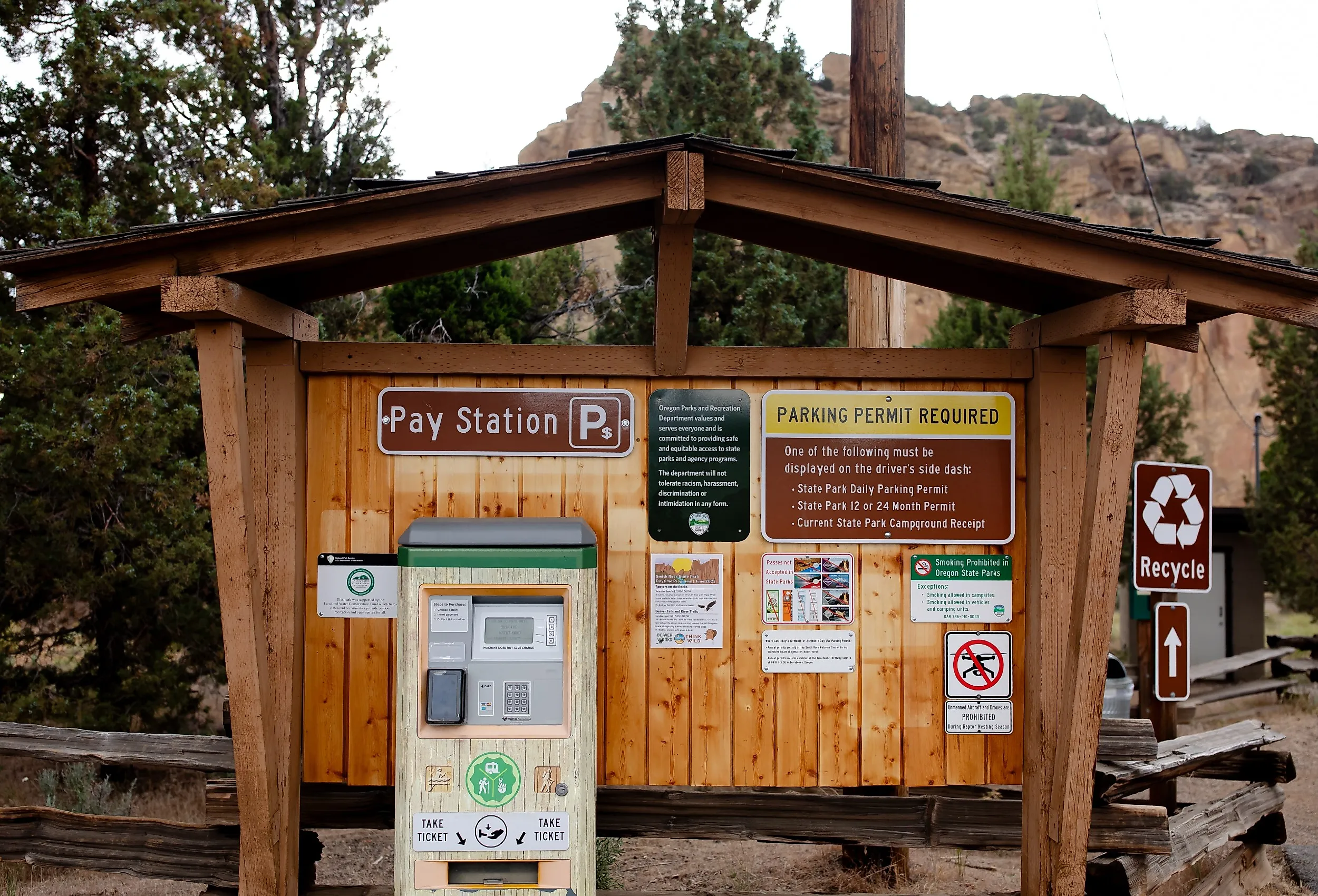
Oregon generally charges for parking at its state parks rather than admission. Only designated day-use properties require a parking permit, and visitors arriving on foot, by bicycle, or by public transportation are exempt from the vehicle charge.
On March 30, 2026, Cape Blanco, Bob Straub, Lake Owyhee, and 19 other Oregon properties began requiring parking permits, bringing the total to 68. The daily charge is $10 for Oregon vehicles and $12 for vehicles registered outside the state. More than 150 Oregon state park properties remain free to park in.
California

California also varies fees by state park. Point Lobos State Natural Reserve, one of the best-known destinations in the California State Park System, charges a $10 vehicle day-use fee. Other California parks have different parking, day-use, reservation, or attraction charges, while some properties can be entered without paying general admission.
Florida
Florida's fee structure varies considerably by park. Bahia Honda State Park charges $8 per vehicle carrying two to eight people, plus a 50-cent Monroe County surcharge per person. Single-occupant vehicles and motorcycles pay $4.50, while pedestrians and cyclists pay $2.50, with the county surcharge already included in both.
Ellie Schiller Homosassa Springs Wildlife State Park instead charges admission per person: $13 for visitors age 13 and older, $5 for children ages 6 to 12, and no charge for children five and younger.
Meanwhile, Hontoon Island State Park has no entrance fee, although camping, cabins, moorage, rentals, and other optional services cost extra.
Hawaii

Most state parks in Hawaii remain free to enter, but several of its most popular destinations charge nonresident fees and require advance reservations.
At Diamond Head State Monument, Hawaii residents enter and park free with valid identification. Nonresidents pay $5 per person and $10 per vehicle, and advance reservations are required. Out-of-state visitors traveling with a Hawaii resident are not covered by that exemption and must book and pay for themselves.
Hāʻena State Park and Waiʻānapanapa State Park use similar resident and nonresident distinctions. At these high-demand destinations, visitors should check both admission and parking requirements because paying for one does not always eliminate the need to reserve or pay for the other.
Massachusetts
In Massachusetts, the entry price often depends on the park and the time of year. Borderland State Park collects parking fees year-round, charging $5 for a Massachusetts-registered vehicle and $20 for an out-of-state one. Hopkinton State Park charges only during its seasonal collection period, and the gap there is wider still: $8 for a Massachusetts plate against $30 for a visitor from out of state. Many smaller Department of Conservation and Recreation properties do not collect parking fees at all or charge only during posted collection hours.
States Where Vehicle Permits Are Usually Required

Rather than charging only at a handful of flagship parks, some states require a vehicle permit at most or all state parks. In these systems, the charge is generally tied to the vehicle rather than the number of passengers.
Georgia
As of 2026, parking at Georgia state parks costs $10 per vehicle. The same daily ParkPass can be used at multiple Georgia state parks on the date of purchase.
That means visitors pay the same basic ParkPass whether they are hiking at Cloudland Canyon State Park, visiting the waterfalls at Tallulah Gorge State Park, or paddling beneath the cypress trees at Stephen C. Foster State Park. A standard annual Georgia ParkPass costs $70 and is valid for 12 months from the date of purchase. Neither the daily nor the annual pass covers Georgia state historic sites, which charge their own admission.
South Dakota

South Dakota requires entrance licenses for motor vehicles entering designated state parks, recreation areas, and lakeside-use areas.
The ordinary daily vehicle license costs $10 for residents and $15 for nonresidents, but Custer State Park is an important exception. Custer uses a separate $25 temporary license valid for seven days and does not sell the ordinary daily license.
Annual entrance licenses are available for frequent visitors, but neither daily nor annual entrance licenses cover the George S. Mickelson Trail, which requires its own trail pass. Camping and other services also cost extra.
Kansas and Nebraska
Kansas and Nebraska also use vehicle-permit systems. Most visitors purchase either a daily permit or an annual permit covering entry to participating state parks rather than paying a separate per-person admission fee at every destination.
Visitors should still confirm whether a permit is valid statewide, for a single calendar day, or only at a particular property, because validity rules and additional activity fees differ by state.
Well-Known State Parks That Charge Day-Use Fees

Several of the country's most recognizable state-managed parks charge straightforward day-use fees even when their wider state systems use more varied pricing.
Valley of Fire State Park in Nevada charges $10 per Nevada vehicle and $15 per vehicle registered outside the state. The fee covers ordinary day use, while camping and other services cost extra.
Dead Horse Point State Park in Utah charges $20 for a private vehicle carrying up to eight people. Motorcyclists, Utah seniors, commercial groups, and visitors entering on foot or bicycle follow different rates.
Texas commonly uses per-person rather than per-vehicle admission. Enchanted Rock State Natural Area charges $8 for visitors age 13 and older, while children 12 and younger enter free. Because the property frequently reaches capacity, visitors are encouraged to reserve a day pass in advance.
The term "entry fee" can refer to several different charges. A family arriving in one vehicle might pay a single vehicle fee in Nevada or Utah, while the same family could be charged according to the number of adults at a Texas park.
Frequent Visitors Can Save Money With An Annual Pass

If you plan to visit several state parks over the course of a year, paying the day-use charge every time may not be the least expensive option. Many states encourage repeat visits by offering annual passes.
Georgia's $70 annual ParkPass replaces the daily vehicle charge at Georgia state parks for 12 months. South Dakota offers resident and nonresident annual vehicle licenses for designated state parks and recreation areas, subject to exclusions such as the Mickelson Trail.
Texas offers a $70 State Parks Pass that waives day-use entrance fees for the passholder and accompanying guests. The exact value depends on which parks are visited, how many people travel together, and each park's normal per-person rate.
Washington's Discover Pass works differently. Rather than covering only state parks, it provides vehicle access to Washington State Parks and participating recreation lands managed by the Departments of Natural Resources and Fish and Wildlife. In 2026, Washington's Discover Pass costs $10 for one day or $45 annually. At major destinations such as Deception Pass State Park, a Discover Pass is generally required for vehicle access.
Prepare Before Visiting A State Park
One of the biggest surprises is that there is no universal definition of an "entry fee" across America's state parks. Some states charge per vehicle, others charge per person, and some collect parking fees rather than admission fees. Other systems waive fees for residents, charge only during peak season, or collect admission at only a handful of high-demand properties.
A day at Ricketts Glen, Hocking Hills, Fall Creek Falls, or Johnson's Shut-Ins carries no general entrance charge. Point Lobos, Valley of Fire, Dead Horse Point, Custer, and Enchanted Rock, by contrast, charge vehicle or per-person fees. In Connecticut, North Carolina, Oregon, Florida, Arkansas, and Hawaii, the answer depends on the particular property, the visitor's residency, the season, or which part of the park they plan to visit.
Checking the official state or park website before leaving remains the easiest way to avoid surprises. Visitors should look separately for admission, parking, reservation, attraction, and activity charges, since an annual pass or entry ticket may not cover all five.
Even with these variations, state parks remain one of the most affordable ways to experience beaches, waterfalls, canyons, forests, mountains, and wildlife areas across the country.