The Sharks Most Likely To Be Found Off US Shores
Every summer, millions of Americans head into the Atlantic, Pacific, and Gulf waters without realizing they're often sharing the ocean with sharks. In most cases, neither side notices the other. Blacktip sharks patrol Florida's surf by the thousands during their annual migration. Massive great whites regularly cruise off Cape Cod and Southern California, although it's impossible to know just how many because multiple independent research groups tag them in different regions. Using data from NOAA Fisheries, the Florida Museum's International Shark Attack File, and marine science research, these are the shark species most commonly found off U.S. shores, as well as where you're most likely to cross paths with them.
Bonnethead Shark

The bonnethead (Sphyrna tiburo) is the smallest member of the hammerhead family and one of the sharks Americans are most likely to encounter in shallow coastal waters. Its U.S. range extends from North Carolina through Florida and around the Gulf Coast. Particularly reliable places to see bonnetheads include Tampa Bay, Florida's Big Bend, Apalachicola Bay, and other seagrass-rich estuaries where NOAA research has identified them as one of the most abundant coastal shark species. In the Pacific, the species ranges north to southern California, but NOAA says it is rarely seen north of San Diego.
Most bonnetheads measure 3-4 feet (0.9-1.2 m) and rarely exceed 5 feet (1.5 m). Unlike larger hammerheads that specialize in fish, bonnetheads feed heavily on blue crabs, shrimp, and other crustaceans, making them common residents of shallow bays and grass flats.
Lemon Shark

The lemon shark (Negaprion brevirostris) is one of the easiest sharks for Americans to encounter while snorkeling or diving in tropical waters. In the United States, it is most common around South Florida, especially Biscayne Bay, Florida Bay, the Florida Keys, and the mangrove-lined shallows of Everglades National Park. Lemon sharks generally tolerate divers, and bites on people are considered exceptionally rare.
The full U.S. Atlantic range extends from New Jersey south through Florida. In the eastern Pacific, its broader range begins around the Gulf of California/Baja region. This species of shark can grow to around 8-10 feet (2.4-3 m) and can weigh more than 400 pounds (180 kg). Their yellow-brown coloration provides excellent camouflage over sandy bottoms, giving the species its common name.
Atlantic Sharpnose Shark

If someone catches a small shark from a pier along the Southeast coast, there's a good chance it's an Atlantic sharpnose shark (Rhizoprionodon terraenovae), which typically weighs less than 25 pounds (11 kg) and grows to be about 3-4 feet (0.9-1.2 m).
The species is among the most abundant small sharks along the Atlantic and Gulf coasts, ranging along the coast between Massachusetts and Florida, throughout the Gulf of America, and into the Caribbean. Americans most frequently encounter them around Florida's Panhandle, Apalachee Bay, Mississippi Sound, Alabama's Mobile Bay, and countless inshore estuaries, where NOAA surveys consistently identify Atlantic sharpnose sharks among the dominant coastal species.
Great White Shark

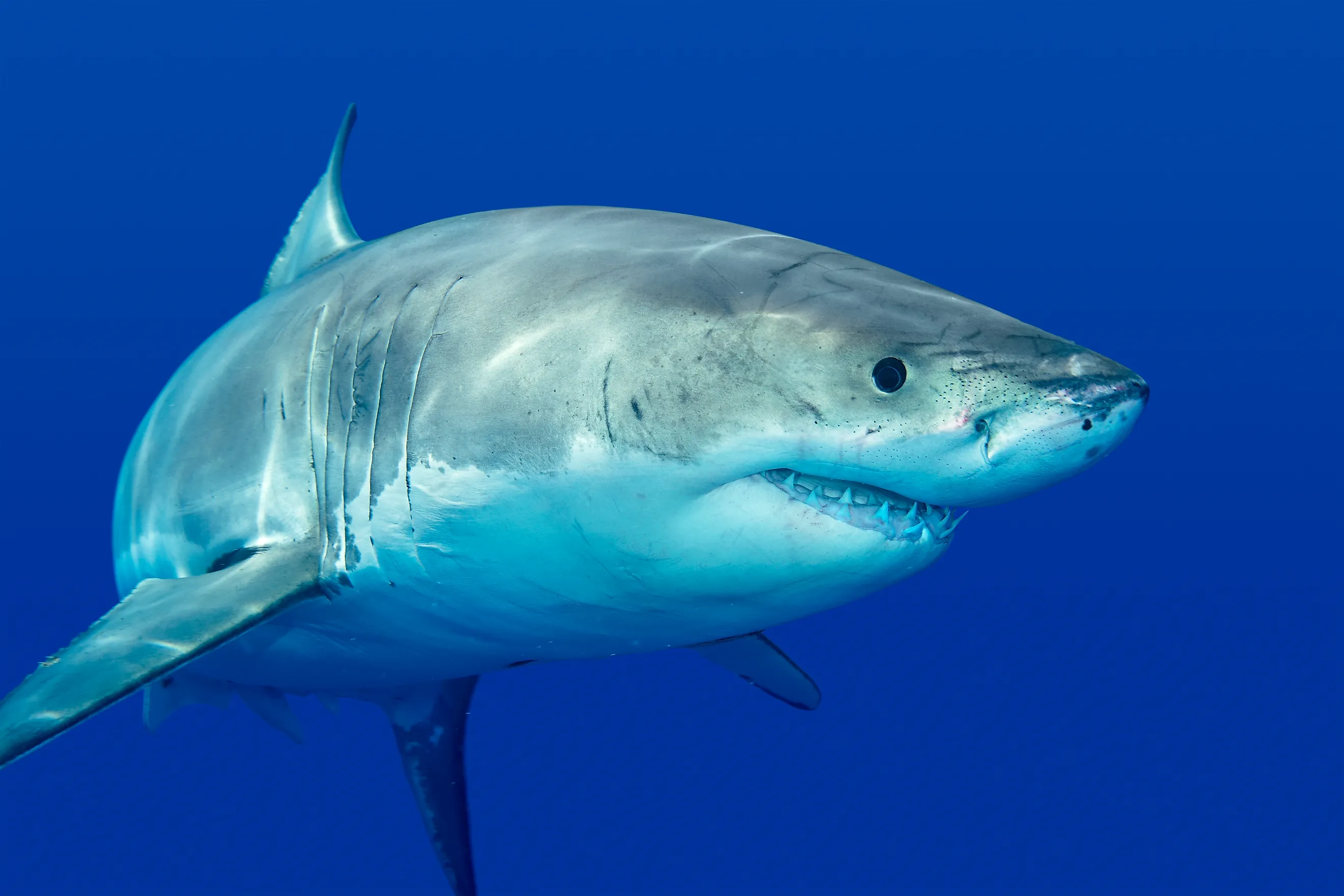
Along the U.S. East Coast, the world's most feared shark, the great white shark (Carcharodon carcharias) range from Maine all the way down to the Gulf of America. But the country's best-known hotspot is Cape Cod, Massachusetts, where recovering gray seal populations have attracted increasing numbers of white sharks each summer and fall.
On the Pacific coast, they're frequently recorded around California's Farallon Islands, Año Nuevo State Park, Point Reyes National Seashore, and the waters off Santa Barbara and Southern California, where elephant seals and sea lions provide abundant prey. NOAA also records white sharks in Hawaiian waters, although sightings there are much less common than in California.
Adult great whites commonly reach 15 feet (4.6 m), while exceptional females may exceed 20 feet (6.1 m) and weigh more than 5,000 pounds (2,268 kg). They primarily hunt elephant seals, sea lions, dolphins, fish, and occasionally whale carcasses. Although great whites are involved in more fatal unprovoked shark attacks worldwide than any other species, encounters remain exceptionally uncommon.
Smooth Dogfish

The smooth dogfish (Mustelus canis) is one of the sharks Americans are most likely to encounter while fishing, kayaking, or wading in shallow bays along the East Coast. Its U.S. range extends from the Gulf of Maine south through Florida, with the species also occurring throughout the northern Gulf of America. Smooth dogfish are especially abundant in Chesapeake Bay, Delaware Bay, Long Island Sound, and the coastal bays of New Jersey, where they migrate into warm, shallow estuaries each spring and summer to feed and reproduce.
Unlike most sharks on this list, smooth dogfish specialize in crushing hard-shelled prey. Adults typically measure 3 to 5 feet (0.9-1.5 m) and rarely exceed 30 pounds (14 kg). Their flattened teeth are adapted for cracking blue crabs, lobsters, shrimp, and other crustaceans rather than slicing fish.
Blacktip Shark

Few sharks come closer to crowded American beaches in greater numbers than the blacktip shark (Carcharhinus limbatus). The species occurs along much of the Atlantic and Gulf coasts, but Florida is its U.S. stronghold. Each winter, migrating blacktips can gather off southeastern Florida in large aggregations visible from boats, beaches, and even aircraft. Juveniles also use shallow bays and estuaries from the Carolinas through the Gulf as nursery habitat.
Adults generally measure around 5 feet (1.5 m), although the species can exceed 8 feet (2.4 m) and roughly 250 pounds (113 kg). Blacktips hunt schooling fish and are famous for occasionally spinning out of the water while feeding. Their preference for shallow coastal water brings them into frequent contact with swimmers and surfers. Blacktips have been implicated in numerous unprovoked bites, particularly in Florida, although most are relatively minor.
Bull Shark

The bull shark (Carcharhinus leucas) stands apart from nearly every shark Americans encounter because living in saltwater isn't a requirement. Specialized kidneys and other physiological adaptations allow bull sharks to move between the ocean, estuaries, and freshwater rivers, and individuals have traveled extraordinary distances inland. In the United States, they're most strongly associated with a number of the most shark-infested coastlines in Florida, the Gulf Coast, and the southeastern Atlantic coast.
Their size, powerful build, preference for murky shallow water, and willingness to enter freshwater make them one of the shark species most relevant to human safety. Because of this ability, they're also one of the most dangerous animals found in U.S. national parks. Bull sharks are among the species most frequently implicated in serious unprovoked bites worldwide. Large females can approach 11 feet (3.4 m) and weigh several hundred pounds, although most adults are considerably smaller.
Sandbar Shark

The sandbar shark (Carcharhinus plumbeus) is considerably less famous than a great white or bull shark, but Americans along the East Coast may be more likely to share the water with one. Sandbars occur from New England south through Florida and into the Gulf of America, favoring continental-shelf waters, bays, and estuaries. Chesapeake Bay is particularly important nursery habitat, with juvenile sandbars using its protected waters during the warmer months.
The species gets its name from its habit of frequenting sandy bottoms and shallow banks rather than from living directly in beach surf. Adults can reach roughly 8 feet (2.4 m) and more than 200 pounds (91 kg), although most are smaller. Sandbars primarily eat fish, crabs, and other bottom-associated prey and generally pose little threat to people.
Spinner Shark

A shark exploding from the water while twisting around its own body might look like a blacktip, but it could be a spinner shark (Carcharhinus brevipinna). The two species overlap extensively along the southeastern Atlantic and Gulf coasts, particularly around Florida, and are frequently confused. Spinner sharks regularly enter relatively shallow coastal water but are not considered particularly aggressive toward humans.
Adults can reach roughly 9 feet (2.7 m), although animals around 6 feet are more typical. Their name comes from their spectacular feeding behavior, which can often see them attacking tightly packed schools of fish from below. They may rocket vertically through the school and break the ocean's surface while spinning.
Nurse Shark

Anyone snorkeling over a reef in Florida may encounter a shark lying almost motionless on the bottom. The nurse shark (Ginglymostoma cirratum) spends much of the day resting beneath ledges or on sandy bottoms before becoming more active at night. In U.S. waters, it is especially familiar around South Florida and the Florida Keys.
While nurse sharks can grow quite large, sometimes beyond 10 feet (3 m) and weigh several hundred pounds, they are generally not dangerous to humans. Instead of chasing large prey through open water, they use powerful suction to pull fishes, squid, crustaceans, and mollusks from holes and crevices.
Tiger Shark

The tiger shark (Galeocerdo cuvier) has one of the broadest distributions of any large shark found off the United States. Americans are most likely to encounter the species around the Hawaiian Islands, where tiger sharks are seen year-round and are among the most recognizable large predators in local waters. Along the mainland, they also occur throughout Florida, the Gulf Coast, the Carolinas, and occasionally as far north as New England during warmer months. NOAA surveys also regularly record tiger sharks around Florida's Big Bend region and the eastern Gulf of America.
Tiger sharks are notorious for being among the species that pose the greatest threat to humans worldwide. While they are one of the ocean's least selective predators, with a broad diet that includes seabirds, fish, and much else, unprovoked attacks on humans are very rare. Tiger sharks commonly exceed 12 feet (3.7 m), while exceptionally large individuals may approach 18 feet (5.5 m) and weigh over 1,400 pounds (635 kg).
Scalloped Hammerhead Shark

The NOAA records the unmistakable scalloped hammerhead (Sphyrna lewini) from New Jersey south through Florida, throughout the Gulf of America, and around Puerto Rico and the U.S. Virgin Islands. In the Pacific, its U.S. range extends from southern California to Hawaii.
Adults commonly reach 8-10 feet (2.5-3 m), although some scalloped hammerhead sharks exceed 13 feet (4 m) and may weigh more than 330 pounds (150 kg). They primarily feed on fish and octopus, often hunting in schools when young before becoming more solitary with age. Although scalloped hammerheads have been implicated in a small handful of unprovoked shark bites worldwide, they are considered shy around humans. NOAA lists two population segments as Endangered and two as Threatened under the Endangered Species Act due largely to overfishing and the international shark fin trade.
Shortfin Mako Shark

The shortfin mako (Isurus oxyrinchus) is the fastest shark in the world, capable of bursts approaching 45 mph (72 km/h). Unlike blacktips or bull sharks that spend much of their time close to shore, makos primarily roam the open Atlantic and Pacific Oceans. In U.S. waters, they occur from New England to Florida, throughout the Gulf of America, and off the entire U.S. Pacific coast, including California, Oregon, Washington, and Hawaii. Sport fishermen most often encounter them in offshore waters such as the Gulf Stream off North Carolina, the Southern California Bight, and the waters surrounding Catalina Island.
Shortfin makos are responsible for relatively few confirmed unprovoked attacks on humans, but they are regarded as potentially dangerous because of their speed, strength, and tendency to leap spectacularly when hooked. Adults typically reach 10-12 feet (3-3.7 m) and can weigh well over 1,000 pounds (450 kg). In the Atlantic, the species is now prohibited from recreational and commercial retention under NOAA regulations because of population declines.
Sand Tiger Shark
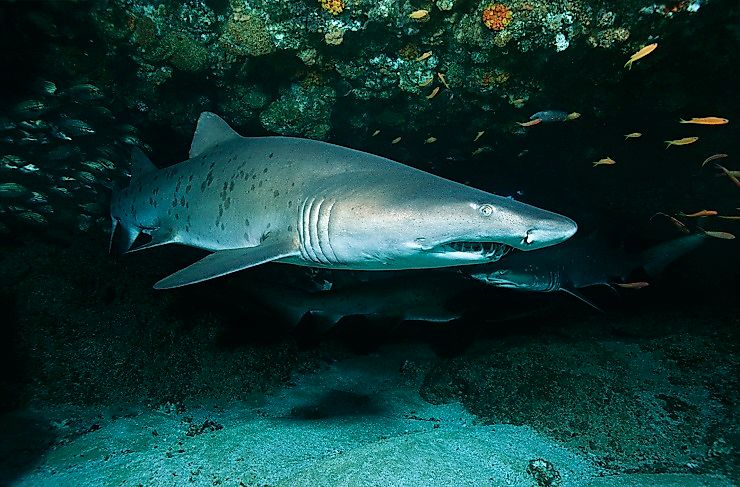
With rows of needle-like teeth protruding even when its mouth is closed, the sand tiger shark (Carcharias taurus) looks more intimidating than almost any other shark swimming off the United States. Despite its fearsome appearance, however, it is generally slow-moving and responsible for very few unprovoked attacks on people. In U.S. waters, sand tiger sharks range from the Gulf of Maine south along the Atlantic coast to Florida and are occasionally recorded in the northern Gulf of America.
They feed primarily on bony fish and crustaceans, and adults commonly reach 6.5 to 10 feet (2-3 m) and can weigh more than 350 pounds (160 kg). Unlike most sharks, sand tigers can gulp air at the surface, allowing them to regulate their buoyancy and hover almost motionless in the water.
Blacknose Shark

At just a few feet long, roughly 4 to 5 feet (1.2-1.5 m), and weighing less than 40 pounds (18 kg), the blacknose shark (Carcharhinus acronotus) is one of the smallest sharks regularly encountered along America's southeastern coastline. It is named for the distinctive dark smudge that appears near the tip of its snout, particularly in younger individuals. In U.S. waters, blacknose sharks occur from Massachusetts south through Florida, throughout the Gulf of America, and into the Caribbean.
Finetooth Shark

The finetooth shark (Carcharhinus isodon) is one of the most common sharks cruising the warm coastal waters of the southeastern United States, yet many beachgoers mistake it for the larger blacktip shark. In U.S. waters, the species ranges from North Carolina south through Florida, throughout the Gulf of America, and west to Texas. NOAA manages the species as part of the small coastal shark fishery and considers it one of the characteristic sharks of the Gulf and southeastern Atlantic coasts. Americans are most likely to encounter finetooth sharks along the Florida Panhandle, Alabama, Mississippi, Louisiana, and the Texas coast, where they often patrol just beyond the surf in pursuit of schools of mullet, sardines, and anchovies. This species poses little threat to people and usually reaches 5 to 6 feet (1.5-1.8 m) and weighs up to about 80 pounds (36 kg).
Sharing US Coastlines With Sharks
Whether it's a nurse shark resting beneath a Florida reef, a sand tiger hovering over a North Carolina shipwreck, or thousands of migrating blacktips streaming past Palm Beach County each winter, America's coastlines are home to an extraordinary variety of sharks. Most are rarely seen, even more rarely dangerous, and knowing where each species lives makes sharing the water a little less mysterious.