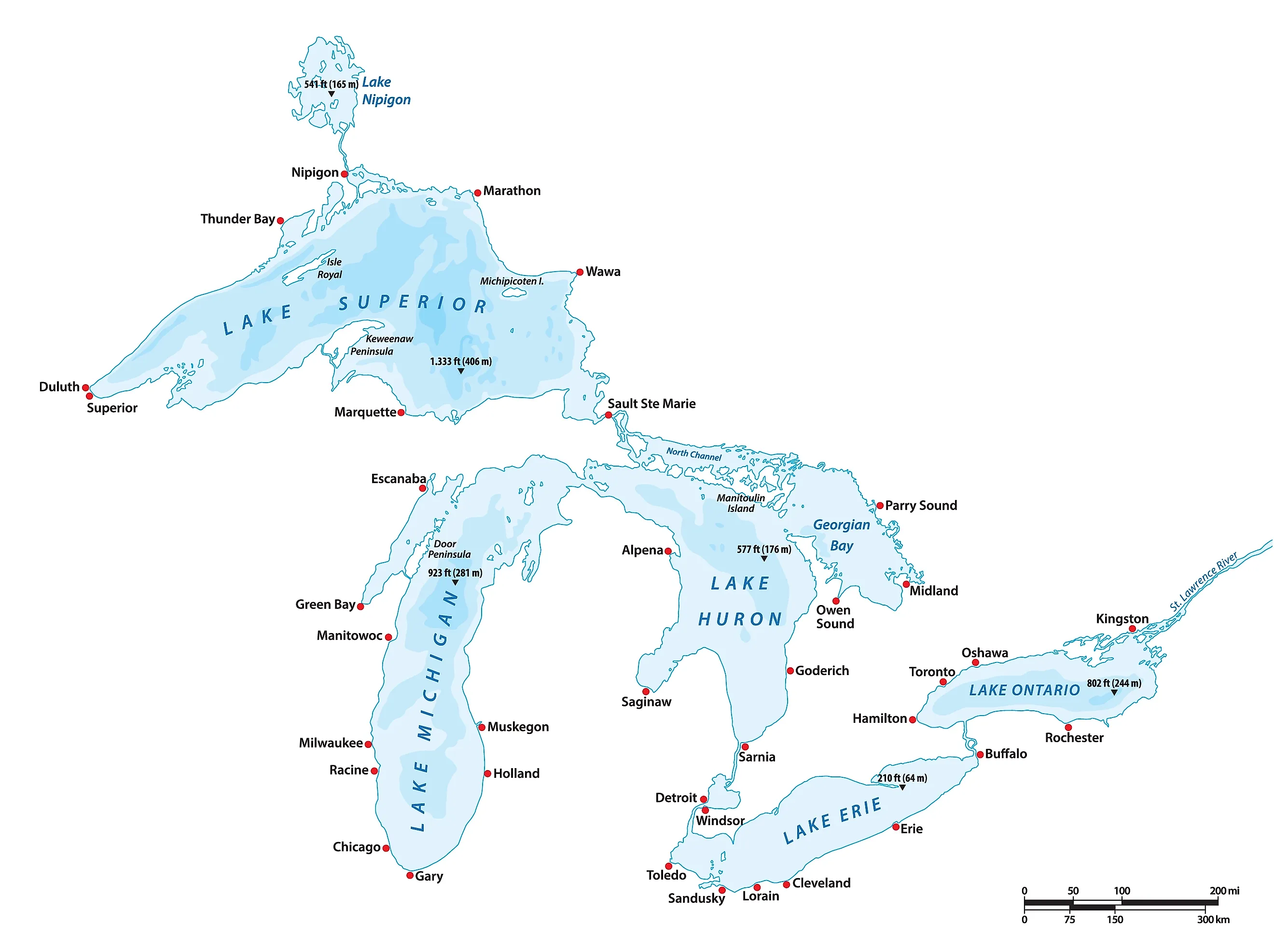
How Lake Athabasca Compares To The Great Lakes
Lake Athabasca beats Lake Erie on average depth by 1.6 meters and on maximum depth by nearly double. It also loses to Lake Erie on surface area by a factor of 3.3 and on volume by 2.4. The eighth largest lake in Canada manages to be simultaneously deeper and smaller than the shallowest Great Lake, which is the kind of result that only emerges when you measure something in more than one direction. Against the other four it is not close on anything.
It Finishes Last On Area

Athabasca is the largest lake in two Canadian provinces and still comes sixth in a field of six.
At 7,850 square kilometers it is beaten by Ontario 2.4 times over, Erie 3.3, Michigan 7.4, Huron 7.6 and Superior 10.5. All five together are 31 Lake Athabascas.
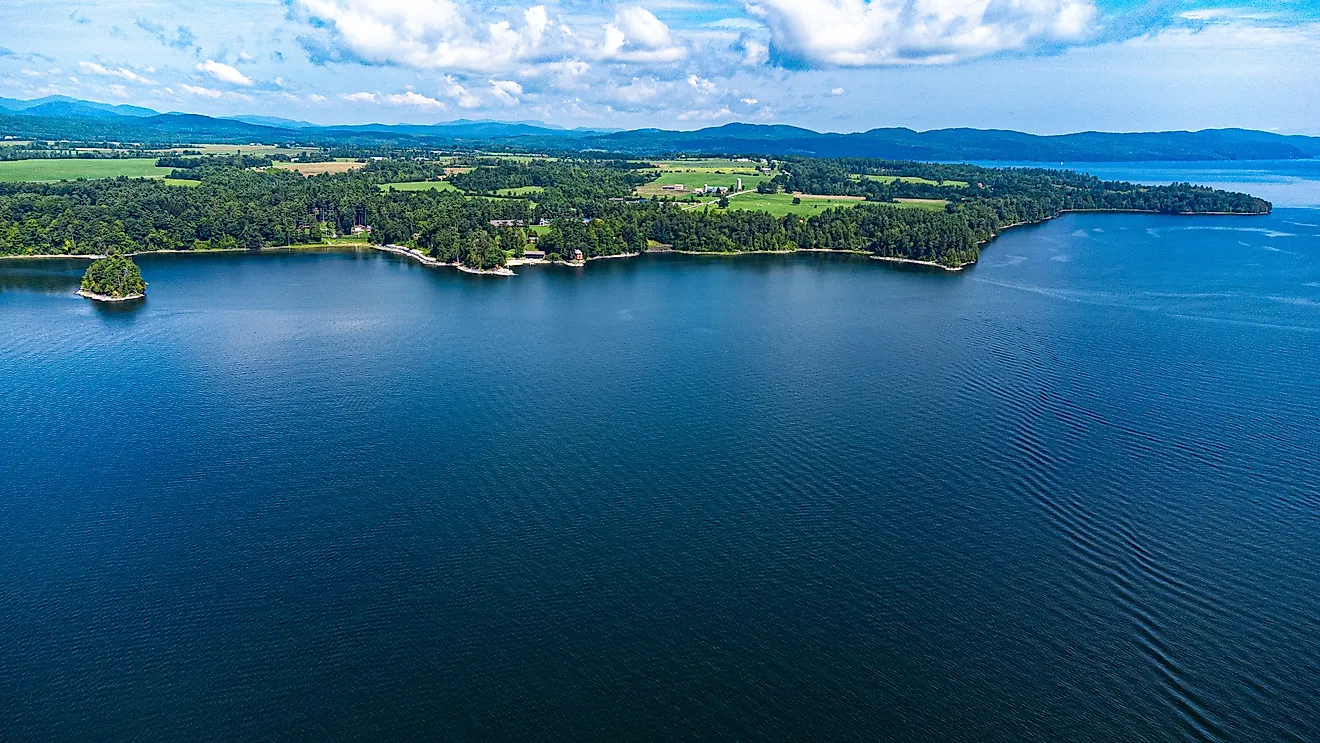
The lake is 283 kilometers long and up to 50 wide, with 74 percent of its surface in Saskatchewan and 26 percent in Alberta. Long and narrow does not compensate.
On Volume It Is Worse

Shallow water over a modest area produces a modest total, and the multipliers climb fast.
Athabasca holds 204 cubic kilometers. Erie holds 2.4 times that, Ontario 8, Huron 17.4, Michigan 24.1 and Superior 59.3. All five hold 111 Lake Athabascas.
Superior alone could absorb it sixty times and still be looking for something to do with the afternoon.
Then It Beats Erie Twice

Turn to depth and one result flips, though only against the usual victim of this series.
Athabasca reaches 124 meters at its deepest against Erie's 64, which is nearly twice as deep. On average depth it manages 20.6 meters against Erie's 19.
That second margin is 1.6 meters. Athabasca has defeated Lake Erie by roughly the height of the person reading this, which it will presumably be mentioning for some time.
The Other Four Are Out Of Reach

Beyond Erie the depth comparison closes immediately.
Huron reaches 229 meters, Ontario 244, Michigan 281 and Superior 406. Athabasca's 124 is less than a third of Superior's maximum and barely half of Ontario's.
On average depth it loses to Huron at 59 meters, Michigan at 85, Ontario at 86 and Superior at 147. One win, eight losses, across two depth measures and five lakes.
It Drains To The Arctic

The structural difference worth knowing is where the water ends up.
Lake Athabasca sits in the Mackenzie River watershed, which flows to the Arctic Ocean. The Great Lakes drain east to the Atlantic through the St Lawrence. Its catchment covers 291,489 square kilometers.
Inflows include the Athabasca, William, MacFarlane, Colin and Fond du Lac rivers, plus the Peace River backing up through the Riviere des Rochers during flooding, which is an unusual arrangement.
There Are Sand Dunes On It

Here is the category where the Great Lakes have nothing to offer at all.
The Athabasca Sand Dunes run roughly 100 kilometers along the southern shore, reach 30 meters high, and are the largest active sand dune formation on Earth north of 58 degrees latitude. They are about 8,000 years old.
A dune field at 59 degrees north, on a lake that freezes solid every winter, is not something Lake Michigan can match. The dunes are the product of a billion-year-old sandstone formation exposed as the lake level dropped.
You Cannot Drive To It

Accessibility is the comparison that puts the two systems in genuinely different worlds.
Saskatchewan's largest lake is accessible only by floatplane, because no roads go that far north. The settlements on it are Fort Chipewyan, Uranium City, Camsell Portage and Fond du Lac.
The Great Lakes have Chicago, Toronto, Detroit, Cleveland and Milwaukee on their shores. Athabasca has a former uranium mining town that emptied when the mine closed.
The History Is Mining And Fur

The human record on the lake is short, intense and largely over.
Fort Chipewyan was founded as a North West Company trading post in 1788, the first European settlement on the lake. Gold prospecting in the 1930s and 40s produced several short-lived settlements on the northern shore.
Then uranium was found in 1953 and Uranium City appeared. The lake has had three economies in two centuries and currently runs on none of them.
The Oil Sands Are Upstream

One modern fact about the Athabasca River shapes everything downstream of it.
The river runs 1,231 kilometers from the Rockies past Fort McMurray and the Alberta oil sands before reaching the Peace-Athabasca Delta and the lake. Its cumulative drainage area is 95,300 square kilometers.
A lake receiving water that has passed through one of the largest industrial extraction zones on the continent is carrying a monitoring problem the Great Lakes would recognize, at a fraction of the population.
The Scoreboard

Lake Athabasca loses to every Great Lake on surface area and on volume, finishing last on both, with all five together covering 31 times its area and holding 111 times its water. It beats Lake Erie on maximum depth by nearly double and on average depth by 1.6 meters, and loses the depth contest to the other four.
In exchange it has the largest active sand dunes north of 58 degrees, drains to the Arctic rather than the Atlantic, can only be reached by floatplane, and has an abandoned uranium town on its northern shore. The Great Lakes are bigger in every dimension that gets printed on a map. Athabasca is the only one of the six with a desert attached.