What Happens To A Great Lakes Freighter Stuck In The Ice
In March 2026 a dozen vessels sat beset in Whitefish Bay under two feet of ice and three feet of snow, unable to move for nearly three days. The Lake Carriers' Association reported that not a single load had got through. The reason help did not arrive is the detail that explains the whole subject: the Coast Guard's only heavy icebreaker on the Great Lakes, the Mackinaw, was itself stuck below the Soo Locks with an engineering problem. One ship stands between the fleet and a standstill.
Wind Does It, Not Cold

Ships rarely freeze in place gradually. They get trapped by ice that arrives.
The Canadian Coast Guard's icebreaking superintendent for the Central Region described a 2022 incident plainly: two to three days of sustained, very strong northwesterly winds pushed the ice back into the Whitefish Bay area, and ten vessels were immobilized.
The same thing happened in 2014, when warmer air and a sudden wind shift loosened the pack and moved it, trapping 18 ships just northwest of the Soo Locks in a 35-mile ice field.
Whitefish Bay Is Where It Happens

One stretch of water accounts for a disproportionate share of these incidents, and the geography explains why.
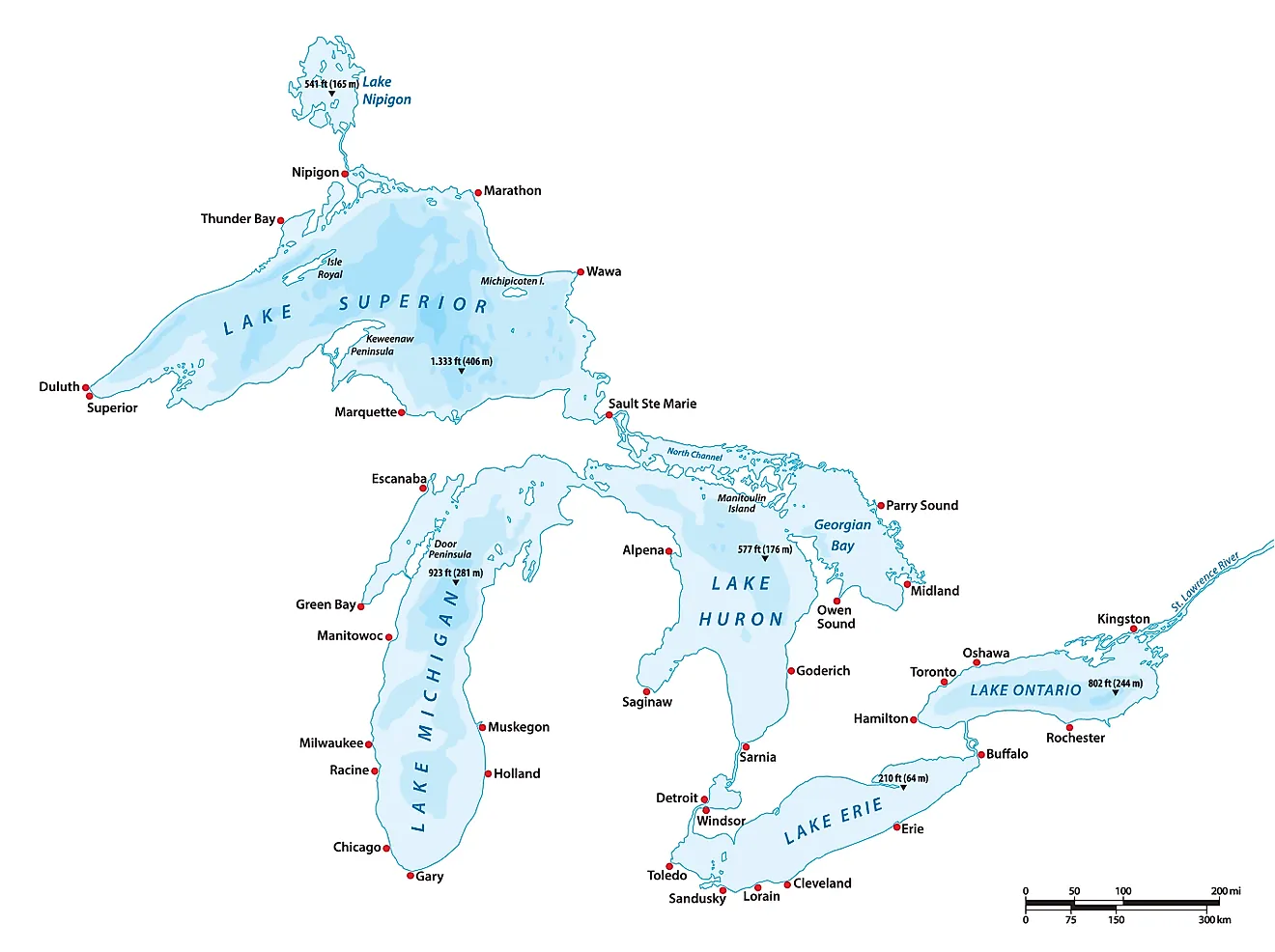
Every ship moving between Lake Superior and the lower lakes must pass through Whitefish Bay before or after transiting the Soo Locks on the St Marys River. It is the funnel.
Wind-driven ice packing into the eastern end of Lake Superior halts movement in both directions at once, which is why a single event can stop an entire fleet rather than delay one vessel.
Being Stuck Is Called Being Beset

A beset vessel is not damaged and not sinking. It is simply held.
Ice closes around the hull and the pressure prevents the ship from making headway regardless of engine power. A laker has a blunt bow built to fill a lock chamber, not an icebreaking bow built to ride up and crush downward.
The ship waits. There is no self-rescue maneuver available to a vessel of that shape in two feet of pack ice.
The Icebreaker Circles The Ship

The actual freeing operation is more delicate than the word icebreaking suggests.
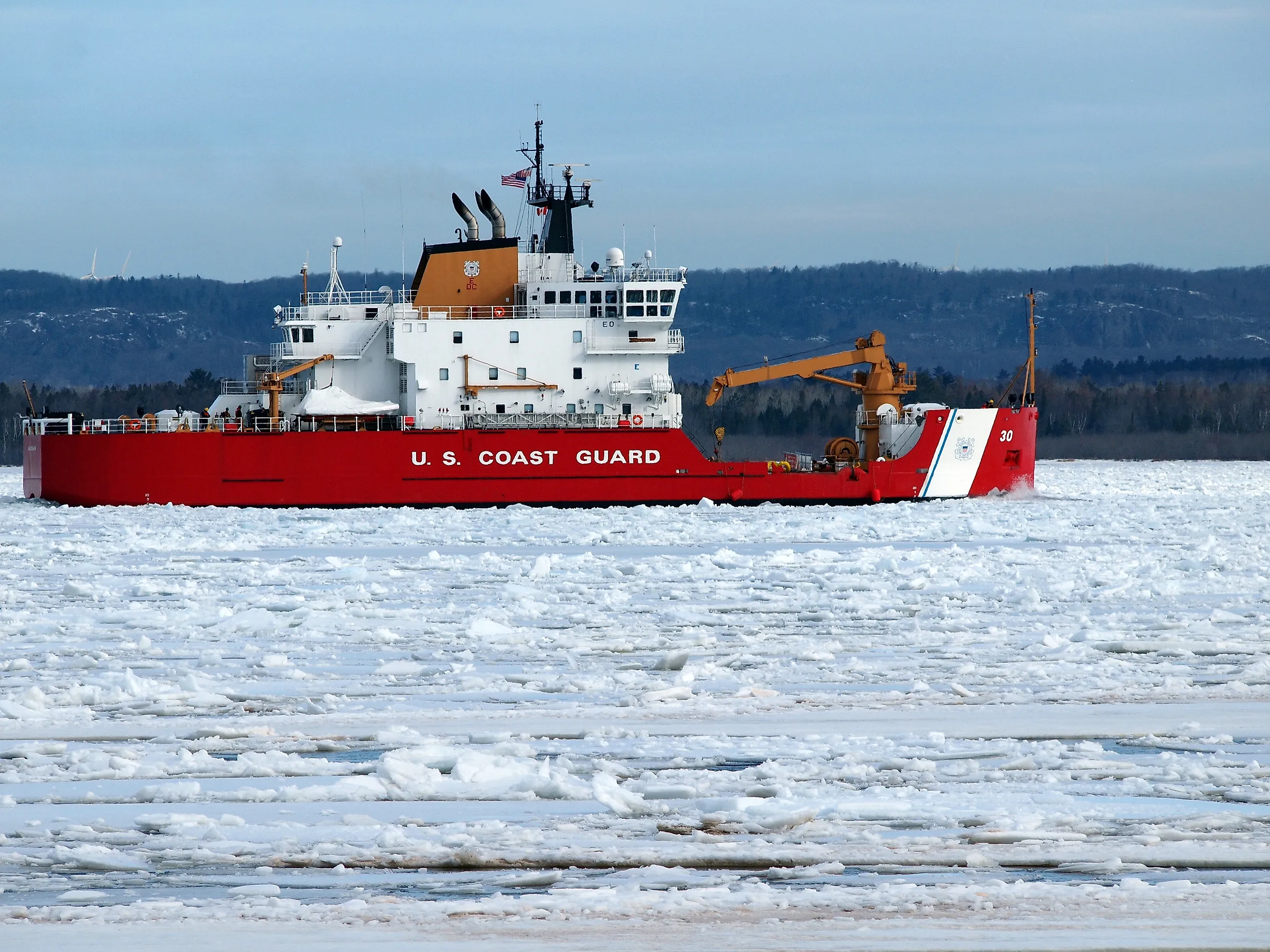
An icebreaker will circle a stuck freighter to clear the ice out from around it, releasing the pressure gripping the hull so the vessel can resume forward movement under its own power. The cutter has to work within an arm's reach of a ship far larger than itself.
Canadian Coast Guard practice is to let ships go once they can move alone, then return and release the pressure again if they become stuck a second time.
Tracks Are Cut In Multiples

Freeing one ship is a small part of the job. Keeping a route open is the larger one.
The Mackinaw cuts separate tracks for upbound and downbound vessels, then adds relief tracks on either side of the main tracks so the ice has somewhere to go when a ship passes through and pushes more of it aside.
Without that relief, a cleared track closes behind the first vessel and the next one is beset in the same place.
Backing And Ramming Is Exactly What It Sounds Like

When the icebreaker itself cannot make progress, the technique is brute force applied repeatedly.
The Mackinaw backs up 500 to 600 feet from the trouble spot, then hits full power and drives forward into it. The process repeats as often as necessary.
The original Mackinaw could break two and a half feet of ice continuously and up to eleven feet by backing and ramming. The current vessel, commissioned in 2006, is the only Coast Guard ship on the lakes capable of the heaviest ice.
There Is A Pump That Rolls The Hull

Icebreakers carry one piece of equipment that exists purely to get them unstuck.
The heeling pump system transfers water from tanks on one side of the hull to the other, rocking the ship to break the grip of the ice. The original Mackinaw could move 160 tons of water across in about a minute and a half.
A ship that can roll itself free is doing something no freighter can. That capability is the difference between an icebreaker and a strong ship.
Freeing Takes Hours, Reaching Them Takes Longer

The published timings show where the real delay sits, and it is not in the cutting.
In one documented case the freighter Algosteel was stuck for 18 hours. The Mackinaw took six hours to reach her through 38 miles of the Mackinac Straits, then 90 minutes to free her. In the severe 2014 winter, one freighter took 17 hours to cut loose.
The Arthur M. Anderson spent five days trapped in Lake Erie ice near Conneaut in 2009 before the Canadian cutter Griffon reached her.
The Costs Run To Millions

A fleet held in place has consequences that reach well beyond the ships.
Between December 2013 and May 2014, US-flag cargo movement fell nearly 7 million tons against the previous year, with at least two steelmakers curtailing production. The Lake Carriers' Association put the cost at 705 million dollars and 3,800 jobs.
In early 2022 a shortage of icebreaking capacity left 750,000 tons of carrying capacity delayed, with four of nine Great Lakes icebreakers in maintenance during the critical month.
Sometimes The Hull Gives

Being beset is usually an expensive delay rather than an emergency, but not always.
Among the 18 vessels trapped in Whitefish Bay in 2014 was one freighter with a damaged hull. Pack ice exerts enormous lateral pressure on plating never designed to resist it.
That is the argument for waiting rather than forcing a passage. A ship that tries to power through heavy ice risks doing to itself what the icebreaker is built to absorb.
The Short Answer

A beset freighter stops and waits. An icebreaker cuts its way to the ship, circles it to release the pressure around the hull, and escorts it out along tracks cut in pairs so the ice has somewhere to go. Freeing a single vessel can take 90 minutes once the cutter arrives, and arriving can take six hours or several days.
The constraint is not technique but availability. In March 2026 a dozen ships sat in Whitefish Bay for three days because the one heavy icebreaker on the Great Lakes was stuck below the locks, which is a reasonable summary of how thin the margin is.