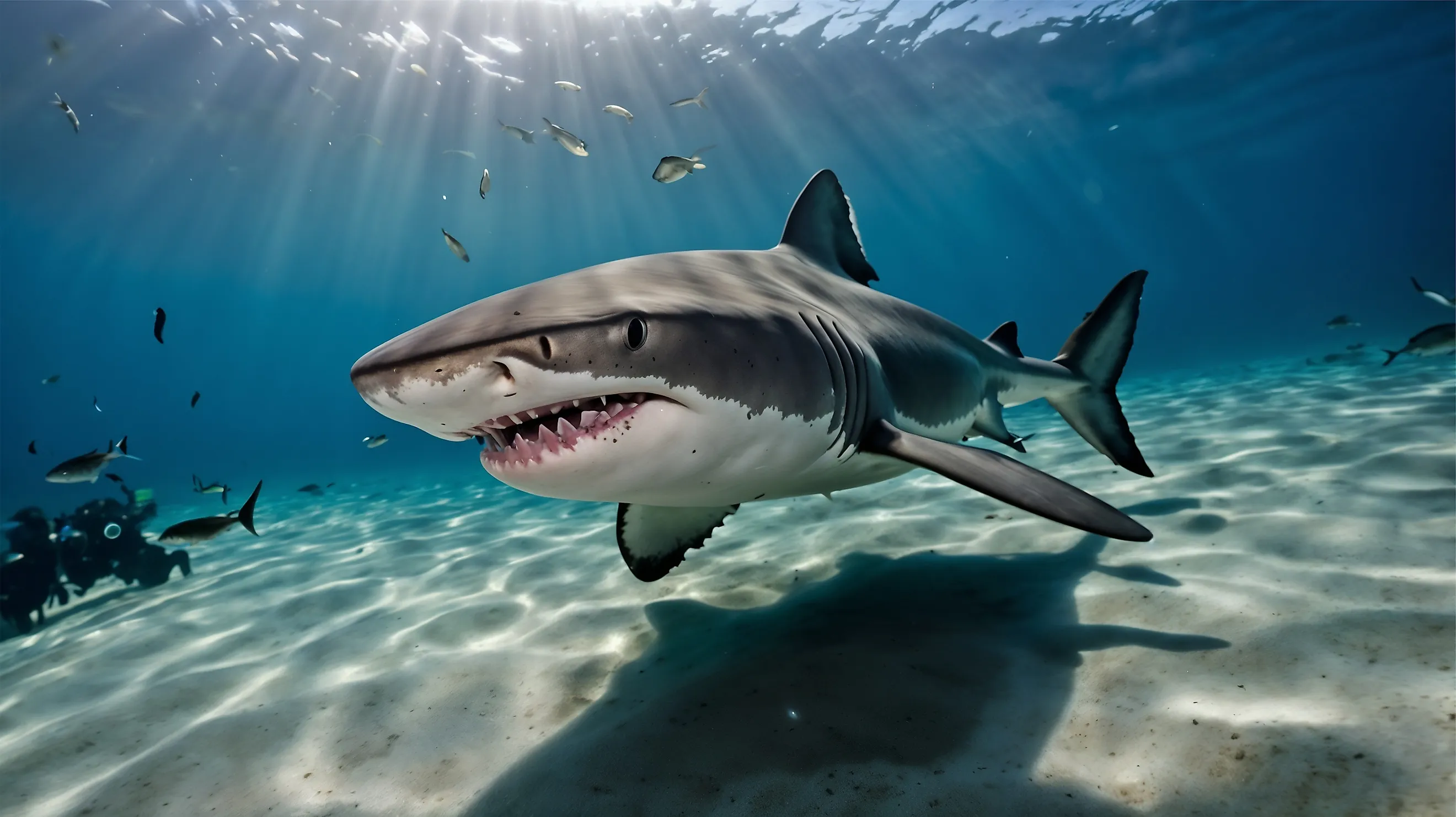
Great White Shark
The great white shark (Carcharodon carcharias) gets a bad rap. This large, fast shark, which has been known to exceed 20 feet in length, is up there with the most famous movie villains in Hollywood history, billed as a man-eater and an imminent threat to swimmers. But there’s much more to this fascinating species than its media portrayal might imply. The great white shark is a beautifully complex apex predator and plays a vital role in maintaining the health of our global oceans.
Anatomy and Appearance
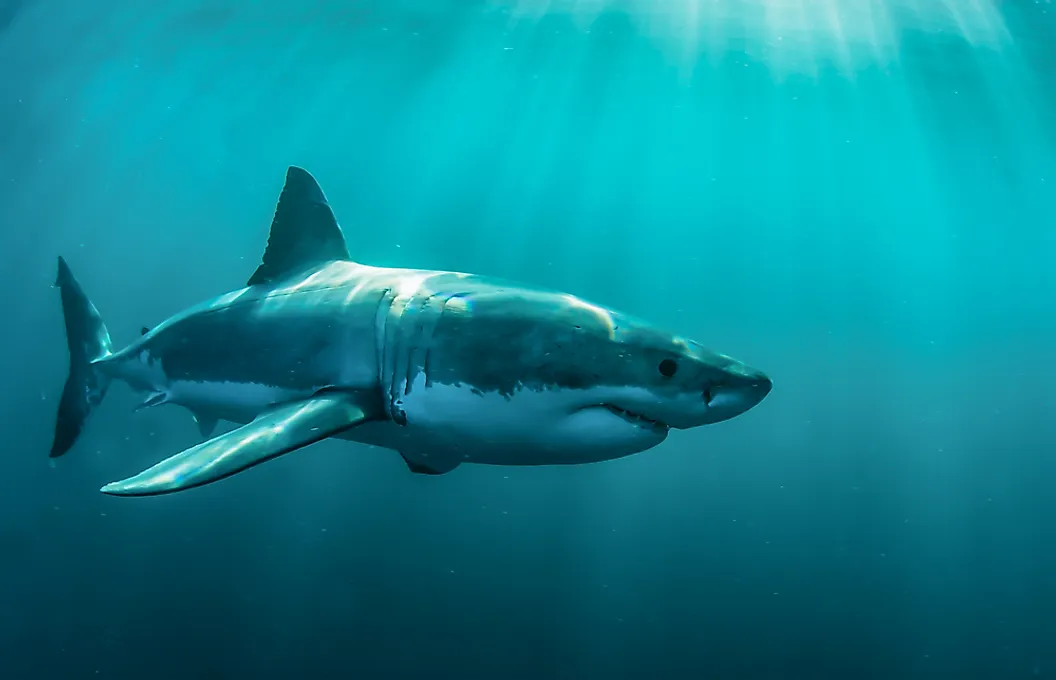
Like most members of the mackerel shark family to which they belong, great whites are torpedo-shaped, with a tail like that of a tuna, a slate-grey upper body, and a white underbelly. This classic silhouette has come to inform the way the public imagines sharks as an entire species, but great white sharks are distinct for a number of reasons. The largest in the family by far, the average weight of a great white shark ranges from about 1,500 to 4,000 pounds, but rare specimens as large as 5,000 pounds have been caught. Though the biggest great white sharks are over 20 feet long, typical individuals are between 11-16 feet long, and females tend to be larger than males.
Also of note are the great white shark’s teeth. Because adults prefer a diet of seals and sea lions, their serrated teeth are designed to cut through bone, and an extremely powerful jaw helps them accomplish this. They possess about 300 serrated teeth in multiple rows, which are continually replaced throughout their life. Great white sharks are also warm-blooded, but not in the same way that mammals are; their circulatory systems redirect heat to critical areas of immediate need, rather than raising the whole body to a uniform temperature. Even this limited endothermic physiology, however, enables them to take advantage of the rich food sources in parts of the ocean where the water is too cold for cold-blooded species.
Reproduction

Great white sharks are relatively slow to reach sexual maturity. Males tend to take about 10 years, while females will be anywhere from 12 to 18 years old before they are sexually mature. Eggs are fertilized internally, and mating behavior is still largely unknown. Great whites are viviparous, meaning that they give birth to live young from eggs retained inside the body. Litters typically range from 2 to 10 pups, and newborns are about one meter long at birth. It is believed that great white sharks travel to warmer waters to give birth, hence their long migrations.
Habitat and Range

The great white shark inhabits temperate seas worldwide. Areas famous for their great white populations include the coast of California, especially the San Francisco Bay area; the southern tip of South Africa; and coastal parts of the northeastern United States, which was the setting for the 1975 great white shark thriller, Jaws.
Great whites are much more broadly distributed, however. Temperate waters with abundant populations of fish and marine mammals tend to attract great white sharks, including off the coasts of Chile, New Zealand, Japan, northern Mexico, southern Australia, and some Mediterranean countries. As a rule of thumb, temperate regions with moderately chilly water temperatures and large populations of seals are likely to host great white sharks from time to time.
Great white sharks are also migratory, traveling distances of up to 2,500 miles annually between their feeding and breeding grounds, even as far offshore as Hawaii. Scientists believe that their preference for near-shore areas with abundant seal populations is because these high-fat food sources help them store calories for their long migrations through the food-poor open ocean.
Diet

The great white shark has a preference for pinnipeds. While their diet is fairly diverse, most populations show a strong preference for seals and sea lions when they’re available. This is believed to be why many great white shark attacks occur when people are surfing, as a human on a surfboard with arms and legs dangling over the sides can resemble a seal from below. Great white sharks are not picky, however. Babies and juveniles will primarily eat fish, and adults will also eat sea turtles, other sharks, dolphins, porpoises, and even sometimes small whales. They’ve been known to scavenge from the carcasses of larger sharks and whales, too.
Behavior

Great white sharks are solitary, exhibiting no known social behavior and traveling alone. Otherwise, not much is known about their habits outside of their predation behavior. They are ambush predators, relying on the element of surprise to inflict a fatal wound on an unsuspecting animal from below. Typically, the shark will charge at its prey, take a bite that will eventually cause the animal to bleed to death, and then retreat to wait until it has died. Only then will the shark return and feed. Some populations, especially those in South Africa, are famous for launching themselves out of the water while conducting these ambush attacks. It remains unclear why specific populations perform this maneuver while others do not.
Ecological Role & Conservation Status
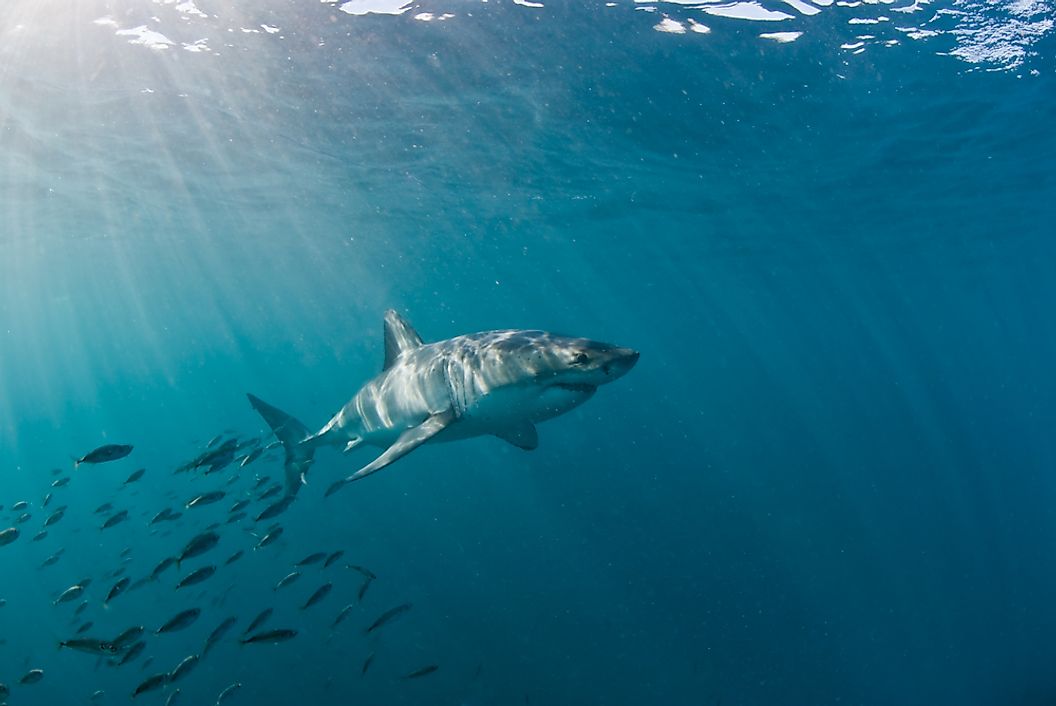
As apex predators, great white sharks play a critical role in maintaining healthy oceans. Their predation habits help to stabilize the populations of species they eat, which in turn keeps the whole marine ecosystem around them in check. The International Union for the Conservation of Nature (IUCN) currently lists great white sharks as vulnerable as of 2026, with certain regions, like the Mediterranean and Canada, listing them as critically endangered. Their population trend is decreasing globally. Great white sharks are threatened by human intervention in multiple ways.
Firstly, great white sharks are sold as food in some countries. They’re also highly sought-after as challenging targets for sports anglers. And although great white sharks are not specifically hunted for this purpose, they are occasional victims of shark finning, the practice of removing a shark’s tail and fins for use in food products.
Although great white sharks are not yet profoundly threatened worldwide, their conservation status is of note because they are an inherently uncommon species. As apex predators that take years to reach sexual maturity, their numbers are not and have never been naturally high. Thus, seemingly small declines can have an outsized effect on the health of the worldwide population.
Humans and Great White Sharks

No shark captures the public imagination quite like the great white. It’s been immortalized in film and television as the ultimate predator, and its reputation for aggression has made generations of beachgoers hesitant to go in the water. In reality, the great white shark is far less of a threat to human swimmers, divers, and surfers than Hollywood would have you believe.
When attacks have happened, they’ve usually been close to shore, in waters 10-30 feet deep at dawn and dusk, when sharks are most active. Victims are usually surfing, kayaking, or diving at the surface when great white sharks attack from below. However, since great white sharks do not actually prefer to eat humans, they will usually not return after the initial bite, and this gives many time to escape. Only 17% of great white shark attacks since 1580 have been fatal for this reason; however, these attacks are still incredibly rare.
Reframing The Narrative
Despite their fearsome reputation, great white sharks are highly adapted, wide-ranging predators whose presence helps keep marine ecosystems balanced and resilient. Slow to mature and naturally scarce, they are especially vulnerable to human pressures, from fishing to habitat disruption. While rare encounters with people capture headlines, the real story is one of an essential ocean guardian in need of protection. Understanding and conserving great whites ultimately means safeguarding the health and stability of the seas they rule.