How Tall Niagara Falls Is Compared To The Statue Of Liberty
If one were to ask what landmarks truly define America, Niagara Falls and the Statue of Liberty would both make the list, as both play a deep role in America's culture. Niagara Falls was once covered in smog from factories, while today it is a natural marvel, while the Statue of Liberty stands as a model of every American ideal.
Both of these landmarks stand out for their height, but which one is taller? Believe it or not, this is a complicated question to answer, as it depends on which of the three waterfalls that are collectively known as Niagara Falls you are measuring and when you are measuring its flow.
It also varies based on how you measure the Statue of Liberty herself, whether you include just her full stature, her torch, or from the ground all the way to the torch.
Measuring the falls

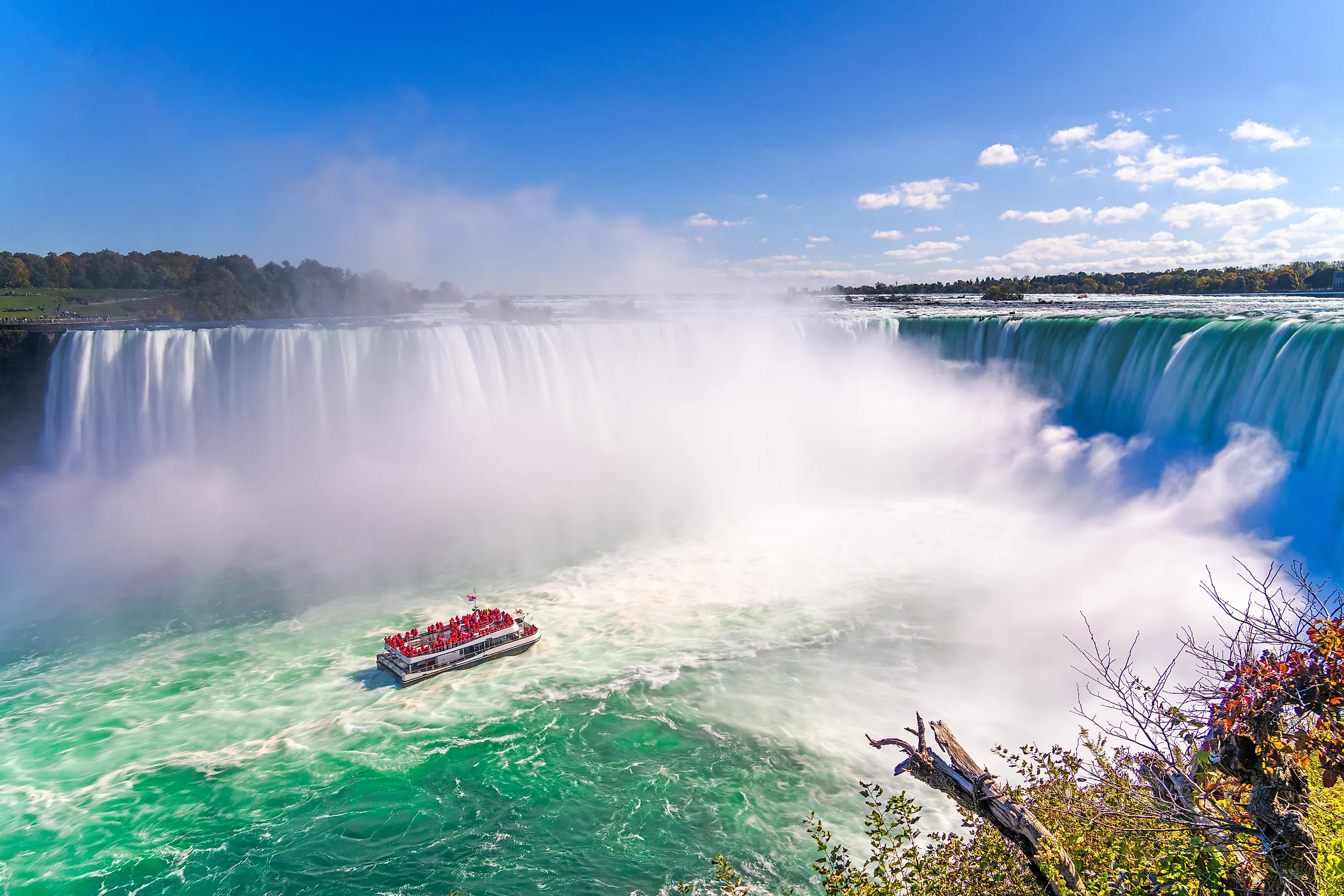
Niagara Falls is made up of Horseshoe Falls, American Falls, and Bridal Veil Falls, each of which varies in height depending on how water is diverted for power generation and the depth of the water in the pool at the bottom. It also depends on whether one measures from the top of the waterfall to the rocks below, or to the pool.
Horseshoe Falls flows down 184 feet during full natural flow from the top to the pool. However, its level can drop as low as 158 feet when the pool below is at a higher level. American Falls, meanwhile, varies from 194 to 168 feet.
Bridal Veil Falls is separated from American Falls by Luna Island and typically has a height of 181 feet.

It's worth noting that Niagara Falls is not the tallest waterfall in the world. It's not even in the top ten. The tallest one is Angel Falls in Canaima National Park in Venezuela, which drops down 3,212 feet. The United States has several taller waterfalls as well, such as the 2,425-foot-tall Yosemite Falls.
Where Niagara Falls stands out is its volume, as it delivers more than 700,000 gallons of water every second. In addition, its average width across all three waterfalls is 3,950 feet, making this the largest waterfall by width and volume in the United States.
Measuring Lady Liberty

Most measurements of the Statue of Liberty list her height as 305 feet and one inch, which would obviously make her taller than all of the falls. But this measurement starts from the ground all the way to the tip of her raised torch.
If only the statue's total body height is considered, from her heel to the top of her head, she would be 111 feet and one inch tall, which is shorter than all of the waterfalls.
To further complicate matters, if one measures from the top of the base she's standing on to her torch, she would be 151 feet, one inch tall, which is still shorter than Niagara Falls.
Who built Lady Liberty?

The Statue of Liberty is so ingrained into American culture that it's hard to imagine a time when she didn't exist. After all, if a disaster or apocalyptic movie wants to showcase a devastating event, they will typically show the Statue of Liberty broken and toppled over.
Yet, its history only dates back to the late 19th century, when a French intellectual and leader in the French Anti-Slavery Society named Édouard de Laboulaye had a grand idea.
In 1865, Laboulaye proposed sending a gift to the United States that would capture the country's optimistic spirit and could celebrate the 100-year anniversary of the Declaration of Independence, France and the United States's historic relationship, and the abolition of slavery.
The sculptor Frederic-Auguste Bartholdi would be in charge of coming up with the blueprint for the statue.

The statue would feature a sun crown representing America's freedom spreading to the world, a tablet with the words July 4, 1776 on it, and a broken shackle and chains at her feet to represent the abolition of slavery after the Civil War.
Unfortunately, work was slow, and it missed any chance of being constructed in 1876. France would craft the statue itself while the United States would fund and construct the pedestal. In order to drive donations, New York World publisher Joseph Pulitzer offered to print every donor's name in the newspaper in 1885, leading to $100,000 in donations from 120,000 people.
The statue itself was completed in France in 1884, but had to be broken apart into 350 pieces and shipped to New York Harbor on June 17, 1885. The pedestal and the statue were completed and assembled in April 1886, and it was formally dedicated on October 28, 1886, by President Grover Cleveland.

The statue is a Neoclassical work, meant to invoke ancient statues such as the Colossus of Rhodes. It was made out of 176,000 pounds of copper, with a 54,000,000-pound concrete foundation. The overall thickness of the copper sheeting equals 0.09 of an inch.
The inscription that the Statue of Liberty is known for is the New Colossus plaque placed on the inner walls of its pedestal. This features a poem written by Emma Lazarus in 1883, but it wasn't added until 1903.
This poem honors immigrants who arrived in America, stating: "Keep, ancient lands, your storied pomp!" cries she with silent lips. "Give me your tired, your poor, your huddled masses yearning to breathe free, the wretched refuse of your teeming shore. Send these, the homeless, tempest-tost to me, I lift my lamp beside the golden door!"
When did the Niagara Falls form?

The Niagara Falls obviously were not made by human hands, but rather by a vast melting glacier known as the Laurentide Ice Sheet. During the last Ice Age, this sheet covered nearly all of Canada and significant portions of the northern United States, including the area that would become the Great Lakes.
The weight of this ice sheet carved out large basins, especially in Lake Superior, which was already sitting in a vast trough left behind from the Midcontinent Rift 1.1 billion years ago. Lake Erie was under less thick ice coverage due to being further south than the other Great Lakes.

Starting 14,000 years ago, the glaciers began to melt, starting from the south first, revealing a much smaller Lake Michigan than its modern size and Lake Erie. Within 2,000 years, the glacier had retreated much farther, revealing Lake Ontario, Lake Huron, and small portions of Lake Superior. Water at this point did flow from Lake Erie through the Niagara River to Lake Ontario, but the volume was small.
That all changed when the glaciers melted over the Niagara Escarpment, a cliff face that formed over millions of years of erosion. This escarpment gave the river a place to drop down into waterfalls, dramatically increasing the water volume flowing into Lake Ontario.

This water sped up erosion, eventually digging a Niagara Gorge, enabling the falls to migrate seven miles upstream from the escarpment to its current modern position. This process of slow retreat will continue to occur, with some estimates stating that the waterfall will disappear entirely in 15,000 years.
Lady Liberty claims the title
Ultimately, the Statue of Liberty is taller than Niagara Falls, with its total height towering more than 100 feet above Niagara Falls. But as mentioned above, this is only if you measure from the ground all the way to the top of her torch. What both share in common is how important they are to the culture of New York.
The Statue of Liberty stands as a monument to American ideals, both in the American Revolution, the Civil War, and as a welcoming place for the huddled masses. Niagara Falls, meanwhile, is a stunning reminder of the power of nature, with the Great Lakes powering the largest waterfall in North America. Both the Statue of Liberty and Niagara Falls are American Colossi of their own.