Hammerhead Shark
Hammerhead sharks are among the most visually distinctive sea creatures on Earth. Their namesake hammer-shaped heads, formally called cephalofoils, vary in size and shape but every species carries one. The shape instantly sets these sharks apart from other species in the order. Hammerheads also display several unusual behaviors and traits, including the great hammerhead's habit of mating close to the surface, exceptionally wide fields of vision, and massive schools that form during seasonal migrations. The great hammerhead is the most well-known of the group but several other species share the same general body plan. Read on to discover more about these distinctive sharks.
Taxonomy

Hammerhead sharks belong to the family Sphyrnidae, a group of cartilaginous fish. The family contains two genera. Sphyrna includes most hammerhead species and takes its name from the Greek word for hammer. Eusphyra contains a single species, Eusphyra blochii, more commonly known as the winghead shark. Its common name comes from the unusually wide wing-shaped cephalofoil, the hammer-shaped head structure characteristic of all hammerhead sharks.
Species within the Sphyrna genus include the great hammerhead (Sphyrna mokarran), scalloped hammerhead (Sphyrna lewini), smooth hammerhead (Sphyrna zygaena), bonnethead (Sphyrna tiburo), scoophead (Sphyrna media), scalloped bonnethead (Sphyrna corona), smalleye hammerhead (Sphyrna tudes), and Carolina hammerhead (Sphyrna gilberti), formally described as a separate species in 2013 after decades of being mistaken for the scalloped hammerhead.
Hammerheads all sit within the order Carcharhiniformes, the ground sharks, which contains more than 290 species and is the largest order in the shark world. The order's defining features include two dorsal fins, an anal fin, five gill slits, and a nictitating membrane that covers the eyes during feeding.
Range And Habitat

Hammerhead sharks are wide-ranging marine predators that inhabit tropical and temperate waters around the world. Their migratory behavior is influenced by water temperature, breeding patterns, and prey availability. Hammerheads can be found along the coasts of the Americas, Africa, Asia, and Australia. In some regions hammerheads move closer to shore during warmer months when prey is abundant, particularly along coastal areas like Florida and Costa Rica. Depending on the species and region, they may move farther offshore or migrate toward cooler waters during colder seasons or periods of unusually warm ocean temperatures.
Although hammerheads are primarily marine sharks, some species, especially juveniles, can enter shallow bays and brackish estuaries with reduced salinity. Certain species, such as the great hammerhead, have especially broad ranges extending across the Caribbean and Gulf of Mexico, the Mediterranean Sea, the waters around Australia, and Japan's Ryukyu Islands. Most hammerhead sharks prefer tropical and subtropical waters, particularly along continental shelves, coral reefs, and coastal shallows. Some species also spend time in deeper offshore waters while remaining relatively close to islands or reef systems.
Physical Traits

The most noticeable trait of hammerhead sharks is the cephalofoil, which varies significantly between species. Great hammerheads stand out for their broad, nearly straight head shape. Scalloped hammerheads have a distinct central indentation that gives the front edge a scalloped appearance. Smooth hammerheads lack the indentation entirely. Winghead sharks have the widest cephalofoil of any species in the family, with a head shape that can span nearly half the body length, while scoopheads have smaller, more gently curved heads.
Scientists believe the cephalofoil serves several important purposes. Its wide shape increases the distance between the shark's eyes, giving hammerheads exceptionally broad fields of vision and improved depth perception. The cephalofoil also enhances electroreception by spreading out sensory organs used to detect the electrical signals produced by prey hidden beneath the sand. The shape of the head may also improve maneuverability and stability in the water, helping hammerheads make tight turns while hunting. Some species also sweep their heads side to side as they swim, allowing them to scan their surroundings more effectively.
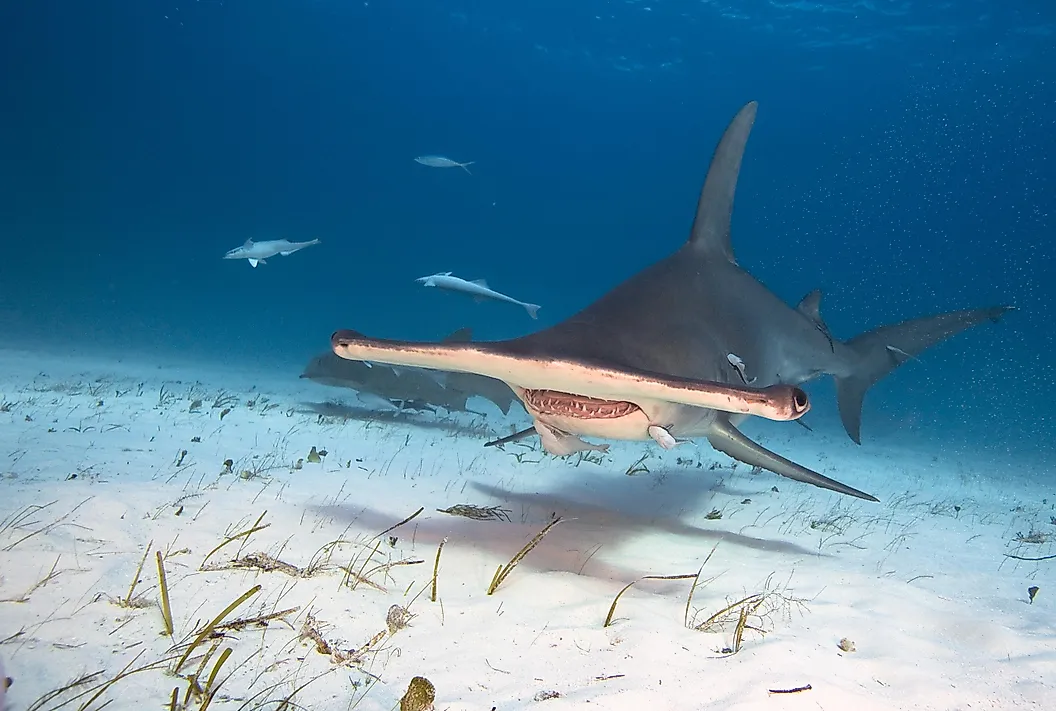
Hammerhead sharks detect electric fields using specialized sensory organs called the ampullae of Lorenzini. All sharks possess these electroreceptors, which allow them to sense the faint electrical signals generated by other animals. The hammerhead's cephalofoil likely enhances this ability by spreading the sensory organs across a wider area than in most other sharks. In some species the shape of the cephalofoil changes with age. Juvenile great hammerheads, for example, have more curved heads that gradually straighten as they mature.
Hammerhead sharks vary greatly in size depending on the species. The smallest is the bonnethead, which typically grows between 2 and 4 feet long, although large individuals may approach 5 feet and weigh around 24 pounds. At the other extreme is the great hammerhead, which averages about 13 feet in length and roughly 500 pounds. Exceptional individuals have measured close to 20 feet, with the IGFA all-tackle record landed off Boca Grande, Florida, in 2006 weighing 1,280 pounds. By comparison, great white sharks generally measure between 11 and 16 feet but can weigh more than 4,000 pounds.
Many hammerhead species have tall, curved dorsal fins and coloration in shades of brown or light gray on the upper body, with a white or cream-colored underside. Great hammerheads typically have 15 to 17 serrated teeth on each side of their upper jaw, with similarly serrated teeth in the lower jaw adapted for grasping prey.
Food
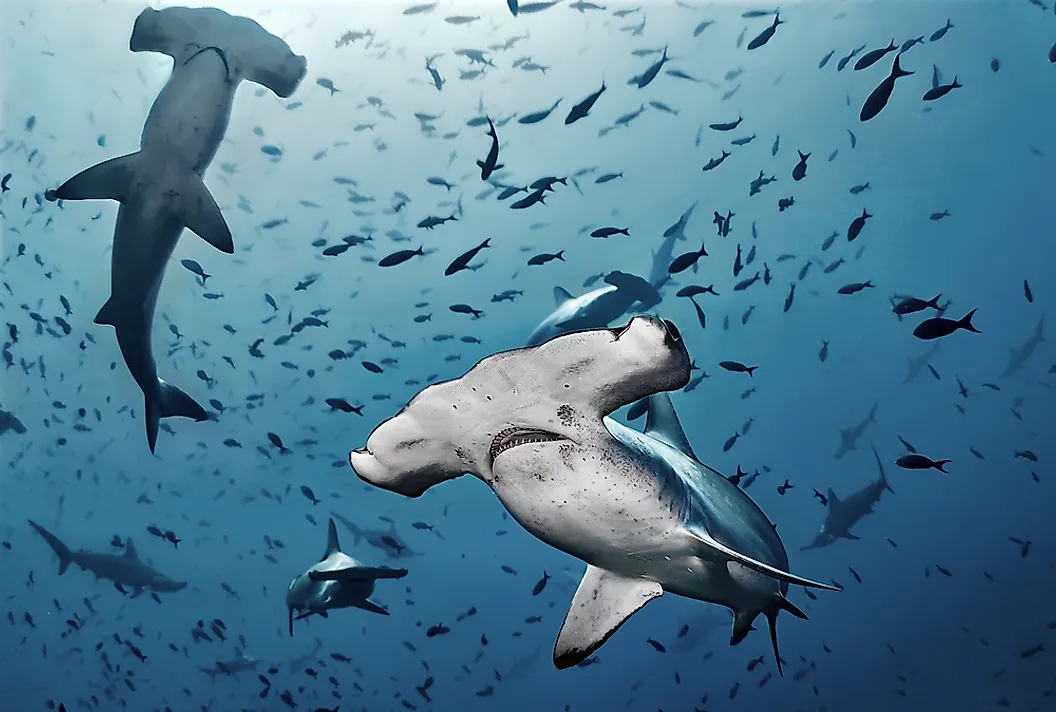
Hammerhead sharks eat a wide variety of marine animals, and one species even consumes plant matter. Winghead sharks, for example, feed on small fish, crustaceans, octopus, and squid found in shallow coastal waters. Great hammerheads target much larger prey including stingrays and other sharks. They are capable of hunting relatively large animals compared with their own body size.
Great hammerheads are especially known for preying on rays and smaller sharks because larger prey provides far more energy than small fish. The strategy lets them feed less frequently while still meeting their energy needs. Bonnethead sharks differ from other hammerhead species because they are omnivores. Alongside crabs, shrimp, and small fish, they also consume seagrass, which can make up more than half of an individual bonnethead's diet. A 2018 study published in Proceedings of the Royal Society B by Samantha Leigh, Yannis Papastamatiou, and Donovan German confirmed that bonnetheads digest seagrass nutrients with measurable efficiency, making them the first scientifically documented omnivorous shark species.

When hammerheads locate prey they can accelerate quickly through the water, with some species estimated to swim at speeds exceeding 20 miles per hour in short bursts. Great hammerheads are known for using their cephalofoil to pin prey against the seafloor before biting it, a technique that is especially effective when hunting stingrays. They are also highly resistant to stingray venom and injuries from barbs, with stingray spines occasionally found embedded in the mouths and jaws of healthy great hammerheads.
Many hammerhead species hunt alone and often become more active at night. Although adult hammerheads have relatively few natural predators, juveniles are vulnerable to larger sharks and even other hammerheads. Larger individuals have occasionally been known to prey on younger members of their own species. Bull sharks and tiger sharks also target juvenile hammerheads. Among marine predators, orcas are one of the few known to hunt adult great hammerheads. In several rare documented incidents, pods of orcas have worked together to attack and kill fully grown hammerhead sharks.
Behavior And Reproduction

Despite often hunting alone, many hammerhead sharks are highly social and travel in schools during migration. Scalloped hammerheads are especially famous for this behavior, with some schools containing hundreds of individuals at known aggregation sites such as the seamounts of the Gulf of California, Cocos Island, and the Galápagos. Females are more commonly found in these large groups than males. Researchers believe hammerheads communicate through body posture and swimming movements that help maintain coordination and protection within the school.
Hammerhead mating behavior varies between species. Some courtship interactions involve prolonged circling and ritualized movements, while others include aggressive biting and grasping during mating. Hammerhead sharks are viviparous, meaning they give birth to live young. Depending on the species, gestation usually lasts between 8 and 12 months. The embryos initially develop from yolk-filled eggs inside the mother before receiving nutrients through a placenta-like connection. Litter sizes vary by species and can range from fewer than 10 pups to more than 40. After birth, the mother provides no parental care. Young hammerheads often remain in shallow nursery habitats until they are large enough to move into deeper waters. The bonnethead has also been documented producing the first scientifically confirmed case of parthenogenesis (asexual reproduction) in a shark, recorded at the Henry Doorly Zoo in Omaha, Nebraska in 2001.
Threats

Several species of hammerhead sharks are considered endangered or threatened by the International Union for Conservation of Nature (IUCN). The great hammerhead and scalloped hammerhead are both listed as critically endangered, the winghead is listed as endangered, and the smooth hammerhead is listed as vulnerable. The global great hammerhead population has declined by more than 80 percent over the past 70 years according to IUCN assessments. Human activity is the primary cause of these population declines. Hammerhead sharks have been heavily targeted in the international shark fin trade because their fins are highly valued for shark fin soup, a dish historically associated with luxury in parts of East Asia. Some hammerheads are also harvested for their meat, liver oil, and skin products.
Humans can also harm hammerhead populations indirectly through overfishing, which reduces prey availability, and through accidental capture as bycatch in commercial fishing gear such as nets and longlines. International trade in all hammerhead species has been regulated under CITES Appendix II since November 2022, requiring exporting countries to certify that the trade will not damage wild populations. Other conservation efforts include restrictions on shark fin sales, improved tracking of vulnerable shark populations, and the identification and protection of important breeding, nursery, and migration habitats from fishing activity.
Hammerhead sharks very rarely attack humans. Although a small number of unprovoked incidents involving hammerheads have been recorded, these encounters are extremely uncommon. Most documented attacks have involved great hammerheads, likely because they are the largest species in the group. In general, hammerheads are not considered especially dangerous to humans and are often described as cautious or inquisitive around scuba divers rather than aggressive.