The Longest Bridges on the Great Lakes
Crossing the Great Lakes system has required some of the most ambitious bridge engineering in North America. The lakes contain twenty percent of the world’s surface freshwater, and major shipping channels carry thousand-foot freighters between ports such as Duluth, Detroit, and Hamilton, making reliable crossings essential for regional trade and transportation.
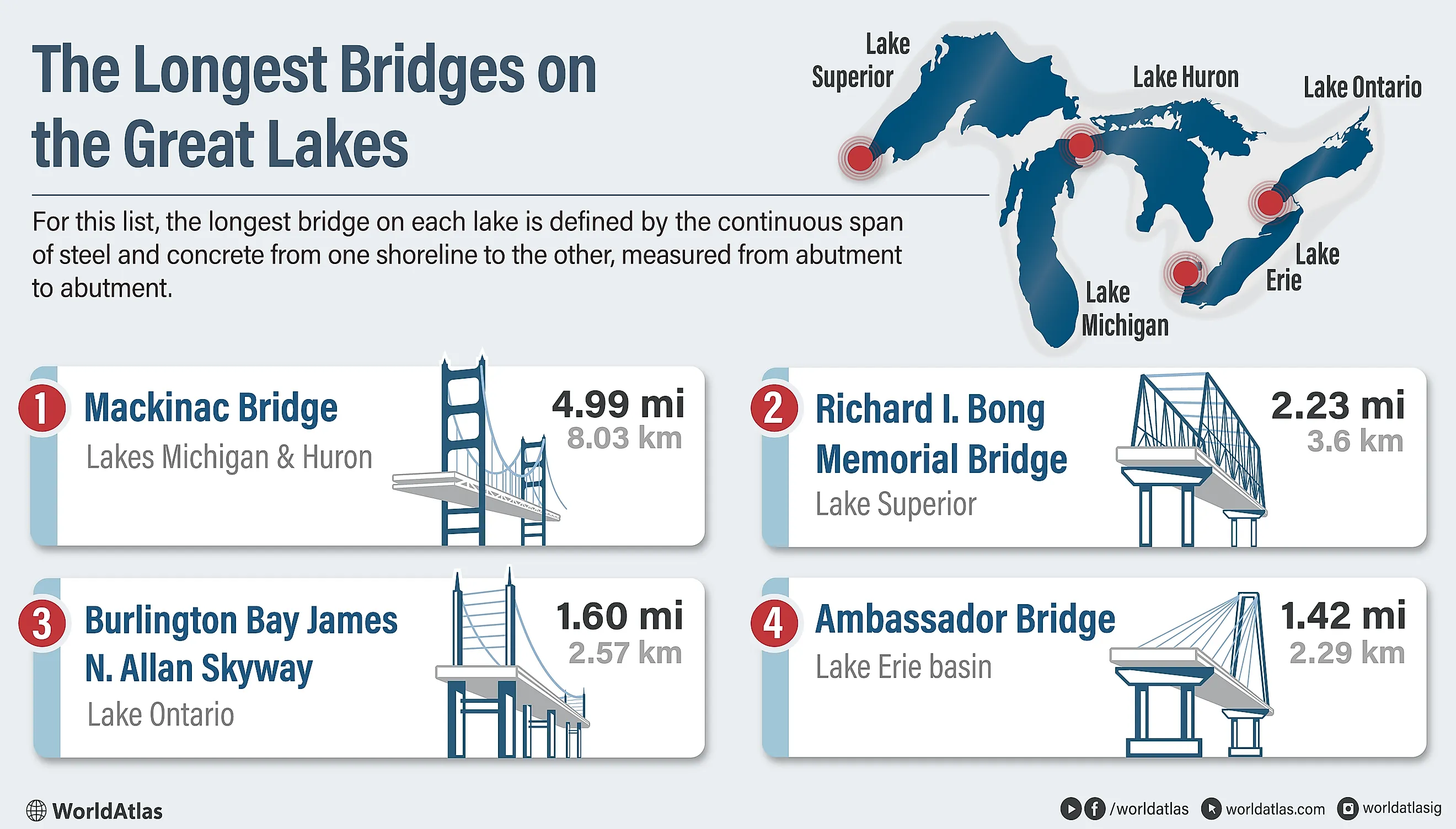
For this list, the longest bridge on each lake is defined by the continuous span of steel and concrete running from one stable shoreline to the other, measured from abutment to abutment. The selections below highlight the longest crossing associated with each of the five lakes: Superior, Michigan, Huron, Erie, and Ontario.
Lakes Michigan and Huron: The Mackinac Bridge

Lake Michigan and Lake Huron (home to the most islands of all the Great Lakes) are joined at the four-mile-wide Straits of Mackinac, sitting at the same elevation and often treated hydrologically as one lake (Lake Michigan-Huron). This gap is bridged by the Mackinac Bridge, which remains the longest suspension bridge in the Western Hemisphere when measured between its cable anchorages. The total length of the crossing reaches 4.99 miles (8.03 km).
The bridge rises nearly 200 feet (61 m) above the water at its center, allowing the massive freighter ships common to these waters to pass underneath without interruption. Driving over the Mackinac Bridge during high winds may mean some vehicles are restricted to about 20 mph. To handle gale-force winds sweeping across the straits, the steel deck can shift as much as 35 feet (10.6 m) to the east or west.
Construction required sinking massive caissons into the lakebed, some reaching depths of 210 feet (64 m) below the surface. The towers stand 552 feet (168 m) above the waves. Unlike smaller river crossings, the “Mighty Mac” utilizes a gridded open-steel deck on its inner lanes. This design choice prevents air pressure from building up under the roadway, which helps stabilize the structure during the intense storms that characterize the junction of these two lakes. Honorable mention: For those seeking a single bridge tied specifically to Lake Michigan, the Hoan Bridge spans the Milwaukee River inlet at the lake’s edge and measures 2 miles (3.2 km).
Lake Superior: The Richard I. Bong Memorial Bridge

Lake Superior is the largest, coldest, and deepest of the five Great Lakes, which helps explain the scale of infrastructure serving its major ports. Bong Memorial Bridge serves as the primary heavy-traffic link across the St. Louis Bay, which drains into Lake Superior. It measures 2.23 miles (3.6 km) in total length.
The bridge consists of a long series of beam approach spans leading to a central tied-arch span. This arch provides a vertical clearance of 120 feet (36.5 m). When viewed from the Wisconsin side, the scale of the approach ramps becomes clear; they gradually elevate traffic over the industrial rail yards that line the harbor.
While the neighboring Aerial Lift Bridge in Duluth is a more frequent subject for photography, the Bong Bridge handles most of the region’s heavy traffic. It replaced an older, lower bascule (draw) that frequently stalled vehicle traffic whenever a ship needed to enter the harbor. By raising the roadway above the water, engineers ensured that truck traffic and the movement of thousand-foot lake vessels could occur simultaneously.
Lake Ontario: The Burlington Bay James N. Allan Skyway

Lake Ontario marks the final step in the Great Lakes system before the water exits through the St. Lawrence River. At the lake's western end, the Burlington Bay Canal separates Lake Ontario from Hamilton Harbour. The Burlington Bay Skyway crosses this gap, carrying one of Ontario's busiest highways. The bridge system consists of two parallel spans, the longest of which is 1.60 miles (2.57 km).
The original span opened in 1958, followed by a second twin span in 1985 to accommodate the volume of the Queen Elizabeth Way. Travelers heading toward Toronto quickly notice the bridge's height (120 feet [36.5 m] above the canal), which allows large ships to reach Hamilton’s industrial harbor. The skyway allows massive ships to move from the open lake into the inner harbor to unload coal and iron ore.
The environment here is corrosive due to the proximity of steel mills and the use of road salt in Ontario winters. Consequently, the bridge undergoes near-constant maintenance. Its design is a high-level steel truss, a common choice for mid-century engineers looking to bridge wide gaps without the complexity of a suspension system.
Lake Erie: The Ambassador Bridge
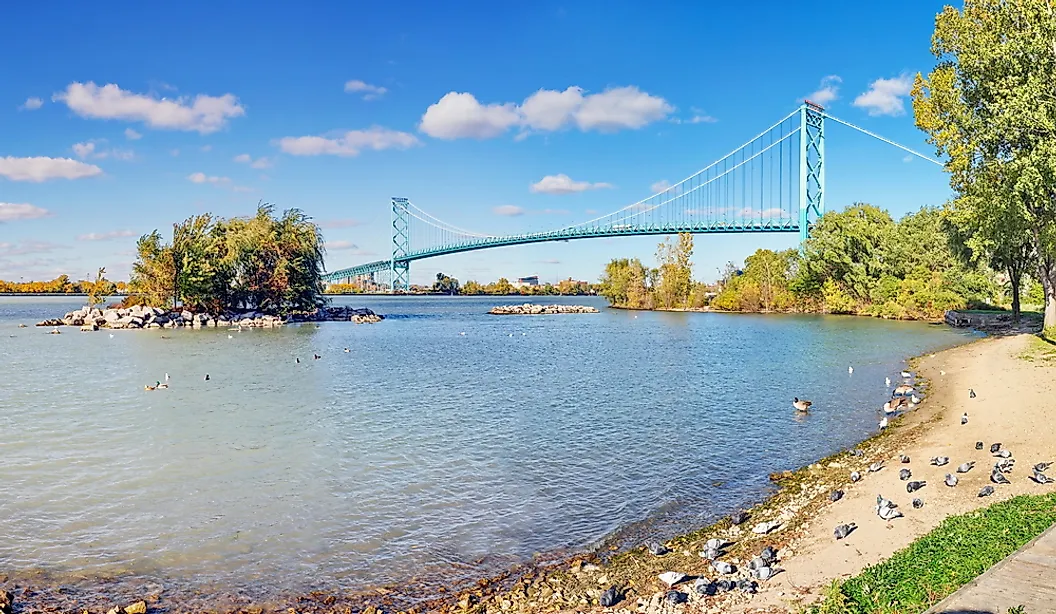
Lake Erie is the shallowest of the five lakes, which often leads to violent wave action during storms. While several bridges span the Niagara and Detroit Rivers, the Ambassador Bridge is one of the most prominent structures connecting the Erie basin. Spanning the Detroit River between Lake St. Clair and Lake Erie, it is 1.42 miles (2.29 km) long.
When it was completed in 1929, its 1,850-foot (564 m) main span was the longest in the world. It remains a privately owned piece of infrastructure and a critical node for the automotive industry. The bridge’s towers are 386 feet (118 m) tall, supporting a suspension system that carries four lanes of traffic.
The bridge sits at a strategic point where the water narrows before emptying into the western basin of Lake Erie. From downtown Detroit, the span dominates the skyline as trucks and cross-border traffic move continuously between Michigan and Ontario. Its height ensures that even Seawaymax-size ocean-going vessels can navigate from the Atlantic through the Welland Canal and into the upper lakes. Despite its age, it remains the primary conduit for roughly a quarter of all merchandise trade between the United States and Canada.
The Great Lakes Giants

The physical demands of the Great Lakes help explain the variety of structures seen across the system. The Mackinac Bridge must endure the massive ice floes that jam the straits in February, while the Ambassador Bridge must manage the weight of thousands of heavy freight trucks every hour. The Mackinac Bridge remains the outlier in terms of scale. Its length is more than double that of the next longest bridge on the list. This is due to the geography of the Straits, where the water is not only wide but the geological shelf drops off deeply, requiring a suspension design that can span the central chasm without placing piers in the deepest sections of the channel.
In contrast, the Richard I. Bong Bridge in Superior utilizes a long series of shorter concrete spans. This is a more cost-effective method when the water is relatively shallow across a wide area, as it allows engineers to plant many support columns directly into the bay floor.
The Burlington Skyway and the Ambassador Bridge represent different eras of transit. The Ambassador Bridge was a product of the roaring twenties, built with an eye toward grand architectural presence and record-breaking statistics. The Burlington Skyway is a utilitarian response to the post-war explosion in car ownership, designed to move high volumes of traffic through an industrial zone.
Each structure marks a former choke point where geography once forced ferries, detours, or seasonal isolation. Today, they are the silent anchors of the regional economy, holding steady against the heavy winds and shifting ice of the North American interior.