The Great Lakes by Depth
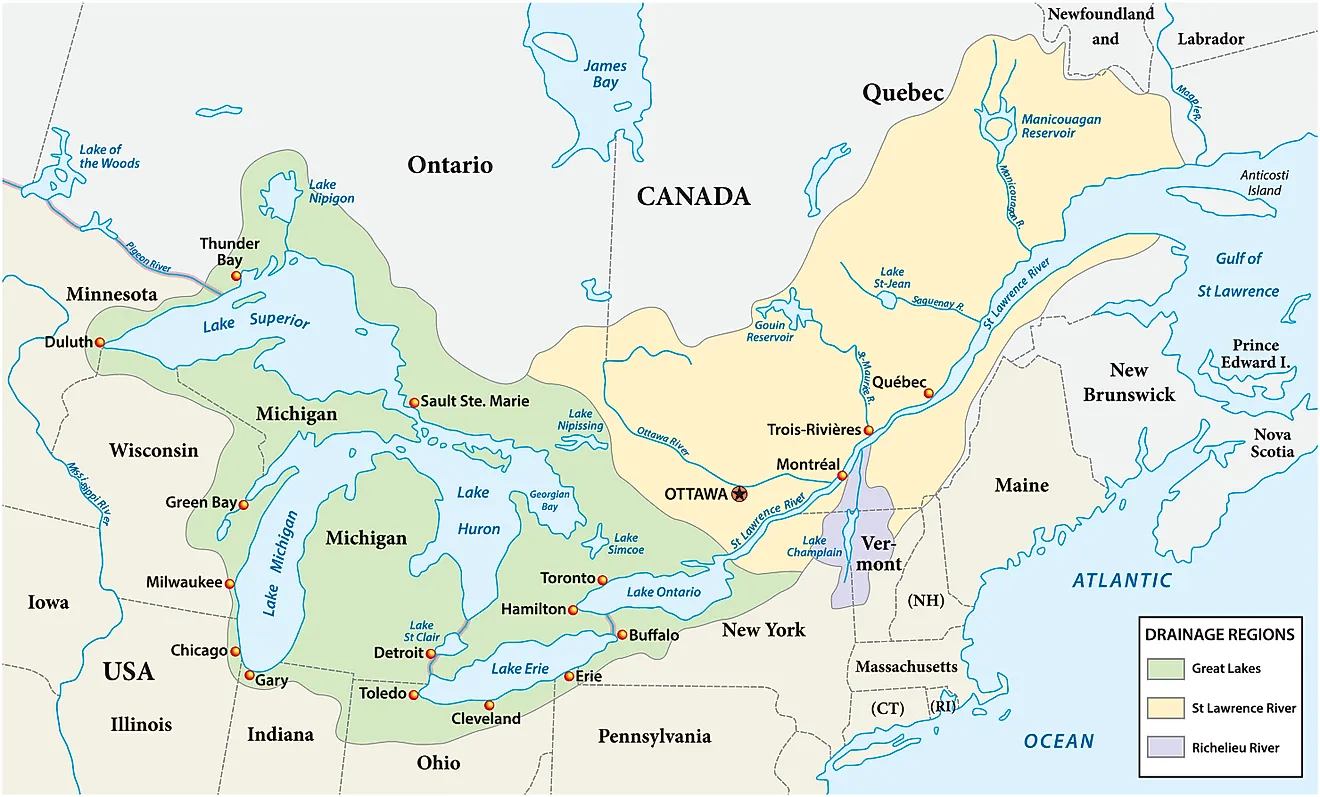
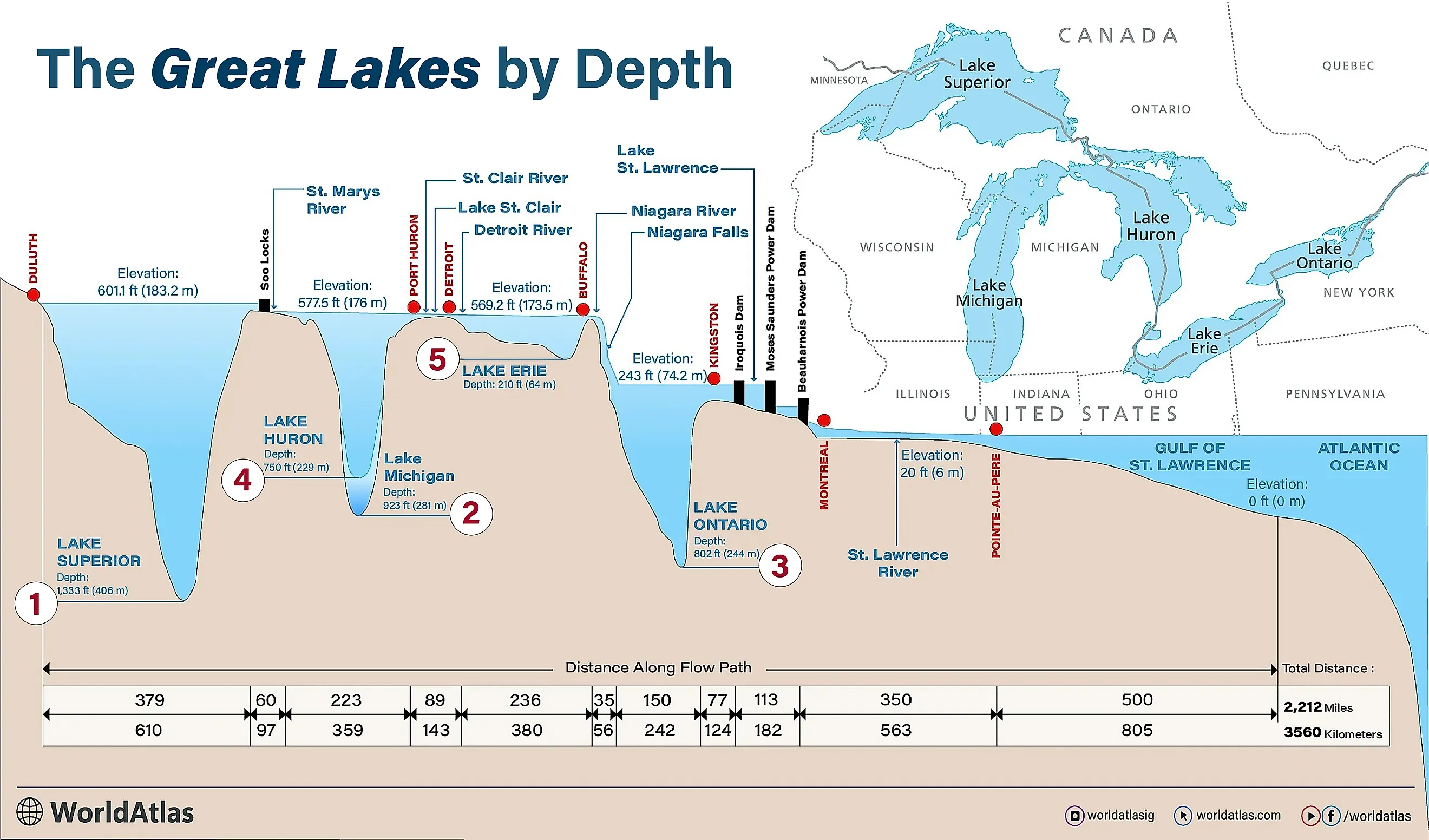
Measured by depth rather than size, the Great Lakes reveal a completely different hierarchy of power. By maximum depth, Lake Superior is deepest at 1,333 ft (406 m), followed by Lake Michigan at 925 ft (282 m), Lake Ontario at 802 ft (244 m), Lake Huron at 751 ft (229 m), and Lake Erie at 210 ft (64 m).
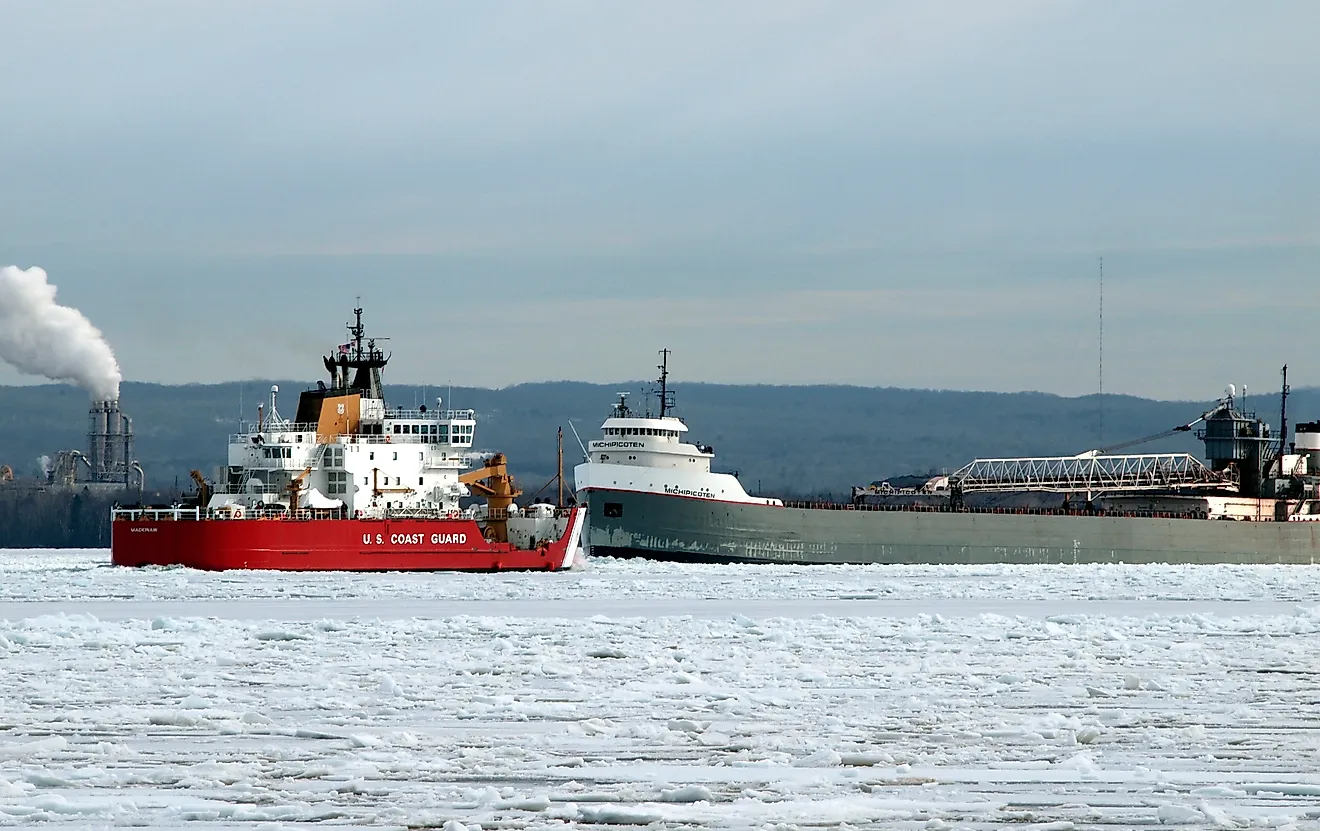
Depth transforms each lake's behavior. Superior's immense basins lock in cold water for nearly two centuries, fueling ocean-scale storms and preserving pollutants for generations. Michigan and Huron form a single, hydraulically joined giant, reshaping currents and fish migrations across the basin. Compact Ontario holds more water than sprawling, shallow Erie, whose quick 2.6-year turnover makes it both biologically productive and highly vulnerable to algal blooms and nutrient surges.
Seen through depth, the Great Lakes become a chain of distinct inland seas, each with its own climate influence, ecological risks, and economic role, from Superior's ship-swallowing trenches to Erie's warm, stormy, heavily used shallows.
The Great Lakes Ranked By Depth
| Rank | Lake | Max Depth | U.S. States Bordered |
|---|---|---|---|
| 1 | Lake Superior | 1,333 ft (406 m) | Minnesota, Wisconsin, Michigan |
| 2 | Lake Michigan | 925 ft (282 m) | Michigan, Wisconsin, Illinois, Indiana |
| 3 | Lake Ontario | 802 ft (244 m) | New York |
| 4 | Lake Huron | 751 ft (229 m) | Michigan |
| 5 | Lake Erie | 210 ft (64 m) | Michigan, Ohio, Pennsylvania, New York |
1. Lake Superior

Lake Superior is the deepest and largest of the Great Lakes, plunging to a maximum depth of 1,333 feet (406 m) in trench-like basins off its southeastern shore. Averaging 483 feet deep, this immense glacial lake holds 10 percent of the world's surface freshwater, its cold, dimictic waters mixing fully only twice a year. Superior's vast volume gives it a residence time of about 191 years and fuels powerful storms that can build waves over 30 feet high. Fed by more than 200 rivers, it drains through the St. Marys River toward Lake Huron and the Atlantic in eastern Canada.
2. Lake Michigan

Lake Michigan is the second-deepest of the Great Lakes, reaching a maximum depth of 923 feet (281 m) in the northern Chippewa Basin and averaging 279 feet (85 m) in depth. A glacially carved basin hydrologically connected to Lake Huron through the Straits of Mackinac, it contributes to the formation of the world's largest freshwater lake by surface area. Michigan holds about 1,183 cubic miles (4,930 km³) of water, with a residence time of roughly 99 years. It is the only Great Lake entirely within the United States, bordered by Wisconsin, Illinois, Indiana, and Michigan, and lined with extensive sand dunes, major ports, and busy industrial shorelines.
3. Lake Ontario

Lake Ontario is the easternmost and second-deepest of the Great Lakes, reaching 802 feet (244 m) in the Rochester Basin and averaging 283 feet. Although it has the smallest surface area, it holds more water than Lake Erie, with a volume of about 1,631 km³ and a residence time of six years. Fed mainly by the Niagara River and drained by the St. Lawrence River, Ontario is the chain's final outlet to the Atlantic. Steep depth gradients, lake-effect snow, productive wetlands, and algal blooms reflect the tension between its ecological richness and heavy urban and industrial pressure.
4. Lake Huron

Lake Huron is the fourth-deepest of the Great Lakes, reaching a maximum depth of 750 feet (229 m) and averaging 195 feet (59 m). Though slightly shallower than Michigan and Ontario, it is the second-largest by surface area and forms the eastern lobe of the hydrologically unified Lake Michigan-Huron system. Fed mainly by the St. Marys River and draining to Lake Erie via the St. Clair River, Huron holds about 3,521 km³ of water with a 22-year residence time. Its famously intricate shoreline, over 30,000 islands, including Manitoulin, hosts rich but heavily altered ecosystems and hundreds of historic shipwrecks.
5. Lake Erie

Lake Erie is the shallowest of the Great Lakes and last in a ranking by depth, with an average depth of just 62 feet (19 m) and a maximum of 210 feet (64 m), the only Great Lake whose deepest point lies above sea level. Fed by the Detroit River and draining over Niagara Falls toward Lake Ontario, it has the system's shortest residence time at 2.6 years. Erie's shallowness makes it the warmest and first to freeze, but also leaves it highly vulnerable to pollution, toxic algal blooms, and invasive species along its densely populated shores and heavily used fisheries.
Viewed through depth, the Great Lakes stop being five familiar silhouettes on a map and become a connected engine of climate, commerce, and ecological risk. Superior's century-scale memory, Ontario's outlet role, Huron-Michigan's shared basin, and Erie’s hyper-reactive shallows show why volume and residence time matter as much as shoreline.