How Many Islands Are There in the Great Lakes?
Scattered across North America's inland seas, the Great Lakes, are about 35,000 islands, enough to make the Great Lakes feel like an ocean of hidden shorelines.
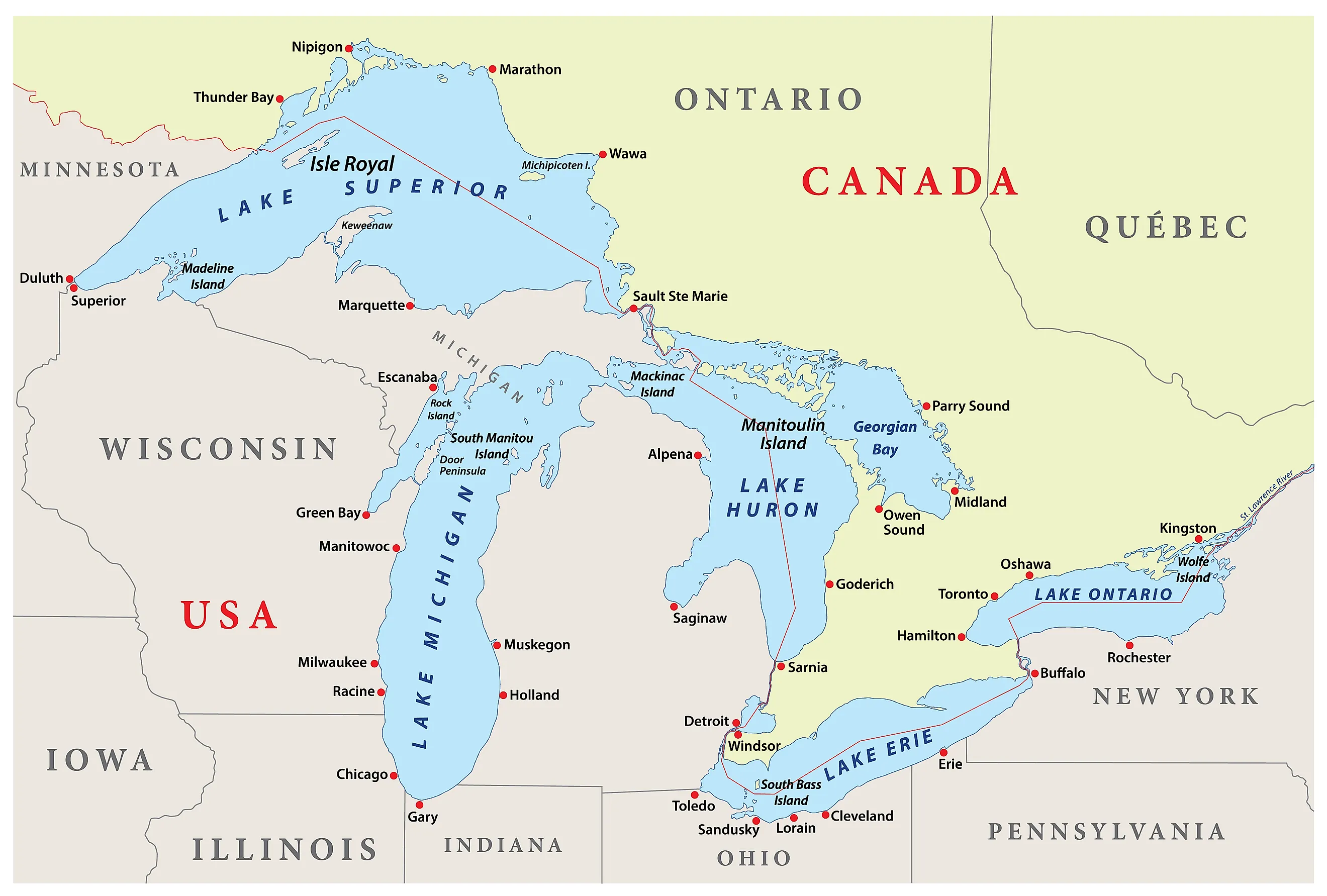
Most of them cluster in Lake Huron, where Georgian Bay and the North Channel contain 30,000-plus islands, while Lake Erie has the fewest, with only a few dozen.
The range is dramatic: Manitoulin Island (Lake Huron) is the world's largest freshwater island and the region's most populated, with roughly 13,000 residents, yet the same waters are dotted with tiny outcrops, some under an acre, like Dollar Island in Michigan's Les Cheneaux chain.
There are some resort favorites like Mackinac and South Bass but also other remote, unnamed rocks, and together, the islands reveal the Great Lakes at every scale, hinting at their icy origins, too.
Lake Huron Islands

Lake Huron has the most islands of any Great Lake, with an estimated 30,000-plus scattered across its expansive waters, especially in Georgian Bay and the North Channel. The crown jewel is Manitoulin Island, located in Ontario. At over 1,000 square miles, it's the largest freshwater island in the world and home to around 13,000 residents. Manitoulin is unique in that it contains more than 100 inland lakes, some of which have islands of their own, making it an island in a lake with a lake that has islands!
Other major islands include Drummond Island in Michigan, with about 1,000 residents, known for its rugged limestone terrain and off-roading trails.

Mackinac Island, though much smaller, is among the most famous: car-free and rich in Victorian-era charm, it draws hundreds of thousands of visitors each year. In Georgian Bay, Ontario's Thirty Thousand Islands form one of the world's largest freshwater archipelagos, filled with tiny islets, summer cottages, and windswept pines.
Some islands, like Cockburn Island, have minimal or no year-round population, offering a glimpse into Lake Huron's wilder side.
Lake Superior Islands

Lake Superior, the largest and deepest of the Great Lakes, is home to a varied collection of islands shaped by ice, wind, and water over thousands of years, around 400 in total by most estimates. Its most famous island is Isle Royale, a vast, roadless wilderness covering over 200 square miles. Located in U.S. waters near the Canadian border, it's the largest island in Lake Superior and the second-largest island in the Great Lakes, after Manitoulin Island in Lake Huron. Though uninhabited year-round, Isle Royale is a national park known for moose and wolves, drawing thousands of backcountry campers each summer.

In contrast, Madeline Island, the largest of Wisconsin's Apostle Islands, is the only one in that chain with permanent residents (around 300) and vehicle access via ferry to La Pointe.
While Madeline Island is the most populated, most of Lake Superior's islands are uninhabited. Caribou Island, a remote outpost in Canadian waters, has no residents and is known for its treacherous reefs and shipwrecks. Many smaller islets, such as Devils Island and Stockton Island, are part of the Apostle Islands National Lakeshore, famous for sandstone sea caves and old-growth forests. Others, like Michipicoten Island in Ontario, are shrouded in mist and mystery. Together, these islands reflect Lake Superior's scale, solitude, and rugged beauty.
Lake Michigan Islands

Lake Michigan's islands are fewer in number than those in Lake Huron or Superior, with an estimated 100 islands scattered across its waters. The most famous is Beaver Island, the largest island in the lake and home to around 600 year-round residents. Located off the coast of northern Michigan, it once hosted a 19th-century Mormon kingdom and now offers forests, beaches, and a small-town atmosphere. Nearby, the North and South Manitou Islands, part of Sleeping Bear Dunes National Lakeshore, are uninhabited today but were once home to farming communities and logging towns. They now attract campers and hikers seeking quiet and wilderness.

In Wisconsin waters, Washington Island lies northeast of Door County and is the lake's most populated island, with about 700 residents. It's accessible by ferry and known for its lavender fields, Scandinavian heritage, and the striking nearby Rock Island, a state park with no vehicles or permanent population. Many smaller islets dot the northern end of the lake, including the Fox Islands and Gravel Island, a protected bird sanctuary off-limits to visitors.
Lake Ontario Islands

Lake Ontario has relatively few islands compared with Lake Huron's sprawling archipelagos, with roughly 100 in the lake itself, but they're rich in cultural, ecological, and recreational value. The most famous cluster is the Thousand Islands, a sprawling archipelago of over 1,800 islands along the St. Lawrence River where it leaves Lake Ontario. These range from forested islets to rocky outcrops barely large enough for a tree, with the largest, Wolfe Island, covering over 45 square miles and home to about 1,400 residents. Other notable inhabited islands include Howe Island and Amherst Island, known for their rural charm and birdwatching.
On the U.S. side, Carleton Island once hosted a British fort and now holds private homes and ruins. Some islands, like Galloo and Main Duck Island, are remote and uninhabited, offering refuge for migratory birds. Near urban centers, Toronto's Toronto Islands form a chain of 15 small islands just offshore, popular for beaches, biking, and skyline views. They have a small residential community and no cars, creating a peaceful escape from the city.
Lake Erie Islands

Lake Erie has the fewest islands of the Great Lakes, only about 50 by most estimates, but its compact group, mostly clustered in the western basin, packs a surprising mix of history, tourism, and biodiversity.
The most famous is South Bass Island, home to the lively village of Put-in-Bay, Ohio. Though only about 2.5 square miles, it hosts thousands of visitors each summer, drawn by waterfront bars, family attractions, and the towering Perry's Victory and International Peace Memorial. Nearby Middle Bass Island offers a quieter retreat, while North Bass Island remains largely undeveloped, with limited access and fewer than a dozen residents.
Kelleys Island, the largest U.S. island in Lake Erie, is known for its beaches, hiking trails, and the impressive glacial grooves carved into its limestone bedrock. It has a small year-round population but swells with vacationers in warmer months. On the Canadian side, Pelee Island is the largest island in the lake overall and the southernmost inhabited place in Canada, known for its vineyards, marshes, and birdwatching.