How Asian Carp Are Changing the Great Lakes Ecosystem
Asian carp, now known as Invasive carp, refers to a group of invasive fish species, in particular the Silver, Bighead, Grass, and Black carp. These species are aggressive in their migration towards the Great Lakes, and if they invade the world’s largest freshwater system, the consequences will be catastrophic. Invasive carp have already destroyed native fish populations in several water bodies, largely due to their size and because they reproduce quickly. They also consume vast amounts of plankton, which happens to be the diet of native fish as well. Bighead and silver carp have already infiltrated the Illinois River. The river connects the Mississippi River to Lake Michigan, allowing carp to reach all the Great Lakes.
The Start of the Carp Invasion

The carp invasion started with the best of intentions. All four invasive carp species were imported to North America in the 1970s in the hope that they would eradicate algal blooms in wastewater treatment plants and ponds. What could not be foreseen at the time was that the carp would escape confinement within just ten years during a flooding event, infiltrating the waters of the Missouri and Illinois Rivers as well as the Mississippi River basin over time. While three of the invasive carp species have not reached the Great Lakes yet, there is a very real possibility that they will, despite all efforts to prevent this from happening. As things stand, invasive carp are already the most significant ecological threat in the Midwest. If the invasion spills over the Great Lakes, tourism will suffer, costing jobs and commerce, and even worse, some native fish species could disappear forever, including lake whitefish, yellow perch, and walleye.
Four Dangerous Threats

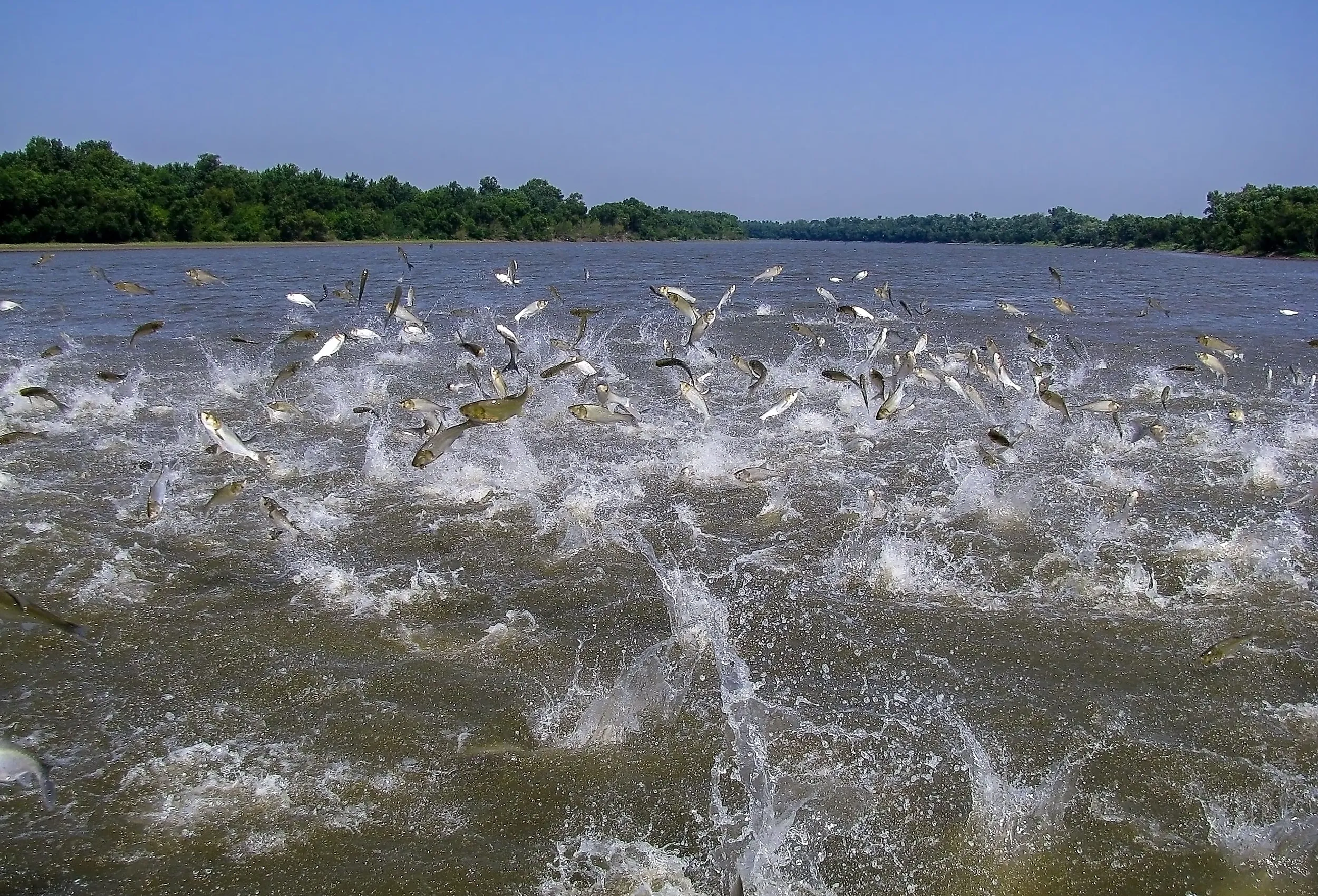
Scientists have confirmed that each of the four main invasive carp species has the potential to destroy native ecosystems and cause problems for fishermen and boats. The silver carp (Hypophthalmichthys molitrix) is sensitive to low-frequency vibrations, including those that come from boat propellers. When they experience these vibrations, they tend to ‘flee’ out of the water, which is essentially a knee-jerk response that causes them to launch up to 10 feet from the water surface. Considering that they can weigh up to 40 kilograms, they can cause major hazards when they are ‘flying’ in the air, especially since they have been known to collide with boaters and water-skiers.
The bighead carp (Hypophthalmichthys nobilis) consumes massive amounts of food. This fish features a giant head and a mouth without teeth that can strain large amounts of food in one go. A bighead carp can become up to 1.5 meters long and weigh as much as 80 pounds, so it continuously filters the water for plankton to keep itself fed. At the same time, it deprives native fish of the food they need to survive.
Grass carp (Ctenopharyngodon idella) feeds on aquatic vegetation and can consume between 40% to 300% of their body weight in greenery every day. This destroys wetlands and grass beds where native fish hide from predators and lay their eggs. Grass carp also digest only about half of the vast amounts of greenery they eat, expelling the rest as waste, which leads to the proliferation of toxic algae.

Lastly, the black carp (Mylopharyngodon piceus) is the biggest threat, especially to the Great Lakes. They feed on snails and mussels, which will become a massive problem for the native mussel populations in the Great Lakes if the black carp ends up in these waters. Mussels are the natural filters of lakes, and if they are destroyed, it would mean poorer water quality immediately.
Damage Already Done

At the moment, silver and bighead carp are still confined to the river systems, with grass carp being confirmed as having a small presence in one of the Great Lakes. Grass carp have already been observed doing damage in Lake Erie, but no other varieties have been seen establishing themselves as yet. Grass carp are also spawning in three tributaries of Lake Erie, namely, the Sandusky River, the Maumee River, and the Huron River. This species is already changing the geography of Lake Erie’s western basin by stripping the underwater greenery and destroying the food sources of the native yellow perch and northern pike. In the Chicago Area Waterway System, silver and bighead carp make up 90% of the total fish weight, creating a biological ‘pressure.’
What An Invasion Would Look Like for Each Lake

If the worst should happen and a full-scale invasion reaches the Great Lakes, each lake would not be affected equally. For one, Lake Erie would be affected the most, not only because grass carp have already damaged its ecosystem, but because it is the shallowest and warmest of the Great Lakes. This means sunlight reaches the bottom of the lake easily, creating more of the plankton carp love. If the other species reach Lake Erie, especially the plankton-eating ones, it could wipe out the famous $1 billion walleye fishery.
If the carp reach Lake Michigan, they will have more than enough food to survive, causing ecosystem damage. Lake Huron is considered a moderate threat, but it is also a back door for carp to enter all the lakes. Lake Ontario and Lake Superior are low risk, with Ontario being far from the current front and Superior supporting a harsh environment that is not conducive to carp populations. That said, it does not mean that invasive carp cannot still do some damage.
The Battle Continues

Well aware of these threats, scientists are doing everything they can to stop the surge of carp from reaching the Great Lakes. Considering that these fish can survive in different environments and live for decades, harsh measures are more than necessary at this point. To prevent damage and keep the other three carp species out, officials are constantly promoting more fishing. Fishing tournaments encourage silver carp fishing, with boats taking to the Illinois River and anglers trying to catch the carp as they leap into the air. Midwest restaurant owners are also trying to add more carp to their menus to increase demand for carp fishing. Other measures include electric barriers that temporarily paralyze carp, sending them in the opposite direction from the lakes. Unfortunately, these barriers also affect native fish, so it is not the best option, even if it is effective in preventing carp from moving upstream.
Scientists have also invented so-called bubble walls, which basically means that a pipe at the bottom of a waterway shoots out bubbles, blocking the fish’s line of sight. They are also trying to use underwater speakers to make unpleasant noises and so prevent the carp from moving past a certain point. To ensure all bases are covered, scientists have also promised rewards and payments to inventors who develop new ways to keep invasive carp out of the Great Lakes.
Government Efforts to Protect the Great Lakes
The U.S. government is also working to protect the Great Lakes from a carp invasion. One of the most elaborate efforts is a $1.15 billion Chicago-area river barrier that would help in preventing carp from reaching any of the lakes. The barrier is under construction, but there are political issues that may halt the project indefinitely.
A Stand-Off That Could Prove Devastating
The Brandon Road Interbasin barrier project could make a huge difference, but it is stalled at the moment. At the same time, grass carp continue to spawn in Lake Erie, and by the time the barrier is built, it may be too late to protect the $7 billion ecosystem. These lakes hold 21% of the world’s surface freshwater, which means we cannot afford for them to be damaged or, worse, to lose them. The future of these lakes depends on how strong the combined efforts are to stay one step ahead of a very smart natural invader.