Why Lake Michigan and Lake Huron Are Technically One Lake
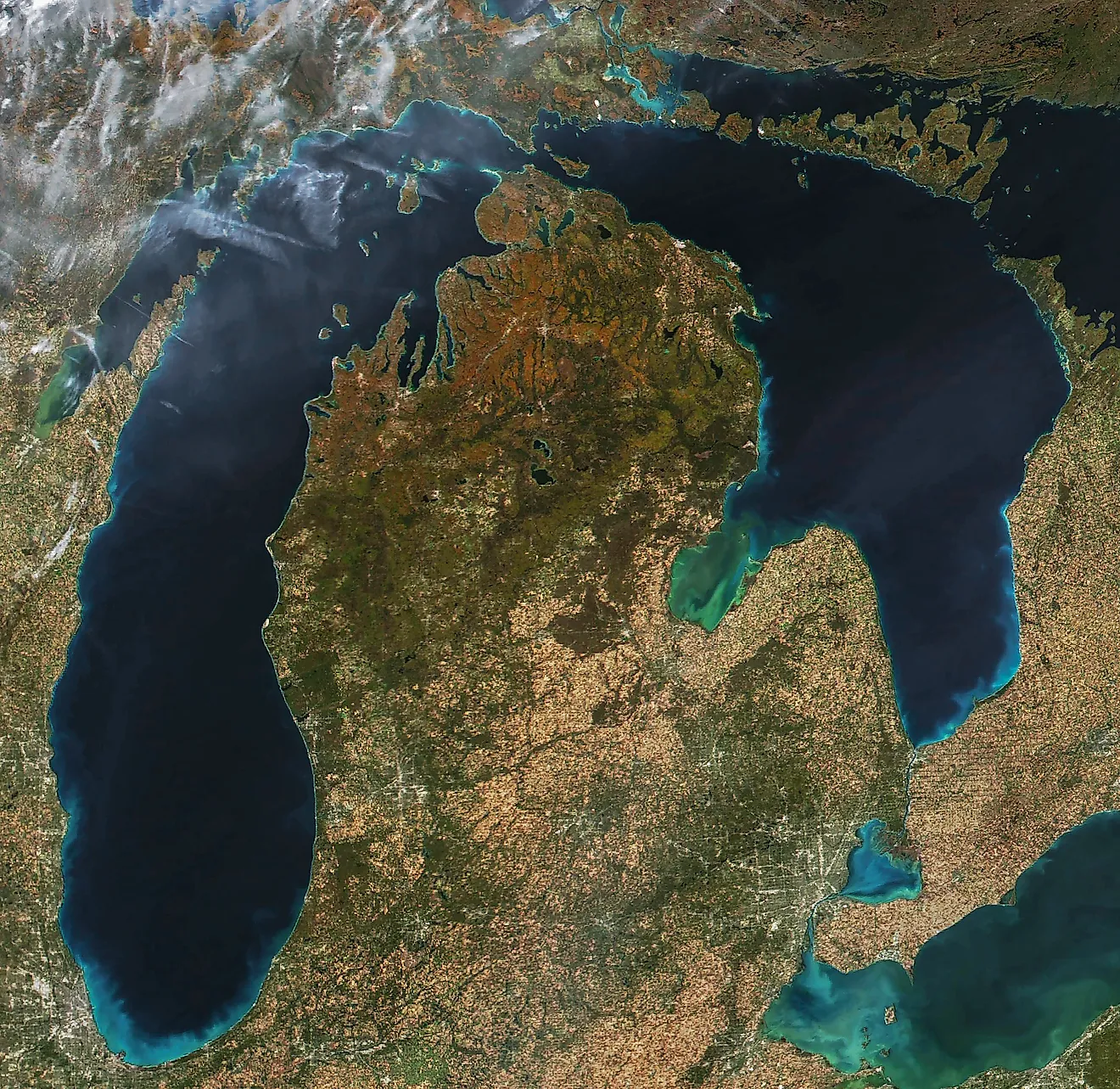
We are taught that there are five Great Lakes. But hydrologically speaking, Lake Michigan and Lake Huron are a single body of water. They're at the same elevation, connect to each other via the Straits of Mackinac, and their water levels are at equilibrium.
Like other geographic groupings, such as the number of continents or oceans, definitions are not always universally understood, especially between laypeople and the specialists who study such groupings. In the case of lakes Michigan and Huron, their status as separate lakes is due to a combination of historical convention and geographic and political boundaries. But the fact remains that these two world-famous lakes are really just one: Lake Michigan-Huron.
Comparisons

Considered as separate lakes and measured by surface area, Huron and Michigan are the third- and fourth-largest freshwater lakes in the world, respectively. (Lake Michigan is also considered to be the largest lake contained entirely within the United States.) Most sources list Lake Superior (31,700 square miles; 82,100 square kilometers) as the world's largest freshwater lake. (Lake Victoria in East-Central Africa is second at about 26,828 square miles; 69,470 square kilometers.) By comparison, Lake Huron's surface areas is 23,010 square miles (59,600 square kilometers); Lake Michigan's is 22,300 square miles (57,700 square kilometers). As a single body of water, however, the surface area of Lake Michigan-Huron (45,310 square miles; 117,300 square kilometers) makes it the largest freshwater lake in the world.

The Caspian Sea in Central Eurasia is often described as the world's largest lake (149,200 square miles; 386,400 square kilometers), but its water is brackish, with a salinity about one-third that of the world’s oceans. Lake Baikal in southern Siberia is the deepest lake in the world; it also has the highest volume of water. However, it's smaller in surface area (12,248 square miles; 31,730 square kilometers) than lakes Superior, Huron, and Michigan.
Past and Present

Lakes Huron and Michigan were charted and named during the European colonization of North America. Due to their size, settlement patterns, and the narrow straits separating them, it was thought they were two distinct lakes. However, from the point-of-view of limnologists — scientists who study inland aquatic ecosystems — Huron and Michigan are in fact one lake, commonly called Lake Michigan-Huron.
Increasingly, maps, encyclopedias, atlases, and scientific bodies, including the National Oceanic and Atmospheric Administration (NOAA) and the US Army Corps of Engineers, refer to Lake Michigan-Huron as a single hydrological body — a single bowl of water with two basins. A shift to designating this body of water as a single lake in popular culture is unlikely, but it would be significant; it would change world perception, especially among people who live and/or recreate along or near its shoreline.

There are also international implications because Lake Michigan is completely inside the United States, while a single Lake Michigan-Huron would be shared with Canada. There are additional considerations, including the ways in which the lakes are studied and how cleanup efforts and scientific initiatives would be funded and administered.
Historically and Culturally Distinct Lakes

For cultural and historical reasons, Lake Huron and Lake Michigan have traditionally been considered separate and distinct lakes. When European explorers came to the Great Lakes region, they set about mapping and naming the lakes. At the time, cartographers saw the lakes as separate, given their size and the fact that both Huron and Michigan appeared to be self-contained bodies of water. It's possible that the early explorers had no way of identifying the two as one lake through direct observation alone.
Both Huron and Michigan occupy separate basin depressions, giving the appearance of two lakes. There are also shoreline distinctions and different depths, giving the impression that they are separate. Since the first mapping and naming of the Great Lakes, it has been conventional wisdom that there are five lakes, as most of us learn in school. Culturally, and through habit, people think of them as two lakes.
How The Great Lakes Are Connected

The Great Lakes as a whole represent the largest freshwater system on Earth by surface area. The lakes are linked through various straits, rivers, and canals, with water flowing from Lake Superior eastward to Lake Ontario, and then into the Atlantic Ocean. Specifically, Lake Superior is connected to Lake Huron through the St. Marys River. Lakes Huron and Michigan are connected through the Straits of Mackinac. Lake Huron is also connected to Lake Erie by way of the St. Clair River, Lake St. Clair, and the Detroit River.

Lake Erie connects to Lake Ontario through the Niagara River, including Niagara Falls, and the manmade Welland Canal. Finally, water flows naturally from Lake Ontario into the St. Lawrence River, which carries it to the Atlantic Ocean; the St. Lawrence Seaway is the navigational system of canals and locks built along this route.
The connection of the Great Lakes is significant, as they are separate lakes with distinct basins, yet they are part of a vast water system connecting Ontario and the Great Lakes states to the ocean. If considering Huron and Michigan as one lake, Lake Michigan is indirectly connected to Lake Erie through Lake Huron. Otherwise, Lake Michigan’s primary outlet is Lake Huron, with no other direct connection to the Great Lakes chain. (Although to be completely accurate, it is linked to the Mississippi River basin via the manmade Chicago Sanitary and Ship Canal.)
One Lake: Lake Michigan-Huron

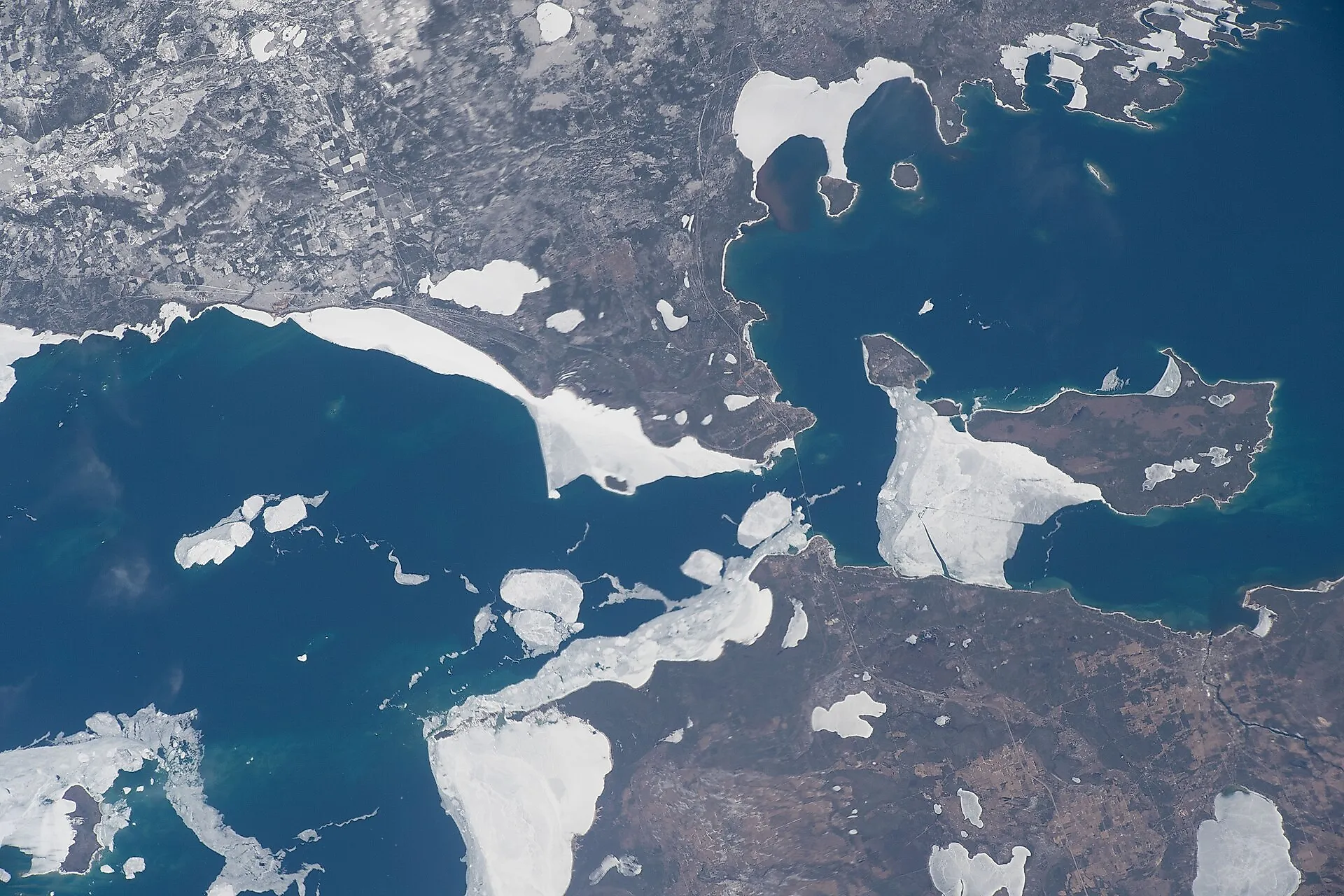
As mentioned, hydrologically speaking, Lake Michigan and Lake Huron are considered one lake. The name Lake Michigan-Huron is the most common name used, although Lake Huron-Michigan is used, as well. The two bodies of water, called basins or lobes, are connected by the Straits of Mackinac, which are about 3.5 miles wide (5.6 kilometers) at the main channel and reach a maximum depth of about 295 feet (90 meters). Because of the distinct basin depressions and the link through the strait, the lakes appear separate, but they're actually at the same elevation (577 feet; 176 meters). The water levels of both Michigan and Huron rise and fall together, with the flow between often changing direction across the straits.

This is different than the typical lake drainage effect, which is unidirectional, as when Lake Erie drains into Lake Ontario via the Niagara River. The two basins behave as one body of water, and the connection through the Straits of Mackinac keeps them at equilibrium. The identical levels of the two basins are a key scientific factor when defining Michigan and Huron as a single body of water. The bidirectional flow of water between the two basins, along with their equal surface elevations, means that hydrologically they function as a single interconnected system.
The classification of any geographic formations has everything to do with historic precedent, local cultural norms, geological considerations, and other scientific and cultural criteria. Mount Everest is also known in Tibet as Chomolungma ("Goddess Mother of the World"), while in Nepal it is Sagarmatha ("Forehead of the Sky"). Before receiving its English name, the mountain was referred to as Peak XV. None of these is incorrect; they just represent a particular point-of-view. Tradition and naming conventions treat Lake Michigan and Lake Huron as two separate lakes, while hydrology recognizes them as a single, interconnected body of water.