The Best Preserved Shipwrecks In The Great Lakes
With official estimates ranging from 6,000 to 10,000 wrecks in total, the Great Lakes have long been considered a tough waterway to navigate, especially in times past when large vessels were still made primarily of wood. A vital route for trade and transportation, their often cold and deep waters, spanning from the southern end of Lake Michigan to the head of the Saint Lawrence River at Lake Ontario, have been the site of countless historic events, from naval battles to the development of some of Canada's and the United States' greatest cities. There have even been several pieces of popular media based on shipwrecks, with The Wreck of the Edmund Fitzgerald, a song by Gordon Lightfoot, perhaps the most enduring and haunting to this day.
While many of the sinkings that have happened on these mighty freshwater seas have either deteriorated beyond recognition or been completely lost to the sands of time, some have managed to stay remarkably preserved. Dive in and learn about the best preserved shipwrecks found across all five of the Great Lakes.
Sweepstakes, Lake Huron

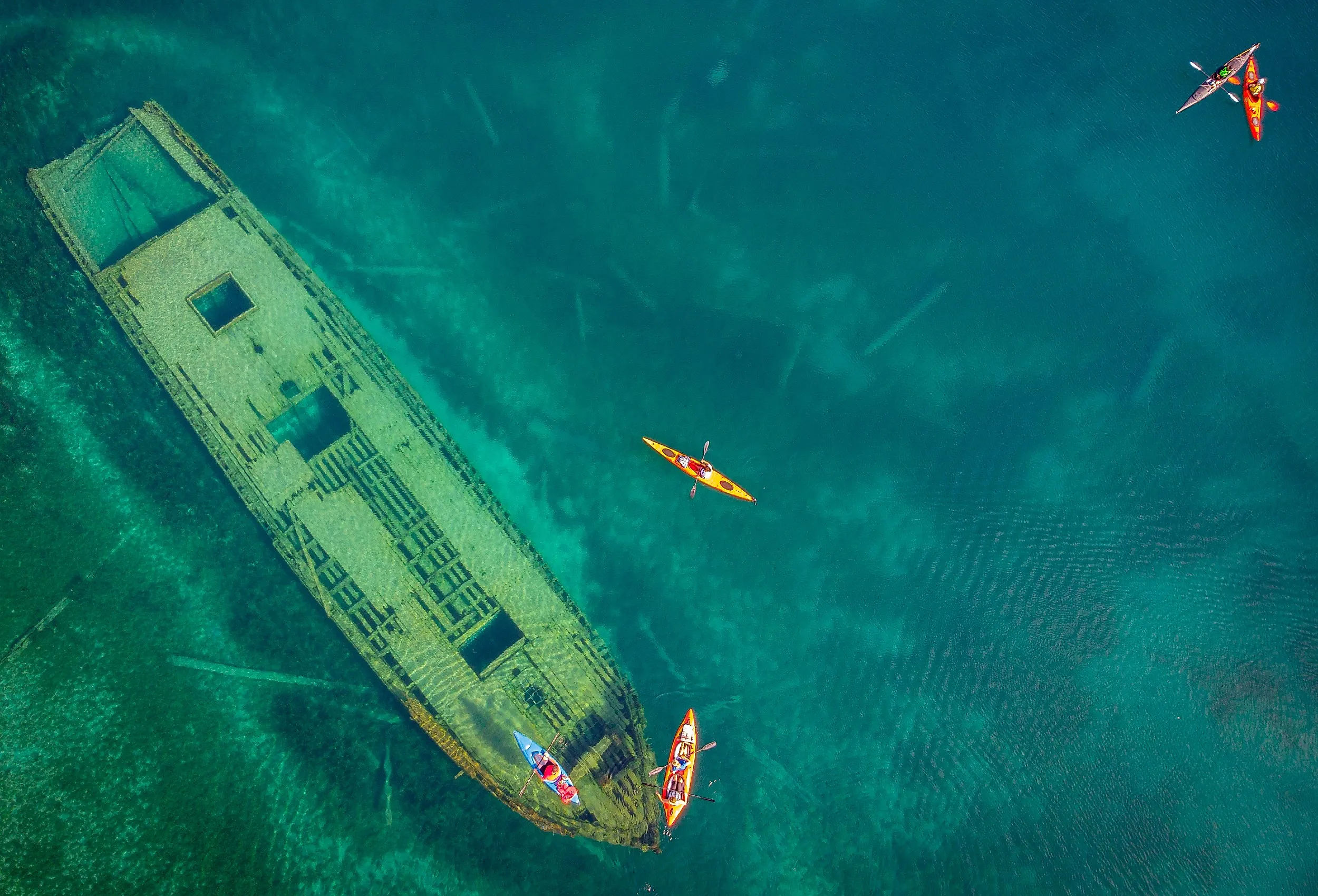
The wreck of the schooner Sweepstakes is likely the most accessible and clearly visible shipwreck in the region. This two-masted schooner sank in 1885 near Tobermory, Ontario, after striking a rock while under tow. It now rests in shallow water within Fathom Five National Marine Park, a general hotbed for boat wrecks.
The vessel lies merely 20 feet under crystal clear waters, making it almost like looking through a window from the surface in calm conditions. Its complete hull outline can be viewed from above, along with other features such as deck boards and the centerboard trunk. The rudder and sternpost are also still very intact, and much of the framing can be examined without even diving.
Because of its shallow depth and protected status, the Sweepstakes is frequently visited by snorkelers, kayakers, and glass-bottom boat tours, offering as direct a look at a historic Great Lakes schooner as you can get without the need for technical abilities.
Scourge & Hamilton, Lake Ontario

The twin wrecks of Scourge & Hamilton are among the most intact vessels from the War of 1812 on the continent. Originally American schooners, both ships sank suddenly during a violent squall on August 8, 1813, while operating on Lake Ontario near the shores of Port Dalhousie. They now rest upright roughly 300 feet below the surface, where cold, low-oxygen freshwater has done an excellent job at slowing decay.
Discovered in 1973, the wrecks are protected as a war grave; they were designated the Hamilton & Scourge National Historic Site of Canada in 1976, and are regulated by Ontario's specialized heritage laws. Structural elements, including hull planking, masts, and deck fittings, remain largely unblemished and clearly defined, while other artifacts, like canons and various other nautical objects, also remain almost just as they were when in use.
Due to their sheer depth and academic importance, access to the ship is limited to technical divers and submersibles, and ongoing research continues to document its condition and significance.
The Dolphin, Lake Michigan

The Dolphin is another 1800s-era schooner that has been well-preserved in the depths of the Great Lakes. Built in 1862, the vessel sank in 1869 on Lake Michigan after a collision in busy shipping waters. It now rests at a depth of 110 feet down near the Straits of Mackinac, where its structure remains just about as it was over 150 years ago.

The hull sits upright, with much of its original shape intact. Deck beams, framing, and sections of the bow and stern are still visible, allowing for a straightforward reading of the ship’s layout even though the water here tends to be a little murky due to silt kickup.
The wreck of the Dolphin, like many other ships in the region, is part of the Straits of Mackinac Shipwreck Preserve and has been documented through extensive survey work, making it a consistent reference point for studying early wooden schooner construction in the region.
Gunilda, Lake Superior

The wreck of the Gunilda is often described as the most well-preserved shipwreck in all of the Great Lakes. This steel-hulled steam yacht sank in 1911 after running aground near McGarvey Shoal, just off Rossport, Ontario. Originally owned by wealthy American financier William L. Harkness, the vessel was considered among the most luxurious private yachts of its time.
It now lies roughly 265 feet deep in Lake Superior, a lake remarkable for its extremely cold, deep waters. Like the majority of the shipwrecks in the area, the hull, deckhouses, and even delicate features such as railings and skylights have stayed seemingly frozen in time, as well as the yacht’s overall structure, with minimal collapse compared to most wrecks of similar age and size.
Niagara Scow, Niagara River

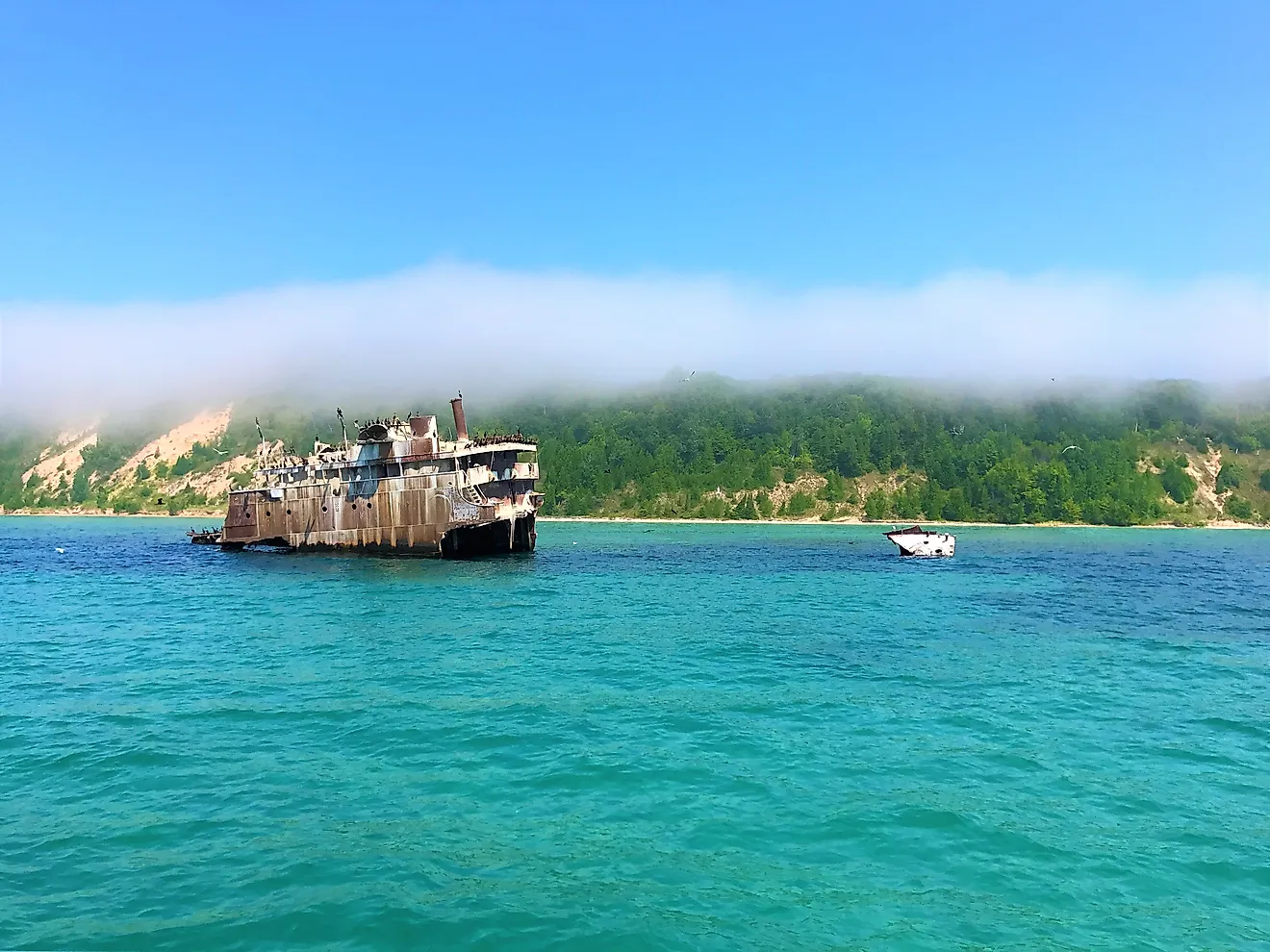
The Niagara Scow (or Iron Scow) is unusual, as it sits perilously above water behind the Niagara Falls between Lake Erie and Lake Ontario. This steel dumping scow became stranded in 1918 in the upper Niagara River after breaking loose from a towing operation, where it then drifted downstream before grounding on rocks just short of Horseshoe Falls sections, more specifically.
It has pretty much remained lodged in place since, where it has been exposed to a constant, strong current and seasonal ice for over a century. Its flat-bottomed structure has almost become an icon of the area, though it is now heavily twisted and partially collapsed. Easily visible from shore, it has also turned into quite the tourist draw in the decades since. Unfortunately, it will likely dislodge someday. Movement has been monitored in recent years, with a piece broken off in 2022 and a shift of about 10 feet as of early 2026.
HMS Ontario, Lake Ontario

This British warship accounts for one of the oldest wreck sites in the region, having sunk during a violent storm on October 31, 1780, while crossing Lake Ontario with a full complement of soldiers, crew, and supplies. All aboard were lost, also making it one of the deadliest maritime disasters on the lake.
Located in deep offshore waters in 2008, the ship rests at an enormous depth of 500+ feet. With a notable amount of structural soundness, its hull remains largely intact, with the deck outline and gunports still visible. Artifacts, including cannons and rigging components, remain in place, providing a detailed snapshot of an 18th-century military vessel.
The site’s isolation and incredibly hard-to-reach location have limited disturbances, and it is now protected as a highly valued historical and archaeological resource.
SS Manasoo, Lake Huron

While it may not have hosted the most wrecks overall, Lake Huron does boast what may be the largest number of preserved wrecks among its counterparts. The wreck of the SS Manasoo is yet another that stands out for how much of its structure remains in one piece, despite its violent sinking.
The vessel went down on September 15, 1928, in heavy seas after its heavy cargo of cattle, vehicles, and people shifted, forcing a rapid capsize. 16 of the 21 travellers on board perished, and the ship now lies around 210 feet under the surface of Georgian Bay.
Portions of the superstructure are still very recognizable, and scattered debris fields are limited, indicating a relatively contained, quick sinking. Moreover, an intact 1927 Chevrolet Coupe remains within the cargo hold, belonging to one of only 5 survivors, Donald Wallace. Another interesting aspect of this wreckage is the fact that it was considered lost until fairly recently, when it was found again in the summer of 2018.
Cornelia B. Windiate, Lake Huron
The wreck of the Cornelia B. Windiate is one of the most visually intact old-timey vessels in the Great Lakes. This three-masted wooden schooner sank in November 1875 during a severe storm on Lake Huron while carrying a loaded cargo of wheat. It now rests peacefully in 185 feet of water near Presque Isle, Michigan.
The cold and clear waters around the ship have preserved the hull, railings, and deck structures in exceptional condition. Most notably, all three masts still stand, making it one of the few wrecks in the region where the full rigging profile remains visible. The bow and stern are also quite pristine, and even smaller features such as the windlass and deck fittings can be easily identified by historians.
The wreck was discovered in 1986 and is protected within the Thunder Bay National Marine Sanctuary, limiting disturbance while allowing experienced divers to visit under strict guidelines.
The EMBA, Lake Michigan
The wreck of the EMBA is a lesser-known but well-defined example of an early 20th-century Great Lakes work vessel. This wooden barge sank on December 15, 1932, on Lake Michigan, about 5 miles off Milwaukee, after being intentionally scuttled at the end of its 42-year service. It now rests in deeper offshore waters, where its structure remains largely unbroken rather than scattered like many other Great Lake wrecks that had much more tragic ends.
The hull sits at a depth of 170 feet, with its overall form still intact and easy to distinguish. Key features such as the bow's relatively flat shape, deck layout, and machinery space can be identified, offering a clear view of how these old-school, compact cargo ships were built and operated.
The wreck of the EMBA has been extensively documented through survey work, and, again, while not as widely known as others, it provides a clean, readable example of a working barge that went down deliberately and without human casualties.
The Clough, Lake Erie
The Clough was a bark built in Lorain, Ohio, in 1867; it sank in Lake Erie in 1868 while carrying stone, and its identity was formally confirmed by the National Museum of the Great Lakes and Cleveland Underwater Explorers in February 2026. The vessel now rests in roughly 70 feet of water several miles off of Cleveland's lakefront.
Original fittings such as capstans, deck beams, and sections of the cabin are whole, and access for divers is somewhat easy, given the ship's position in relatively open water, as well as its compact debris field.
The story of the Clough is also tragic: the wreck site is associated with the June 2024 death of CLUE founder David VanZandt, and the vessel’s identity was formally confirmed afterward through additional site visits, mapping, and archival research. This highlights the dangers, even for experts, of reaching archaeological sites beneath the waves of the Great Lakes.
What Can Be Learned From These Historic Underwater Sites?
These wrecks show how varied losses on the Great Lakes can be, with a diverse mix of warships, schooners, barges, private yachts, and more, each preserved in notably pristine states and orientations. What stands out is not just their conditions, but also clarity, with many of these sites sitting in crystal-clear waters that make them easy to observe for those willing to make the dive.
This inland aquatic region, in many ways, serves as one of the most accessible underwater archives of North American maritime history, with many of its wrecks open for guided tours or featured in prominent museums. A must-visit if you would like to learn more about the subject is the Great Lakes Shipwreck Museum in Paradise, Michigan, open seasonally from May 1 to October 31.