The American Ports That Move More Cargo Than Some Countries
One Texas port ships more crude oil overseas each day than Nigeria. A single California port handles more containers in a year than every harbor in the United Kingdom. Several US ports each move more cargo than a whole foreign country's ports combined, and the reason lies inland. Freight reaches the docks from deep in the country, grain barged down the Mississippi from farms in 31 states, oil piped in from the West Texas shale fields. Behind each port stretches a huge slice of America, and that is what lets a single one out-handle an entire nation's ports in a year.
Port of Los Angeles, California

Furniture is the biggest import at the Port of Los Angeles. Ports measure container traffic in TEUs, or twenty-foot equivalent units, so a standard 40-foot box counts as two. In 2025, the port took in 680,016 TEUs of furniture, nearly twice as much as auto parts, the next item on its import list. China is its largest trading partner and accounts for about 40% of its business, according to port director Gene Seroka.
A large share of those containers leaves Southern California by train. The Alameda Corridor, a 20-mile rail line completed in 2002, carries cargo from the docks at Los Angeles and neighboring Long Beach to the railroads that cross the country. In recent years, it has carried more than a quarter of the loaded containers moving through the two ports. Los Angeles has been the busiest container port in the United States for 26 years in a row. It handled 10.2 million TEUs in 2025, more container traffic than all the ports of the United Kingdom handled in 2024, at 9.6 million.
Port of Long Beach, California

Next door on San Pedro Bay, the Port of Long Beach has been shifting its trade away from China. Around 2020, about 70% of its cargo was tied to China, and by early 2026 that share had fallen to 60%, according to port CEO Noel Hacegaba. Vietnam is now its second-largest trading partner. The port set a record in 2025 with 9.9 million TEUs, more than the 9.3 million that all of Mexico's ports handled in 2024. That volume is spread across six container terminals, and five of them each moved more than 1 million TEUs during the year. Electronics and furniture lead the imports. The 2025 shipments also included millions of Disney's Ultimate Stitch interactive plush dolls, which port officials called the hottest toy of that Christmas.
Port of Corpus Christi, Texas

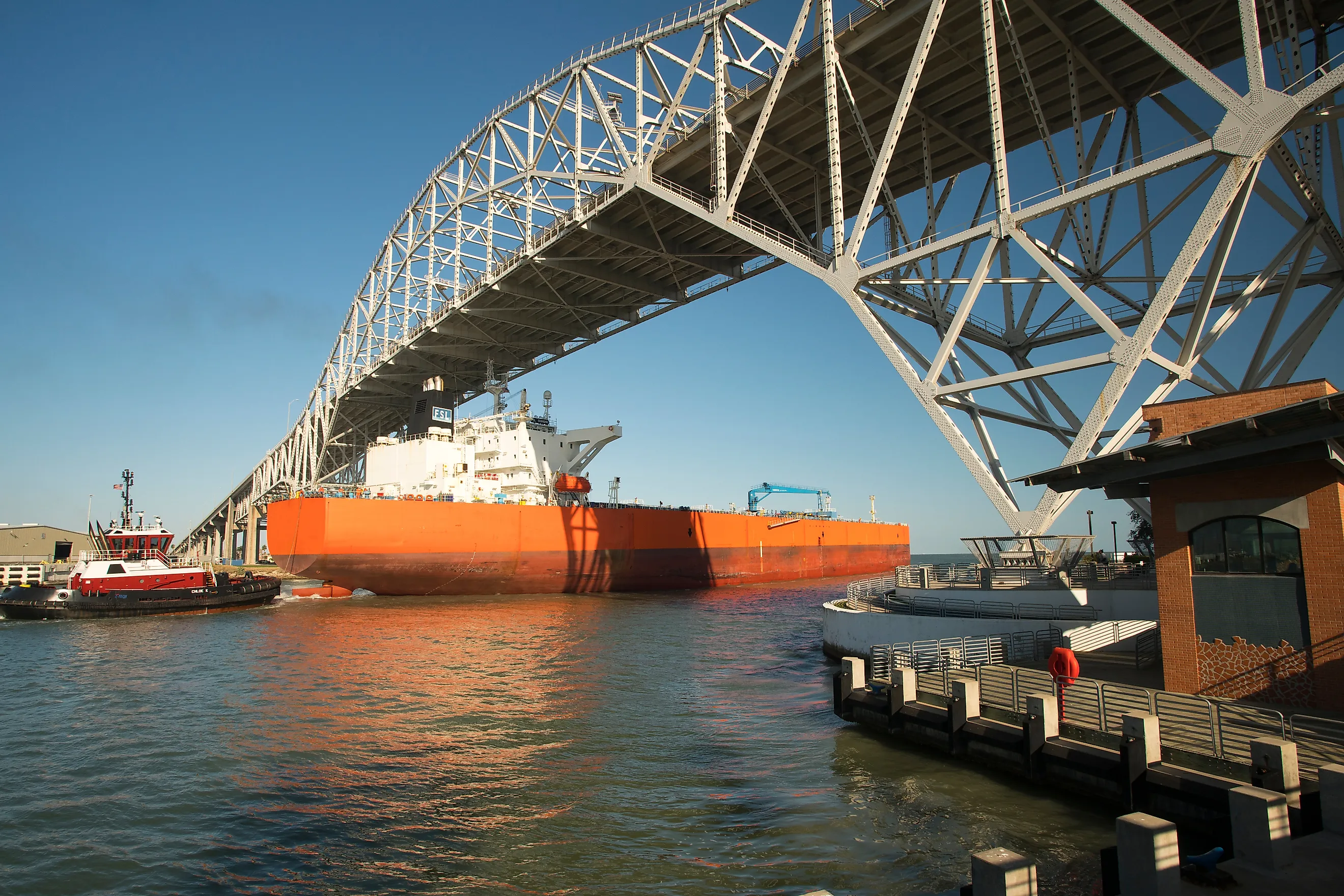
Crude oil exports from the Texas coast took off after 2015, when the federal government lifted its ban on selling most American crude abroad. Two years later, the Port of Corpus Christi loaded its first very large crude carrier. The port took the lead among American crude export hubs in late 2019 and early 2020, after three big new pipelines began delivering crude from West Texas. Over roughly a decade, its yearly cargo climbed from about 85 million tons to more than 200 million, driven largely by crude exports.
Today, about 60% of American crude exports leave through Corpus Christi, roughly 2.3 million barrels a day in recent years, according to port CEO Kent Britton. Nigeria exported about 1.5 million barrels a day in 2024. In 2025, the port finished deepening its ship channel from 47 to 54 feet, and one terminal that dredged its berth to match can now load up to 25% more crude onto each very large tanker.
Port of Houston, Texas

Farther up the coast, ships bound for Houston leave Galveston Bay and travel 52 miles up the Houston Ship Channel toward the city. Along the way, they pass more than 200 private terminals and eight public ones, which together make up the Port of Houston.
The channel is home to North America's largest petrochemical cluster, and Port Houston handles about 60% of the nation's resin exports, the plastic pellets that factories melt and mold into finished products.
Containers load at Port Houston's Bayport and Barbours Cut terminals, which handled 4.3 million TEUs in 2025. The channel as a whole carries far more weight. In 2023, 309.5 million short tons moved along the channel, about 281 million metric tons and the most of any port in the country. Every port in Norway combined handled 216 million metric tons that year.
Port of South Louisiana

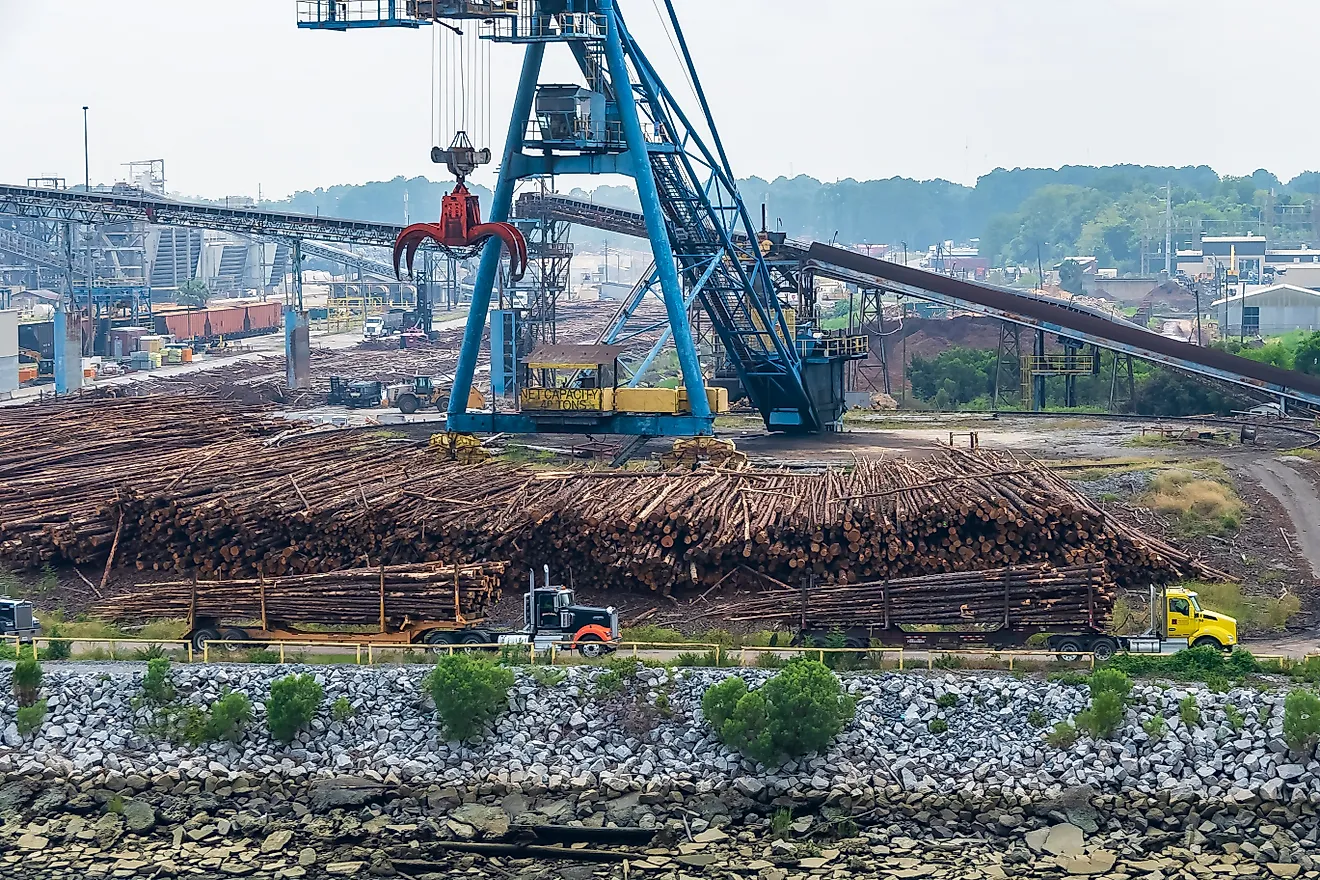
East of Texas, the Port of South Louisiana stretches 54 miles along the Mississippi River between New Orleans and Baton Rouge, and much of its cargo starts far upriver. The river connects the port to farmers in 31 states, and its seven grain elevators load ships bound for more than 90 countries. Barges carry much of that harvest downstream. In 2024, 33,715 grain barges were unloaded in the New Orleans port region, about 92 a day. The lower Mississippi, from Baton Rouge to the Gulf of Mexico, handles about 60% of American soybean exports and 59% of corn exports.
The U.S. Army Corps of Engineers counted 217.5 million short tons of cargo at the port in 2023, about 197 million metric tons. That tops the 172 million metric tons that moved through all the ports of Greece. Oil and chemicals share the riverfront with grain. By the port's own count, 58.9 million short tons of crude oil and 30.5 million short tons of chemicals and fertilizers crossed its docks in 2023.
Port of Savannah, Georgia

On the Atlantic coast, trains at the Port of Savannah load right inside the terminal gates. Mason Mega Rail, at Garden City Terminal, works 42 trains a week, and the Georgia Ports Authority calls it the largest on-terminal rail facility in North America. A record 545,214 containers moved through the port by rail in 2025. The terminal covers more than 1,500 acres, which the ports authority says makes it the largest single-terminal container port in the Western Hemisphere.
Savannah handled 5.7 million TEUs in 2025. France, with ports on both the Atlantic and the Mediterranean, handled 5.4 million across all of them in 2024. From Garden City, cargo can reach 44% of American consumers within two to three days, according to the ports authority.
Port of Virginia

Farther north, ships entering Norfolk Harbor now sail the deepest commercial shipping channel on the East Coast. Dredging to 55 feet finished in February 2026, and parts of the channel are as wide as 1,400 feet. Two of the largest container ships, carrying up to 24,000 TEUs each, can pass each other there without waiting for the tide. With 3.2 million TEUs in 2025, the Port of Virginia outpaced the whole of Israel, whose ports handled 3.1 million in 2024. Between 36% and 40% of the port's cargo leaves by rail, on lines that run as far west as Kansas City, Missouri.
Port of New York and New Jersey

The Port of New York and New Jersey has an enormous market close at hand. About 13.3 million people live within an hour of its terminals, and 134 million are within 36 hours by rail or truck. Most of its loaded traffic is inbound. In 2025, the port took in about 4.5 million TEUs of loaded imports and shipped about 1.4 million TEUs of loaded exports, a ratio of roughly three to one. Furniture led those imports in 2024, as it does in Los Angeles.
Counting empty containers, the port handled 8.9 million TEUs in 2025, and its loaded containers alone came to about 6 million, second only to Los Angeles among American ports. All the ports of Sri Lanka together moved 7.8 million TEUs in 2024.
Port of Duluth-Superior, Minnesota and Wisconsin

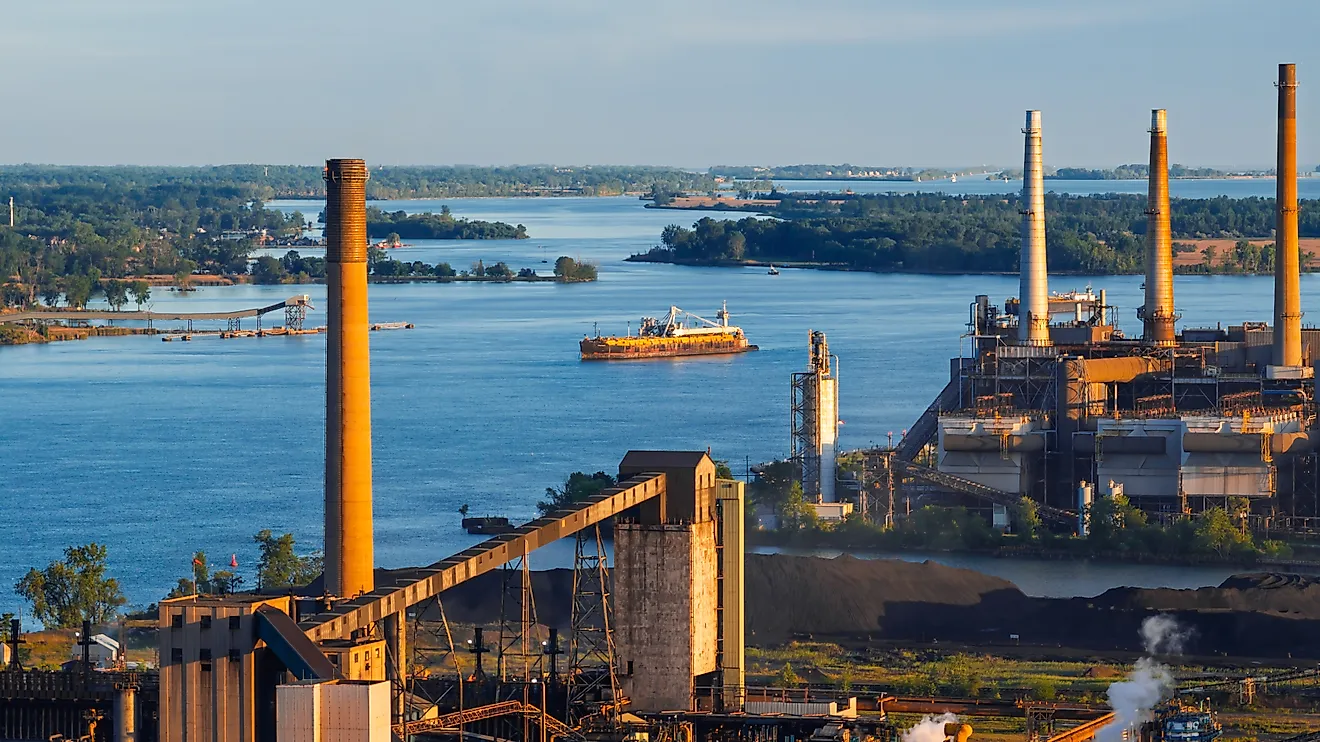
Far inland, the Port of Duluth-Superior sits at the western tip of Lake Superior, 2,342 miles from the Atlantic Ocean by way of the Great Lakes and the St. Lawrence Seaway. A ship makes that trip in less than a week. Duluth-Superior is the largest port on the Great Lakes by tonnage, and in 2023 it moved 30.5 million short tons, about 27.6 million metric tons. That is more than the national total for Estonia, whose ports handled 23 million metric tons in 2023.
Iron ore makes up more than half of the port's cargo. It is mined in northeastern Minnesota as taconite and shipped across the lakes to steel mills in states such as Indiana and Ohio. In 2023, the port shipped more than 21.5 million tons of ore, its most in a single season since 1995. According to the port, Minnesota supplies 80% of the iron ore used in American steel made from raw ore.
Most of these ports carry a nation's worth of cargo because so much of the United States lies within reach of their docks. San Pedro Bay shows how far that reach can stretch. Together, Los Angeles and Long Beach handled about 20.1 million TEUs in 2025 and took in 31% of the containerized imports that reached the country by sea. That is more than the 14.5 million TEUs handled by all the ports of the Netherlands in 2024, though Japan's ports handled 21.9 million. When trade far from the water slows, the tonnage at the docks drops with it. In 2025, one taconite mine on Minnesota's Iron Range closed and another was partly idled. Duluth-Superior's cargo fell almost 15% that year, to its lowest level since 1938.