The One State That Builds Most Of America's Aircraft
Washington assembled 512 of the 600 commercial jets that Boeing delivered in 2025, a share of 85.3 percent. All 512 came from two factories just 40 miles apart: the 737 from Renton, and the 767 and 777 from Everett. South Carolina, the only other state where Boeing builds airliners.
No federal agency counts aircraft output by state—the measure used here is large commercial jets delivered by state of final assembly. This is how Washington builds them, from the 737 lines in Renton to a parts plant in Auburn.
Striking Out in 2024
The clearest measure of Washington's slice of America's jet production came in the fall of 2024, when members of the International Association of Machinists and Aerospace Workers, the union that represents Boeing factory workers in the Puget Sound region, went on strike. The strike lasted from September 13 to November 4, 2024, and ended when members ratified a new contract.
In its Securities and Exchange Commission filings, Boeing stated that the stoppage paused production of its 737, 767, 777, and 777X aircraft, along with two military derivatives, the KC-46A tanker and the P-8A patrol aircraft. The one commercial line that kept running was the 787 line in North Charleston, South Carolina.
Aircraft deliveries fell during and just after the strike, with Boeing handing over 14 jets in October 2024 and 13 in November 2024. Compare that to the volumes delivered across 2025: with every line running, the monthly average was 50. The full-year total for 2024 came to 348, compared with 528 in 2023 and 600 in 2025.
The company's bottom line also suffered, with $3 billion in pre-tax charges on the 777X and 767 programs in the third quarter of 2024, and a further $1.1 billion on the same two programs in the fourth quarter.
A Good Year

The 2025 total breaks down as follows: 737s (447), 767s (30), 777s (35), and 787s (88).
Every 737 was assembled in Renton, and every 767 and 777 in Everett, which puts a "Made in Washington" label on 512 of the 600 jets delivered that year. The other 88 came from South Carolina with the same pattern continuing into 2026. Of the 314 jets Boeing delivered in the first half of the year, 274 were built in Washington, a share of 87.3 percent.
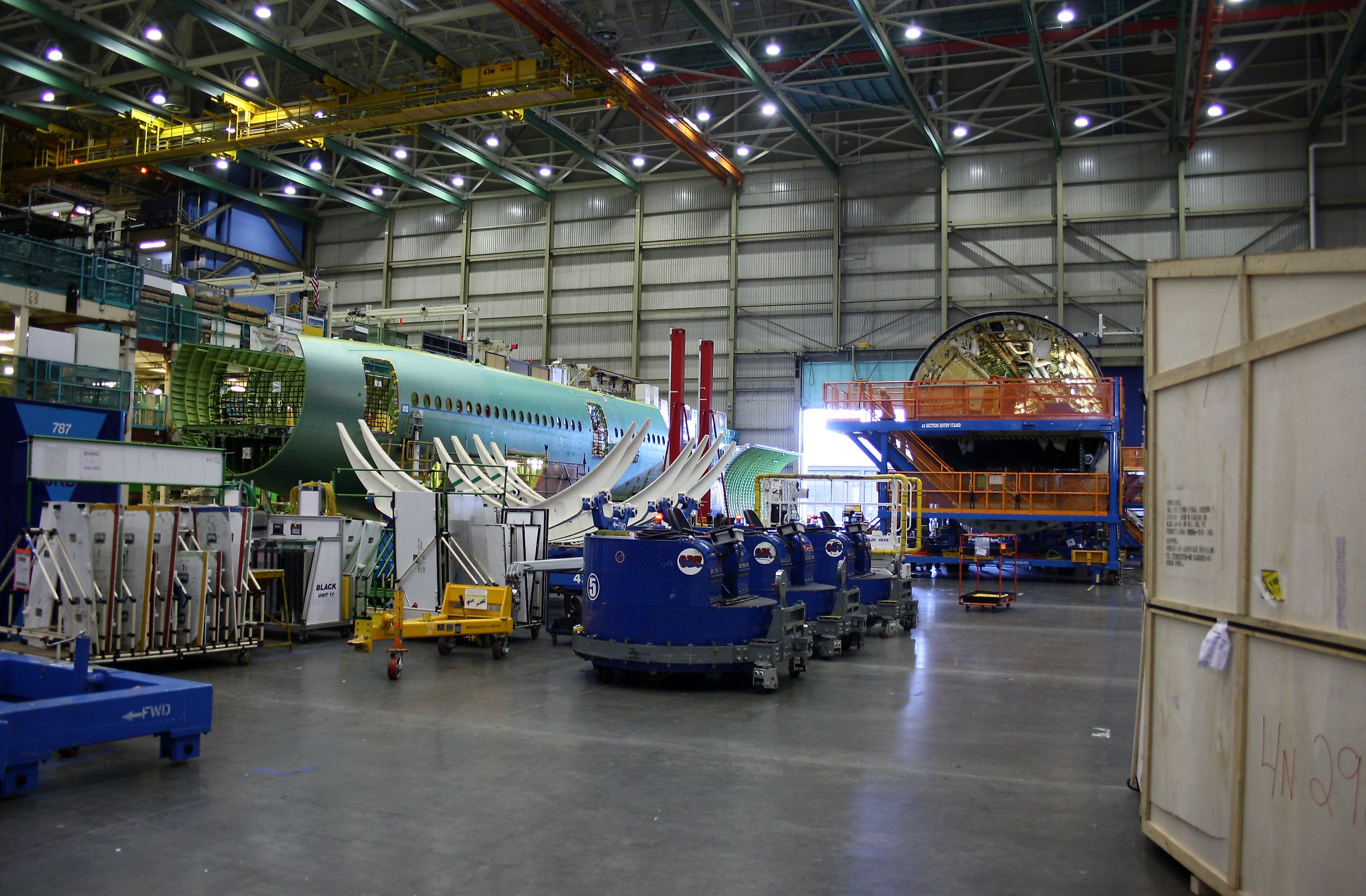
The Everett factory opened on May 1, 1967, to build the 747, and its main building covers 98.3 acres. As of 2026, it builds the 767 freighter, the KC-46A tanker based on it, and the 777, and in July 2026 Boeing opened a fourth 737 assembly line there, called the North Line, at a cost of $1 billion.
Building so many aircraft takes a large workforce. As of December 2025, Boeing reported 65,024 employees in Washington out of 181,984 worldwide, which is 35.7 percent of the company. Its next-largest state workforce was in Missouri, at 17,423.
The Bureau of Labor Statistics counted 84,700 aerospace product and parts manufacturing jobs in Washington in June 2026, a category that includes Boeing and its suppliers.
Renton And The 737
Originally built by the U.S. Navy at the south end of Lake Washington in 1941 to produce a flying boat, Boeing's Renton factory has since turned out more than 14,500 commercial jets, and its 1.1 million square feet of factory space is now given over to the 737 MAX.
The 10,000th 737 left the line in March 2018, earning the program a Guinness World Records title in the process.
Fuselages for 737s are built in Wichita, Kansas, and shipped by rail to Renton, where three assembly lines add the wings, engines, landing gear, and interiors. Once completed, jets take off from Renton Municipal Airport, the city-owned field beside the factory, for the short flight to Boeing Field in Seattle, where each one is prepared for delivery to the airline that ordered it.
The plant also supplies the military. The P-8A Poseidon, the Navy's submarine-hunting patrol aircraft, begins as a 737 on the Renton lines before its mission systems are installed at a Boeing facility in Tukwila, a neighboring city. Boeing delivered six P-8s in 2025 and two in the first half of 2026.
Boeing Field, Auburn, And Frederickson

Boeing Field, the common name for Seattle's King County International Airport, has been around since 1928 and sees an average of 150,000 takeoffs and landings a year. The Boeing 737 delivery center here opened in its expanded form in 2015, with more than 90,000 square feet of space and three covered jetways where customers inspect and accept their aircraft.
The company's very first factory is located on the same airfield. Now part of The Museum of Flight, the Red Barn is the wooden shipyard building that William Boeing, the company's founder, bought in 1910. It served as the company's main factory from 1917 to 1936 and was moved to Boeing Field in 1975. The museum's Aviation Pavilion displays the company's first 747, which made its first flight in 1969, and the first 737, which flew in 1967.
Many of the parts used in Boeing's aircraft come from Auburn, in south King County. The company's fabrication site there has operated since 1966 and makes parts, tools, and assemblies for commercial aircraft. The Washington State Department of Ecology described it in 2021 as the largest airplane parts plant in the world.
As of 2012, the most recent figures Boeing has published, the site covered 331 acres, with 4.2 million square feet of buildings, and produced more than 400,000 parts a month.
Frederickson, an unincorporated community in Pierce County south of Puyallup, is where the tails of the aircraft come from. Boeing opened the plant in 1992, and it builds the tail assemblies for the 777 and 777X and the vertical fins for the 787. A separate building produces wing skins and spars.
Two Plants, 512 Jets
Washington's position as America's top commercial aircraft maker boils down to Boeing's two factories, Renton and Everett. Between them, they assembled 512 of the 600 commercial jets Boeing delivered in 2025, with 274 of the 314 delivered in the first half of 2026.
Add to this the parts plants in Auburn, the tails and wing spars from Frederickson, and the delivery center at Boeing Field, and by the measure of large commercial jets, Washington is miles ahead of the rest.