The Last American Shipyards Still Building Ships
Every new Navy warship comes from a short list of private shipyards, and so does every large cargo ship built for domestic trade. The work at Norfolk Naval Shipyard in Virginia and the Navy's three other public yards is repair and overhaul. Most of the Navy's major ships are built at seven private yards instead, according to the Government Accountability Office.
The country's share of the global commercial market was about 0.1 percent in 2024, and more than half went to Chinese yards. With so little commercial work available, the yards still building are each tied to a narrow kind of ship. A yard stays busy for as long as the program behind its ship lasts. In the past year, that has meant a $76.6 billion order at one yard and canceled frigates at another.
Bath Iron Works, Bath, Maine

The future USS William Charette was christened on August 1, 2026, at Bath Iron Works on Maine's Kennebec River, and every ship now in construction there is the same kind. Each one is an Arleigh Burke-class guided-missile destroyer, a 509-foot warship that only Bath and Ingalls Shipbuilding in Mississippi are set up to produce one after another. The newest in line, the J. William Middendorf, went into production in May 2026 as the 88th ship of the class, at a cost of about $2.2 billion.
As of October 2026, 11 destroyers were under contract at Bath, with seven in construction and four waiting for fabrication to begin. Hull sections are assembled indoors in the Ultrahall before they are joined on the shipways, and finished hulls are floated off on a dry dock rated to lift 28,000 tons, nearly three times the weight of a fully loaded Flight III destroyer. About 6,800 people worked at the yard in October, and at the end of 2025 it ranked fourth among Maine's employers. On October 12, Bath was certified by the Department of War to build a second Flight III destroyer in the 2027 budget, a ship that still needs funding from Congress.
General Dynamics Electric Boat, Groton, Connecticut

Farther down the coast, submarine hull sections travel by barge to General Dynamics Electric Boat on the Thames River in Groton, Connecticut. Many of those pressure-hull modules are fabricated at Quonset Point, Rhode Island, and moved on Holland, a barge 400 feet long and 100 feet wide. In Groton, the sections are joined and outfitted, and each finished boat is launched from a graving dock, a basin dug into the shore that can be flooded, using transfer cars and a pontoon. Electric Boat and Newport News Shipbuilding are the only two American yards that build nuclear submarines, and the work on every Virginia-class attack boat is divided between them.
The largest boat in that pipeline is the District of Columbia (SSBN 826), the first Columbia-class ballistic missile submarine. It is about 560 feet long and displaces roughly 21,000 tons, and its bow was finished at Newport News and shipped north. Delivery is expected by the end of 2028 under the General Dynamics schedule, and the Navy's 2027 budget estimate puts it in March 2029, ahead of a first patrol in 2030.
A $76.6 billion contract for nine Virginia-class and five Columbia-class submarines was awarded to Electric Boat on July 29, 2026. About 1.3 Virginias a year are completed by the two yards together, short of the Navy's goal of two. The hiring target for 2026 was 8,000, the largest in the company's 120-year history, on top of a workforce of more than 27,000, and in late July a company executive said hiring was more than halfway there.
Hanwha Philly Shipyard, Philadelphia, Pennsylvania

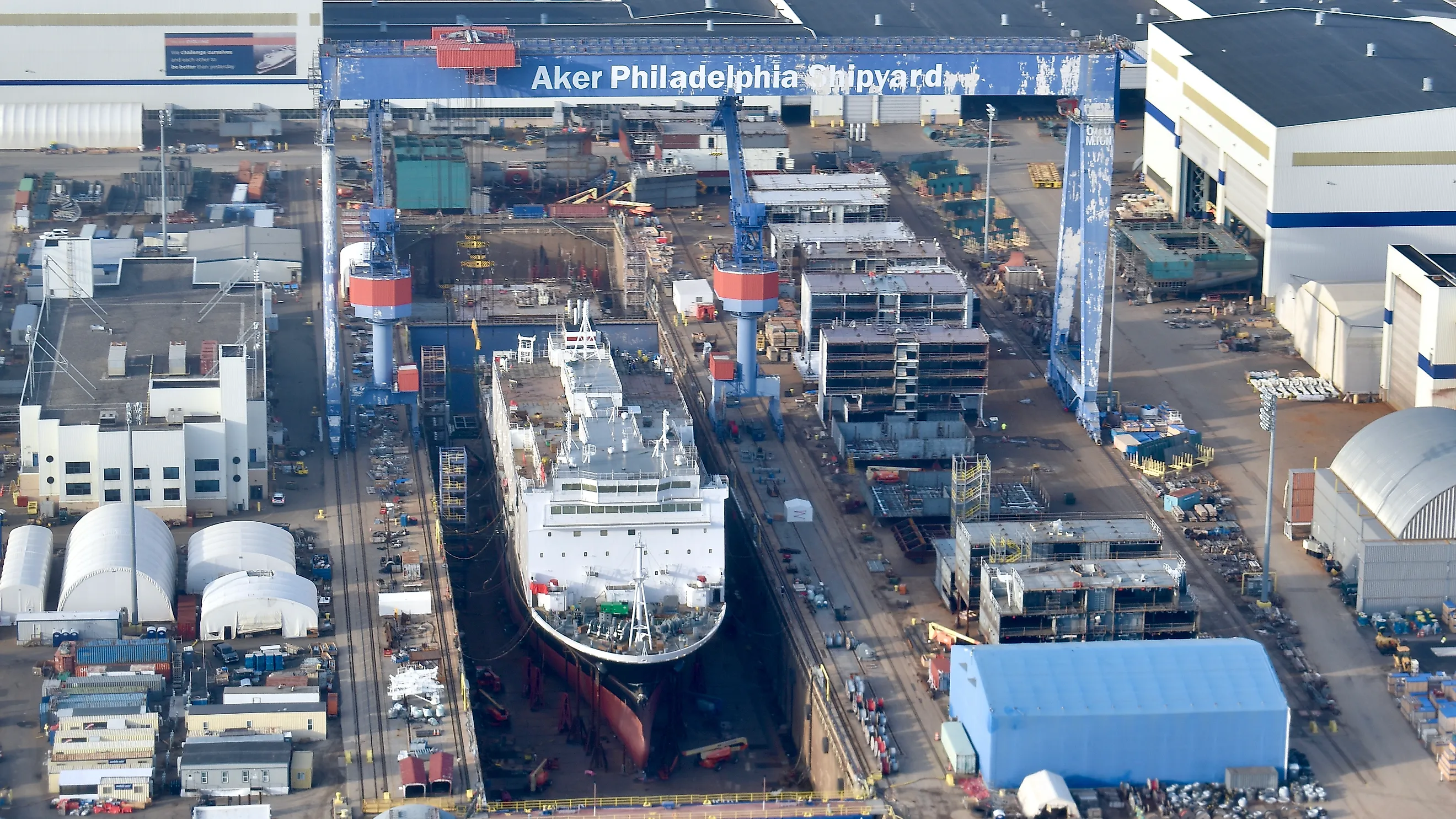
Cargo moving between American ports has to travel on ships built in the United States under the Jones Act, so those orders cannot go to yards overseas. Nearly half of the large, ocean-going Jones Act ships built in the country since 2000 came out of Hanwha Philly Shipyard, on part of the former Philadelphia Navy Yard, according to the company. Everything there is built around a single 1,000-foot dry dock and one Goliath crane, and a ship is finished about once every eight months.
The newest is TS Lone Star State, a 524-foot training ship christened in July 2026 for Texas A&M Maritime Academy, with berths for 600 cadets and 100 faculty. It is the fourth of five federal training ships built at the yard, and the last, TS Golden Bear, is due in 2027. About 2,000 people work there, and the yard has been owned since 2024 by South Korea's Hanwha, which paid $100 million for it. A $5 billion plan would add two docks and three quays, with a target of as many as 20 ships a year, compared with fewer than two now. A $1.4 billion order for two missile range instrumentation ships, built on the training-ship hull, was announced in July 2026, and work has started on the first of three Aloha-class containerships for Matson. Ten Jones Act tankers ordered by Hanwha Shipping are scheduled to begin delivering in 2029.
Newport News Shipbuilding, Newport News, Virginia

Nuclear-powered aircraft carriers are built in one American yard, Newport News Shipbuilding on Virginia's James River, and the newest one has been held up by its elevators. Weapons elevators lift bombs and missiles stored in the magazines up to the flight deck. The John F. Kennedy (CVN 79), a Ford-class carrier of about 100,000 tons, left the yard on August 12, 2026, for acceptance trials with 7 of its 11 weapons elevators complete. Unfinished elevators and work on the arresting gear that stops landing jets pushed its delivery back two years, to March 2027.
About 26,000 people work across the yard's 550 acres, which stretch along two miles of the river. Two more Ford-class carriers are in its schedule. Enterprise (CVN 80) is due in March 2031 at an estimated $14.2 billion, and Doris Miller (CVN 81) is due in February 2034 at about $15.2 billion.
The Kennedy delay reached the rest of the fleet. USS Nimitz, which had been set to retire in May 2026, has been kept in service until March 2027, the month the Kennedy is scheduled to arrive.
Eastern Shipbuilding Group, Panama City, Florida

Eastern Shipbuilding Group, based in Panama City, Florida, held the first contract for the Coast Guard's Heritage-class offshore patrol cutters, awarded in 2016. Construction fell behind after Hurricane Michael struck the Panhandle in 2018, and the GAO later found problems with the design. Work stopped on two of the cutters in 2025, and in June 2026 the contract was ended by agreement with the Coast Guard.
The next large job at Eastern is on the opposite corner of the country. Steel cutting for the first of three hybrid-electric ferries for Washington State Ferries began on August 5, 2026. Each ferry will be 409.5 feet long with room for 160 cars and 1,500 passengers, and all three will launch into St. Andrew's Bay before the long voyage to Puget Sound, with deliveries planned in 2030, 2031, and 2032. Thirty-five ship-assist tugs have also come out of Eastern's three Gulf Coast yards over the past two decades.
Austal USA, Mobile, Alabama

The follow-on contract for the Heritage-class cutters belongs to Austal USA, whose 165-acre campus sits on the east bank of the Mobile River in Alabama. In late August 2026, the future Pickering, Icarus, and Ingham were all under construction there. Each is a 110-meter cutter, about 360 feet long, and 25 are planned at roughly $17 billion to replace the Coast Guard's older medium endurance cutters. Pickering, the fifth ship of the class, is due in 2027. The yard was long known for aluminum hulls, and the cutters are built of steel on a steel panel line added in recent years. Modules for the Virginia-class and Columbia-class submarine programs are made there as well.
Bollinger Mississippi Shipbuilding, Pascagoula, Mississippi

West of Mobile, in Pascagoula, Mississippi, 33 of the 85 modules for the first heavy icebreaker built in the United States in about 50 years were under construction at Bollinger Mississippi Shipbuilding this summer. Prototype modules for the Coast Guard's Polar Security Cutter were started in 2024, and full production began in May 2025. About 43 modules are expected to be underway by the end of 2026, some of them stern sections nearly four stories tall. The finished ship is planned at 460 feet and about 22,900 long tons, with a hull of 1.5-inch-thick steel, longer than both the 399-foot Polar Star and the 420-foot Healy that the Coast Guard operates now. Delivery is targeted for 2030, a date the GAO has estimated could slip to 2033.
The second icebreaker program in these yards is the Arctic Security Cutter, ordered in a $3.3 billion deal for six ships, with four built by Bollinger and two in Finland. Construction on the first U.S.-built Arctic Security Cutter started in April 2026, and it is due in 2029. Its pieces come from several Bollinger yards, with the mid-body at LaShip in Houma, Louisiana, the bow and stern at Larose, and the superstructure at Gulfport. About 4,000 employees at more than a dozen Bollinger facilities along the Gulf Coast support that work.
Ingalls Shipbuilding, Pascagoula, Mississippi

The other shipyard in Pascagoula, Ingalls Shipbuilding, covers about 800 acres on both banks of the Pascagoula River, and this fall its newest amphibious ship came back from sea trials. Harrisburg (LPD 30) is the first Flight II ship of the San Antonio class, the amphibious transport docks that carry Marines and their landing craft, and Ingalls is now the only yard building them. The 684-foot ship spent several days at sea for tests of its steering and communications, and it is being prepared for acceptance trials and delivery to the Navy later in 2026.
More than 11,000 people work at Ingalls, Mississippi's largest manufacturing employer, compared with as many as 25,000 at its peak in the 1970s and 1980s. A growing share of the work now goes outside the yard. Eight structural units for a later ship in the class, Philadelphia (LPD 32), have been sent to two partner companies, and outsourced shipbuilding hours are set to rise by another 30 percent in 2026.
The destroyer class built at Bath comes off the ways in Pascagoula too. George M. Neal (DDG 131), the fourth Flight III destroyer built in Pascagoula, was christened on July 11, 2026, and 36 Arleigh Burkes have been delivered from the yard. The big-deck amphibious assault ship Bougainville (LHA 8) is still in the yard as well, with delivery now set for July 2027.
Fincantieri Marinette Marine, Marinette, Wisconsin

The Navy's newest frigates are being built far from salt water, at Fincantieri Marinette Marine on the Menominee River in Marinette, Wisconsin. Plans once called for 20 of the 496-foot Constellation-class frigates, and six were on order in 2025. In November 2025, the last four were canceled, leaving Constellation (FFG 62) and Congress (FFG 63) in construction and under Navy review, with the first ship's delivery already pushed back 36 months to April 2029. In December, 93 of the yard's 2,175 employees and contractors were laid off, most of them engineers and office staff.
Some of the frigate modules come from Fincantieri Bay Shipbuilding in Sturgeon Bay, Wisconsin, where the 639-foot Mark W. Barker was built. When it entered service in 2022, the Barker was the first U.S.-flagged bulk freighter built on the Great Lakes since 1983. Marinette's next order is for a different kind of ship. Four Medium Landing Ships for the Marine Corps were assigned to the yard in February 2026, the start of a program expected to reach 35 vessels, and construction on the first two is planned for 2027.
General Dynamics NASSCO, San Diego, California

The Navy's support ships are built on the Pacific coast at General Dynamics NASSCO on San Diego Bay, the only one of the Navy's major shipbuilders in the West. The oiler Sojourner Truth (T-AO 210) took shape on the yard's inclined ways, the sloped building berths that run down to the bay, before its delivery on June 9, 2026, as the sixth ship of the John Lewis class. Each of these 742-foot oilers carries 162,000 barrels of fuel for refueling warships at sea.
The last Expeditionary Sea Base, the Hector A. Cafferata Jr., was delivered on August 25, 2026, completing that class at NASSCO. These floating bases, about 785 feet long, support special operations forces and mine-hunting helicopters far from shore. With the sea base line finished, the oilers are the yard's main new-construction work, and its local workforce of about 3,400 is tied to a contract for 17 of the 20 oilers the Navy has planned.
The narrow specialties that keep these yards open also set the pace for the fleet. Carriers come from a single yard, so a two-year delay at Newport News held USS Nimitz in service past its planned retirement. Attack submarines come from two yards, and their combined output of about 1.3 boats a year sits well below the Navy's goal of two, and Electric Boat's hiring target for 2026 was 8,000 people. The same narrowness leaves a yard little to fall back on when a program shrinks. Four of Marinette's six frigates were canceled in a single announcement, and the next large job at Eastern after its cutter contract ended is a set of ferries for Puget Sound. Philadelphia is where the pattern could change. Hanwha's target is as many as 20 ships a year at a yard that now finishes about one every eight months, and reaching it depends on the two new docks in the $5 billion plan.