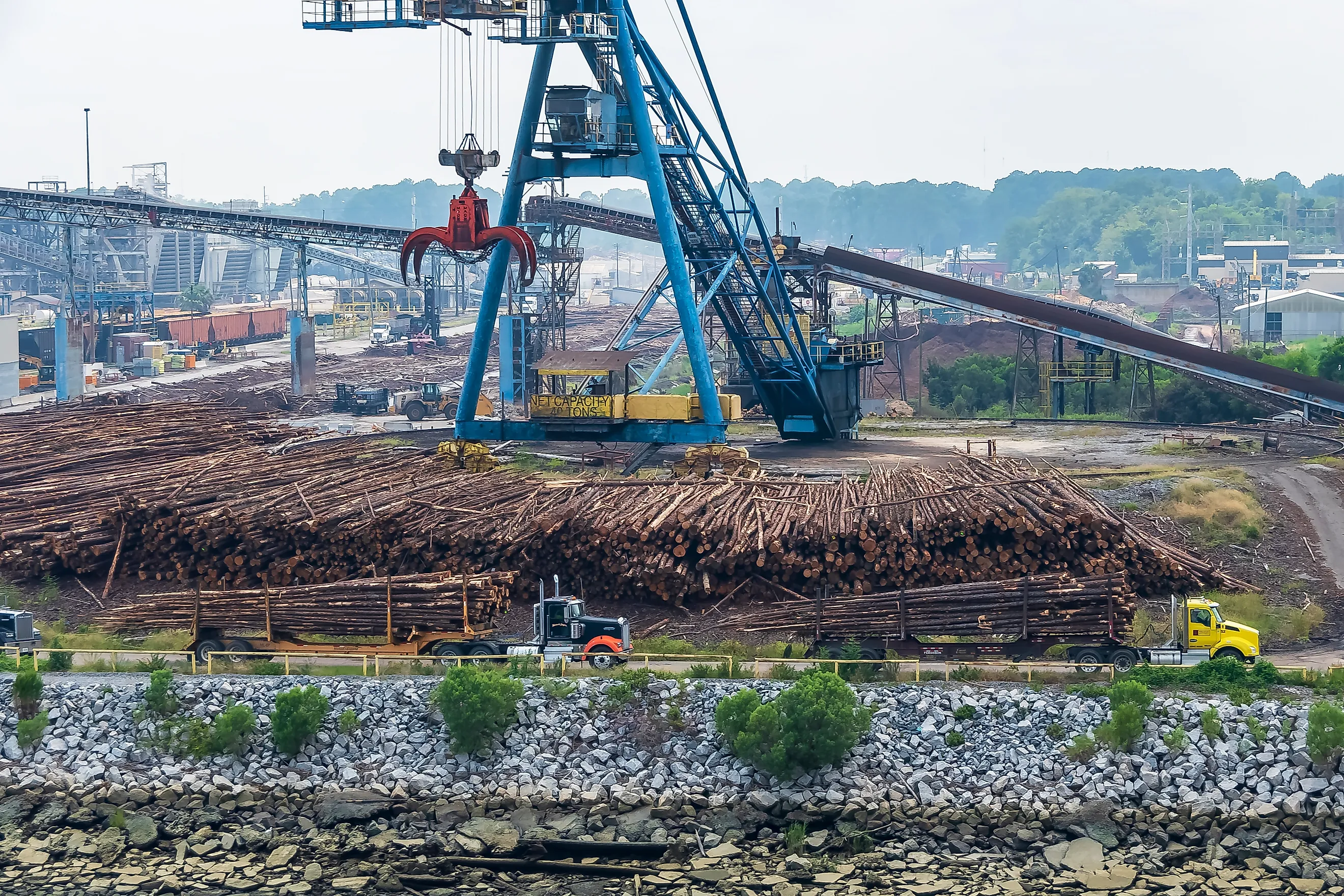
The Top Timber-Producing States In America
For much of the 20th century, the Douglas-fir forests of Oregon and Washington were the heart of America's timber industry. After federal harvests in the Pacific Northwest fell sharply in the 1990s, the center of gravity moved south, to fast-growing pine forests stretching from Texas to the Carolinas. By 2011, the South accounted for 63 percent of all the timber harvested in the United States, according to the US Forest Service. That shift shows up clearly in this ranking, where Southern states dominate the top of the list and the Pacific Northwest holds its own a little further down. The list compares the total roundwood each state harvested between 1993 and 2024, meaning the logs cut from its forests before they ever reach a mill.
Figures come from the USDA Forest Service's Timber Products Output (TPO) data and are measured in thousand cubic feet (MCF). One MCF equals 1,000 cubic feet, so 1 million MCF works out to 1 billion cubic feet. The totals combine hardwood and softwood (in basic terms, trees with leaves and fruits versus trees with needles and cones) harvested for sawlogs, pulpwood, veneer logs, and other industrial products, and they count timber cut within each state rather than lumber made by its mills.
1. Georgia (22,797,691 MCF)

Georgia ranks first in timber production over the past three decades. Much of that wood comes from loblolly and slash pine planted across the Coastal Plain, fast-growing trees raised in managed stands and cut on cycles as short as 10 to 15 years for pulpwood and 25 to 35 years for sawtimber. Softwood accounts for around 19.54 million MCF of the state's total, including 8.58 million MCF of pulpwood and 7.14 million MCF of sawlogs. Hardwood contributes another 3.26 million MCF, led by 1.77 million MCF of pulpwood and 1.05 million MCF of sawlogs. Georgia's production is therefore heavily weighted toward softwood, but includes a wide range of product categories and an overall scale that no other state matches.
2. Alabama (19,047,142 MCF)

Alabama has a lead of more than 4 million MCF over its neighboring state, Mississippi, for second place on the 1993-2024 ranking. Softwood accounts for approximately 15.15 million MCF, led by 7.04 million MCF of pulpwood and 5.94 million MCF of sawlogs. Another 812,824 MCF goes toward veneer logs. Hardwood production contributes about 3.9 million MCF, including 2.74 million MCF of pulpwood and 792,770 MCF of sawlogs. Alabama's large pulpwood harvest highlights the importance of paper manufacturing to the state's forestry industry. Privately owned forest covers close to two-thirds of the state, which gives Alabama the raw material to keep those mills supplied.
3. Mississippi (14,764,614 MCF)

Mississippi harvested nearly 14.8 million MCF of timber in the 1993-2024 period. Forests cover more than 60 percent of the state, almost 90 percent of them privately owned, and pine supplies most of the harvest even though hardwood and mixed oak-pine stands cover more ground. As in most of its neighbors on the list, the pulp and lumber sectors lead the state's timber industry. Softwood accounts for approximately 12.03 million MCF, with pulpwood totaling around 5.08 million MCF, while sawlogs contribute another 4.95 million MCF. The state also produced nearly 1 million MCF of softwood veneer logs. Hardwood adds about 2.74 million MCF, including 1.62 million MCF of pulpwood and just over 1 million MCF of sawlogs.
4. North Carolina (13,583,898 MCF)

North Carolina ranks just ahead of its southern neighbor, South Carolina, with a total harvest over the past three decades approaching 13.6 million MCF. Softwood contributes approximately 9.69 million MCF, led by 4.44 million MCF of sawlogs and 3.53 million MCF of pulpwood. Another 589,742 MCF goes toward veneer production. Hardwood adds nearly 3.9 million MCF, including 1.82 million MCF of sawlogs and 1.26 million MCF of pulpwood.
Taken together, softwood and hardwood sawlogs account for more than 6.25 million MCF of North Carolina's harvest, making lumber production an especially important part of its timber economy. Pine from the Coastal Plain and Piedmont supplies most of the softwood, while oak, yellow-poplar, and other hardwoods from the Piedmont and mountains helped build the state's furniture industry.
5. South Carolina (12,534,734 MCF)

South Carolina's 1993-2024 timber harvest exceeded 12.5 million MCF, with softwood accounting for nearly 10.69 million MCF. Southern pine, mostly loblolly, makes up the bulk of that softwood, and the pulpwood goes to mills that turn it into paper and packaging. Pulpwood is the state's largest softwood product, reaching almost 4.5 million MCF. Sawlogs are close behind at around 4.15 million MCF, while veneer logs contribute another 593,786 MCF. Hardwood production totals approximately 1.85 million MCF, including 1.23 million MCF of pulpwood and 372,846 MCF of sawlogs. Composite panels and bioenergy or fuelwood account for smaller portions of the harvest.
6. Louisiana (11,145,296 MCF)

Louisiana ranks sixth nationally, with softwood representing nearly 9.83 million MCF of its 11.15 million MCF harvest between 1993 and 2024. Pulpwood is the largest individual product category, totaling around 4.2 million MCF. Sawlogs contribute another 2.53 million MCF, while veneer logs account for approximately 2.09 million MCF. Those veneer logs are peeled into thin sheets and glued into plywood, and Louisiana is one of the Southern states where most of the country's softwood plywood is now made. Hardwood production adds 1.31 million MCF, much of which also goes toward pulpwood. Hardwood pulpwood totals 863,647 MCF, compared with 386,248 MCF of sawlogs.
7. Oregon (10,724,777 MCF)

Oregon is the top-ranking state outside the Southeast, harvesting nearly 10.72 million MCF of roundwood. Douglas-fir fills both its forests and its sawmills. The state leads the nation in softwood lumber and plywood, though harvests on federal land fell sharply after the Northwest Forest Plan took effect in 1994. Like its Pacific Northwest neighbor, Washington, Oregon's production is overwhelmingly softwood, accounting for roughly 97% of its total. Sawlogs dominate this category, totaling approximately 7.36 million MCF. Veneer logs contribute another 1.69 million MCF, while pulpwood accounts for just over 1 million MCF. Hardwood production is comparatively small at around 343,000 MCF, with sawlogs making up 142,233 MCF.
8. Arkansas (10,049,812 MCF)

Arkansas has a varied geography that supports both hardwoods and softwoods, but softwood still made up most of its harvest, at approximately 7.83 million MCF. Loblolly and shortleaf pine grow across the southern part of the state, shortleaf dominates much of the Ouachita Mountains, and oak and hickory are common in the Ozarks to the north. Sawlogs are the leading softwood product at 3.91 million MCF, followed by 2.64 million MCF of pulpwood. Hardwood production totaled almost 2.22 million MCF, with pulpwood accounting for 1.29 million MCF and sawlogs contributing another 865,404 MCF.
9. Texas (9,156,832 MCF)

The timber harvest in Texas is focused primarily on softwood. It comes from about 12 million acres of pine forest across 43 counties in East Texas, the Piney Woods, in a state far better known for ranchland and desert. Production of softwood totals approximately 7.66 million MCF, led by 2.88 million MCF of sawlogs, 1.62 million MCF of veneer logs, and 1.53 million MCF of pulpwood. Miscellaneous products contribute another 1.07 million MCF. Hardwood production from 1993 to 2024 reached almost 1.49 million MCF, including 813,746 MCF of pulpwood and 362,978 MCF of sawlogs.
10. Virginia (8,949,980 MCF)

Virginia produces a substantial volume of both softwood and hardwood, although softwood remains the larger category. Loblolly pine dominates the Coastal Plain and has been planted widely across the Piedmont, while oak and hickory forests cover much of the mountainous west. Its 5.47 million MCF of softwood includes approximately 2.09 million MCF of sawlogs and 1.83 million MCF of pulpwood. Another 609,643 MCF falls under miscellaneous products. Hardwood production adds around 3.48 million MCF, including 1.74 million MCF of sawlogs and 1.34 million MCF of pulpwood. That balance sets Virginia apart from most states on the list, where one type of wood makes up the large majority of the harvest.
11. Washington (8,757,138 MCF)

Like Oregon, Washington has a softwood-focused timber industry. Softwood accounts for nearly 95% of Washington's 1993-2024 timber production, with softwood sawlogs making up more than 75% of the softwood total. Pulpwood adds another 1.04 million MCF, while veneer logs contribute 667,081 MCF. Hardwood production is much smaller, at approximately 440,000 MCF, with sawlogs accounting for 295,428 MCF. Most of the harvest goes to sawmills, with pulpwood a distant second. Douglas-fir and western hemlock make up about three-quarters of the state's timber, and about 85 percent of the harvest comes from the wet forests of western Washington.
12. Florida (8,344,020 MCF)

Florida's timber industry is overwhelmingly based on softwood, which accounts for around 7.77 million MCF of the state's 8.34 million MCF harvest since the 1990s. That softwood comes mostly from slash and loblolly pine in North Florida, where fast-growing slash pine is widely planted for pulpwood. Pulpwood is the leading product, totaling over 3.9 million MCF, followed by approximately 2.49 million MCF of sawlogs. Miscellaneous softwood products contribute another 630,863 MCF, while smaller amounts go toward poles, veneer logs, and composite panels. Hardwood production is considerably more limited at 578,320 MCF. Much of that harvest goes toward pulpwood and bioenergy or fuelwood, with relatively little used for sawlogs.
13. Tennessee (4,756,492 MCF)

Tennessee produced nearly 3.41 million MCF of hardwood between 1993 and 2024, compared with 1.34 million MCF of softwood, a more balanced mix than most states on the list. Hardwood sawlogs lead the state's harvest, totaling nearly 2.29 million MCF. Its sawmills work mostly with white and red oak, yellow-poplar and hickory, woods that end up in flooring, cabinets, and furniture. Another 980,161 MCF goes toward pulpwood, while miscellaneous hardwood products contribute approximately 103,000 MCF. Softwood production is led by pulpwood at 839,188 MCF, followed by sawlogs at 277,351 MCF. These figures put Tennessee among the country's leading hardwood-producing states, with sawlogs and pulpwood accounting for much of its overall harvest.
14. Kentucky (3,006,201 MCF)

Kentucky's timber harvest is dominated by hardwood, which accounts for about 2.8 million MCF of its 3 million MCF total. Hardwood sawlogs alone contribute more than 2.32 million MCF, making them the state's most important timber product by far. Miscellaneous hardwood products add another 236,629 MCF, while hardwood pulpwood contributes 129,034 MCF. Softwood production is much smaller, totaling just over 210,000 MCF. This includes approximately 108,000 MCF of sawlogs and 59,618 MCF of miscellaneous products. Much of its white oak goes to stave mills, which cut it into the barrel staves used to age the state's bourbon.
15. Idaho (2,728,050 MCF)

Idaho ranks 15th nationally in the 1993-2024 period, with timber production heavily weighted toward softwood rather than hardwood. About 80 percent of Idaho's forestland is federally owned, and less than half of its timberland is open to active management, which limits how much wood reaches its sawmills. Softwood accounts for approximately 2.72 million MCF, nearly all of the state's total harvest. Sawlogs dominate this category, reaching 2.22 million MCF, while pulpwood contributes another 157,507 MCF. Miscellaneous wood products account for 155,188 MCF, with smaller amounts going toward veneer logs and bioenergy or fuelwood. Hardwood production is quite limited, totaling just 6,950 MCF.
Where America's Timber Comes From
Measured by total harvest, the South leads this list by a wide margin, but much of that lead comes from pulpwood. In Georgia, Alabama, Mississippi, South Carolina, Louisiana and Florida, more of the softwood harvest goes to pulpwood than to sawlogs, feeding paper and packaging mills rather than lumberyards. Oregon and Washington cut their timber for a different market. Oregon's 7.36 million MCF of softwood sawlogs is slightly more than Georgia's 7.14 million, even though Georgia's total harvest is more than twice as large. Rank the states by softwood sawlogs alone, and Oregon, not Georgia, sits at the top.