Why Alligators Don't Live West of Texas
American alligators are strongly tied to warm, low-lying freshwater environments, which handily explains their presence in the southeastern United States. But you'll never find them west of Texas. What do alligators have against the American west?
For one, a gator's survival depends on the long, stable warm seasons that support food sources, growth, and reproduction. Vast swathes of wetlands also help, providing shallow water and dense vegetation for hunting and nesting. West of Texas, those conditions begin to break down. Cooler winters, fragmented water systems, and increasingly arid terrain reduce the continuity of appropriate habitat for these cold-blooded predators. Read on to learn more about these apex predators and exactly why they're mostly relegated to the Southeast.
Physical Description And Behavioral Of American Alligators

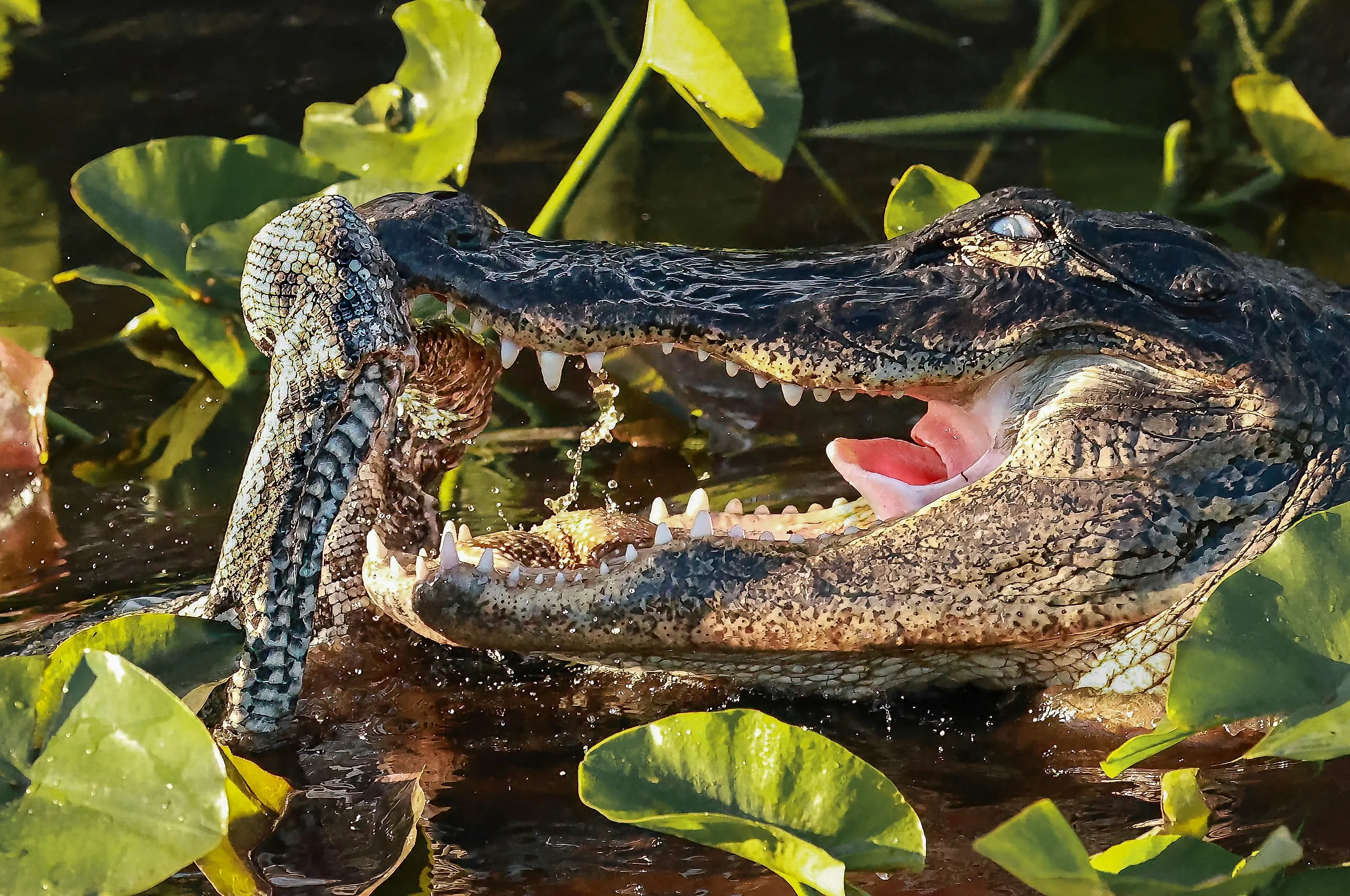
American alligators are large crocodilian reptiles with thick, leathery bodies, broad, rounded snouts, and dark gray to black skin that helps them blend into their freshwater environments. Adults, which average around 8 to 11 feet (2.4 to 3.5 m) in length and can weigh from 500 to 800 lbs (227 to 360 kg), typically move between water and land, using their powerful tails for swimming and short, sturdy legs for walking on shore. Moreover, their eyes and nostrils sit high on the head, allowing them to remain mostly submerged while watching for movement above the surface.
Behaviorally, they are primarily ambush predators, staying motionless for long periods before striking with rapid bursts of speed, and sometimes going into a "death roll," in which they clamp onto their prey's limb and spin around to subdue and detach it. They are most active during warm months and often bask on banks to regulate body temperature, as needed, since they are cold-blooded. During colder periods, they tend to reduce activity significantly and may enter brumation in burrows or underwater refuges.
Favored Food Sources
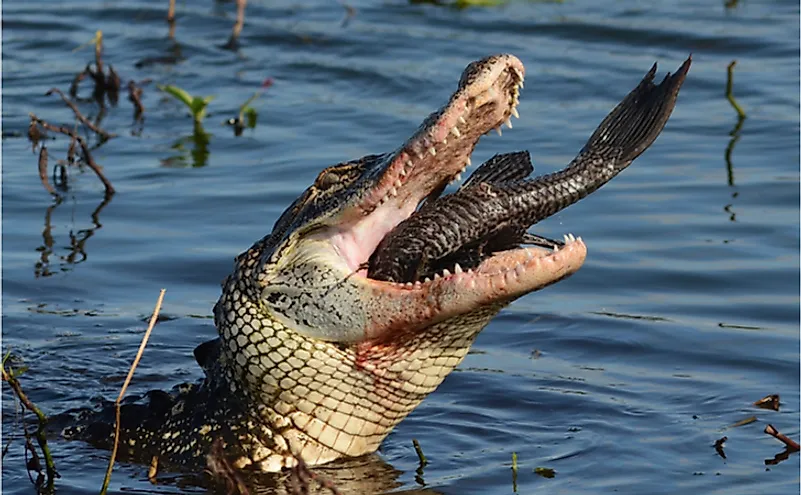
Alligators are opportunistic carnivores, feeding on a wide range of prey depending on their size and habitat. Younger individuals primarily consume insects, small fish, amphibians, and crustaceans found in shallow waters, whereas adults shift toward larger prey such as fish, turtles, snakes, birds, mammals, and sometimes even humans when available. They also scavenge carrion and will take advantage of easy feeding opportunities short distances away from bodies of water.
Diet varies seasonally and is influenced by water levels, temperature, and local prey availability. With that, feeding behavior is closely tied to water temperature and seasonal metabolic changes and patterns observed annually. Furthermore, they typically hunt at night and rely on stealth to capture and kill prey in or near water.
Typical Range In North America

American alligators are native to the southeastern United States, and as you may already be able to tell, they heavily rely on temperate, fresh bodies of water such as wetlands, swamps, rivers, lakes, and slow-moving streams. Their core range includes coastal areas of North Carolina, South Carolina, Georgia, Florida, Alabama, Mississippi, Louisiana, and East Texas.
Florida contains a very dense and well-known population, especially in the Everglades and surrounding wetland systems, with an estimated 1.3 million wild gators. Louisiana also hosts an extensive alligator-friendly habitat across much of it, with an estimated 2 million wild alligators, particularly in its many coastal marshes and bayous along the Gulf of Mexico (Gulf of America).
Although their natural range peters out near central Texas, again, the eastern half of the Lone Star State still boasts about 400,000 to 500,000, mostly concentrated in spots like Caddo Lake (one of the biggest natural lakes in Texas), Brazos Bend State Park, and Big Thicket National Preserve.
Why Do Alligators Favor The Deep South?

To recap, these regions are favorable for alligators because they combine warm temperatures, abundant freshwater, and highly productive wetland ecosystems. The meandering rivers, swamplands, marshes, and shallow lakes, where getting around is easy for these amphibious critters, also provide idyllic conditions for ambush hunting, while simultaneously reducing the energy required for movement. Dense aquatic vegetation offers cover for both vulnerable juveniles and full-grown adults as well, improving hunting success and protection from larger predators.
Soft, muddy banks then allow for nesting and burrow construction, which are important for egg incubation and temperature control. These regions also see plenty of seasonal shifts in wetland size and scope, often concentrating fish, amphibians, and other prey into smaller areas during dry stretches, increasing feeding efficiency at these times.
Lastly, the Deep South's warm climates are critical because alligators are what is known as "ectothermic" (more commonly called "cold-blooded") and depend on external heat to regulate their metabolism, digestion, and reproduction. Furthermore, long growing seasons support high biodiversity in general, ensuring consistent food availability year-round across the South's various sub-tropical habitats.
Why Is The Southwest Devoid Of Alligators?

The differences in environments from East Texas to West Texas, and then the rest of the Southwest of the United States beyond, are staggering. As you pass the central Texas Hill Country and head west, climates become increasingly unsuitable for American alligators. This species depends not only on prolonged warm temperatures to maintain normal, everyday functions, but plenty of moisture too, and transitioning westward from the south takes you from one of the wettest places on the continent to easily one of the driest. Here's what specifically makes these transitions an essentially impassible barrier for alligators in the wild.
Drastically Different Climate and Temperature

To start, in much of the western United States, winters are colder and longer, with frequent freezing conditions that would be lethal to juveniles and highly stressful for adults. Even short periods of sustained ice cover prevent feeding and limit movement between water bodies. Many western regions also experience large daily temperature swings, which add additional physiological strain. While alligators can tolerate brief cold snaps, extended freezing and enormous seasonal water loss prevent stable, year-round populations from becoming established in the Southwest
Also in deep contrast to the Southeast, much of the West has regularly low humidity, which reduces thermal stability, especially in inland basins and high, mountainous elevations (of which there are very few in the Southeast as well). These conditions would greatly reduce the length of the active season should a gator somehow make its way over, to the point where growth and reproduction would become unreliable or impossible.
And when you move north of states like New Mexico, Arizona, and California, average yearly temperatures simply get too low, often seeing drawn-out, snowy winters that are completely hostile to several species of reptiles, not just gators.
Little To No Wetland Habitats

Another major limiting factor of the West is the scarcity of suitable wetland ecosystems. American alligators depend on slow-moving freshwater systems with somewhat stable water levels and abundant vegetation. Much of the western United States is, in turn, dominated by arid or semi-arid landscapes, including deserts, scrublands, and grasslands, where permanent wetlands are rare and widely separated when they do occur.
The rivers that exist here are often heavily channelized, intermittent, or prone to seasonal drying, which further disrupts habitat stability. Reservoirs and irrigation canals may provide water, but out west, they too often lack the complex vegetation structure and natural flood cycles required for breeding and nesting.
Overall, without continuous wetland networks, populations cannot disperse, establish territories, or maintain genetic diversity. This fragmentation prevents the formation of self-sustaining colonies, even in areas where occasional suitable water bodies might temporarily exist.
Changing Topography And Coastal Geology

Topography and geological structure limit the westward expansion of American alligators beyond Texas even more. The landscapes common to the West transition from low-lying coastal plains in the Southeast to elevated terrain, including the Rocky Mountains and extensive basin-and-range systems as you get into Nevada and Utah. These features create steep gradients, overly fast-flowing rivers, and deeply fractured drainage basins that are unsuitable for alligator movement and habitat formation.
Alligators instead rely on still or lazily moving waters that aren't more than a few meters deep and with soft sediment at the bottom, conditions typically absent in high desert or high-energy stream environments. Western watersheds are also more isolated, with many rivers draining internally or flowing through confined valleys rather than broad floodplains.
Furthermore, coastal environments along the Pacific differ significantly as well, with cooler ocean temperatures, strong tides, and limited freshwater marsh systems compared to the Gulf Coast.
Another Reptile For The Job
American alligators clearly need specific environmental conditions that rarely occur in North America outside the southeastern United States. Their dependence on warm temperatures, flat, freshwater wetlands, and low-elevation landscapes explains their sharp range limits, and those combined factors disappear the more westward you head. So, the next time you are swimming in an Arizonan lake, rafting down a river in Utah, or hiking a Pacific Coast marsh in California, you need not fear gators, but should maybe keep an eye out for the odd venomous snake instead.