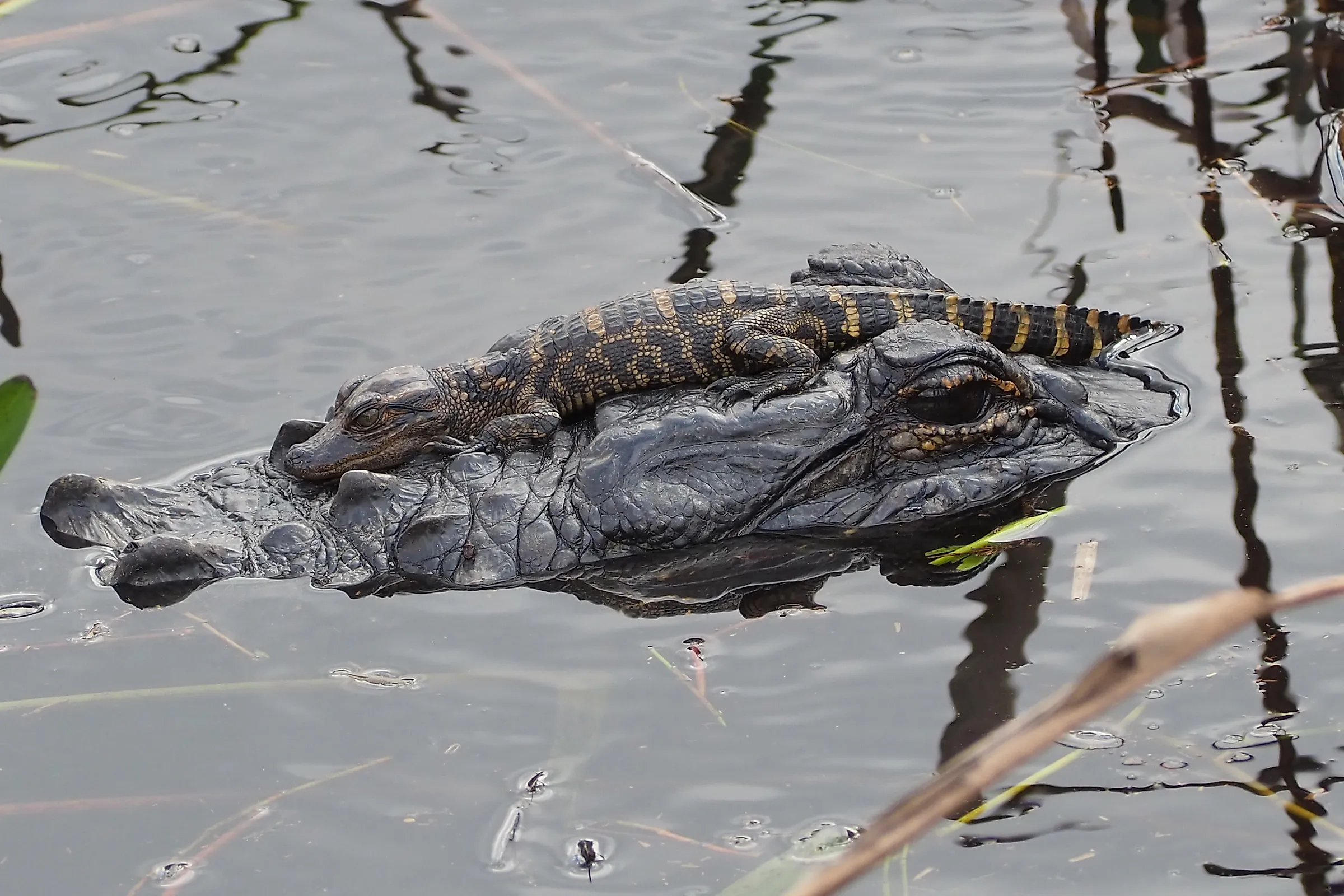
What Is The Difference Between A Crocodile And An Alligator?
A south Florida mangrove is the only place on Earth where wild crocodiles and wild alligators share the same water. Most people couldn't reliably tell them apart if they had to. The two are different species in different families, separated by tens of millions of years of evolution. That split shows up in the snout, the teeth, the size, the salt glands in the tongue, and where each animal can actually survive. Once you know what to look for, the differences are easy to spot.
Where Alligators And Crocodiles Live
Crocodiles live across far more of the planet than alligators do. Different species are spread across Africa, southern Asia, northern Australia, and parts of Central and South America. American crocodiles also reach into southern Florida, which is the one place in the world where wild crocodiles and wild alligators share the same waters.
Alligators are limited to two living species. The American alligator covers roughly ten states across the southeastern United States, with the heaviest populations in Louisiana and Florida. Recent estimates put the wild U.S. population somewhere between four and five million animals, a remarkable rebound for a species that was federally listed as endangered in the 1960s. The other living species, the Chinese alligator, is in much rougher shape. Habitat loss along the lower Yangtze has cut its wild range down to a handful of small reserves in Anhui province, and the IUCN now lists it as critically endangered.
Florida's American crocodiles are a separate recovery story. Hunting and habitat destruction had pushed the U.S. population below 300 adults by the mid-1970s. Federal protection has helped that number climb back above 2,000 today, concentrated almost entirely in the southern tip of the state.
Saltwater Versus Freshwater

Crocodiles can live in saltwater for weeks at a stretch. They have functional salt-excreting glands on the tongue that pump excess sodium and chloride out through small pores. That single piece of plumbing opens up an enormous range of habitats, including coastal mangroves, estuaries, and even the occasional open ocean crossing.

Alligators have similar lingual structures, but they don't work the same way. Research on American alligators has found that their tongue glands secrete at very low rates and don't actively dump salt, so the animals stick to freshwater wetlands, swamps, rivers, and slow lakes. Alligators will tolerate brackish water for short periods, but they aren't built for prolonged saltwater living.
The Difference In Snout Shape

The fastest way to tell a crocodile from an alligator is to look at the snout. An alligator's snout is broad and rounded, shaped roughly like the letter U. Alligator skulls are built to handle hard prey like turtles and large snails, so the wider jaw delivers more crushing force.

A crocodile's snout is narrower and more pointed, closer to a V. A Crocodile snouts are better suited to grabbing and holding fish and mammals, where speed and grip matter more than raw bite pressure.
Teeth And A Closed Jaw

Closed mouths give the second tell. When an alligator clamps its jaws shut, the upper jaw fully covers the lower one and hides all of the bottom teeth. A closed crocodile mouth is the opposite. The fourth tooth on each side of the lower jaw juts up over the upper lip and stays visible at all times, which is why crocodiles always look like they're showing off a partial grin. Alligator teeth also tend to be a bit blunter and more rounded, while crocodile teeth come to sharper points.
Color And Camouflage

Adult alligators run dark gray to nearly black, with paler bellies. Adult crocodiles are usually lighter, somewhere in the tan to olive-brown range. The difference comes down to camouflage. Alligators live in the tannin-stained water of swamps and slow southern rivers, where a darker body blends in. Crocodiles more often hunt in lighter coastal water and sandy estuaries, where a paler body disappears better. Both species can pick up green tints from algae growing on their backs, which is where the cartoon image of bright green alligators came from.
Size And Lifespan

Alligators typically live 30 to 50 years in the wild, with some individuals reaching past 70 in protected settings. Large crocodile species like the saltwater and Nile crocodile routinely live 60 to 70 years, and a handful of captive animals have passed 100. Cassius, a saltwater crocodile in Australia, was estimated to be more than 120 years old when he died in 2024.
The size gap between the two animals is real but smaller than people sometimes assume. Adult male American alligators top out around 14 feet and roughly 1,000 pounds, with most full-grown males in the 11- to 13-foot range. Saltwater crocodiles are the giants of the group. Big males commonly reach 17 feet. The largest verified specimen on record was a Filipino male named Lolong, who measured 20 feet 3 inches and weighed 2,370 pounds. Reports of much larger animals exist, but very few have been measured under controlled conditions.
Mating And Offspring
Alligator mating life is more loyal than scientists used to assume. A long-running study at Louisiana's Rockefeller Wildlife Refuge, published in 2009, found that about 70 percent of re-trapped female American alligators chose the same male partner across multiple breeding seasons. Some pairs were documented breeding together across nearly a decade. That kind of mate fidelity is unusual for a reptile and was the first evidence of pair bonding in any crocodilian species.
Crocodiles, on the other hand, mostly do not pair up across seasons. Genetic studies of crocodile nests routinely turn up clutches of eggs sired by more than one male, which suggests females mate with several partners during a single breeding cycle. Multiple paternity shows up in alligator nests too, on the order of 46 percent in long-term studies, but the long-term partner fidelity finding still seems to be specific to alligators.