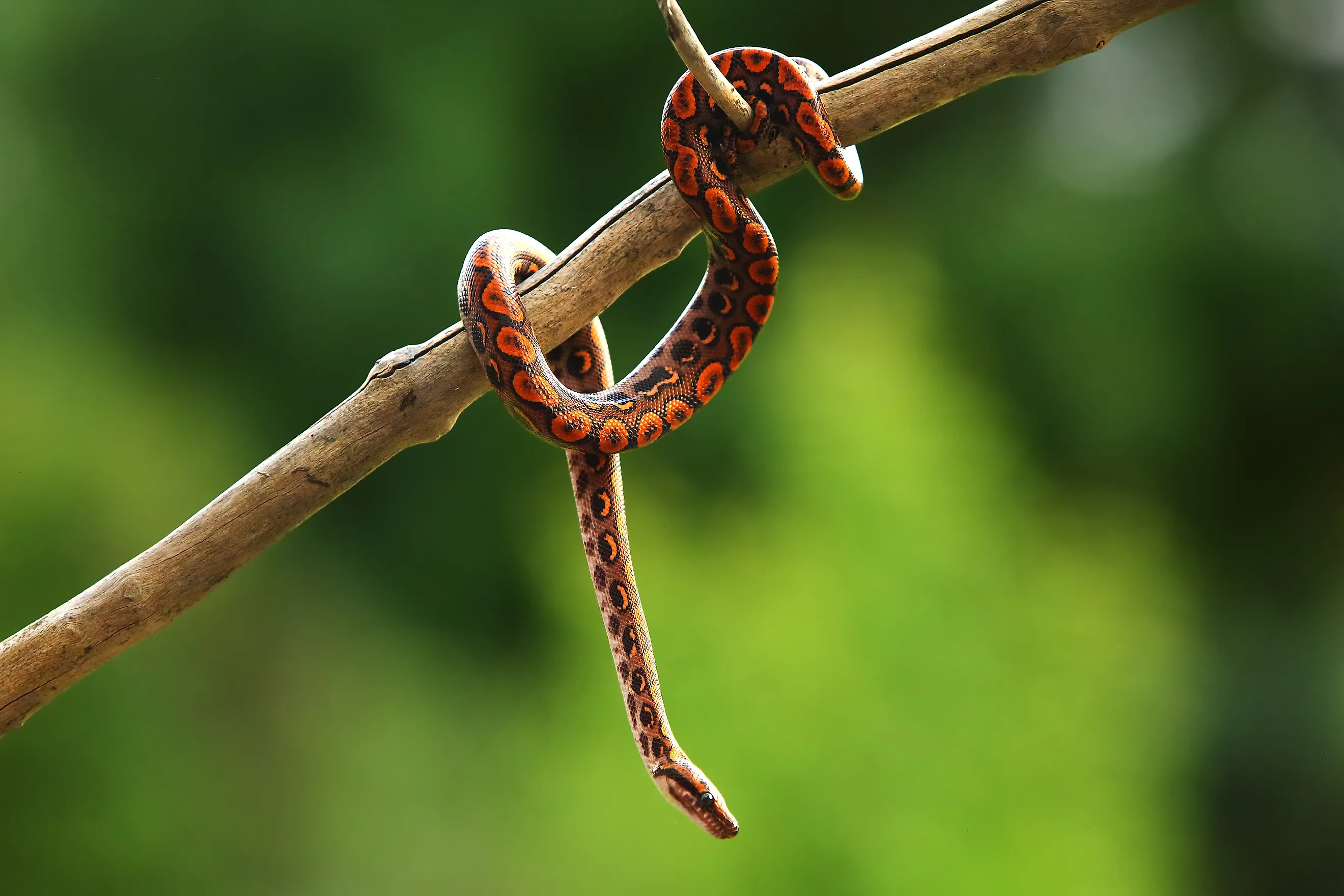
Rainbow Boa
Rainbow boas are a beautiful and unique species of snake that refract light through their scales, causing a rainbow holographic prism to appear along their bodies as they move. Endemic to Central and South America, these snakes are skilled tree-climbers and swimmers. Here you’ll learn not only about why they have that rainbow shine, but also about their habitat, their behavior, their diet, and their reproduction. Additionally, you'll learn why the rainbow boa holds importance both ecologically and spiritually to indigenous people. It's no wonder that myths and traditions have formed around this beautiful, shimmering serpent! Read on to learn more.
Taxonomic Classification

The rainbow boa, Epicrates cenchria, is in the family of Boidae (Boas). Boas are known as primitive snakes and differ from other snake species because they have two hind limbs, known as vestigial legs. These are small spurs that protrude from either side near their cloaca, the vent at the base of their tail. They also have two lungs, unlike other snakes that only have one lung. Rainbow boas are constrictors, which means they are non-venomous and only use constriction to kill their prey. The Epicrates stands for the constriction, while cenchria means bead-like scales. There are five different subspecies within the Epicrates cenchria species, including the Brazilian rainbow boa, the Marajo Island rainbow boa, the Peruvian rainbow boa, the Espirito Santo rainbow boa, and the Central Highlands rainbow boa.
Description and Appearance

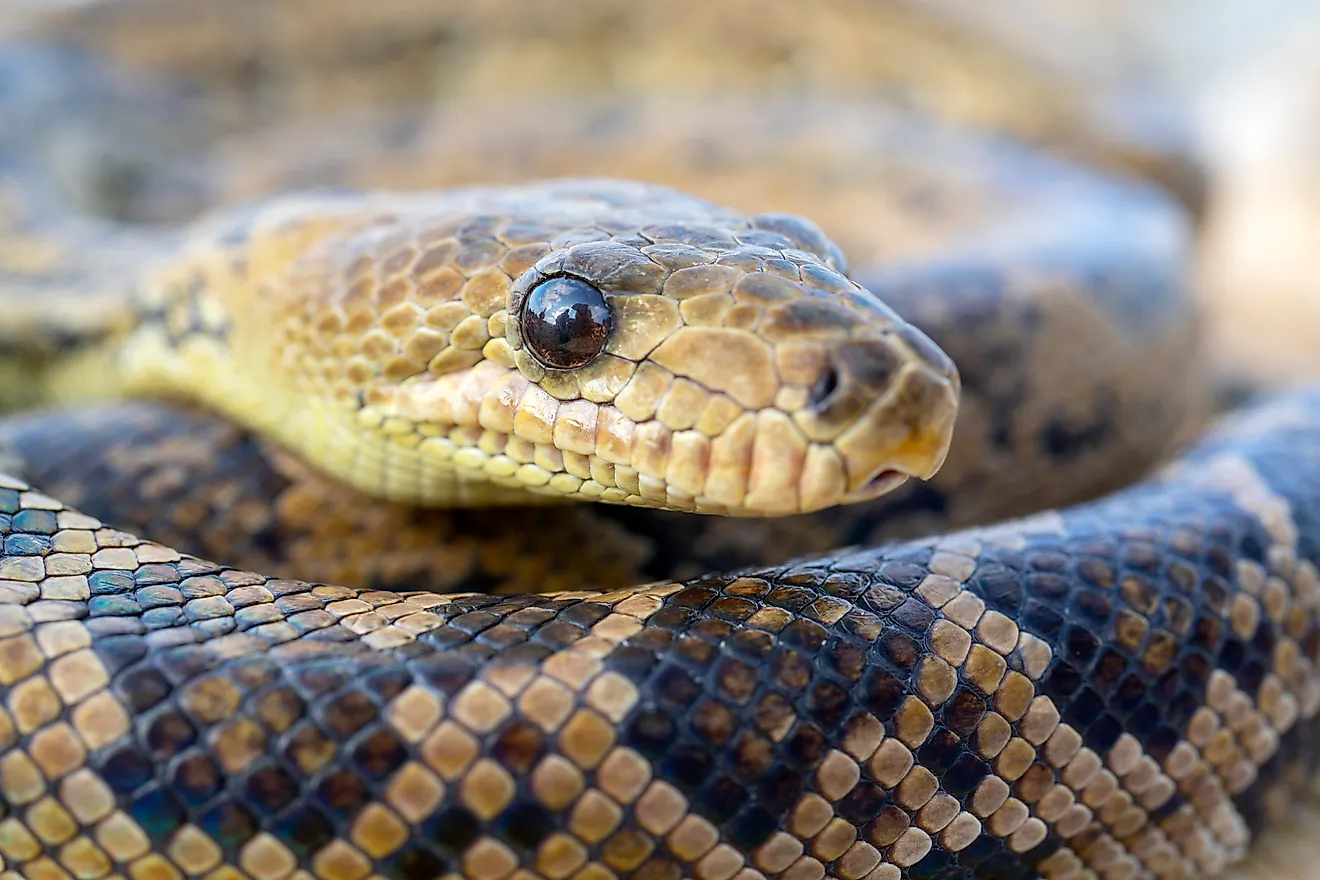
The rainbow boa is known for its uniquely colorful and iridescent appearance. The ridges on their scales refract light, creating an iridescent sheen. This creates rainbow patterns and prisms on their bodies that shift as they move, and the purines in the cells of the outermost layer of their skin are what create these magnificent, vibrant colors. This phenomenon is known as the thin-film effect. The thin-film effect occurs when many microscopic, transparent layers of scales or tissue interact with light at certain angles. Light will hit the different layers of the surface and reflect off the upper and lower layers of the scales in opposite directions. The two different reflected light waves then overlap, causing interference and resulting in certain colors either disappearing or intensifying, creating the shimmering rainbow holographic effect. Their skin refracts light, creating all sorts of alternating rainbow shades. Their primary base is just as beautiful without their holographic sheen. They range from reds to browns to oranges. Usually, they have three very distinct dark stripes near their heads, and dark rings that run along the length of their body. These rings are often filled with crescent-shaped markings in shades of orange, yellow, and red. These go all the way down their back and appear cohesive with the dark spots on their sides. This coloration allows them to easily camouflage. These snakes measure about 4 to 6 feet in length, but have been known to grow longer in certain situations. When they’re born, they are only about 10 to 20 inches long and grow fairly rapidly, growing up to 3 to 4 feet within their first year alive. Females are generally always larger than the males. These snakes can live up to 10 to 20 years, which is about average for many snakes in the wild.
Habitat

These boas live in Central and South America. Mostly found in the countries of Costa Rica, Brazil, Guyana, Suriname, Venezuela, and Panama. Although most commonly known for living in the Amazon, they also inhabit a wide variety of other areas. One common biome they frequent is tropical savannas, a semi-arid to semi-humid terrestrial biome that is comprised of grasslands, trees, and shrubs. The rainbow boa also lives in tropical moist forests, which are considered tropical and subtropical environments. Known for their broadleaf forests and abundant vegetation, these areas are lush and dense. They are extremely biodiverse, have heavy year-round rainfall, and constant warm temperatures. These types of forests have a vertical forest structure: starting on the ground with the forest floor, then the understory, then the canopy, and finally the emergent layer. Rainbow boas live on the ground level, hiding among the deep fallen leaves, thick tangled roots, and dead logs. They also traverse the understory, hiding in the lower flora, lying on low branches, and hiding near water. They can blend in and conceal themselves well within this environment, making it much easier to hunt at night since they’re nocturnal.
Behavior

Rainbow boas are solitary and elusive; they easily conceal themselves in their environment, lying low during the day and soaking in the heat. Since they are nocturnal, they begin hunting about an hour or two after the sun sets. They can hunt at night using the heat-sensing pits near their jaw. This allows them to essentially have thermal cameras, and they can visibly sense body heat, known as infrared radiation, in the dark. Inside these heat-sensing pits is a membrane that is microscopic. When a warm-blooded animal is nearby, the heat from the prey warms the membrane up. The snake's optic tectum in its brain then takes this heat, transferring it into thermal data, which can allow the snake to visually see its prey.
The rainbow boa is not a migratory reptile; it sticks to living in its respective area year-round. They can recognize other members of their species through chemical cues, which is how they communicate. They are also known to be extremely aggressive and will attack if threatened.
Reproduction

Mating occurs regularly around the same time every year. They tend to reproduce between November and January and give birth between spring and summer. A female rainbow boa will be pregnant for about five months. They carry anywhere between 10 and 30 young at once. Rainbow Boas reproduce through ovoviviparity, which means that, unlike other snake species, these boas retain the eggs inside their bodies and give birth to live young. When they are born, they weigh roughly between 12 and 30 grams. Rainbow Boas become sexually mature when they reach a length of around 1.5 meters. This typically occurs around 4 years of age in females and 3 years of age in males, but can also occur earlier, as it's more dependent on their length than their age.
Diet

Rainbow boas are carnivorous, like all snakes. They search out rodents such as rats and mice, as well as birds, including their eggs. Examples of specific prey they seek out include the southern Amazon red squirrel and Tome’s sword-nosed bats. They focus primarily on hunting warm-blooded prey. They will also hunt in the shallows of the water for amphibians and lizards that live near the banks of rivers. Like almost all boas, they are good swimmers, but they don’t prefer to hunt this way, and it is not their preferred food source. The rainbow boa takes a slower approach by waiting and hiding, ambushing their prey, and constricting them. Once they find an area they believe would be a good hunting ground, they camouflage themselves patiently awaiting prey that comes nearby until they can attack.
Threats

Predators of the rainbow boa include large mammals and large birds of prey like raptors and eagles. Environmental threats are high. Due to their unique and beautiful colors, they are unfortunately sought after for pet stores and animal trade, leading to a decline in wild populations from over-collecting. Deforestation and the destruction of their native habitats for agriculture, development, and ranching have all significantly impacted their population. Although they are not currently endangered, these factors may pose a risk to their future safety.
Ecological and Cultural Significance

Rainbow boas play an essential ecological role by maintaining appropriate populations of rodents and pests so they don’t overrun an area. They have played a large role in the research on structural coloration due to its unique features, as well as in general wildlife education. Notably, they also have significant cultural importance in global folklore. This species is known for being related to divine light, water, and creation due to its light-refracting effects and prisms. Its rainbow appearance is also why this snake is a symbol of renewal; to some indigenous people, rainbows symbolize protection and the promise of new life after rain. So it makes sense that the rainbow boa is a symbol of this to many. In the Amazon, the rainbow boa is also known as the “sunset serpent” by Indigenous storytellers. This special boa is considered a mystical guardian that collects the light from the sky as day shifts into night and the sunset begins to glow.
Such a unique and spectacular species of snake, along with all snakes and creatures on this earth, should be protected as best as we can as humans. The rainbow boa holds special meaning not only to our earth but to the people who have inhabited it for centuries. Snakes are not always portrayed well in film and media; they are often depicted as scary, leading people who don’t understand them to fear them. They are of grave importance to our ecological systems, and it is imperative to educate anyone who wants to learn more about them. The more you know and understand about snakes, the more you may like them and want to protect them. Rainbow boas are definitely an intriguing snake to learn more about!