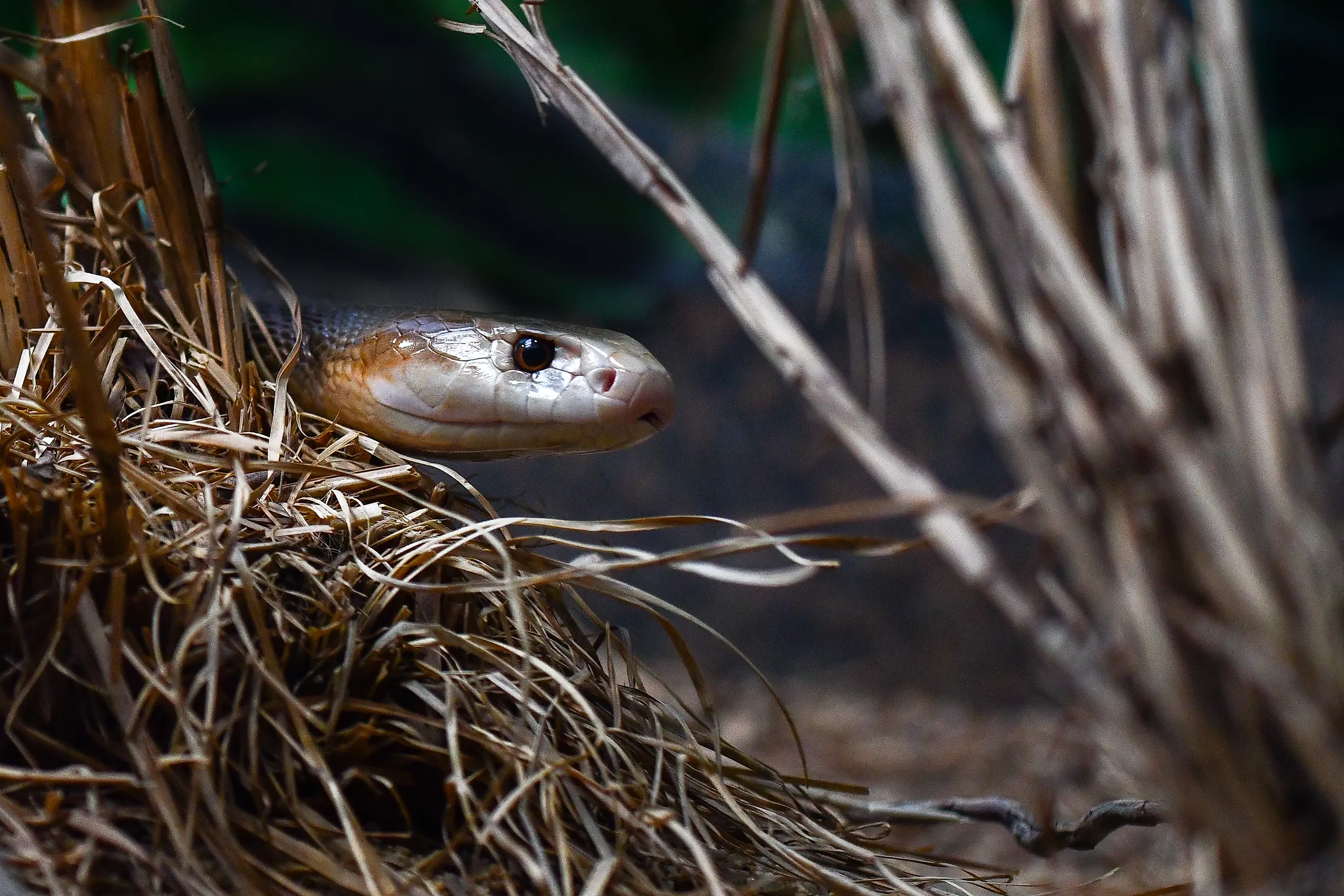
Coastal Taipan
Australia has more venomous snake species than anywhere on Earth: over 140 land snakes, 32 sea snakes, and roughly 100 of those carrying venom potent enough to do real damage. The coastal taipan (Oxyuranus scutellatus) sits high on the danger ranking even by that company, with venom potency that placed it among the world's deadliest snakes and a confirmed bite-fatality rate of essentially 100% before a specific antivenom became available in 1955. It also has a hair-trigger nervous disposition, twelve-millimeter fangs (the longest of any Australian elapid), and a habit of setting up shop wherever rats are easy to find. The result is a snake that the human population of coastal Queensland has had to learn to coexist with, not always on equal terms.
Taxonomic Classification

The coastal taipan's scientific name is Oxyuranus scutellatus. The genus name Oxyuranus comes from the Ancient Greek words for "needle-like" and "arch of heavens"; the species name scutellatus means "small flat shields" and refers to the snake's scales. One subspecies is recognized, the Papuan taipan (Oxyuranus scutellatus canni), though some herpetologists argue the population isn't distinct enough to merit a separate name. O. scutellatus sits in the family Elapidae, which covers venomous snakes with short, fixed front fangs and includes the king cobra of Asia and the black mamba of Africa. Two cousins keep the coastal taipan company in the Oxyuranus genus: the inland taipan (Oxyuranus microlepidotus), generally ranked the most venomous land snake in the world by lethal dose, and the Central Ranges taipan (Oxyuranus temporalis), described to science only in 2007 from a specimen collected the year before in remote Western Australia. The genus name "taipan" itself comes from dhayban, the word for the snake in Wik-Mungkan, a language of Cape York Peninsula in Queensland.
Physical Description

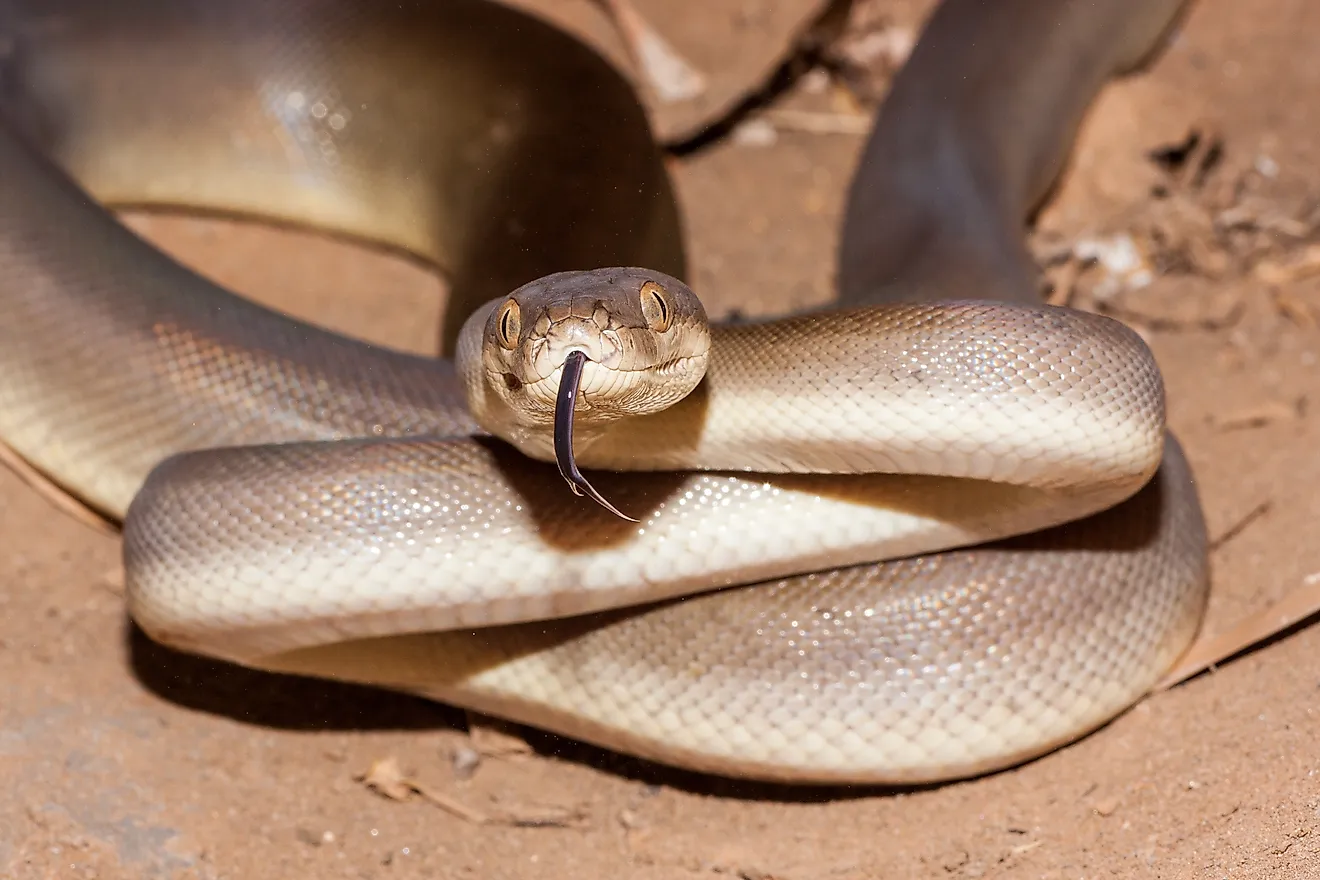
The coastal taipan is the largest elapid in Australia. Adults average six to eight feet (1.8 to 2.4 m) in length, with the largest reliable records pushing close to ten feet. The body is whip-thin and built for speed; the head is narrow and angular, with the largest fangs of any Australian elapid at up to twelve millimeters. Color ranges from light tan through dark brown across the back, with paler bellies and pale heads, and captive snakes have been observed shifting toward darker shades in winter (more dark surface area, more solar heat absorbed). Color alone is unreliable for identification, since coastal taipans share their browns with the eastern brown snake (which has caused most snake-bite deaths in Australia in recent decades). Herpetologists settle the question by counting scale rows: 21 to 23 around the mid-body, 220 to 250 ventral scales running down the underside, a single anal scale, and subdivided subcaudals on the underside of the tail.
Range And Habitat

As the common name suggests, the coastal taipan is found along the eastern, northeastern, and northern coasts of Australia, plus the island of Papua New Guinea and several smaller islands in between. Preferred habitats are warm and often humid rather than arid (the inland taipan handles the dry-interior niche), and include tropical and subtropical coastal grasslands, savanna woodland, monsoon forest, and wet sclerophyll forest. The species has also expanded into a man-made habitat that suits it almost too well: cane fields. Coastal Queensland sugarcane plantations, and oil-palm plantations in Papua New Guinea, both produce reliable rodent populations and few snake predators, which is why farm workers in those regions disproportionately end up in the bite-incident statistics. The species' diet keeps it close to rats and mice wherever they show up, including the outer edges of suburban and agricultural development.
Behavior

The coastal taipan is carnivorous and a specialist on small mammals. Rats, mice, bandicoots, and the occasional bird make up almost all of its diet. It hunts mostly by day (it is diurnal as a rule, though it sometimes shifts to dawn and dusk in hot weather), and relies on excellent eyesight more than most snakes, which is rare in a family where olfactory cues usually dominate. The strike pattern is distinctive. Rather than holding on after a single bite (the constrictor approach) or chewing in to deliver more venom (the colubrid approach), the coastal taipan delivers several rapid strikes and then backs off, letting the prey stagger and die before approaching to feed. This minimizes the risk of injury from a thrashing animal. The same instinct is what creates trouble with humans: a startled coastal taipan would much rather slip away, but a cornered one will advance on the threat at speed and strike repeatedly. The bites that earn the species its reputation almost always happen when a human has wandered too close without noticing the snake at all.
Reproduction

Coastal taipans are oviparous and breed year-round, with a peak (in captive populations, at least) in late winter and early spring. Males compete for mates through ritual combat: two snakes intertwine their bodies and try to push each other to the ground, in what looks like a pair of muscular ropes wrestling in slow motion. The winner gets first access to nearby females; the pair does not stay together after mating. Two to three months later, the female lays a clutch of seven to seventeen eggs, which hatch after another two to three months. Juveniles disperse on their own immediately and grow fast, though the exact age at sexual maturity is not well documented in the wild. Captive coastal taipans have lived up to fifteen years; lifespans in the wild are not reliably known.
Ecological Role, Antivenom History, And Threats

Ecologically, the coastal taipan is a top-tier rodent controller, which matters more than it sounds: unchecked rat and mouse populations damage native fauna and agricultural output alike. Adult taipans have essentially no natural predators, but juveniles are eaten by goannas (monitor lizards), kookaburras, birds of prey, and larger snakes including the king brown. The IUCN classifies O. scutellatus as Least Concern, though continuing habitat conversion and human encroachment are the watchpoint.
The antivenom history is worth recording because it cost a life. In July 1950, a 19-year-old amateur herpetologist living in Sydney, Kevin Budden, made the trip up to Far North Queensland with one explicit goal: capture a live taipan so the Commonwealth Serum Laboratories in Melbourne could finally extract enough venom to develop an antivenom. On July 27, in scrub near a rubbish dump at Edge Hill outside Cairns, Budden found and grabbed a 1.8-meter taipan by hand. While transferring it to a holding bag, he lost his grip and was bitten on the thumb. He insisted the snake be kept alive and flown to Melbourne for research, then died the following day from the neurotoxic venom. The snake arrived in Melbourne by air on July 31, and zoologist David Fleay milked it for venom on August 1, 1950, the first successful milking of a live taipan on record. The antivenom developed from that venom was released by Commonwealth Serum Laboratories in 1955 and saved its first life almost immediately: a 10-year-old Cairns boy named Bruce Stringer. Budden's snake is preserved in the collections of Museums Victoria, and in 2014 researchers tested the original 1950 venom samples and found them still lethally toxic after more than six decades in storage.
A Snake Australia Learned To Live With
The coastal taipan is, by any honest measurement, one of the most dangerous land snakes in the world, and it lives next door to several million Australians. The accommodation between the two species has come at a cost (most directly Kevin Budden's), but the result is that bite fatalities, once a near-certainty, are now vanishingly rare. The snake itself is doing fine; the Wik-Mungkan word it carries has outlasted both the colonial naturalists who recorded it and the era when meeting one in the cane fields meant a short walk to a long funeral.