Africa's "Thunderbird" Is At Risk Of Extinction
The Southern ground hornbill is the largest hornbill on Earth. Its booming territorial call carries up to 5 km and is regularly mistaken for a lion's roar. It will attack its own reflection in glass, often shattering car windows and house panes in the process. In several southern African cultures, a single Southern ground hornbill feather placed in a river is said to summon rain that will not stop until the feather is removed. The bird is called the "thunderbird" and the "rainbird" in those traditions, and is sometimes given a full human-style burial when found dead. It is also disappearing.

The Southern ground hornbill (Bucorvus leadbeateri) is endemic to sub-Saharan Africa, ranging across 16 countries in open woodland, grassland, and savannah from sea level to about 3,000 metres. Taxonomically it sits, along with the Northern (Abyssinian) ground hornbill B. abyssinicus, in the genus Bucorvus and the family Bucorvidae. The family was historically grouped with the other hornbills (Bucerotidae) but has since been separated on the basis of distinct morphology, behaviour, and molecular evidence. The two ground hornbill species are the only members of the family. Both are confined to Africa. The Southern species is the larger of the two, reaching one metre in length and up to 6.18 kg in weight, with males larger than females.
The species is classified as Vulnerable on the IUCN Red List, with a projected population decline of 30 to 49% over the three generations from 1970 to 2049. The bird is regionally Endangered in South Africa, Namibia, and Eswatini, and has disappeared from approximately 70% of its historical range. It is one of the most ecologically important birds in African savannah systems and is among the most well-known birds on the continent culturally. Its functional disappearance from large parts of the range would be permanent.
Biology And Behaviour

The Southern ground hornbill spends more than 70% of its waking time walking, not flying. Groups of two to twelve birds cover up to 11 km per day in search of food, scanning the ground with strong forward-facing vision and probing soil and leaf litter with a heavy, decurved bill. The diet is opportunistic and almost entirely animal: reptiles (including venomous snakes), frogs, small mammals, ground-nesting birds and their chicks, large insects, scorpions, and occasional carrion. The birds also act as apex predators in their micro-habitat, controlling populations of smaller vertebrates, and as bioindicators of savannah health: when their numbers crash, something significant has gone wrong in the surrounding ecosystem.

The species is the largest cooperative-breeding bird in the world. A territorial group consists of one breeding pair, called the alpha pair, and up to ten non-breeding helpers, typically adult sons and younger beta males. The helpers feed the alpha female before, during, and after the breeding period, defend the territory, and help rear the single fledgling. Sons may stay with the natal group for five or more years learning the system before dispersing to find their own territories. Daughters usually leave earlier and may live alone for several years before forming a breeding pair. The birds are very long-lived: 40 to 50 years is typical in the wild, and individuals in captivity have reached 70.
Why The Population Is Falling

Habitat loss is the primary driver. Expansion of agriculture, overgrazing of communal land, urban edge growth, and climate-driven changes in rainfall patterns have all fragmented the woodlands and savannahs the species depends on. Within those reduced areas, the loss of large old trees is a specific and growing problem: the birds need cavities in mature trees as nest sites, and the rate of cavity loss to clearance, elephant damage, and storms now exceeds the rate at which new cavities form in younger trees. South African Dr. Lucy Kemp, Project Manager of the Mabula Ground Hornbill Project and the 2021 Whitley Award winner for her work on the species, explained the South African distribution to WorldAtlas:
"In South Africa, the Southern ground hornbills occur in the provinces of KwaZulu Natal, Limpopo, Mpumalanga and the Eastern Cape. Approximately 60% of the national population occurs in the Greater Kruger National Park, while the remainder is in communal, farming, hunting and privately-owned land. However, the numbers of these birds are continuing to decline, mostly on commercial farmland and communal grazing areas where cultural protection is no longer prevalent."

Poisoning is the second major threat, and it operates through two pathways. First, the birds scavenge on carcasses left after hunting, and lead fragments from bullets remain in much of the discarded tissue. Lead toxicosis is fatal at very small doses. Second, livestock farmers and crop owners sometimes lace carcasses with pesticides to kill predators (typically jackals, leopards, and crop-raiding birds), and ground hornbills feeding on the same carcasses die alongside the intended targets.

The territorial behaviour that makes the species so distinctive also gets it killed. When a bird sees its reflection in a window, car panel, or solar panel, it attacks the perceived rival. Repeated attacks damage windows, mirrors, and farm equipment. Retaliatory killings follow. The traditional cultural reverence for the bird, which once provided informal protection across much of the range, has weakened in recent decades, and hunting for feathers used in rain ceremonies during drought has increased.
Finally, the species reproduces slowly. Females do not begin breeding until about ten years of age. Pairs nest at intervals of several years rather than annually. About 80% of clutches contain two eggs, laid three to five days apart, but the second chick is consistently neglected and dies of dehydration even when food is abundant. The second egg appears to function as biological insurance against failure of the first, a strategy that works for the species but means that real annual recruitment is one chick per breeding pair, at best.
Conservation Through The Mabula Ground Hornbill Project
The Mabula Ground Hornbill Project, based at the Mabula Game Reserve in Limpopo, has worked on the species since 1999. The organisation was founded by Ann Turner and is now run by Dr. Lucy Kemp, whose parents Alan and Meg Kemp pioneered scientific research on the species in the 1970s. The project's approach combines monitoring, reintroduction, threat mitigation, and policy advocacy.
"Our work is currently focussed outside of protected areas (although we conduct monitoring and chick harvesting within protected areas) primarily in South Africa, and our activities also include outreach to neighboring range states through local partners," Dr. Kemp told WorldAtlas.

The reintroduction strategy is the most distinctive element. Because the second chick in a clutch will almost always die in the nest, the project extracts second chicks from wild nests, raises them in controlled conditions, and uses them as the founding stock for new groups in areas where the species has been lost. The harvested second chick would otherwise add nothing to wild population recruitment; using it for reintroduction generates additional birds without depressing wild productivity.
The project has also partnered with a South African university to develop an artificial nest design that is engineered to last for most of a breeding female's productive lifetime, is climate-resilient against the increasingly extreme summer temperatures of the savannah, and can be installed in areas where the cavity supply has been lost. Installation sites are chosen in collaboration with landowners.

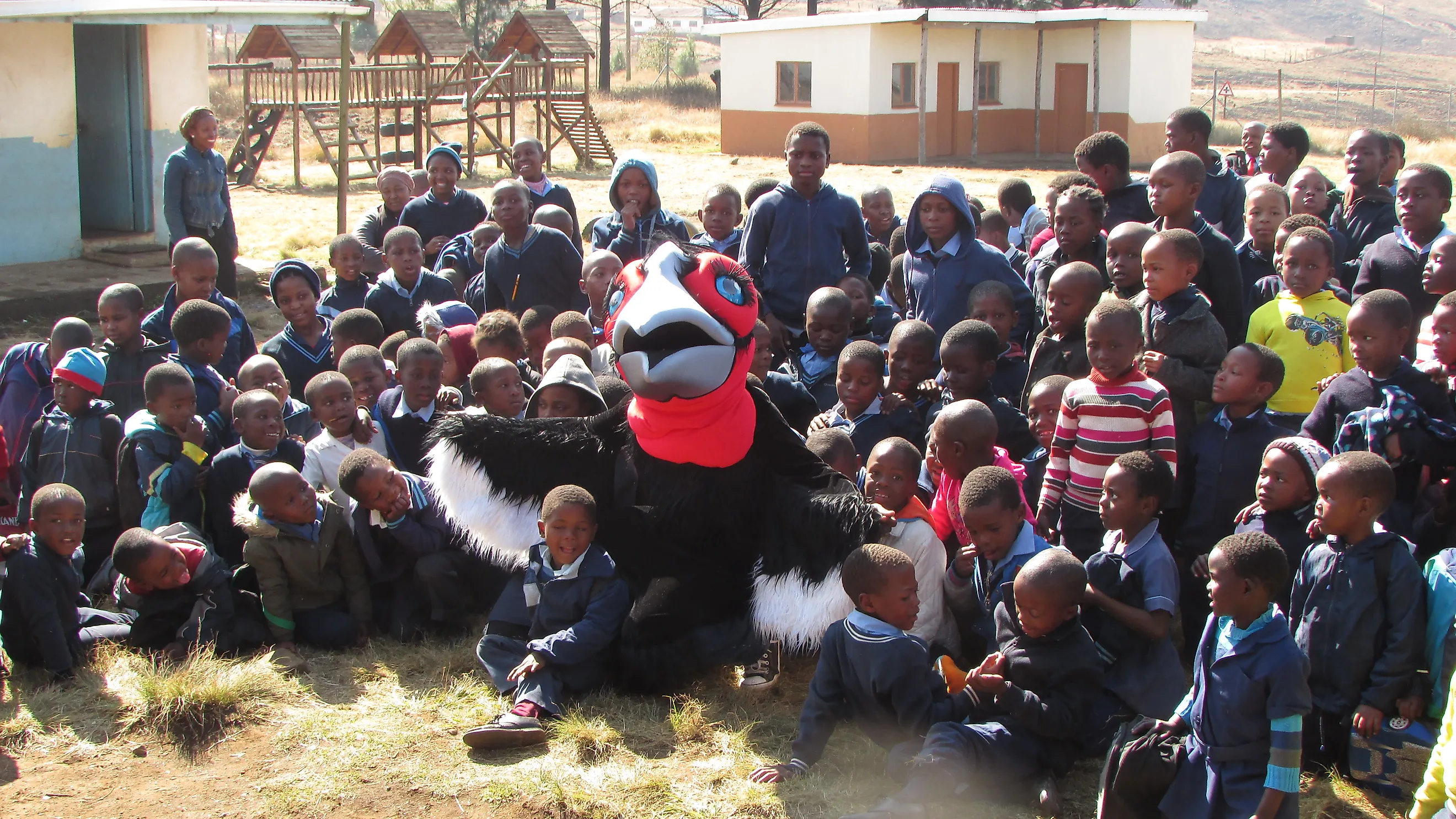
The Mabula team also works with other organisations conserving species facing the same threats (especially raptors and vultures vulnerable to the same poisons and to the same retaliatory killings) to lobby for changes in pesticide regulation and lead-ammunition policy in southern Africa. The project's outreach programmes in rural schools and communities target the behavioural side of the problem.

"We go by the cooperative approach, where we seek to work with the people who are the source of some of the threats in developing practical solutions to the threats," said Dr. Kemp.
What Losing The Thunderbird Would Mean
The Southern ground hornbill is one of the slowest-reproducing birds in Africa, has lost approximately 70% of its historical range, and faces threats that are not declining. The species is also a flagship indicator: its presence or absence in a landscape reflects the health of that landscape more broadly. Where the Southern ground hornbill is gone, smaller predators and scavengers usually follow. Dr. Kemp summarised the case for sustained intervention to WorldAtlas:
"The Southern ground hornbills are an integral part of African landscapes, one of the most well-recognized bird species in the continent. The more we lose, the harder it will be to recover what has been modeled to go extinct without conservation intervention. These birds play an important ecological and cultural role, and their disappearance from the savannah would be irreparable."