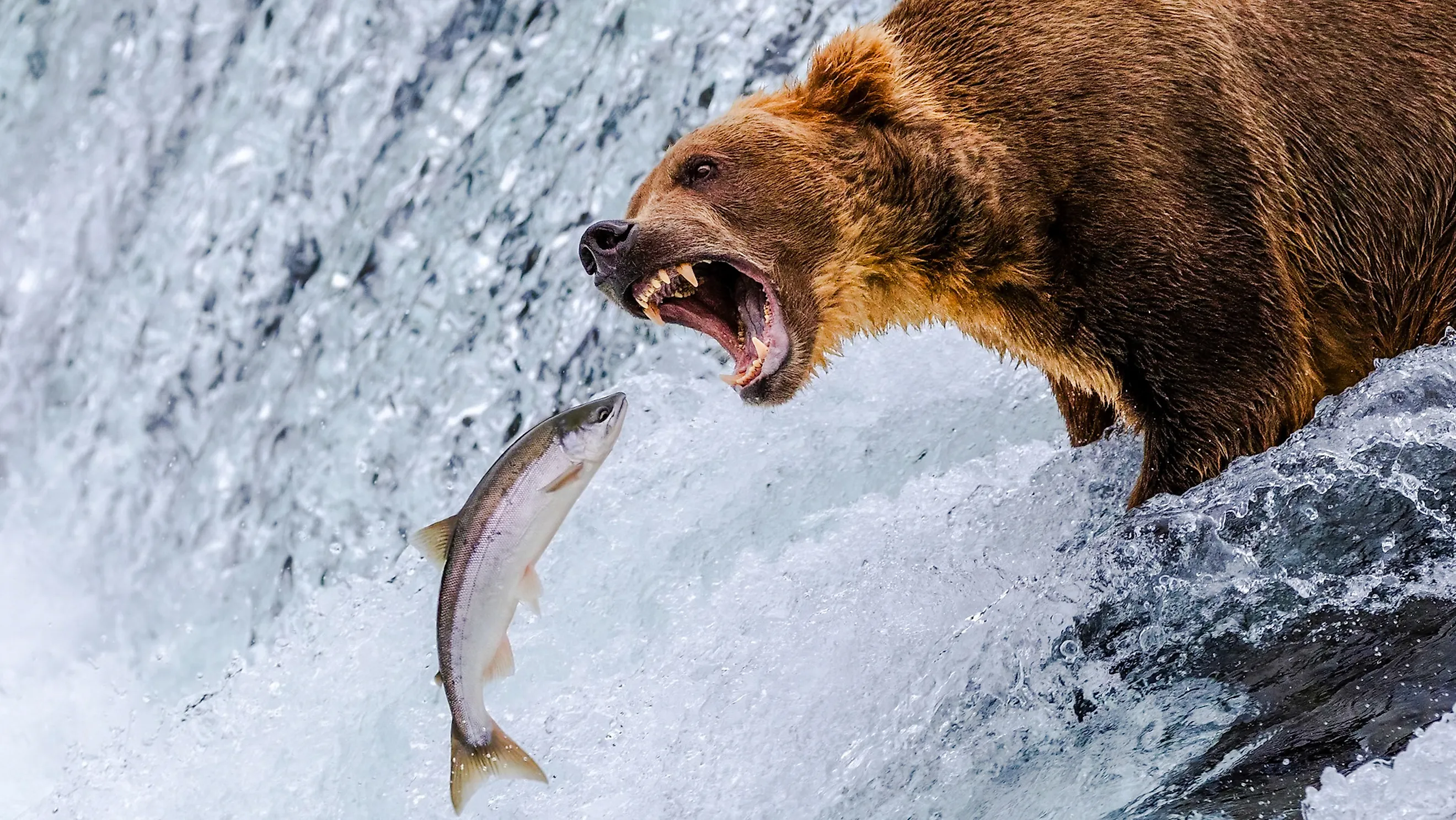
Grizzly Bear
Around 55,000 grizzly bears remain in North America, the survivors of an aggressive 19th- and early-20th-century bounty-program extermination that pushed the subspecies from an estimated 50,000 individuals across 18 western states down to roughly two percent of its historical range by the 1930s. The Latin name Ursus arctos horribilis sticks the species with the adjective "horrible" (early European settlers were not subtle), and the silver-tipped fur that gave the bear its English name reads the same way from a distance: a 600-pound omnivore that can outrun an Olympic sprinter, dig a den into a hillside with two-inch claws, and shift its seasonal diet across roots, berries, salmon, and elk. The bears are now mostly restricted to Alaska, Canada, and four contiguous-state ecosystems where conservation programs have steadily rebuilt the lower-48 population from fewer than 800 in 1975 to over 1,900 today.
Taxonomy
The grizzly's full scientific name is Ursus arctos horribilis, a subspecies of U. arctos, the brown bear. Brown bear taxonomy has been argued over for more than a century, and at one point in 1918, biologist Clinton Hart Merriam divided the North American brown bears into 86 separate subspecies on skull-measurement criteria that have since been mostly abandoned. Two North American brown bear subspecies are now broadly accepted: the mainland grizzly (U. a. horribilis) and the Kodiak bear (U. a. middendorffi), which has been genetically isolated on the Kodiak Archipelago in Alaska for around 12,000 years and runs noticeably larger than mainland grizzlies (Kodiak males regularly exceed 1,300 pounds).
Two North American grizzly subspecies are extinct. The California grizzly (U. a. californicus), the animal still depicted on the state flag of California, was hunted to extinction with the last confirmed killing in 1922 and the last reported sighting in 1924. The Mexican grizzly (U. a. nelsoni), known for its silver coloration, was declared extinct in the mid-1960s, with the last confirmed individuals shot in the Sierra del Nido of Chihuahua in 1964.
One other population sometimes treated as the mainland grizzly is the Alaska Peninsula brown bear, on the southern Alaska coast where the salmon-fed diet produces some of the largest individuals in the subspecies.
Range and habitat

The grizzly's historical range covered most of the western United States, western Canada, and northern Mexico, with grizzlies most abundant in the Rocky Mountains and along the Upper Missouri River. Today the range has contracted sharply and runs through Alaska, the Yukon, Northwest Territories, Nunavut, and British Columbia in Canada, with four recovered or recovering populations in the contiguous United States: Greater Yellowstone, Northern Continental Divide, Cabinet-Yaak, and the Selkirks.
Alaska holds the largest grizzly population at around 30,000 individuals, followed by Canada at roughly 21,000 to 25,000. Per the U.S. Fish and Wildlife Service's 2024 distribution summary, the lower 48 hold at least 1,923 grizzlies, with 1,092 in the Northern Continental Divide Ecosystem (mostly Montana), 727 in the Greater Yellowstone Ecosystem (Wyoming, Idaho, and Montana), about 60 in the Cabinet-Yaak Ecosystem along the Montana-Idaho border, and a minimum of 44 in the U.S. portion of the Selkirks (which crosses Idaho, Washington, and British Columbia). The North Cascades Ecosystem of Washington, identified as a recovery zone in 1993, currently has no known resident grizzly population, though a federal-state reintroduction effort began in 2024 to restore one.
The biggest contiguous-state grizzly hotspot is the Yellowstone National Park region, where the bear population has grown from about 136 individuals in 1975 to 727 today across the Greater Yellowstone Ecosystem. Most of Montana's grizzlies live in the Northern Continental Divide Ecosystem in the northwest of the state, anchored by Glacier National Park.
Despite the restricted current range, grizzlies are highly adaptable across habitat types. They live in woodlands, alpine areas, deciduous forests, subalpine meadows, coastal rainforest, and tundra. The salmon-rich corridors of the Pacific Northwest and southern Alaska support the largest individuals; inland populations rely more on roots, tubers, berries, and ungulates. Grizzlies once occupied the Great Plains in large numbers but were eliminated from the region by hunting through the 19th century.
Physical traits

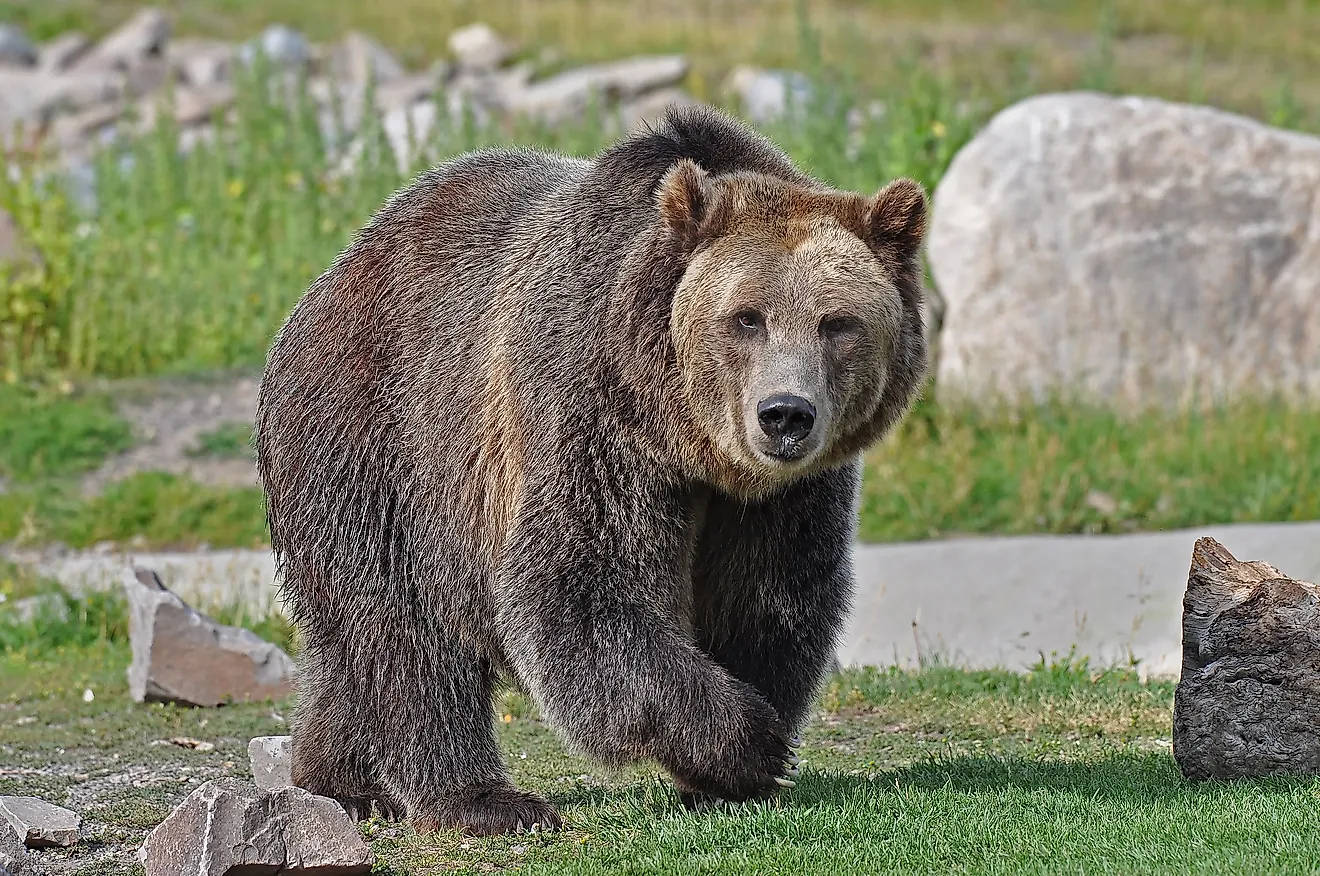
Grizzly coat colour varies from light tan and blond through dark brown to nearly black, with the silver-tipped (or "grizzled") guard hairs along the back and shoulders that give the bear its common name. The face is the most distinctive feature: a concave or "dished-in" profile with short, rounded ears (noticeably shorter than the black bear's longer, more upright ears). Younger grizzlies have larger ears that sit closer together; the ears appear smaller and more widely spaced as the head grows.
The defining anatomical feature of the grizzly is the muscular shoulder hump, a mass of muscle attached to the spine that powers the bear's digging stroke. Combined with the two- to four-inch front claws (substantially longer and less curved than the black bear's one- to two-inch claws), the hump lets grizzlies excavate ground squirrels, marmots, roots, and winter dens at speeds no other North American mammal can match. The grizzly's rump sits lower than its shoulders, the reverse of the black bear, which is a useful field-identification cue.
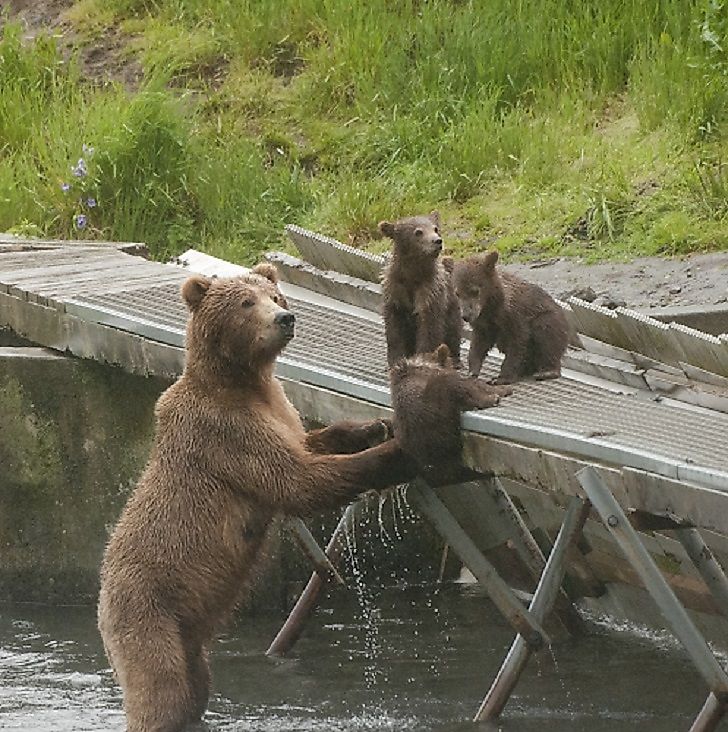
Adult males in the lower 48 typically weigh 400 to 790 pounds and females 290 to 400 pounds, with coastal Alaska populations running substantially larger. Body length runs about 6.5 to 7.8 feet. Grizzlies stand on their hind legs not to threaten but to get a better visual or scent line on whatever has caught their attention; the upright posture is investigative, not aggressive.
The senses tell a counterintuitive story. Grizzlies see in colour but are mildly near-sighted. The famous nose is real (grizzlies can detect carrion or food from a mile away under the right wind conditions), and hearing covers both low and high frequencies well enough that Yellowstone bears reportedly track chattering squirrels in order to locate the whitebark pine cones the squirrels have cached for winter.
Food

The grizzly's adaptability is largely a function of its omnivorous diet. A literature review for the Greater Yellowstone Ecosystem documented more than 260 plant and animal species consumed by local grizzlies, drawn from four of the five kingdoms of life. Plant foods include grasses, sedges, berries (huckleberries and buffaloberries especially), roots, tubers, pine nuts, and the occasional cone. Animal foods include salmon, trout, ground squirrels, marmots, mice, ungulate calves, and larger prey like adult elk, moose, and bison. Carrion and the kills of other predators are major opportunistic food sources.
Grizzlies can sprint up to 30 miles per hour over short distances, fast enough to run down weakened or younger ungulates. The bite force averages around 1,160 psi, putting the grizzly's jaws among the strongest of any terrestrial mammal. Cubs are vulnerable to wolves, mountain lions, and occasionally to adult male grizzlies, but adult grizzlies have no natural predators in their range.
Diet shifts seasonally. Spring runs heavy on winter-killed ungulate carcasses and emerging vegetation. Summer adds berries and the army cutworm moths that congregate at high elevations in Yellowstone (where a single grizzly can consume up to 20,000 moths in a day). Autumn is hyperphagia, the pre-hibernation feeding window in which a grizzly may put on three to four pounds a day. Grizzlies do not feed during hibernation, which runs five to seven months in lower 48 ecosystems and longer in interior Alaska.
Behaviour and reproduction

Grizzlies are mostly solitary outside the mother-cub bond. Female home ranges run around 50 to 300 square miles; male home ranges run up to 500 square miles or more and overlap multiple female ranges. Bears communicate through a vocal range that includes grunts, moans, growls, and the bawl of a distressed cub, and through scent marking by rubbing against trees and through scrape marks. Mothers and cubs maintain near-constant low-volume contact.
Mating runs from May through July. Males compete physically for access to receptive females and may mate with multiple partners across the season. Females are induced ovulators (ovulation is triggered by copulation), and fertilised eggs undergo delayed implantation: the blastocyst remains free-floating until late autumn, when implantation occurs only if the female has built up sufficient fat reserves to support pregnancy and lactation through hibernation. Active gestation after implantation lasts about two months, with cubs (typically two, occasionally one to four) born in the den in January or February. Cubs weigh less than a pound at birth, nurse through the winter on the milk of the dormant mother, and emerge with her in spring. Females keep their cubs for two to three years and will not mate again during that period, which is one of the slowest reproductive cycles among North American mammals.
Threats and conservation

The grizzly is listed as Least Concern on the IUCN Red List at the species level (counting all of Ursus arctos globally), but the lower-48 population has been listed as Threatened under the U.S. Endangered Species Act since 1975. The Mexican grizzly is extinct; the California grizzly is extinct; the grizzly's range across the contiguous United States is around two percent of its pre-1800 footprint.
Nineteenth-century westward expansion eliminated grizzlies across the Great Plains and most of the southwestern range. State and federal bounty programs paid for grizzly carcasses, and poisoned-bait campaigns targeting wolves and grizzlies in support of the livestock industry accelerated the population collapse. The lower-48 population bottomed out at around 700 to 800 individuals by the time of the 1975 ESA listing.
The 1993 U.S. Fish and Wildlife Service Grizzly Bear Recovery Plan identified six ecosystems for recovery focus: Greater Yellowstone, Northern Continental Divide, North Cascades, Selkirks, Cabinet-Yaak, and the Bitterroot. Four of those ecosystems now support breeding populations. Recovery has been substantial enough that two federal attempts to delist the Yellowstone population (in 2007 and 2017) have proceeded, though both were ultimately reversed by federal courts over genetic-isolation and connectivity concerns.
Fatal grizzly attacks on humans run around two to three per year across North America. Glacier National Park has recorded around 11 fatal bear attacks since the park's establishment in 1910, the most notable being the "Night of the Grizzlies" on August 13, 1967, when two young women were killed by two different bears in separate incidents in the same night, an event that prompted a comprehensive overhaul of bear management in the national park system. Attacks typically involve a surprised bear, a defensive mother with cubs, or a bear conditioned to human food. Current management challenges include climate-driven shifts in food availability (whitebark pine decline in particular) and the steady expansion of human residential and agricultural land use into grizzly recovery zones, particularly in Montana.
How to stay safe in grizzly country
Standard backcountry protocol in grizzly habitat: make noise while hiking (calling out at blind turns and dense brush), travel in groups of three or more (statistically, attacks on lone hikers and pairs are substantially more common than on larger groups), carry bear spray and know how to use it, store food in bear-resistant canisters or hung properly, and stay on designated trails. Never approach a bear at any distance, particularly a sow with cubs. Avoid animal carcasses, which a grizzly may be guarding. Never run from a bear (running triggers a chase response); back away slowly while keeping the bear in view and speaking calmly. Individual bears vary considerably in temperament, and proper judgement on a backcountry trail matters more than any single protocol.