8 Types of North American Squirrels
North America is home to at least eight native species of squirrel in the strict sense, including six tree squirrels of the genera Sciurus and Tamiasciurus plus two species of flying squirrel in the genus Glaucomys. The size range across these eight is roughly 20-to-1: the fox squirrel sometimes reaches 1 kilogram, while the southern flying squirrel can weigh as little as 50 grams. All eight share a long bushy tail, sharp incisors that grow continuously through life, ankle joints that can rotate 180 degrees (allowing the head-first descent of vertical trees), and a diet centered on seeds and nuts that they cache in scattered locations for later retrieval. The Sciuridae family they belong to is much larger and includes ground squirrels, chipmunks, marmots, woodchucks, and prairie dogs, but the eight ahead are the species most commonly called squirrels in everyday usage. They are also the species most likely to be encountered in residential backyards, urban parks, and forested areas across the continent.
Fox Squirrel

The fox squirrel (Sciurus niger) is the largest tree squirrel native to North America, with a head-and-body length of 25-38 cm, a tail nearly equal in length, and a total weight of 500 to 1,000 grams. Fur color varies considerably by population, ranging through brown-gray, brown-yellow, brown-orange, and in some eastern Great Plains populations an all-black melanistic morph. The species occupies most of the eastern and central United States and small portions of southern Canada, with introduced populations on the West Coast. Fox squirrels prefer open woodlands with scattered trees, particularly oak-hickory or oak-pine forest, and rely heavily on acorns and hickory nuts as their seasonal staple foods. The IUCN classifies the species as Least Concern, with stable to expanding populations across most of its range.
Western Gray Squirrel

The western gray squirrel (Sciurus griseus) is the largest tree squirrel native to the West Coast of North America, with a total length of about 50 cm and a weight up to about 950 grams. The species occupies oak woodlands and conifer-oak forests along the Pacific Coast, with populations in Washington State, Oregon, and most of California. Western gray squirrels are more strictly arboreal and more reclusive than eastern gray squirrels, spending the majority of their time in the tree canopy and coming to the ground primarily to forage or bury food caches. The IUCN classifies the species as Near Threatened due to habitat loss, fire-related habitat changes, and competition from introduced eastern gray squirrels, with notable population declines across Washington and Oregon.
Abert's Squirrel

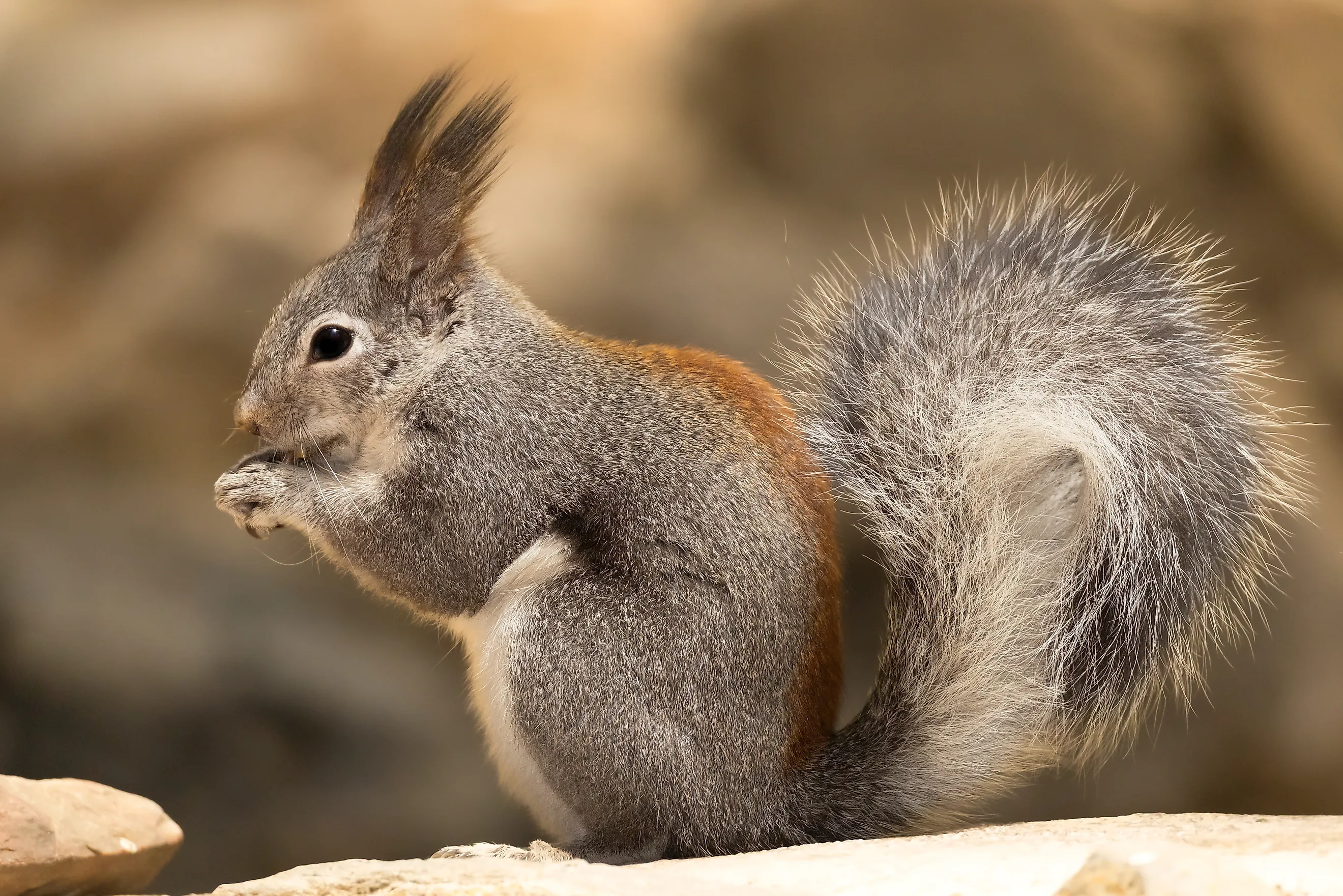
Abert's squirrel (Sciurus aberti) is a medium-large tree squirrel of the southwestern United States and northern Mexico, with a total length of about 46-58 cm and a weight of 540-900 grams. The species is immediately distinguishable by the long ear tufts that grow up to 7 cm during winter and the broad, tassel-like tail. Abert's squirrel has an unusually narrow ecological niche: it lives almost exclusively in ponderosa pine forests of the Colorado Plateau and the Mogollon Rim, feeds primarily on ponderosa pine seeds and inner bark, and shelters in stick nests called dreys built among the pine branches. The species was named after Lieutenant Colonel John James Abert, a 19th-century officer of the US Army Topographical Engineers who oversaw scientific exploration of the American West. The IUCN classifies Abert's squirrel as Least Concern.
Eastern Gray Squirrel

The eastern gray squirrel (Sciurus carolinensis) is the most widely distributed tree squirrel in North America and the species most commonly encountered in eastern US backyards and urban parks. Adults reach a body length of 23-30 cm with a tail of similar length, and weigh between 400 and 700 grams. Color is typically gray with a white underside, but the species shows two well-known color variants: a black (melanistic) form common in the Great Lakes region and southern Canada, and an occasional all-white (albino or leucistic) form. Eastern gray squirrels can descend a tree head-first by rotating their hind ankle joints 180 degrees so the claws point upward as they climb down. The species has been introduced to the United Kingdom, Ireland, and Italy, where it competes with native red squirrels and has become an invasive species of major conservation concern.
American Red Squirrel

The American red squirrel (Tamiasciurus hudsonicus) is a small, aggressive tree squirrel of the boreal and mountain coniferous forests of North America, with a body length of 16-22 cm and a weight of 200 to 250 grams. The fur is rust-red on the back and white below, with a distinct white eye ring. The species ranges across most of Canada and Alaska, the Rocky Mountains, the northern Great Lakes states, and New England. American red squirrels are unusually territorial for tree squirrels and defend large food caches called middens (piles of cone scales and discarded cones that can grow to a meter deep over decades of accumulation by successive generations of squirrels in the same territory). The IUCN classifies the species as Least Concern, although the Mount Graham red squirrel (a genetically distinct subspecies endemic to the Pinaleño Mountains of southeastern Arizona) is critically endangered, with a 2024 fall survey counting only about 144 individuals.
Douglas Squirrel

The Douglas squirrel (Tamiasciurus douglasii), also called the chickaree, is a small tree squirrel of the Pacific Northwest coniferous forests, with a body length of 18-23 cm and a weight of 170-230 grams. The species is closely related to the American red squirrel but slightly smaller and darker, with olive-brown to reddish-brown upper fur and an orange-buff belly. Douglas squirrels range across southwestern British Columbia, Washington, Oregon, and the Sierra Nevada of California, where they share habitat with the western gray squirrel. The naturalist John Muir wrote at length about the species in his 1909 book Our National Parks, calling the Douglas squirrel "the most influential of all the Sierra animals" and "by far the most interesting and influential of the California Sciuridae." The IUCN classifies the Douglas squirrel as Least Concern.
Northern Flying Squirrel

The northern flying squirrel (Glaucomys sabrinus) is a nocturnal gliding squirrel of the coniferous and mixed forests of Canada, Alaska, and the northern United States, with a body length of 25-37 cm and a weight of 75-140 grams. Flying squirrels do not actually fly: they use a furred membrane called the patagium that stretches between their wrists and ankles to glide for distances of up to about 50 meters between trees. The species is rarely seen by people because of its strict nocturnal habits, and it is best detected with infrared cameras or by listening for the soft trilling vocalizations the squirrels use to communicate with one another. Northern flying squirrels eat lichens, fungi (especially the truffle-like underground fungi that form mycorrhizal partnerships with conifer roots), seeds, and occasionally insects, and they play an important ecological role by spreading mycorrhizal fungal spores through their forest territories.
Southern Flying Squirrel

The southern flying squirrel (Glaucomys volans) is smaller than its northern cousin, with a body length of 21-26 cm and a weight of just 45-85 grams (the smallest squirrel species native to North America). The species ranges across the eastern United States south of New England and into southern Ontario and Quebec, with a separate population in the highlands of central Mexico and Guatemala. Southern flying squirrels are even more strictly nocturnal than northern flying squirrels and are notable for their highly social winter behavior: in cold weather, groups of up to 20 squirrels will share a single tree cavity for warmth, huddling together to conserve body heat through the night. The species eats nuts, seeds, fruits, fungi, insects, and occasionally bird eggs and nestlings, making it one of the more omnivorous squirrels of North America. The IUCN classifies the species as Least Concern.
What These Eight Have In Common
All eight species above belong to the family Sciuridae, the squirrel family, which contains more than 280 species worldwide. The eight covered here are tree squirrels and flying squirrels, the species most often called simply "squirrels" in everyday usage; the same family also includes ground squirrels, chipmunks, marmots, woodchucks, and prairie dogs, which together comprise dozens of additional species in North America that are not covered in this article. The black-furred squirrels often spotted in eastern North American cities are not a separate species: they are melanistic color variants of either the eastern gray squirrel or the fox squirrel, produced by a genetic mutation affecting melanin pigment production. The black coloration is particularly common in the Great Lakes region and southern Ontario, where research suggests the darker fur may provide a modest thermal advantage during cold winters. Conservation status varies across the eight: most are listed as Least Concern by the IUCN, but the western gray squirrel was reclassified as Near Threatened in 2019, and several geographically restricted subspecies (most notably the Mount Graham red squirrel of Arizona, with about 144 individuals counted in 2024) are critically endangered.