Maps of Florida
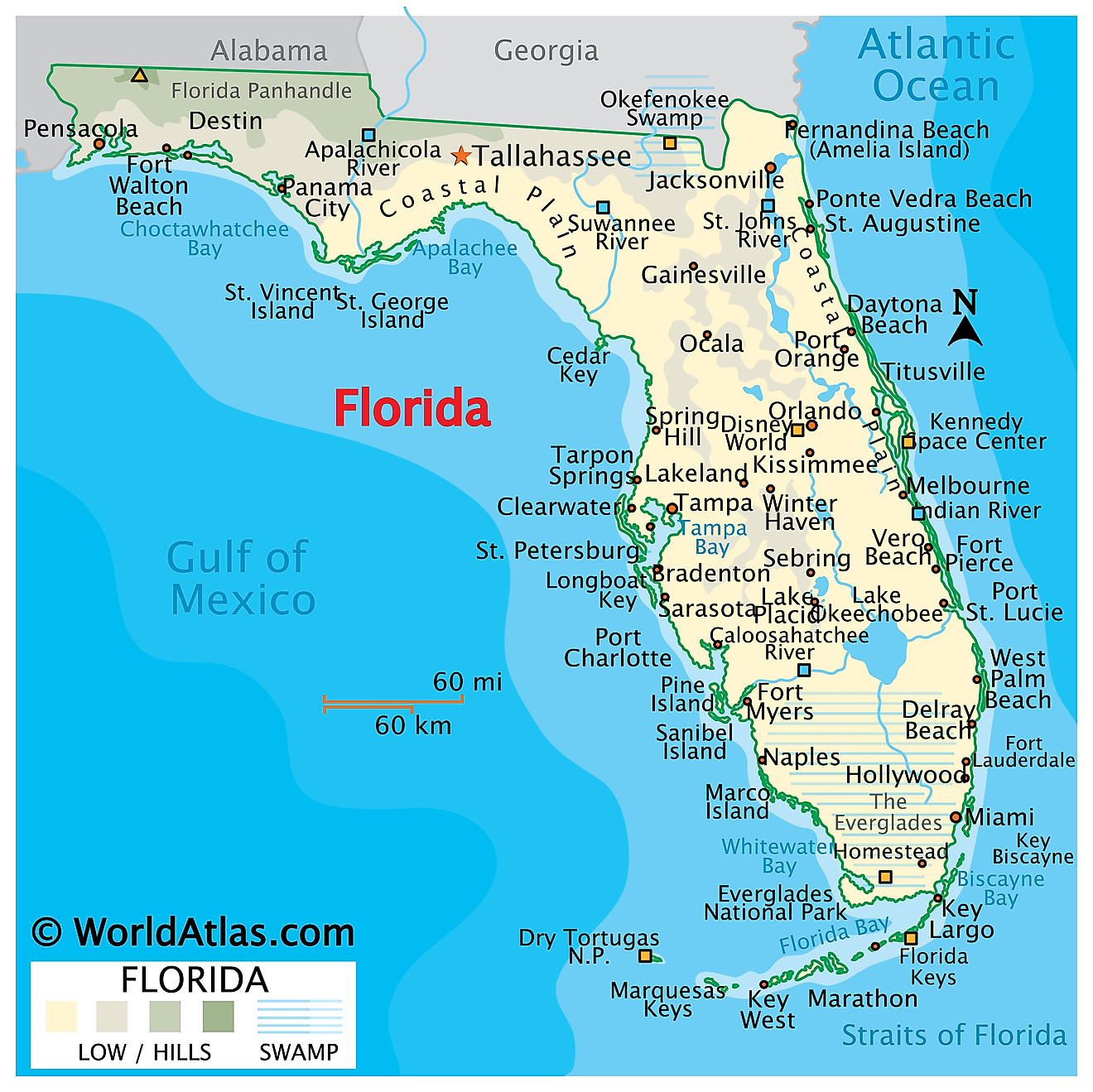
Florida, nicknamed the Sunshine State, is a peninsula in the southeastern United States. It borders Alabama and Georgia to the north and is the only state with a coastline on both the Atlantic Ocean and the Gulf of Mexico. It also spans two time zones, Eastern and Central.
Florida's capital, Tallahassee, sits in the northern panhandle, while Jacksonville, the most populous city, lies in the northeast along the St. Johns River. The United States acquired Florida from Spain and organized it as a territory in 1821; it became the 27th state in 1845.
Size
Covering about 65,758 sq mi (170,312 sq km), Florida is the 22nd largest state. It is roughly half the size of Finland and about twice the size of Maine. Nearly one-fifth of that area is water: about 53,625 sq mi (138,887 sq km) is land, and the remaining 12,133 sq mi (31,424 sq km) is water, a reflection of the state's vast lakes, rivers, and wetlands.
Bodies Of Water

Florida holds more than 7,700 lakes and over 1,700 rivers that together run more than 25,000 mi (40,000 km). The largest lake, Lake Okeechobee, covers 730 sq mi (1,900 sq km), making it the eighth-largest natural freshwater lake in the United States and the second-largest wholly within the contiguous 48 states, after Lake Michigan. Lake George is the state's second-largest lake at 72 sq mi (186 sq km).
The longest river is the St. Johns, which runs more than 300 mi (483 km) and is unusual for flowing north; the Atlantic tide even reverses its flow twice a day near its mouth. The Suwannee River is second at 246 mi (396 km), while the short Miami River, only about 5.5 mi (8.9 km) long, runs through the heart of Miami. Beyond its lakes and rivers, Florida is defined by its wetlands, above all the Everglades, a slow-moving sheet of freshwater through sawgrass marshes, mangroves, and cypress swamps that has earned the nickname the River of Grass.
Climate
Florida's climate is mostly humid subtropical, turning truly tropical at its southern tip. January averages range from about 59 degrees Fahrenheit (15 C) in the north to 75 F (24 C) in the south, while July averages run from roughly 73 F (23 C) to 95 F (35 C). The state receives around 54 inches of rain a year, which sustains its lush greenery and rich biodiversity. Sitting between the Atlantic and the Gulf, Florida is also one of the most hurricane-prone states in the country.
Topography
Florida is remarkably flat. Its highest point, Britton Hill, reaches just 345 ft (105 m), the lowest high point of any US state, while its lowest points sit at sea level along the coasts. Much of the state, including densely populated areas like Miami, lies below 12 ft (3.7 m) in elevation, which makes southern Florida among the regions most exposed to rising sea levels driven by climate change.
Geology
Florida rests on a foundation of limestone, which dissolves easily and gives rise to countless sinkholes and to the vast Floridan Aquifer, one of the most productive aquifer systems in the world and the source of drinking water for most of the state. Because it sits far from any tectonic plate boundary, Florida, along with North Dakota, records among the fewest earthquakes of any US state.
Natural Environment
Florida's wildlife is as varied as its landscapes, from the American alligator, Florida panther, and manatee to birds such as the osprey and the brown pelican. Its plant life is equally distinctive, with saw palmetto, slash pine, and mangroves all well adapted to the climate. The Everglades have also become a hotspot for invasive species, including the Burmese python and the Brazilian pepper tree, which crowd out native plants and animals and reshape the region's habitats.
Natural Attractions

Everglades National Park, the "River of Grass," is Florida's signature natural site, a vast wetland spanning the state's south. The Florida Keys, a coral-cay archipelago forming the southernmost point of the continental United States, are famed for their reefs and easygoing pace. Inland, the Ocala National Forest offers pine woods and more than 600 lakes and springs, and Crystal River is the only place in the state where visitors can legally swim with manatees in the wild. Farther out, Dry Tortugas National Park, about 70 mi west of Key West and reachable only by boat or seaplane, guards the 19th-century Fort Jefferson amid clear water and coral reefs.
Tourist Attractions

Florida draws well over 130 million visitors a year. The best known destination is Walt Disney World in Orlando, whose parks include Magic Kingdom, Epcot, and Hollywood Studios, joined nearby by Universal Studios and its film-themed rides. On the Space Coast, the Kennedy Space Center remains a magnet for anyone interested in space and science. To the northeast, historic St. Augustine, the oldest continuously occupied European-founded settlement in the continental US, preserves colonial architecture and the fortress of the Castillo de San Marcos. Down south, Miami's South Beach is famous for its Art Deco district, nightlife, and sand.
Regions
Florida is often divided into four broad geographical regions: the Coastal Plains, the North Central region, the Everglades, and the Keys.
The Coastal Plains
The Coastal Plains take in much of the state, a generally flat expanse of sand, gravel, and clay sloping toward the Atlantic and the Gulf. The region is full of marshes and wetlands, notably the sparsely populated Big Bend area in the panhandle. Nationally, the Atlantic Coastal Plain runs the length of the eastern seaboard, down to the Texas-Mexico border.
North Central
The North Central region, in the north of the state, is slightly hillier than the rest of Florida, dotted with pine forests, magnolias, and Spanish moss. Britton Hill, the state's highest point, lies here.
The Everglades
The Everglades region, the "River of Grass," fills the marshy, swampy south. This huge tropical wetland shelters a remarkable range of plants and animals, among them the West Indian manatee, the American crocodile, the American alligator, and the Florida panther. Everglades National Park is a UNESCO World Heritage site.
The Florida Keys
The Florida Keys, off the state's southern tip, form an archipelago of roughly 1,700 islands. Among its most famous corners is Dry Tortugas, a remote national park of about 100 sq mi (259 sq km) prized for its birdlife, coral reefs, and marine life.
Counties Map
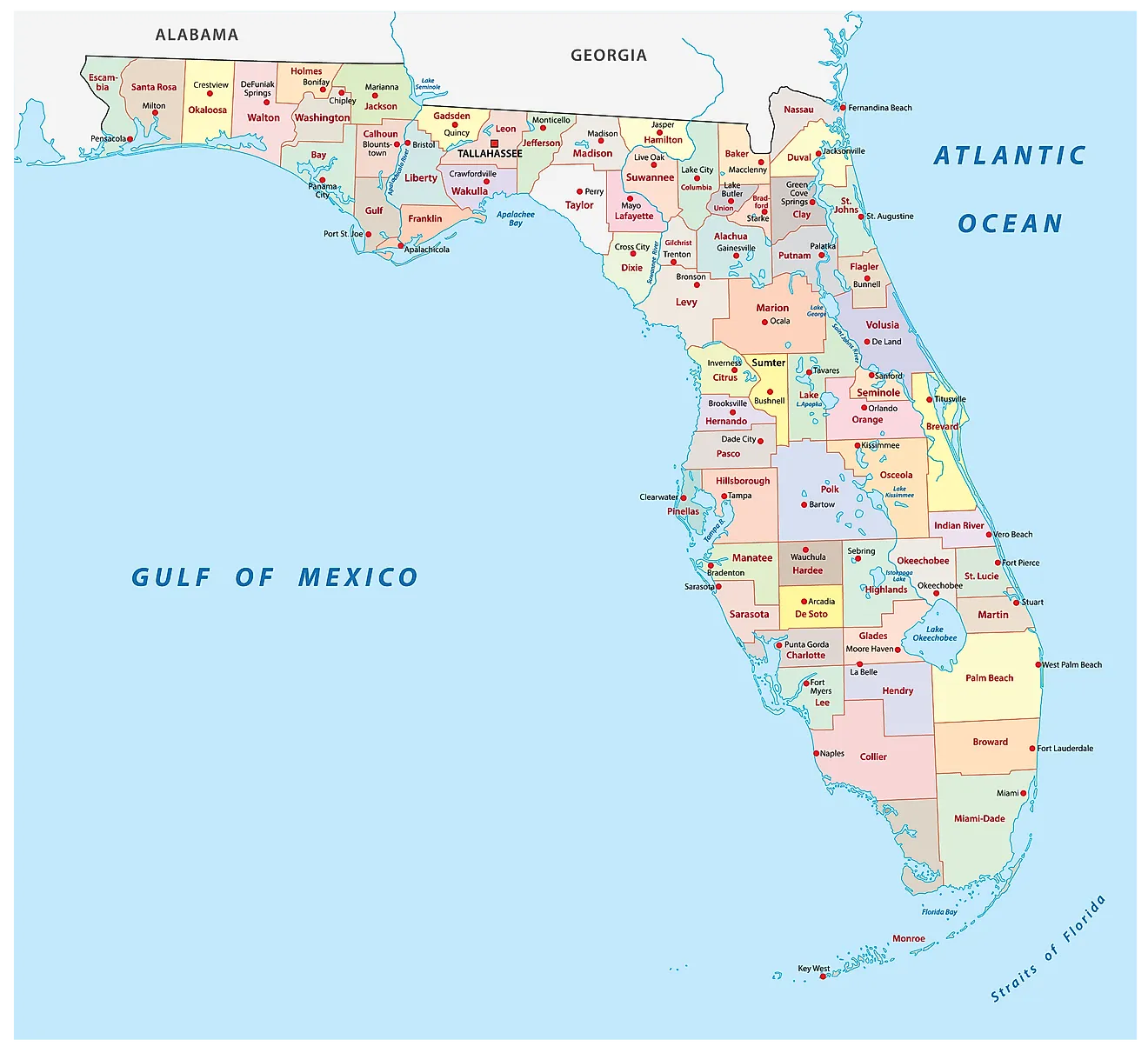
The State of Florida is divided into 67 counties. In alphabetical order, these counties are: Alachua, Baker, Bay, Bradford, Brevard, Broward, Calhoun, Charlotte, Citrus, Clay, Collier, Columbia, DeSoto, Dixie, Duval, Escambia, Flagler, Franklin, Gadsden, Gilchrist, Glades, Gulf, Hamilton, Hardee, Hendry, Hernando, Highlands, Hillsborough, Holmes, Indian River, Jackson, Jefferson, Lafayette, Lake, Lee, Leon, Levy, Liberty, Madison, Manatee, Marion, Martin, Miami-Dade, Monroe, Nassau, Okaloosa, Okeechobee, Orange, Osceola, Palm Beach, Pasco, Pinellas, Polk, Putnam, Saint Johns, Saint Lucie, Santa Rosa, Sarasota, Seminole, Sumter, Suwannee, Taylor, Union, Volusia, Wakulla, Walton, and Washington.
With an area of 65,758 mi2, the State of Florida is the 3rd most populous state in the USA. Located in Leon County, in the heart of the state’s northern panhandle region is Tallahassee – the capital city of Florida. Tallahassee serves as an educational hub for both Florida and the USA. Situated along the banks of St. Johns River, in northeastern Florida is Jacksonville – the state’s largest and the most populous city.
Where is Florida?
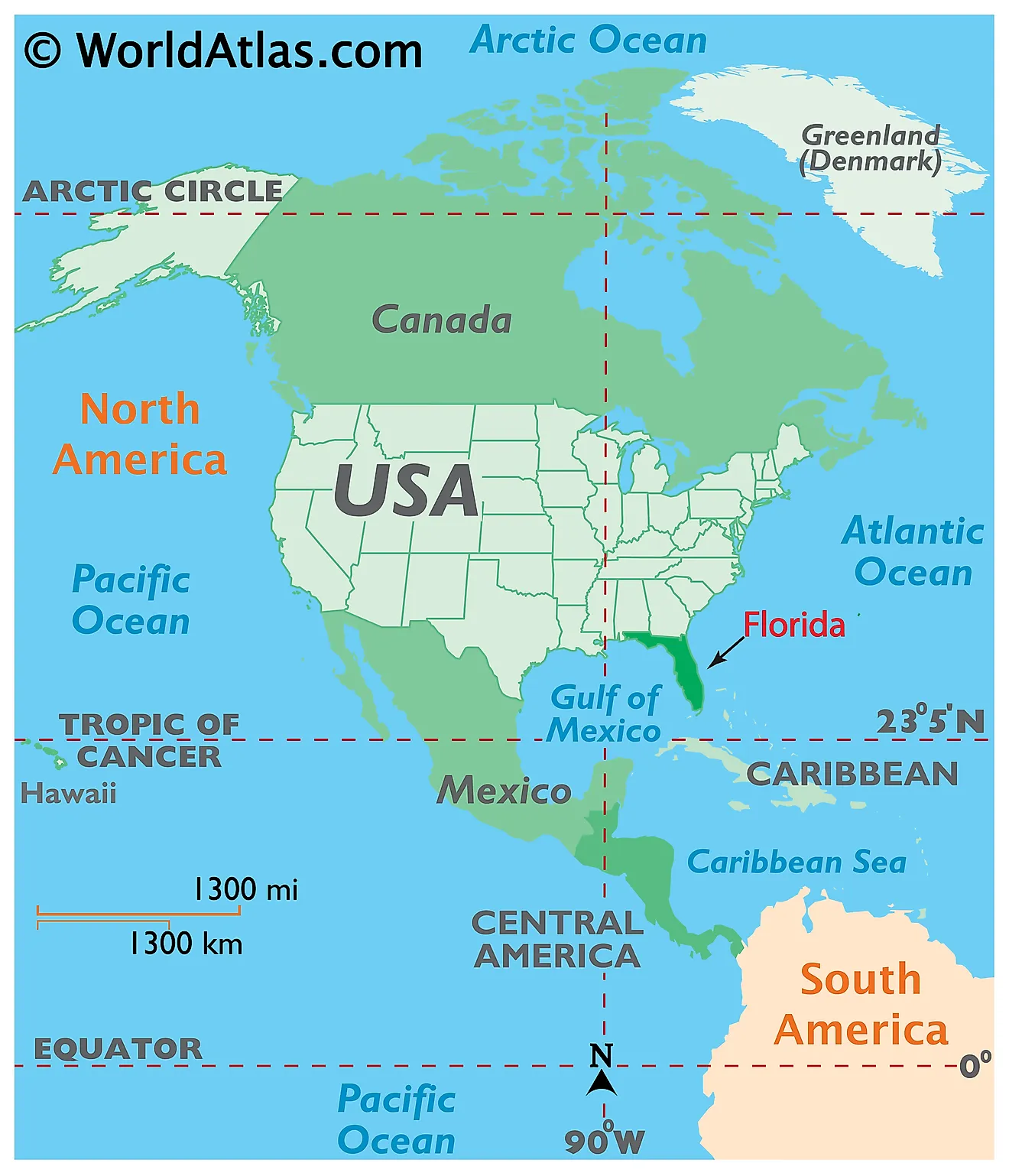
The State of Florida is located in the far southeastern region of the United States. Florida shares its land border with the State of Alabama in the northwest, and with the State of Georgia in the north. Florida has the largest coastline in the contiguous United States and is surrounded by the Gulf of Mexico to the west; by the Atlantic Ocean to the east and by the Straits of Florida to the south.
Regional Maps: Map of North America
Outline Map of Florida
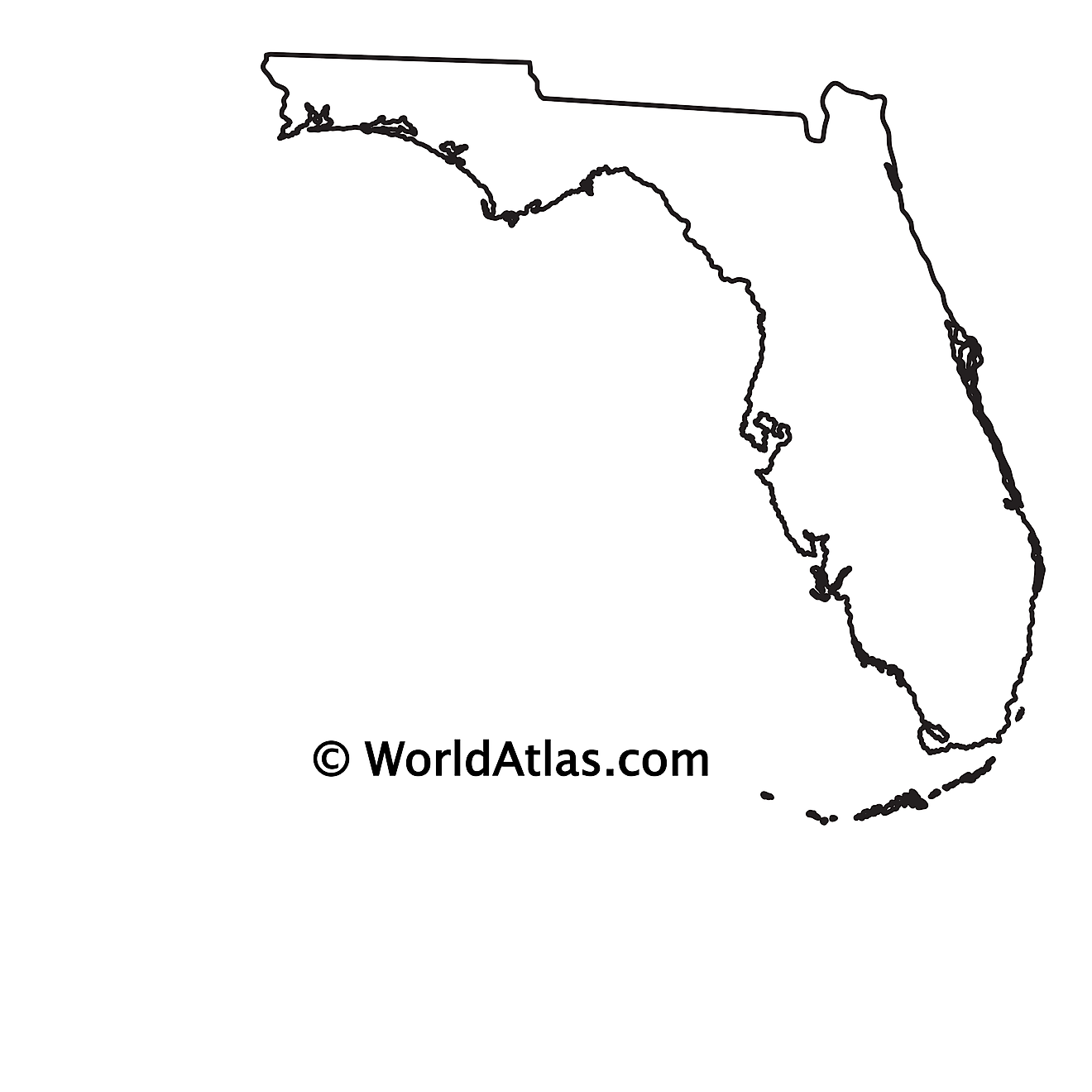
The above blank map represents the State of Florida, located in the far southeastern region of the United States. The above map can be downloaded, printed and used for geography education purposes like map-pointing and coloring activities.
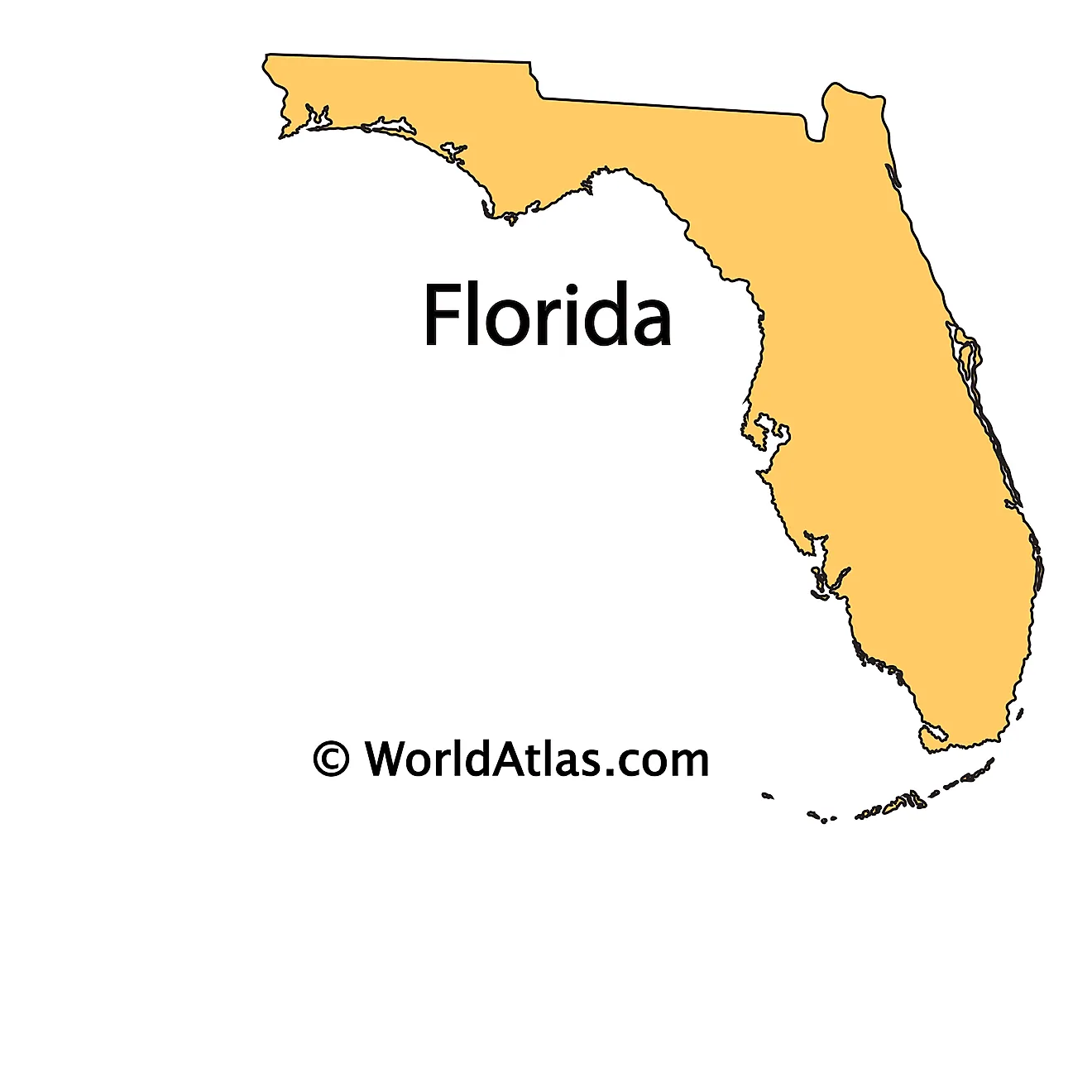
The above outline map represents the State of Florida, located in the far southeastern region of the United States. Florida has been nicknamed as the "Sunshine State."
Key Facts
| Legal Name | State of Florida |
|---|---|
| ISO 3166 Code | US-FL |
| Capital City | Tallahassee |
| Major Cities |
|
This page was last updated on August 21, 2026