8 Picture-Perfect Main Streets In New Jersey
In Clinton, the South Branch of the Raritan River spills over a wide waterfall between two old mills, and people still gather on the 1870 iron bridge just to watch the water go by. That is the kind of downtown that keeps turning up across New Jersey, where the walk itself is the point. These main streets hold the working life of their towns: the corner bakery, the theater, the antique dealer, the tavern that has been pouring since before the state had numbered highways. Some lean on art, some on history, some on a single river bend or a stubborn old brewery. The eight below are all built for walking.
Cranbury

The Cranbury Inn has been feeding travelers on Main Street since the 1700s, back when the town made a convenient halfway stop on the run between New York and Philadelphia. It later served as a stagecoach stop and, by local account, a station on the Underground Railroad, and today it handles the town's weddings, engagement parties, and milestone dinners, with a long wine and craft-beer list to match. It anchors a downtown that feels both busy and unhurried at once.
History sits close to the surface here. The Elizabeth M. Wagner History Center holds the Cranbury Historical and Preservation Society's records of the town, including photographs and recorded oral histories. The Society also stages Whispers from the Grave, an evening at Brainerd Cemetery and the Cranbury Inn, where costumed actors take up positions at the gravesites and on the inn's porch to tell the stories of Cranbury's Revolutionary War patriots, part of the town's marking of the 250th anniversary of American independence. Colonial music and light refreshments are included.
Princeton

Princeton's downtown gained a major new draw in October 2025, when the Princeton University Art Museum reopened in a 146,000-square-foot building after a five-year rebuild. Admission is free, and the collection runs to more than 117,000 objects covering some 5,000 years, so you can take in Roman mosaics and modern American painting in a single afternoon without spending a cent.
Nassau Street and the blocks around it hold the rest. At the Morven Museum and Garden, once home to Declaration signer Richard Stockton, the current exhibition Five Independent Souls tells the story of New Jersey's five signers through more than a hundred artifacts. The McCarter Theatre Center, a Tony-winning house on the edge of the university, runs a full season of theater, dance, and music. And the Bent Spoon on Palmer Square makes its ice cream and sorbet in small batches from local, organic ingredients, making it the correct last stop on a Princeton walk.
Lambertville

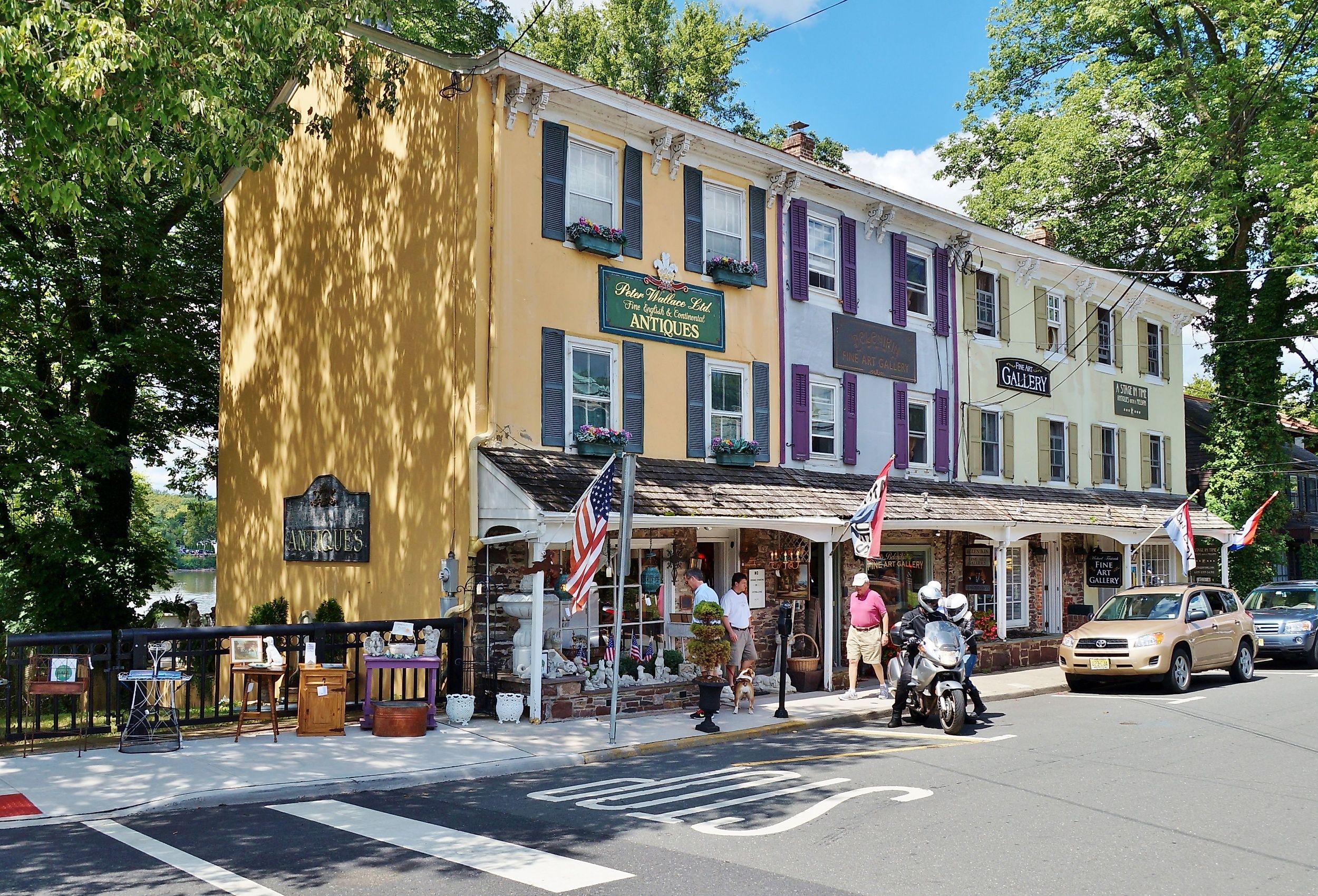
Lambertville earned the title Antiques Capital of New Jersey the honest way, by filling its narrow riverfront blocks with dealers. The People's Store anchors the trade, a multi-floor market where more than forty sellers rotate their stock, so the browse is different every visit. The Artists' Gallery, a cooperative run by local painters and printmakers, sells original work at prices the artists set themselves.
The town wears its past plainly. Preserved row houses and Victorian storefronts line the streets down to the Delaware, and the 1816 James Wilson Marshall House now serves as the local historical society's headquarters. Marshall grew up in that Federal brick house before heading west, where in 1848 he spotted the flakes of gold at Sutter's Mill that touched off the California Gold Rush. Everything worth seeing sits within an easy walk.
Frenchtown

Frenchtown started as a ferry crossing on the Delaware River, and the water still sets the rhythm of the place. Bridge Street runs down to the river past small boutiques and galleries, and the old Delaware and Raritan Canal towpath picks up at the edge of town for walkers and cyclists. Each July the town leans into its name with a Bastille Day celebration, a French-themed street festival of food, music, and family events that marks the 1789 storming of the Bastille. In the fall, Riverfest brings vendors, live music, and paper-boat races down to the riverbank.
The arts run deeper here than the size of the town suggests. ArtYard, a nonprofit contemporary art center built on the site of a former chicken hatchery, packs 21,000 square feet with gallery space, a residency program, and a 162-seat theater. It is the reason a lot of people keep circling back to Bridge Street.
Clinton

The red building everyone photographs in Clinton is the Red Mill, a four-story gristmill from around 1810 that sits right at the waterfall on the South Branch of the Raritan River. Cross the 1870 iron truss bridge on Main Street and you reach its counterpart, a 19th-century stone mill that has housed the Hunterdon Art Museum since the 1950s, with changing exhibitions of art, craft, and design. The 200-foot-wide falls run between them, which is why the view from the bridge turns up on so many postcards.
The rest of downtown holds up its end. Just past the west end of the bridge, the Clinton House has been serving food to travelers since the 1800s, a survivor from the days when this was a mill town on a working river. Between the water, the mills, and the storefronts, Clinton fits a lot into a few blocks.
Red Bank

Count Basie grew up in Red Bank, and the town named its performing-arts center after him. The Count Basie Center for the Arts puts touring music, comedy, and theater on its main stage and keeps a smaller, more intimate room called the Vogel inside for closer shows. A few blocks away, the Two River Theater produces its own plays and musicals rather than just booking road shows.
Red Bank also trades heavily in old things. The Antique Center of Red Bank gathers more than a hundred dealers under one roof, a genuine maze of furniture, signs, and oddities. Nearby, Recycled Relics and Antique Chic deals in industrial and repurposed pieces for people hunting something that will not turn up anywhere else. It is the sort of downtown where an afternoon disappears fast.
Millburn

Millburn's downtown grew up around the Paper Mill Playhouse, the official State Theater of New Jersey, which has staged Broadway-caliber productions on the banks of the Rahway River since the 1930s. Shows that start here sometimes end up on Broadway, and the theater draws performers and audiences straight out of New York. Millburn Avenue fills in around it with the kind of places locals actually use: the Millburn Deli, famous for its sloppy joe on rye; the gastropub Millburn Standard; and the old-school Millburn Diner.
Walk a few minutes past downtown and you reach the edge of the 2,000-acre South Mountain Reservation. Its best-known feature is the South Mountain Fairy Trail, where a local teacher named Therese Ojibway began tucking tiny handmade fairy houses among the trees in 2011. Hundreds have appeared along the path since, built of bark, twigs, and acorns, and finding them is the whole point of the walk.
Haddonfield

Haddonfield holds a strange distinction: in 1858, in a marl pit just off the main streets, workers dug up the first nearly complete dinosaur skeleton ever found in North America, the Hadrosaurus foulkii. The town leans into it, and a life-size bronze of the dinosaur now stands downtown. The rest of the district trades on colonial history, with old street lamps, a sidewalk clock, and storefronts that go back centuries.
A few spots pull the past and present together. Gouldsburgers, on Kings Highway, is a downtown counter turning out prime-beef burgers and Cooper-sharp cheesesteaks. A short walk away, King's Road Brewing opened in 2016 inside a 1777 building that once served as Gibbs Tavern, and it did so in a town that had been legally dry since 1873. Older still is the Indian King Tavern, whose oldest section dates to about 1730 and where the New Jersey legislature met in 1777 to adopt the state's Great Seal. It is a state historic site today, and the walk between the three covers most of Haddonfield's history in a few hundred yards.
What The Best Main Streets Have In Common
From Cranbury’s historic inn and Princeton’s cultural institutions to Lambertville’s antiques and Haddonfield’s Revolutionary-era landmarks, these New Jersey towns show how much character can fit into a compact downtown. Their main streets bring together history, art, dining, shopping, and entertainment, giving visitors plenty to discover within just a few walkable blocks.