Invasive Species In The Florida Everglades
With roughly 350 species of birds, 300 of fish, 50 of reptiles, and 40 of mammals, the Everglades ranks among the most biodiverse places on the North American continent. That richness is under siege. The state of Florida classifies some 180 of these species as threatened or endangered, and invasive species are a leading reason why. By crowding out native wildlife, monopolizing food and habitat, and rewiring entire food webs, non-native invaders reshape the ecosystems they enter. The 32 profiled below are among the worst offenders loose in the Everglades today, each one piling pressure onto hundreds of native species already fighting to hang on.
Invertebrates
Asiatic Clam (Corbicula fluminea)

A resident of North America for decades, the Asiatic clam has only recently pushed into southern Florida, and it makes up for lost time by breeding relentlessly. Growing up to two inches long, yellow-green to brown with ridged shells, the clams blanket the bottom so thickly that the native Chironomidae fly can no longer burrow, driving it out of its own habitat. They also pack into pipes and canals in numbers heavy enough to foul irrigation lines and disrupt water supplies across the region.
Bromeliad beetle (Metamasius callizona)
Better known as the "evil weevil" for the wreckage it has left among Florida's bromeliads, this Mexican weevil turned up in the state in 1989, most likely riding in on a shipment from Veracruz, Mexico. Adults run 11 to 16 mm long, glossy black with a single yellow or orange stripe down the back. Its larvae bore through the hearts of bromeliads, and it has already pushed two Florida bromeliad species toward the edge while threatening some of the rarest survivors inside the Everglades.
Lobate lac scale (Paratachardina pseudolobata)
A Florida Department of Agriculture inspector first spotted the lobate lac scale on a hibiscus plant in August 1999. The infested plant was destroyed, but the insect came back year after year. Barely 1.5 to 2 millimeters long as an adult, with a dark brown and reddish shell, it swarms the twigs and small branches of woody plants in dense crusts. Heavy infestations cluster along the eastern edge of the Everglades, where the scale has been recorded on hundreds of plant species and can kill the shrubs and small trees it overwhelms.
Island Apple Snail (Pomacea maculata)

The island apple snail looks so much like the native Florida apple snail that the two are easy to confuse, though the invader is bigger, with a rounded, dark brown shell. Probably dumped by aquarium hobbyists, it devours rooted aquatic plants and has almost no natural predators in the Everglades. Its arrival has scrambled the diet of the native snail kite, a bird built to feed on the smaller native snail. As its usual prey dwindles, the kite increasingly targets the invader, but the larger shell is harder to handle, a mismatch that puts the specialist raptor at risk.
Fish
Suckermouth Catfish (Pterygoplichthys multiradiatus)

The suckermouth or sailfin catfish likely slipped into the United States through the aquarium trade in the 1950s. Armored in black bony plates and reaching about two feet long, it earns its keep as a tank cleaner by grazing algae, but in the wild it competes with smaller native fish for food. Its rigid, spiny fins can be deadly to the birds that try to eat it, and several brown pelicans have been found choked on one. That said, an early 21st-century study found little evidence of major harm to native fish, so its impact may be less severe than its menacing look suggests.
Walking Catfish (Clarias batrachus)

True to its name, the walking catfish can haul itself overland on its pectoral fins to reach the next pond, surviving out of water for more than 18 hours. Slender and grayish-brown with white flecks, it grows to about 20 inches and 2.5 pounds. It escaped from Florida aquaculture facilities in the 1960s and spread fast. During dry spells it eats almost anything to survive and can strip a fish farm's stock, and it carries enteric septicemia, a bacterial infection it can pass to native Everglades fish.
Blue Tilapia (Oreochromis aureus)

Blue tilapia has been released into Florida again and again, for research, sport fishing, and aquatic-plant control, and it is now one of the state's most widespread invasive fish. Adults run 4.75 to 7.75 inches, bluish-grey fading to a white belly, with red-edged dorsal and tail fins. When spawning, they scoop out nest craters up to two feet across, gouging the bottom in ways that can smother native plants and crowd out native fish trying to breed in the same waters.
Mayan Cichlid (Cichlasoma urophthalmus)

First recorded in Florida Bay in 1983 and likely dumped from an aquarium, the Mayan cichlid has since spread through southern Florida in force. Around 15 inches long, it wears six to eight dark bars down a highly variable body, marked by a telltale turquoise ring and a broken lateral line near the tail. It is an opportunistic feeder, taking plants, smaller fish, and invertebrates, including the native Florida apple snail, whose numbers keep falling.
Reptiles
Knight Anole (Anolis equestris)

Native to Cuba, the knight anole first showed up in Florida around 1952, either released by a pet owner or stowed away on a ship. At 13 to 20 inches, bright green with a pale stripe over the eye and shoulder, it dwarfs Florida's native anoles, and it eats a broad menu of native creatures. That combination of size and appetite makes it a direct threat to the Everglades' native green anole.
Green Iguana (Iguana iguana)

The green iguana first turned up in Florida in the 1960s, arriving through the pet trade and as a stowaway on cargo shipments, and its numbers exploded after Hurricane Andrew tore through in 1992. These lizards range in color across green, reddish brown, lavender, black, and blue, sport a crest of spines down the back and tail, and can top six feet, among the largest iguanas in the Americas. They favor waterside ground, where their burrows can undermine levees and canals, and while mostly vegetarian, they will eat tree snails, threatening the native Florida tree snail.
Tokay Gecko (Gekko gecko)

The tokay gecko was turned loose in the Everglades in 1965 to knock down the cockroach population, but its tastes proved far wider, taking birds, frogs, lizards, and other native prey. Stout and spotted, with strong, well-defined limbs, it grows 10 to 12 inches long. Its threat to native species is considered mild, and there is no broad campaign to wipe it out.
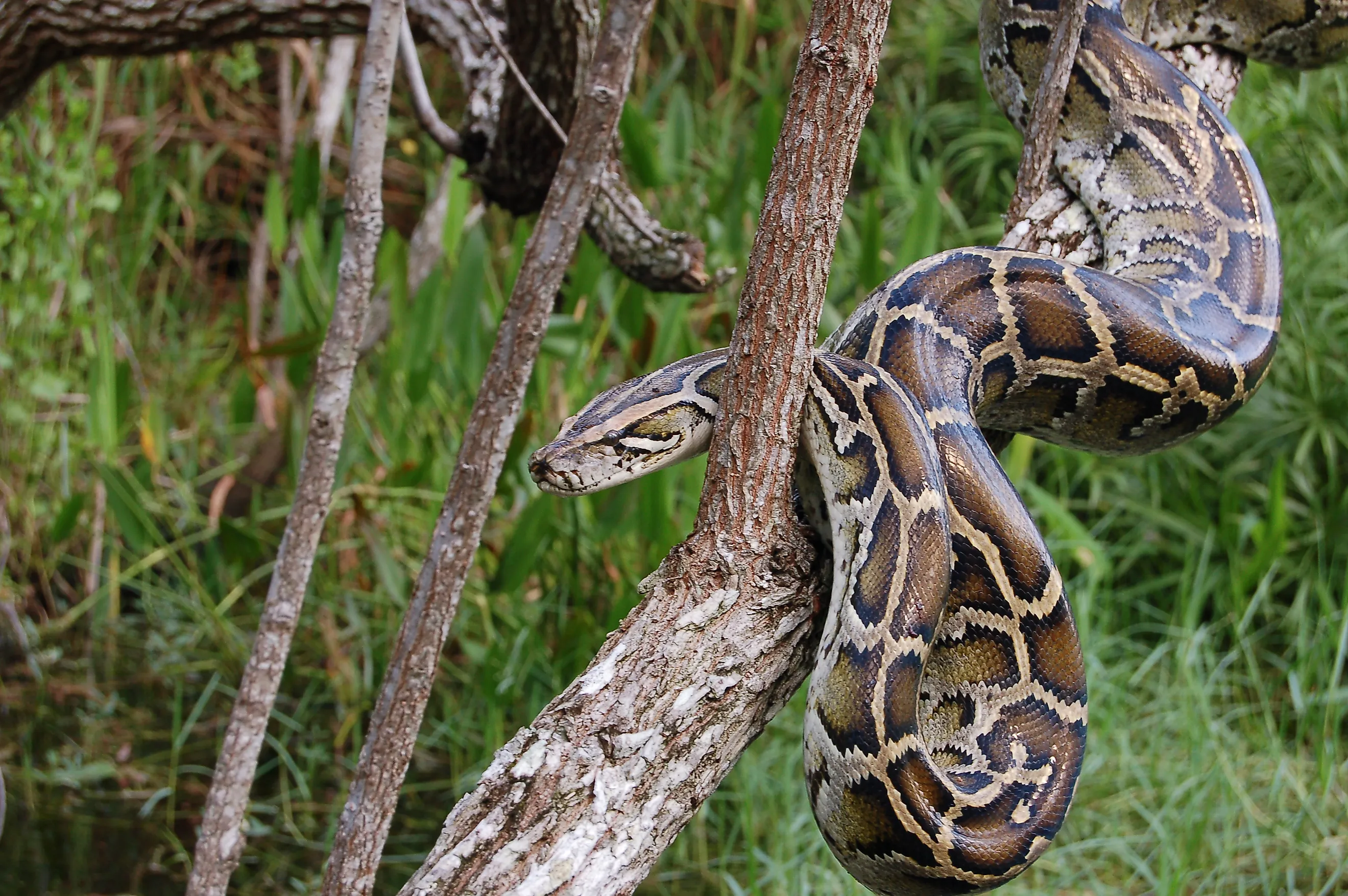
Burmese Python (Python bivittatus)

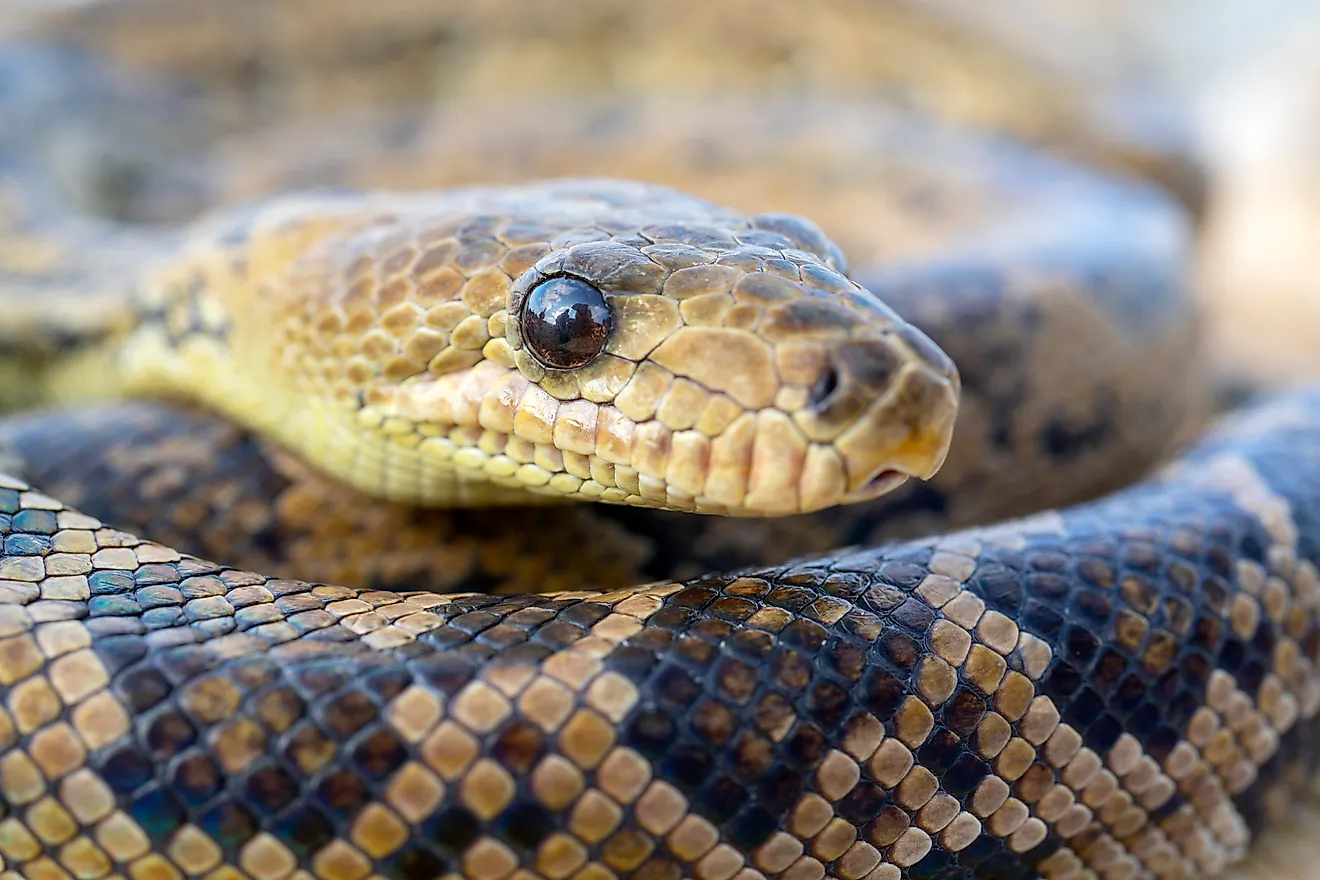
No invader has reshaped the Everglades more dramatically than the Burmese python, which arrived around 1979 through accidental or deliberate pet releases and now breeds throughout the region. Reaching close to 20 feet, brown with dark, blotchy saddles, it can swallow prey as small as wrens and as large as white-tailed deer. The toll has been staggering: a landmark study found raccoon and opossum sightings down about 99 percent and bobcats down roughly 87 percent in the park, with marsh rabbits and foxes all but vanished. Everglades National Park has spent well over a decade searching for a way to beat the snake back.
Nile monitor (Varanus niloticus)

Researchers trace the Nile monitor's arrival in Florida to around 1990, through a mix of deliberate and accidental releases from captivity. Olive green to black with yellow bands or spots, this semi-aquatic lizard reaches about six and a half feet. It is a voracious egg eater, raiding the nests of native species including the burrowing owl, gopher tortoise, brown pelican, American crocodile, and diamondback terrapin. A broad diet, prolific breeding, and the ability to move freely across land, freshwater, and saltwater make it stubbornly hard to eradicate.
Green Anaconda (Eunectes murinus)

First spotted in the Everglades in 2000 and slowly increasing, the green anaconda almost certainly got here as a released pet. Olive-green with dark blotches above and yellow-and-black scales below, it is the heaviest snake on Earth; large females commonly run 16 to 20 feet, with exceptional individuals reported considerably longer and heavier. (In 2024, researchers proposed splitting the green anaconda into two species, though the change remains contested.) With no natural predators here, a growing anaconda population would prey on native fish, turtles, mammals, and birds, adding one more heavyweight constrictor to a region already reeling from the python.
Argentine Black and White Tegu (Salvator merianae)

The Argentine black and white tegu reached the Everglades around 2013, almost surely through the exotic pet trade. One of the largest lizards in the Western Hemisphere at nearly five feet, it wears mottled black-and-white bands down its back and tail. Tegus are relentless nest raiders, digging up and eating the eggs of native animals such as the American alligator. The species is still a recent arrival, but the evidence points to a population poised to keep growing.
Birds
Muscovy Duck (Cairina moschata)

The Muscovy duck was brought into Florida on purpose in the 1960s as an ornamental bird for urban parks. Native to parts of North America but not to Florida, it is a hefty waterfowl, with a wingspan of 54 to 61 inches and a weight up to nine pounds, its white-to-black plumage flecked with purple and green and its face marked by a red, warty caruncle. In the wild it spreads disease to native birds and interbreeds with them, muddying the local gene pool and the natural balance.
Monk Parakeet (Myiopsitta monachus)

The pet trade shipped more than 64,000 monk parakeets into the United States between 1968 and 1972. Green and gray and 11 to 13 inches long, the bird is best known for the bulky communal nests it builds on power poles, a headache for utilities. Its effect on the Everglades is still not well understood, though it may compete with native wildlife for food. Smart and cheap to buy, it remains a popular pet across much of the country.
Mammals
Wild Boars (Sus scrofa)

European settlers brought pigs to the Americas in the 16th century, and their feral descendants are now among the Everglades' most destructive mammals. Stocky and grey-brown, three to six feet long and up to 220 pounds, the wild boar can carry some 45 infectious diseases and has been recorded passing trichinosis to the endangered Florida panther. Its habit of rooting through the ground for food tears up soil and erodes pond and stream banks.
Domestic/feral cat (Felis catus)

Cats arrived with European settlers in the 16th century, and Florida now holds an estimated five million-plus feral cats. A feral cat looks much like a house cat but tends to be leaner, more muscular, and often battle-scarred. As efficient hunters, they drive down populations of small native animals, among them cotton mice, beach mice, the Florida scrub-jay, and the endangered Lower Keys marsh rabbit, and they can pass diseases to native cats such as the bobcat and Florida panther.
Black Rats (Rattus rattus)

The black rat, or house rat, stowed away on early European ships and was among the first non-native animals to reach Florida. Its fur runs black to light brown, and it measures five to seven inches and weighs 2.6 to 8.1 ounces. Though the state has a few other feral rats, the black rat is by far the most abundant, competing with native rodents for food and shelter and pressing hard on the endangered Key Largo woodrat.
Plants
Water Lettuce (Pistia stratiotes)

Water lettuce spreads across the surface as dense floating mats of fuzzy, pale green rosettes. It was first recorded here around the 1770s, most likely a hitchhiker on shipping between North and South America. Those thick mats choke off oxygen, block water flow, and shade out native plants, though statewide control has kept it fairly contained in the Everglades.
Brazilian Peppertree (Schinus terebinthifolius)

Sold in 19th-century Florida as a prettier stand-in for holly, the Brazilian peppertree is now one of the state's signature invaders. An evergreen shrub with glossy leaves, white flowers, and clusters of small red berries, it grows 23 to 33 feet tall and throws dense canopies that starve the plants below of light. It also poisons its competition, leaching chemicals into the soil that stunt native growth, and in doing so displaces both the plants and the animals that depend on them.
Australian Pine (Casuarina equisetifolia)

Planted across Florida in the late 19th century to stabilize canals and ditches, and later as a shade tree, the Australian pine (really three related species) is an evergreen that can shoot past 100 feet, with slender, needle-like branchlets and tiny brown flowers. Fast-growing, it forms dense stands that block light from native plants and take over nesting ground from animals such as the American alligator and sea turtle. Its shallow roots fail to hold sand the way native vegetation does, which accelerates beach erosion.
Water hyacinth (Eichhornia crassipes)

With spongy stalks, glossy leaves, lavender-blue flowers, and trailing purple roots, water hyacinth links together into thick floating rafts. Introduced to Florida in the 1880s, it has one of the fastest growth rates of any plant on Earth and quickly became a serious weed. As its mats seal off the water's surface, they cut sunlight to plants below and drain oxygen from the water, endangering the animals that live in it.
Air Potato (Dioscorea bulbifera)

The air potato is a fast-climbing vine of broad green leaves that can grow roughly eight inches a day and clamber high into the tree canopy, cutting off light to everything beneath it. Native to Asia and Africa, it was introduced to Florida in 1905, cultivated as a medicinal and ornamental plant before it escaped, and it has run wild in the Everglades for more than a century since. It smothers whole stretches of forest, spreading from potato-like aerial tubers, and is still used in folk medicine for ailments such as diarrhea and dysentery.
Melaleuca (Melaleuca quinquenervia)

The melaleuca, or paperbark tree, is an evergreen reaching up to 80 feet, with peeling brownish-white bark and soft white flowers. Introduced to Florida in 1906 for soil stabilization, shade, and windbreaks, it was later scattered from airplanes over the Everglades in a misguided bid to dry the wetlands out. It grows into dense, near-impenetrable monocultures that shove out sawgrass and cypress, the backbone of Everglades habitat, and its oily leaves turn stands into a standing fire hazard.
Burma Reed (Neyraudia reynaudiana)

Burma reed, or silk reed, is a towering perennial grass that can reach 15 feet. Brought to Florida in the early 20th century for erosion control and as an ornamental, it has since overrun the fragile pine rockland around Everglades National Park, its dense stalks shading out natives like slash pine. Worse, its dry, packed foliage burns hot, feeding fiercer wildfires that scorch the very habitats native plants need to recover.
Downy Rose Myrtle (Rhodomyrtus tomentosa)

Sold as an ornamental in Florida in the 1920s, the downy rose myrtle was flagged as a priority invasive not long after. A large shrub up to 12 feet tall, it bears leathery leaves, pink flowers, and ripe purple berries that pass for blueberries. Like Burma reed, it invades pine rockland, in this case elbowing out saw palmettos, and University of Florida researchers warn it could become a far bigger problem if it is not reined in soon.
Latherleaf (Colubrina asiatica)

Latherleaf is a sprawling shrub whose stems can stretch 30 feet, named for the soapy lather its leaves produce in water. It carries glossy green leaves and small clusters of green-and-white flowers. Native to Asia, it became naturalized in the Caribbean before reaching Florida by the 1930s. It piles into dense mats that crowd native plants out of their ground, and its rapid spread flattens biodiversity and rewrites the plant communities that Everglades wildlife depends on.
Hydrilla (Hydrilla verticillata)

Hydrilla is a submerged perennial with coarse, toothed leaves and stems up to 30 feet that tangle into dense underwater mats. Brought in as an aquarium plant in the 1950s, it spread so fast that by the 1990s it blanketed more than 140,000 acres of Florida lakes and rivers. Its canopies steal sunlight from other aquatic plants and pull oxygen out of the water, harming fish and other wildlife. Growing more than an inch a day, it ranks among the most aggressive aquatic invaders in the Everglades.
Old World Climbing Fern (Lygodium microphyllum)

Native to tropical Asia, Africa, and Australia, the Old World climbing fern has swallowed huge tracts of southern Florida since it took hold in the mid-20th century. Its fronds climb up to 90 feet, draping over shrubs and trees in thick curtains that block the sun and smother whatever grows beneath. In places its blanket has buried entire stretches of Everglades forest, and its speed and suffocating habit make it one of the hardest invasive plants here to control.
Carrotwood (Cupaniopsis anacardioides)

Introduced from Australia in the 1960s, carrotwood is a tough tree that shrugs off drought, poor soil, shade, and flooding alike, its gray outer bark hiding a bright orange layer beneath. Reaching about 35 feet, it forms dense stands that push out native plants and thin biodiversity. That same resilience makes it hard to kill and lets it invade a wide sweep of Everglades habitats, especially along the coast.
Final Thoughts
The invasive species crowding the Everglades keep multiplying, but they are not going unchallenged. National park and state biologists are studying and managing these threats through targeted removal, public education, and steady biodiversity research, in effect racing the clock to protect the native species that give the region its identity. The years ahead will show how much ground those efforts can hold, with the hope of carrying hundreds of native species through to the next generation.
Invasive Animal Species in the Everglades
| Scientific Name | Common Name | Origin and Year Introduced | Class |
|---|---|---|---|
| Corbicula fluminea | Asiatic clam | China, 1961 | Invertebrate |
| Metamasius callizona | Bromeliad beetle, evil weevil, Mexican weevil | Mexico & Central America, 1989 | Invertebrate |
| Paratachardina pseudolobata | Lobate lac scale | India & Sri Lanka, 1999 | Invertebrate |
| Pomacea maculata | Island apple snail | South America, 2000s | Invertebrate |
| Pterygoplichthys multiradiatus | Suckermouth catfish, armored catfish | South America, 1950s | Fish |
| Clarias batrachus | Walking catfish | Thailand, 1960s | Fish |
| Oreochromis aureus | Blue tilapia, Israeli tilapia | Africa & Middle East, 1961 | Fish |
| Cichlasoma urophthalmus | Mayan cichlid | Mexico & Central America, 1983 | Fish |
| Anolis equestris | Knight anole | Cuba, 1952 | Reptile |
| Iguana iguana | Green Iguana | Central America, 1960s | Reptile |
| Gekko gecko | Tokay gecko | Southeast Asia, 1965 | Reptile |
| Python bivittatus | Burmese python | Southeast Asia, 1979 | Reptile |
| Varanus niloticus | Nile monitor | Africa, 1990 | Reptile |
| Eunectes murinus | Green anaconda | South America, 2000 | Reptile |
| Salvator merianae | Argentine tegu | Argentina, 2013 | Reptile |
| Cairina moschata | Muscovy duck | South or Central America, 1960s | Bird |
| Myiopsitta monachus | Monk parakeet, quaker parrot | South America, Established by 1969 | Bird |
| Sus scrofa | Wild boar, feral pig | Europe, 16th century | Mammal |
| Felis catus | Domestic/Feral Cat | North Africa and Southern Europe, 16th Century | Mammal |
| Rattus rattus | Black rat, roof rat, house rat, ship rat | Europe, 16th Century | Mammal |
Invasive Plant Species in the Everglades
| Scientific Name | Common Name | Origin and Year Introduced |
|---|---|---|
| Pistia stratiotes | Water lettuce, water cabbage | Africa or South America, 1765 |
| Schinus terebinthifolius | Brazilian pepper, Florida holly, Christmas berry, pepper tree | Brazil, Argentina, Paraguay, 1840s |
| Casuarina equisetifolia, Casuarina glauca, Casuarina cunninghamiana | Australian pine, beefwood, ironwood, she-oak, horsetail tree | Australia, South Pacific Islands, Southeast Asia, Late 19th century |
| Eichhornia crassipes | Water hyacinth, water orchid | Amazon Basin, 1884-1890 |
| Dioscorea bulbifera | Air potato, potato yam, air yam | Asia and Africa, 1905 |
| Melaleuca quinquenervia | Melaleuca, paperbark, tea tree, cajeput, punk tree, white bottlebrush tree | Australia, New Guinea, the Solomon Islands, 1906 |
| Neyraudia reynaudiana | Burma reed, silk reed, cane grass, false reed | Southern Asia, 1916 |
| Rhodomyrtus tomentosa | Downy rose myrtle, downy myrtle, hill gooseberry, hill guava | Asia, 1924 |
| Colubrina asiatica | Latherleaf, Asiatic or common colubrina, hoop with, Asian snakeroot | Asia, In Southern Florida by 1933 |
| Hydrilla verticillata | Hydrilla, water thyme, Florida elodea, waterweed | Sri Lanka, 1950s |
| Lygodium microphyllum | Old World climbing fern | Tropical Asia, Africa, and Australia, Observed already established in 1958 |
| Cupaniopsis anacardioides | Carrotwood, beach tamarind, green-leaved tamarind, tuckeroo tree | Australia, 1960s |