10 Best Natural Wonders To Visit In The Rockies This Year
The Rocky Mountains stretch from New Mexico up into northern Canada, containing countless cool geological features, beloved national parks, and some of North America's highest peaks. The truly great natural wonders to be found here range from Yellowstone's Grand Prismatic Spring to the blue waters of Banff's Lake Louise, Colorado's colorful Maroon Bells, and Montana's epic Glacier National Park. Even lesser-known Rocky Mountain states like Idaho contribute the impossibly clear waters of Redfish Lake, while Utah's scenic Mount Timpanogos marks the range's western edge. With that, here are ten local spots you should check out this year.
Maroon Bells, Colorado

The Maroon Bells stand near Aspen, with their twin peaks reaching 14,019 feet (4,273 m) and 14,163 feet (4,317 m). Their dark, reddish mudstone slopes are part of the Elk Mountains, a subrange within the Rocky Mountains. Maroon Lake, at the mountains' base, rests at a still lofty 9,580 feet (2,920 m), creating the famous reflection view of the "bells."
The surrounding Maroon Bells-Snowmass Wilderness also contains more alpine lakes, forests, and high-elevation trails worth exploring, including routes toward Crater Lake and West Maroon Pass. The area is especially striking in autumn, when aspen groves turn bright yellow in unison.
Hanging Lake, Colorado

Hanging Lake sits in west-central Colorado's Glenwood Canyon, perched on a narrow limestone ledge above the Colorado River. This eye-catching pool formed when travertine deposits created a natural barrier, allowing water to collect along the cliff, and Bridal Veil Falls currently feeds it through a short stream that drops from the rock above, while the larger Spouting Rock sits higher up the cliff.
The lake and its surrounding area are protected within the White River National Forest, where numerous fragile geological formations and sensitive plant communities have prompted strict visitor controls. The best way to get around is on foot, with a marked trail going roughly 1.2 miles (1.9 km) each way. Beware, the hike also requires climbing a thigh-burning 1,000 feet (305 m) up and down, too.
The Garden Wall, Montana

The Garden Wall in Glacier National Park forms a dramatic section of the Continental Divide, where steep cliffs rise above the famed Going-to-the-Sun Road. The wall is more specifically part of the Lewis Range and reaches roughly 9,550 feet (2,911 m) near its highest points, where exposed rock layers record ancient sedimentary deposits laid down more than a billion years ago.
The Highline Trail follows the Garden Wall for several miles, passing beneath cliffs and alpine slopes with views toward the surrounding valleys and peaks. In summer, melting snow feeds streams and waterfalls across the mountainsides, while wildflowers color the higher slopes. This is a must-do for anyone up for a fairly strenuous, yet extremely rewarding walk in the Rockies.
Grand Canyon of the Yellowstone, Wyoming

The Grand Canyon of the Yellowstone cuts through the heart of Yellowstone National Park, exposing layers of volcanic rock beneath the park's fascinating geothermal landscape. It stretches for roughly 20 miles (32 km), with depths reaching an impressive 1,200 feet (366 m) down in places. But the most recognizable feature for many visitors is Lower Falls, which plunges 308 feet (94 m) into the canyon below.
The colorful walls of the canyon get their hues from hydrothermal alteration of the rocks, particularly around the canyon's numerous thermal areas. To see it for yourself, several viewpoints along both the North and South Rims provide different perspectives of the gorge, as well as local falls and the Yellowstone River beyond.
Grand Prismatic Spring, Wyoming

Grand Prismatic Spring in Yellowstone National Park is one of the largest hot springs in the world and a standout geothermal feature within the American Rockies. This spring measures roughly 370 feet (113 m) across and reaches depths of more than 120 feet (37 m), and its vivid blue center is surrounded by bands of green, yellow, orange, and red created by heat-loving microorganisms living at different temperatures.
The Grand Prismatic Spring Overlook provides a broad view of the spring and its colorful mineral terraces. Furthermore, it sits in the Midway Geyser Basin, alongside other remarkable geothermal features such as Excelsior Geyser.
Wheeler Peak, New Mexico

Wheeler Peak in northern New Mexico is the highest point in the state at 13,161 feet (4,011 m), forming part of the Sangre de Cristo Mountains, the southernmost major range of the Rocky Mountains. This peak also sits within Carson National Forest near Taos, allowing it to be surrounded by a surprising amount of alpine tundra and subalpine woodlands for a region that is otherwise known for its deserts.
The Williams Lake Trail is a scenic route into the mountain's high country, while the Wheeler Peak Trail continues toward the summit. Once you get above the tree line, the terrain becomes increasingly exposed, with wind-exposed views across the Sangre de Cristo Mountains and northern New Mexico in nearly all directions. The peak is particularly impressive in late summer, when snow has largely disappeared from the higher-up trails.
Redfish Lake, Idaho

Redfish Lake rests at the base of the Sawtooth Mountains of Idaho, where jagged peaks rise sharply above its pristine, blue waters. Stretching about 4.5 miles (7.2 km) and reaching depths of roughly 387 feet (118 m), it is the largest lake in the Sawtooth National Recreation Area. Like many bodies of water in the Rockies, Redfish Lake formed through glacial activity, with its eastern shoreline now boasting idyllic views toward Mount Heyburn.
To get here, a paved road reaches the lake's more developed recreational areas at its northern end, while a network of hiking trails follows the shoreline and climbs deeper into the Sawtooth Wilderness. In summer, you can also cross the lake by boat (with a handful of ramps and docks available to access the water) to reach trails along its remote western shore.
Mount Timpanogos, Utah

Mount Timpanogos rises to 11,752 feet (3,582 m) in Utah's Wasatch Range, which runs south from Salt Lake City along the Rocky Mountains' far western edge. Its broad summit and distinctive twin peaks dominate the skyline east of Utah Valley, with upper slopes containing vast swathes of verdant alpine meadows, talus fields, and remnants of permanent snowfields, too, given the sheer altitudes the mountain can reach.
The tough but rewarding Mount Timpanogos Trail from American Fork Canyon climbs roughly 4,500 feet (1,372 m) before reaching the top, passing locales like Emerald Lake and the quiet, exposed terrain of Timpanogos Basin. In late summer, the high meadows are usually filled with wildflowers, while the summit itself provides unforgettable sightlines across Utah Valley, Utah Lake, and the surrounding Wasatch Mountains.
Lake Louise, Alberta

Banff National Park's Lake Louise is easily one of the Canadian Rockies' most recognizable natural wonders, backed by an awe-inspiring wall of rugged peaks and fed by glacial meltwater. The lake's distinctive turquoise color comes from "rock flour" suspended in the water, carried downhill by the Victoria Glacier.
At 5,680 feet (1,731 m) above sea level, Lake Louise sits in a high valley crisscrossed by hiking trails and viewpoints, and at its eastern end, the famed Fairmont Chateau Lake Louise. The nearby Plain of Six Glaciers Trail follows the shoreline before climbing toward the glacier feeding into its far western side, while the Lake Agnes Trail reaches another, smaller alpine lake above the valley. Also note that summer brings the clearest water and easiest trail conditions, while ice skating can often be enjoyed on the lake in the winter after it freezes over.
Mount Assiniboine, British Columbia

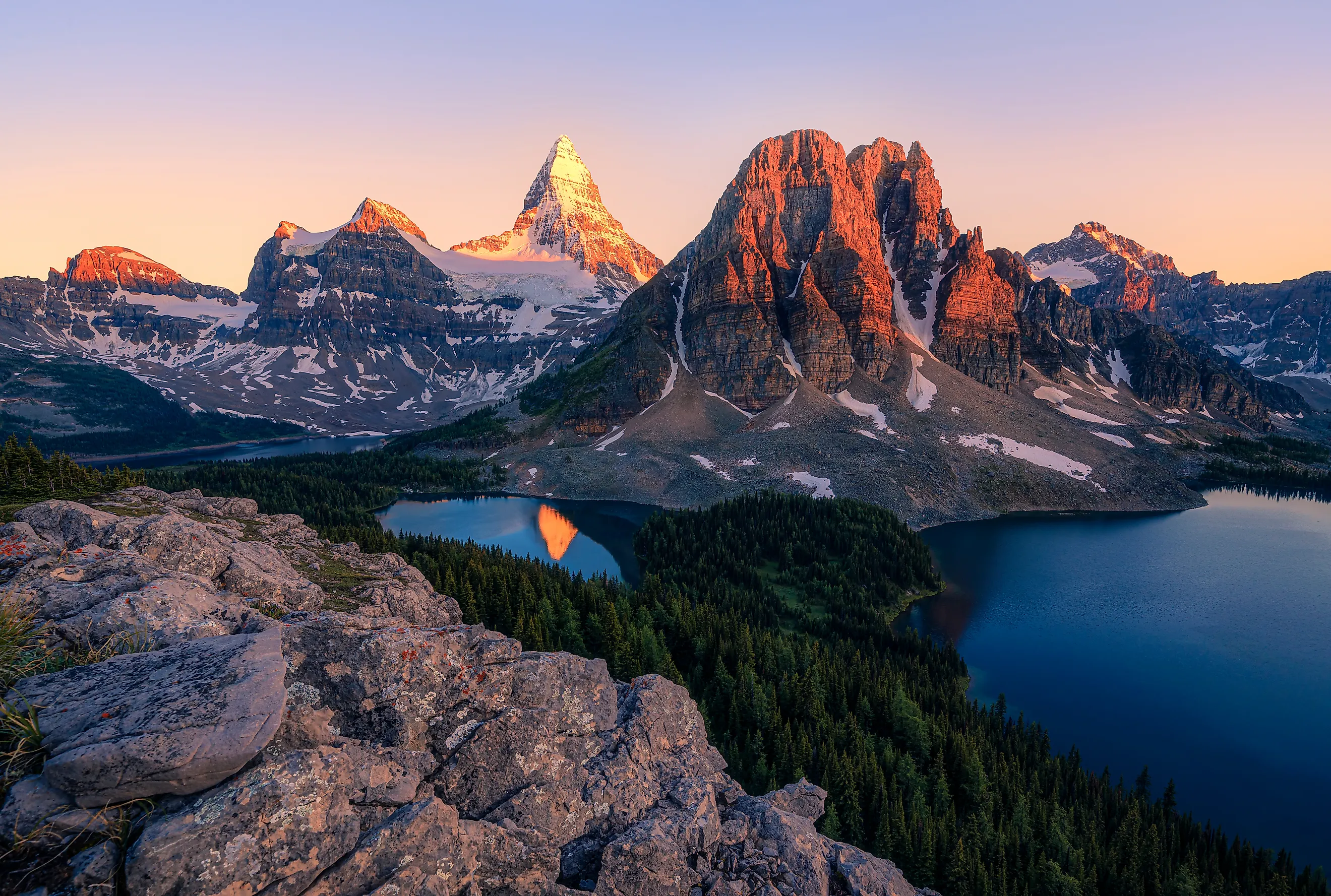
Mount Assiniboine is certainly one of the most striking peaks in the entire Rocky Mountain range, reaching 11,870 feet (3,618 m). Its distinctive pyramid shape has earned it the nickname "Matterhorn of the Rockies," while the surrounding Mount Assiniboine Provincial Park contains other gorgeous landmarks like glaciers, meadows, and several mountainous lakes.
The peak sits in B.C. near the Alberta border and is also part of the Continental Divide, attracting many sightseers and adventurers coming in from Calgary, by far the biggest nearby city. That being said, there are no roads into the core of the park, so visitors must reach the area by backcountry hiking trails (which require reservations) or helicopter.
Lake Magog provides a classic, must-see viewpoint, with Mount Assiniboine reflected across the water beneath the mountain's steep north face, often best enjoyed at dusk or dawn.
See the Beauty of the Rockies at these Wonderful Spots
The Rockies contain a remarkably wide range of natural features within a single mountain system, albeit a very big, wide-reaching system spanning much of the continent. Glacial lakes, volcanic remnants, snowcapped peaks, deep canyons, and waterfalls of various sizes all show off different sides of the region worth seeing. From Alberta's forested northern reaches to New Mexico's high deserts, these ten unforgettable places represent why the Rockies remain a major destination for outdoor adventurers of all kinds.