The Rivers Where Salmon Grow Largest
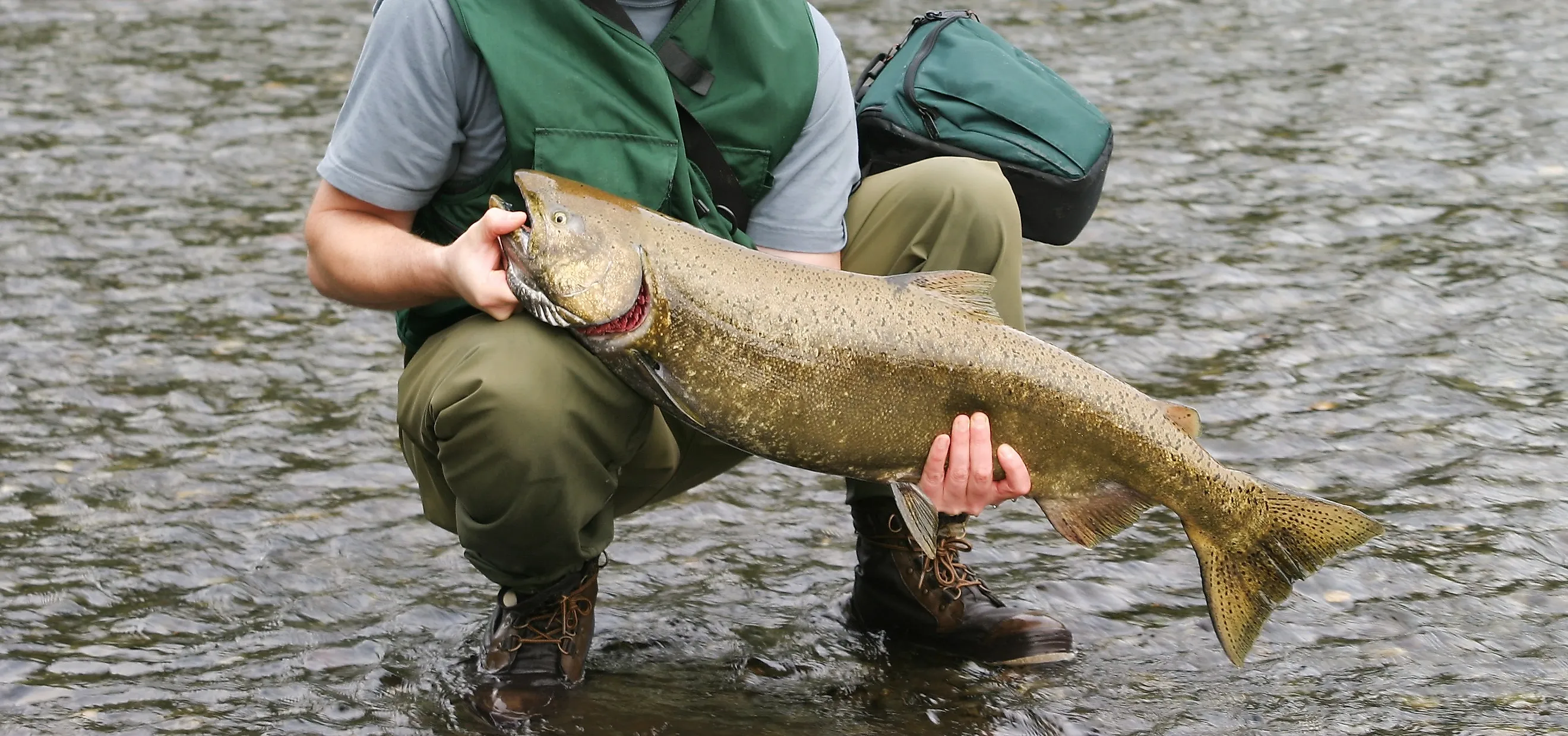
The largest salmon ever caught on rod and reel was a 97-pound king that Les Anderson pulled from Alaska's Kenai River in 1985, and no angler has beaten it since. How big a salmon grows comes down to its species and the years it spends feeding at sea before it returns to spawn. It also needs a river it can still swim up, which is part of why the biggest fish are getting harder to find.
The seven rivers below hold North America's heaviest king, Atlantic, coho, and pink salmon, across Alaska, the Great Lakes, and Quebec. Several of those records are decades old, and the fish behind them may never be matched.
Kenai River, Alaska: A 97-Pound World-Record King

Les Anderson was fishing the Kenai's early king run with his partner Bud Lofstedt when he hooked the fish the Kenai is still known for. The king was too large to haul into their small boat, so Anderson led it to shore instead, and the two rushed it to a scale in town before it could dry out and lose weight. It proved worth the fuss. The king came in at 97 pounds, 4 ounces, a rod-and-reel world record that has stood ever since.
The timing of this haul was a surprise. Mid-May kings on the Kenai typically ran 20 to 30 pounds, while the river's late run in July was the one known for 70- and 80-pound fish. Biologists credit genetics, along with the extra year many Kenai kings spend at sea, for making them the largest salmon in Alaska. A trophy king elsewhere in the state weighs about 50 pounds, while Kenai fish can top 75.
The river, which drains much of the Kenai Peninsula, supports two distinct king runs and the busiest freshwater king fishery in the state. In the quarter century after Anderson's catch, only a handful of kings over 90 pounds had been landed. The closest, at 95 pounds, 10 ounces, still fell more than a pound and a half short of the record.
Umpqua River, Oregon: An 83-Pound Chinook From 1910

Oregon's oldest standing coldwater fishing record belongs to a king salmon. Ernie St Claire caught an 83-pound Chinook in the Umpqua River in 1910. The Oregon Department of Fish and Wildlife still lists it as the state record more than a century later, and no other coldwater record in Oregon is nearly as old.
The Umpqua's salmon were already in decline a few decades after that catch. A joint 1946 study by Oregon's Fish Commission and State Game Commission estimated that only about 4,400 spring Chinook entered the river that year, including roughly 935 jacks, young males under 20 inches. The report attributed the decline to overfishing, along with log jams, splash dams built to move timber downstream, mill dams, and hydroelectric development. Some runs were holding steady, including winter steelhead, shad, and striped bass.
The striped bass thrived despite the river's changes. In fact, the Umpqua later produced Oregon's record striped bass, a 68-pound fish caught in 1973. One river on the southern Oregon coast holds the state's top marks for both a native Pacific salmon and a fish introduced from the Atlantic coast, a reminder of how much the lower river has changed since the days when kings like St Claire's came in from the Pacific Ocean.
Columbia River, Washington: The June Hogs Lost to Grand Coulee Dam
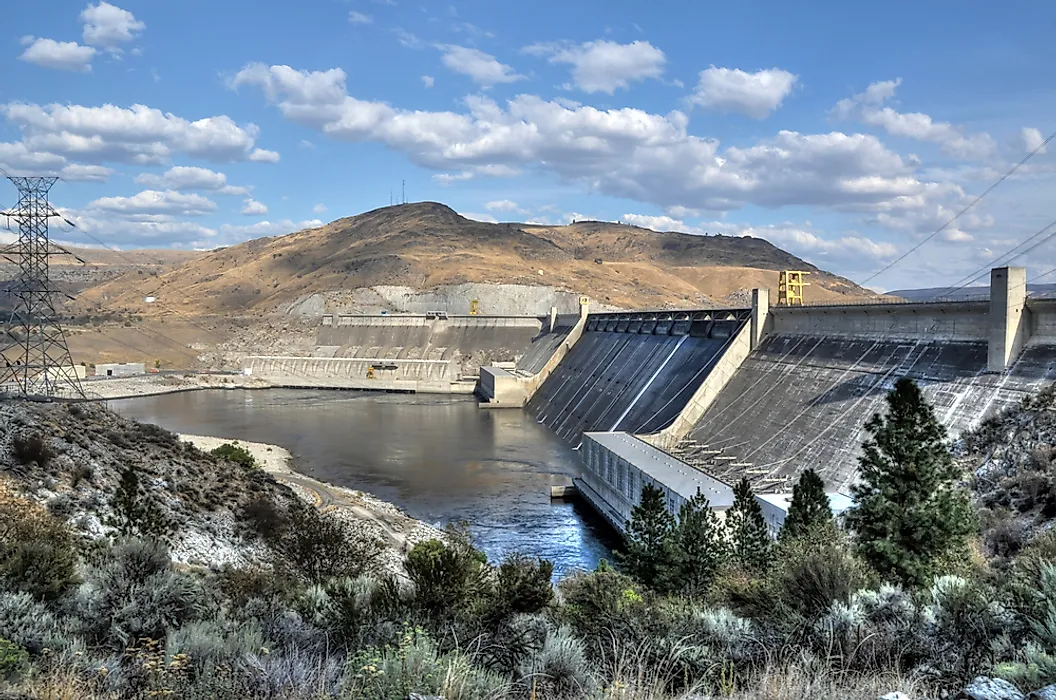
Summer Chinook three to four feet long and over 60 pounds were once common in the Columbia River, according to the Northwest Power and Conservation Council. They were the largest salmon ever caught in the Columbia, bound for the upper basin in Washington and British Columbia. These upstream travelers reached the upper river in June, and their size earned them the name June hogs. A four-foot salmon weighing 64 pounds was caught in the Spokane River in the spring of 1937.
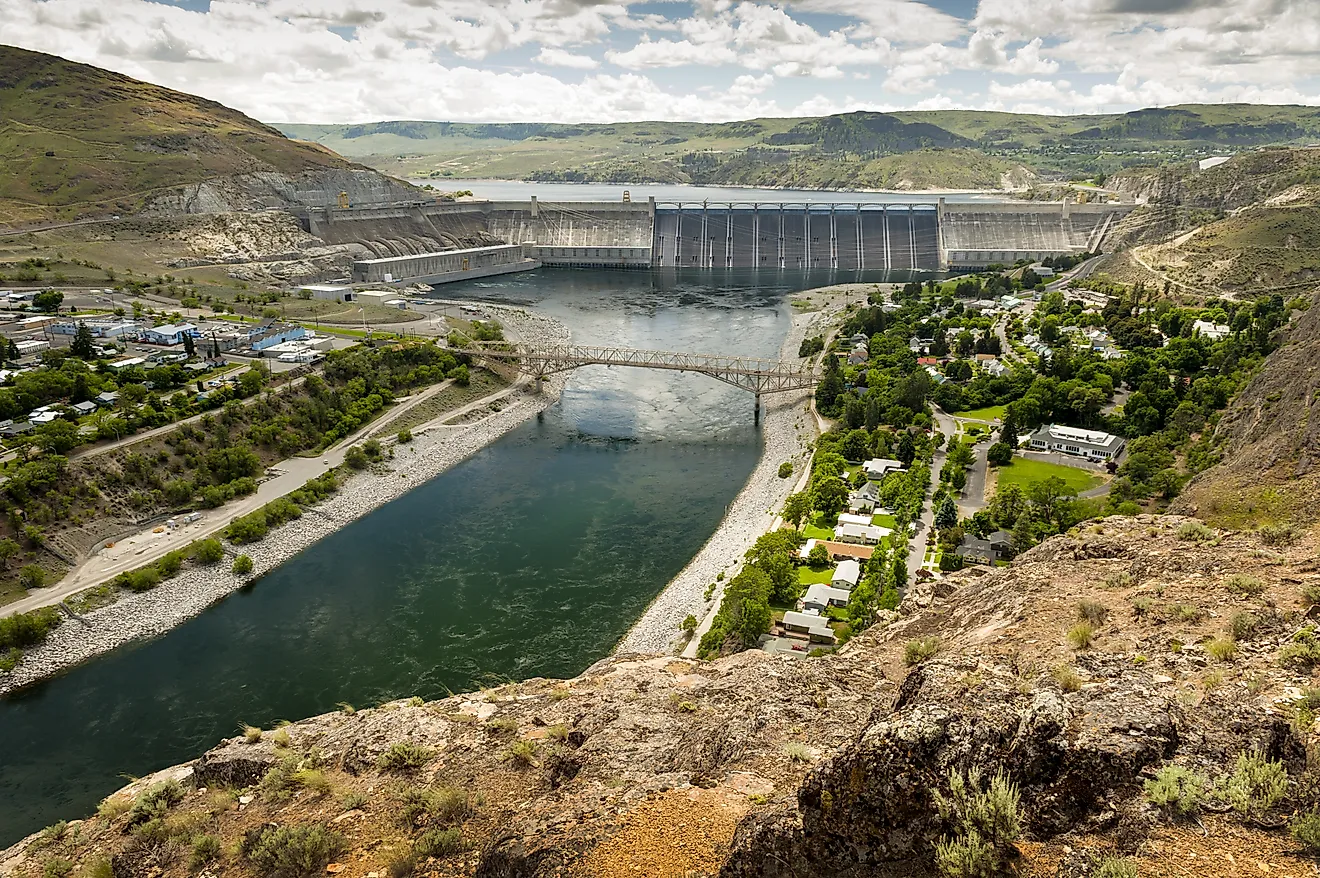
Those big runs ended with Grand Coulee Dam. Completed in 1941 without fish passage, the dam blocked access to more than 1,100 miles of spawning habitat in the upper Columbia, along with the populations that produced the biggest summer Chinook. The Spokane and Coeur d'Alene tribes, who relied on the fish as a staple food, lost one of their main resources. Canneries downriver prized the June hogs. A surviving photograph from Astoria shows an 85-pound Chinook, a true June hog, caught there in 1925.
Summer Chinook still enter the Columbia each June and July, now spawning in tributaries such as the Wenatchee, Methow, and Okanogan below the dams. Today, a 40- or 50-pound fish is notable. According to reporting by Seattle's KUOW, a century of dam building, overfishing, habitat loss, and hatchery practices has cut the average size of these salmon roughly in half.
Grand Cascapedia River, Quebec: A 55-Pound Atlantic Salmon

In June 1939, a young angler named Esmond B. Martin hooked a 55½-pound Atlantic salmon on a Lady Amherst fly in the Grand Cascapedia River, on Quebec's Gaspé Peninsula. The Atlantic Salmon Federation records it as the largest Atlantic salmon ever caught on rod and reel in North America. His aunt, who owned a private fishing camp on the river and had hoped to land the giant herself, was reportedly so annoyed that he caught it first that he was never invited back.
Martin's fish was not a fluke. The Cascapedia River Museum cites author Ronald Swanson's count that only 21 or 22 Atlantic salmon of 50 pounds or more have ever been recorded in North America, and 17 of them came from this one river. Today, the museum reserves the name Grand Cascapedia Giants for salmon over 45 pounds. Like all Atlantic salmon, these fish put on their weight while feeding in the North Atlantic Ocean before returning to their river home.
The river runs about 120 kilometers (75 miles) between Lake Cascapedia, fed by streams of the Chic-Choc Mountains, and Cascapedia Bay on Chaleur Bay. By the 1880s it had become a retreat for wealthy anglers, and several Governors General of Canada, including the Marquess of Lansdowne and Lord Stanley, kept summer homes along it. Almost its entire course in Quebec is now protected within the Cascapedia River Wildlife Reserve, established in 1982.
Salmon River, New York: A 33-Pound World-Record Coho

Surprisingly, the world record coho salmon did not come from the Pacific, where these fish generally thrive. Jerry Lifton caught a 33-pound, 4-ounce coho in New York's aptly named Salmon River on September 27, 1989. The New York State Department of Environmental Conservation (DEC) still cites it as the world record. The same river produced a 47-pound, 13-ounce Chinook in 1991, which earned the Great Lakes record, according to the DEC.
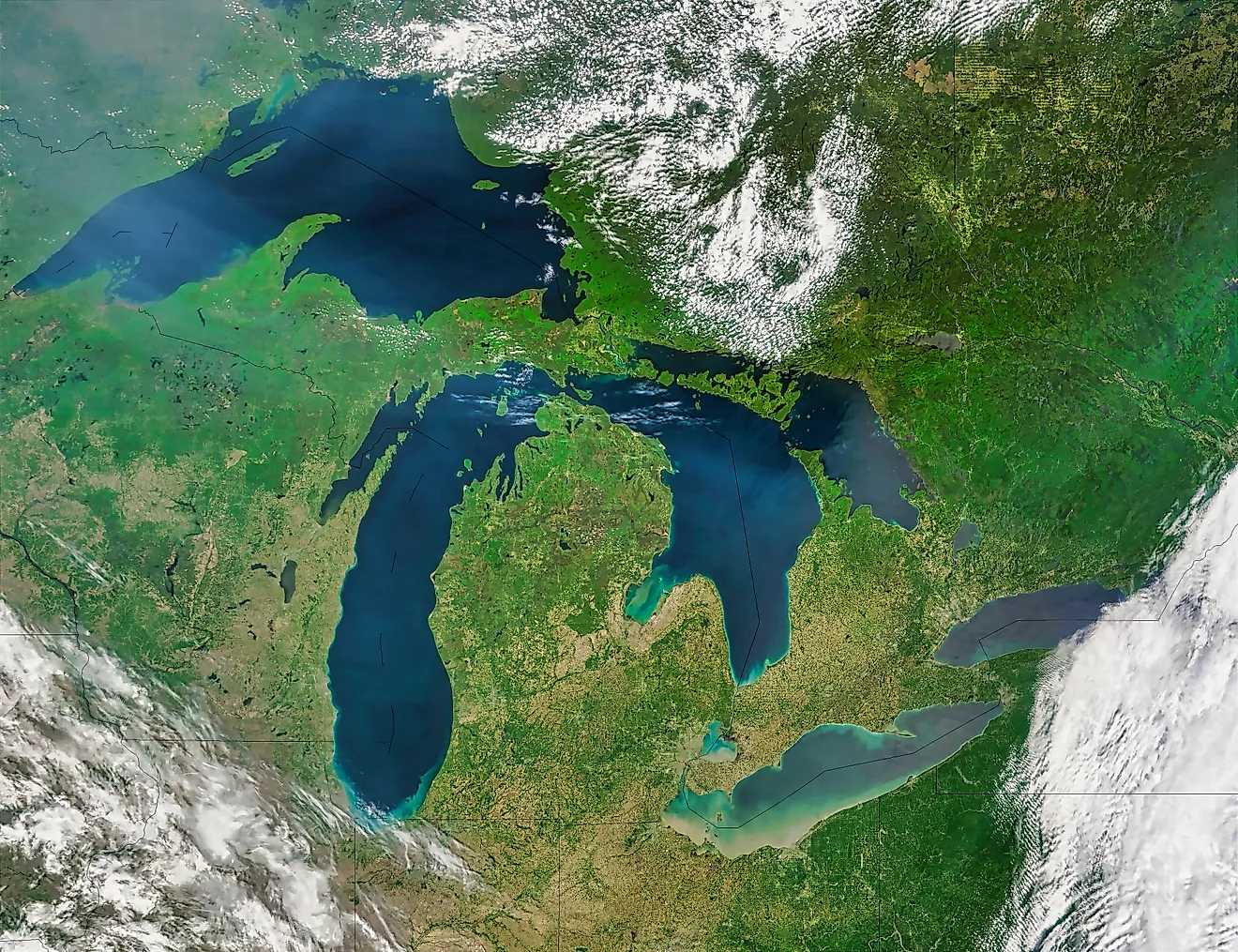
Neither species is native to Lake Ontario. Pacific salmon there come from stocking, and the Salmon River is the center of the program. The Salmon River Fish Hatchery in Altmar, built in 1980, raises Chinook, coho, steelhead, and brown trout, and its salmon come from eggs taken from adults returning up the river. Each year it stocks more than 1.4 million Chinook fingerlings and 750,000 steelhead yearlings.
The river runs 17 miles between Lighthouse Hill Reservoir and Lake Ontario at Port Ontario in New York. Even the record books here have their complications. In August 2025, an angler pulled a pink salmon from the river that easily outweighed New York's record from 1985, but the DEC declined to recognize it because it had retired the pink salmon record in 2024.
Platte River, Michigan: A 30-Pound Record Coho

Just 10 years after the river became the birthplace of the Great Lakes salmon fishery, Michigan's record coho salmon surfaced. It weighed 30.56 pounds and measured 40 inches when an angler caught it in the Platte River in 1976, using a spawn sack. In 1966, with sea lamprey under control and Lake Michigan overrun by alewives, the state's fisheries chief, Howard Tanner, acquired surplus coho eggs from Oregon. The first young coho went into the Platte in late March that year, and more were released into Bear Creek, a Manistee River tributary. Results came quickly. By September 1966, returning coho were already reaching the Platte's barrier trap, and the first full spawning run followed in the fall of 1967. Building on that success, Chinook salmon from Washington's Toutle River were added in 1967.
The Platte remains the heart of that program. The Platte River State Fish Hatchery near Beulah has been the main source of coho eggs for Michigan since 1966, and most of the state's coho are still planted in the Platte. An average adult Great Lakes coho weighs about five pounds, but the 1976 record was roughly six times that size. Tanner, who later served as DNR director, died in August 2026, and the state credits his decision to introduce the salmon with creating a thriving recreational fishery.
Stillaguamish River, Washington: A 15-Pound Record Pink

Pink salmon are the smallest Pacific salmon, usually weighing three to five pounds, which makes these two catches from Snohomish County stand out. On October 11, 2007, 19-year-old Adam Stewart caught a 15.4-pound pink in the lower Stillaguamish River. It measured 31 inches long with a girth of 24.75 inches, and the Washington Department of Fish and Wildlife certified it as the state record. A state biologist noted its huge hump, a feature of male pinks returning to spawn and the reason anglers call them humpies.
The trophy fish Stewart replaced was famous in its own right. On September 30, 2001, nine-year-old Alex Minerich caught a 14.86-pound pink in the nearby Skykomish River at Hansen's Bar. In 2007, the state noted that fish still held the International Game Fish Association world record. Stewart's heavier fish needed its own application to claim that title.
Pinks are also the most abundant Pacific salmon, and most return to Washington rivers in odd-numbered years. In 2007, nearly 3.3 million were expected in Puget Sound rivers and streams. Large runs raise the odds of an outsized fish, which may explain why two record pinks came from neighboring Snohomish County rivers flowing toward the Pacific Ocean.
Why The Biggest Salmon Belong To History
The largest salmon in these records share long years at sea and open passage to their spawning grounds. Kenai kings spend an extra year at sea gaining girth, and the Grand Cascapedia's giants come from a protected wild river. Where dams blocked the upper rivers, as at Grand Coulee, the giants disappeared. The Great Lakes are the exception, where stocked coho and Chinook set world and regional records in lakes far from any ocean. Many of these high marks are decades old. The Umpqua's dates to 1910, the Cascapedia's to 1939, and the Kenai's to 1985. Each shows what a river once produced, and on rivers like the Columbia, how far salmon size has fallen since.