How Many Sailors It Takes To Run A Great Lakes Freighter
A modern Great Lakes freighter sails with roughly two dozen people aboard, and the number barely changes for the biggest ships on the lakes. Interlake Steamship's crews generally number 22 to 25 per vessel, according to the company, and its 1,013.5-foot Paul R. Tregurtha had 23 people aboard when it stopped in Whitefish Bay on eastern Lake Superior after a generator fire in June 2018. That is six fewer than the 29 men lost with the Edmund Fitzgerald in 1975, on a ship about 285 feet shorter.
Part of that difference sat in the engine department, where the Fitzgerald's three oilers stood round-the-clock watches, while a diesel laker with extensive automation now carries a single QMED on daytime hours. Watch-standers in the deck and engine departments are divided into three rotating teams under federal law, which is why so many jobs aboard come in threes as these ships carry iron ore out of Lake Superior and coal down through the Soo Locks.
Each Ship's Minimum Crew Is Written On A Coast Guard Certificate

The 858-foot Roger Blough had 24 people aboard when it ran aground on Gros Cap Reefs in eastern Lake Superior in May 2016, and the American Mariner carried 19 crew when it left Ashtabula, Ohio, in January 2023, according to federal accident reports. Each of those crews had to meet a minimum written into the ship's certificate of inspection, a Coast Guard document naming the licensed officers and crew needed to operate the vessel safely. Under federal law, a ship may not sail without that complement aboard, and vessels of 1,000 gross tons or more on voyages of 400 miles or longer must carry three licensed mates in addition to the captain, so the pilothouse watches on a laker are split among three mates.
Shipboard Jobs Come In Threes Because Of The Watch Rule

On merchant ships over 100 gross tons, including those on the Great Lakes, the licensed officers and the sailors and oilers who stand watch must be divided into at least three watches while underway, and no one in the deck or engine department can be required to work more than 8 hours in a day.
A day underway divides into six 4-hour watches. Two of them fall to each person, 12 hours apart, for a total of 8 hours, the most anyone in those departments can be required to work, so covering all six takes three people for every watch-standing job. Interlake mate Matthew Bassett described his own schedule to Cleveland Magazine in 2024 as "12 to four, twice a day," meaning he goes on watch at noon and again at midnight. The same rhythm applies to wheelsmen and watchmen, and the Edmund Fitzgerald's 1975 crew included three mates, three wheelsmen, three watchmen, and three oilers.
The Deck Department Is The Largest On Board

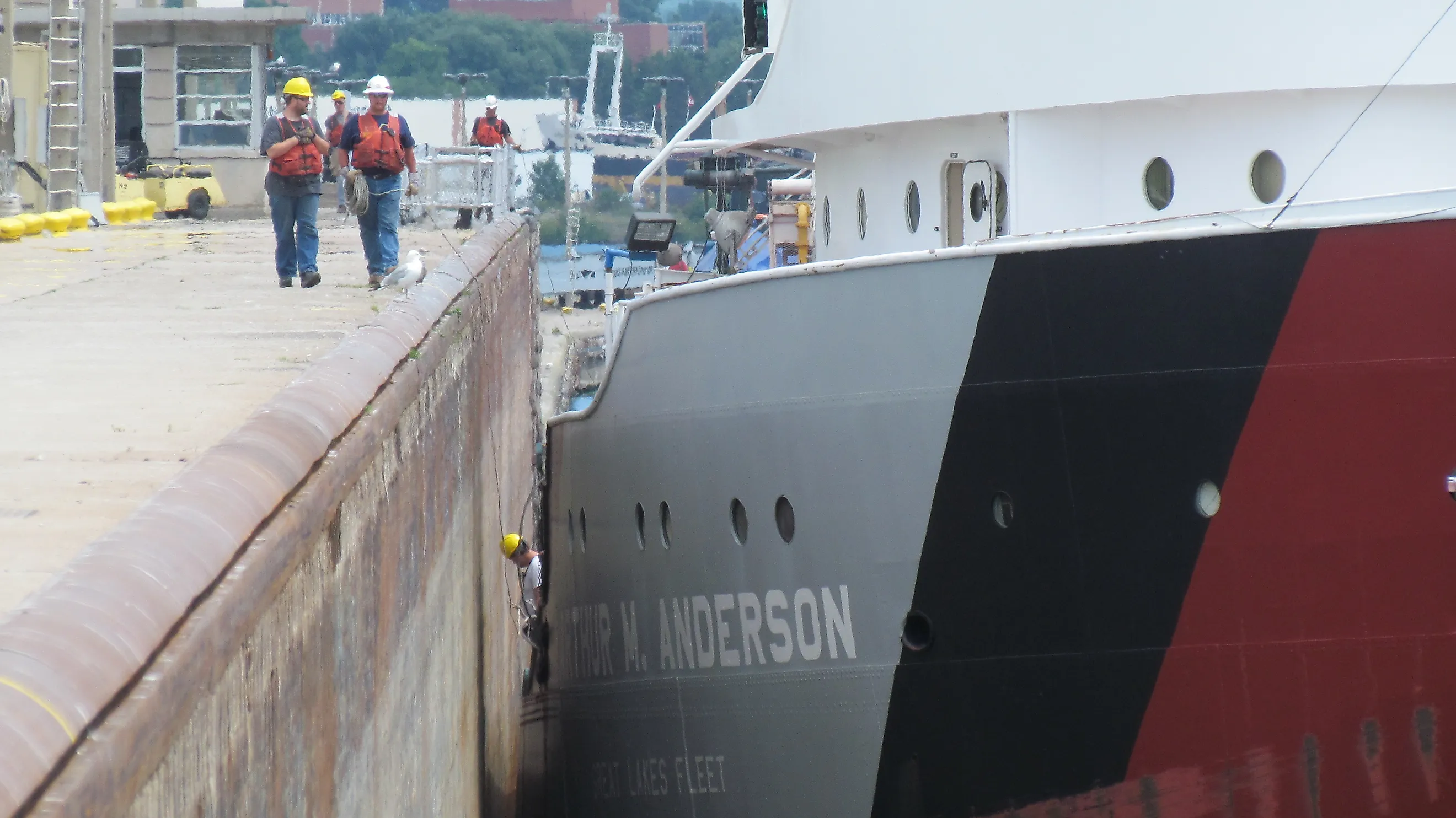
Deckhands, often ordinary seamen early in their careers, keep daytime hours of roughly 8 a.m. until 4:30 p.m. while underway and turn out at any hour when the ship docks or passes through a lock. If a freighter reaches port at 1:30 a.m., loading or unloading starts at 1:30 a.m., according to the Lake Carriers' Association, and the deckhands handle the mooring cables and winches, with a bosun often running the deck crew as its foreman. On most lakers they also remove and replace the hatch covers over the cargo holds.
The two watch-standing deck jobs, wheelsman and watchman, usually require an able seaman rating, which a sailor earns by passing a Coast Guard exam after 360 days at sea and additional training. On the open lake a wheelsman serves as lookout, and in rivers and harbors the wheelsman steers on the mate's orders, while a watchman works on maintenance projects underway and runs gates or stands security watch at the dock. In certain fleets the two roles are combined into one wheelsman's job, leaving three unlicensed sailors on deck watches instead of six.
Engineers And Conveyormen Run The Machinery And The Boom

Most US lakers carry self-unloading gear, and the Paul R. Tregurtha's five cargo holds can be emptied in about eight hours through a belt system that feeds a 260-foot boom. The conveyorman who runs that system works in the engine department, maintaining the belts and supervising the gatemen, often deckhands or watchmen, who release cargo from the holds onto the belts during unloading.
A chief engineer and three assistant engineers hold the licenses below deck, and QMEDs, short for qualified members of the engine department, monitor and maintain the machinery alongside wipers. On steamships, three QMEDs can split the day into 4-hour watches, while a diesel ship with extensive automation carries a single QMED who works regular daytime hours.
Cooks Work Outside The Watch System
Chief steward Julie Kowalski and second cook Cristonna Lisby were feeding a 22-person crew aboard the Mark W. Barker in 2024, working roughly 6 a.m. until 6 p.m. with no days off while aboard, Cleveland Magazine reported. Galley staff stand no watches, and theirs is the smallest department on the ship. The Fitzgerald carried four people in its galley in 1975, two of them porters, and porters usually move up to second cook after about 30 days.
Why The Edmund Fitzgerald Carried 29

In November 1975, the engine department of the 729-foot Fitzgerald, launched in 1958, held five engineers, three oilers, and a wiper, nine people in all, while Interlake's 1,004-foot Mesabi Miner ran with an engine department of seven in 2020. The Fitzgerald's three oilers stood engine-room watches in the three-team rotation, work that falls to a single daytime QMED on a diesel laker with extensive automation. The ship also carried two maintenance men and a cadet, and as a straight-decker emptied by shoreside equipment in around 14 hours, it had no conveyorman or gatemen among its 29.
Mechanical stokers were installed on newer lakers in the 1940s and retrofitted onto older ships in the 1950s, ending hand-firing on most of the fleet, though the Daniel J. Morrell, a coal-fired steamer built in 1906, still carried firemen and coal passers among the 29 aboard when it sank in Lake Huron in 1966. The Fitzgerald's coal-fired boilers were converted to burn oil during the winter layup of 1971 and 1972, and its 1975 crew list included no firemen or coal passers.
Sixty Days Aboard And A Ten-Week Layup

Interlake's licensed officers work 60 days on and 30 days off, and relief officers fill those berths while the regulars are home. Hitches elsewhere on the lakes vary widely, and some last only two days. The Soo Locks between Lake Superior and Lake Huron close on January 15 and reopen on March 25, a shutdown of about 10 weeks during which most of the fleet lays up for maintenance, leaving just under 10 months of shipping each year.
Eric Peace of the Lake Carriers' Association told Seaway Review that the workforce is aging, with not a lot of youth coming in. About 200 students attend Great Lakes Maritime Academy in Traverse City, Michigan, and its superintendent said in 2025 that job opportunities for graduating cadets have not been this strong since the end of the Vietnam War. Pay for some of its graduates tops $100,000 a year right out of school.
The Head Count Barely Changes
The 639-foot Mark W. Barker sailed with 22 people in 2024 and the 1,013.5-foot Paul R. Tregurtha carried 23 in 2018, a difference of one person across about 375 feet of hull. Four deck officers and four licensed engineers account for eight licensed berths, and where a fleet keeps separate wheelsmen and watchmen, six more berths cover the three watches. Deckhands and the engine and galley ratings bring the total into the low 20s. The Barker, the first new US-flag laker built on the Great Lakes since 1983, carries only five hatches, large hydraulically operated MacGregor covers of a type more common on ocean ships and worked with far fewer of the hand-released clamps that a conventional laker spreads across many more hatches, and its engine room can be largely run by one person from a control room. Every watch-standing job aboard the Barker still needs three people.