How Stocked Salmon Kept Lake Michigan From Collapsing
By the 1960s, Lake Michigan’s fishery was on the brink. Sea lampreys had ravaged lake trout while invasive alewives swarmed the lake and washed ashore by the millions. Then, fisheries managers released Pacific salmon. Coho and Chinook found a vast food supply in the alewife boom. They helped control the invader and fueled a world-class sport fishery. The gamble gave anglers prized new catches and helped pull the lake back from ecological disaster.
Salmon did not rescue Lake Michigan on their own. Sea-lamprey control, lake-trout stocking, harvest limits, and stronger environmental protections also drove the recovery. Yet salmon filled part of the predatory void left by lake trout and kept the crisis from worsening. Their introduction became one of the boldest experiments in Great Lakes history. Learn how stocked salmon helped bring Lake Michigan back from the edge.
The Invaders of the 1900s

In the 1930s, an invasive species entered Lake Michigan known as sea lampreys. Native to the Atlantic Ocean, this eel-like creature uses its suction-cup-like mouth and sharp teeth to drain blood from fish. Deepening of the Welland Canal in 1919 gave sea lampreys access beyond Niagara Falls; they were documented in Lake Erie by 1921, Lake Michigan by 1936, and throughout all five Great Lakes by 1938.
These sea lampreys caused immense damage to the fish populations in the Great Lakes, especially lake trout. A single sea lamprey can kill up to 40 pounds of fish during its 12- to 18-month feeding stage. In Lake Superior, overfishing and lamprey predation reduced an annual commercial lake-trout harvest that averaged about 4 million pounds between 1920 and 1950 to 210,000 pounds by 1964.
Due to this vast die-off in larger fish, another fish species was able to thrive: alewives. These fish are small, usually four to nine inches long, and are an invasive species. Alewives were recorded in Lake Ontario in 1873, although their origin there remains uncertain; they probably reached Lake Erie through the Welland Canal before spreading westward. They were officially recorded in Lake Michigan in 1949.
This was poor timing, as sea lampreys killed off the lake trout that would have normally fed on alewives. These alewives consumed eggs and plankton needed for other fish species. Without natural predators, their population boomed out of control until it led to mass die-offs, with millions of dead alewives washing ashore on Lake Michigan in the 1950s and 1960s.
The situation was unsustainable, and something had to be done to save Lake Michigan.
Enter the Salmon

In 1964, Dr. Howard A. Tanner began work as the chief of the Michigan Department of Conservation's Fish Division. He had to figure out a way to handle the alewives and restore the fisheries.
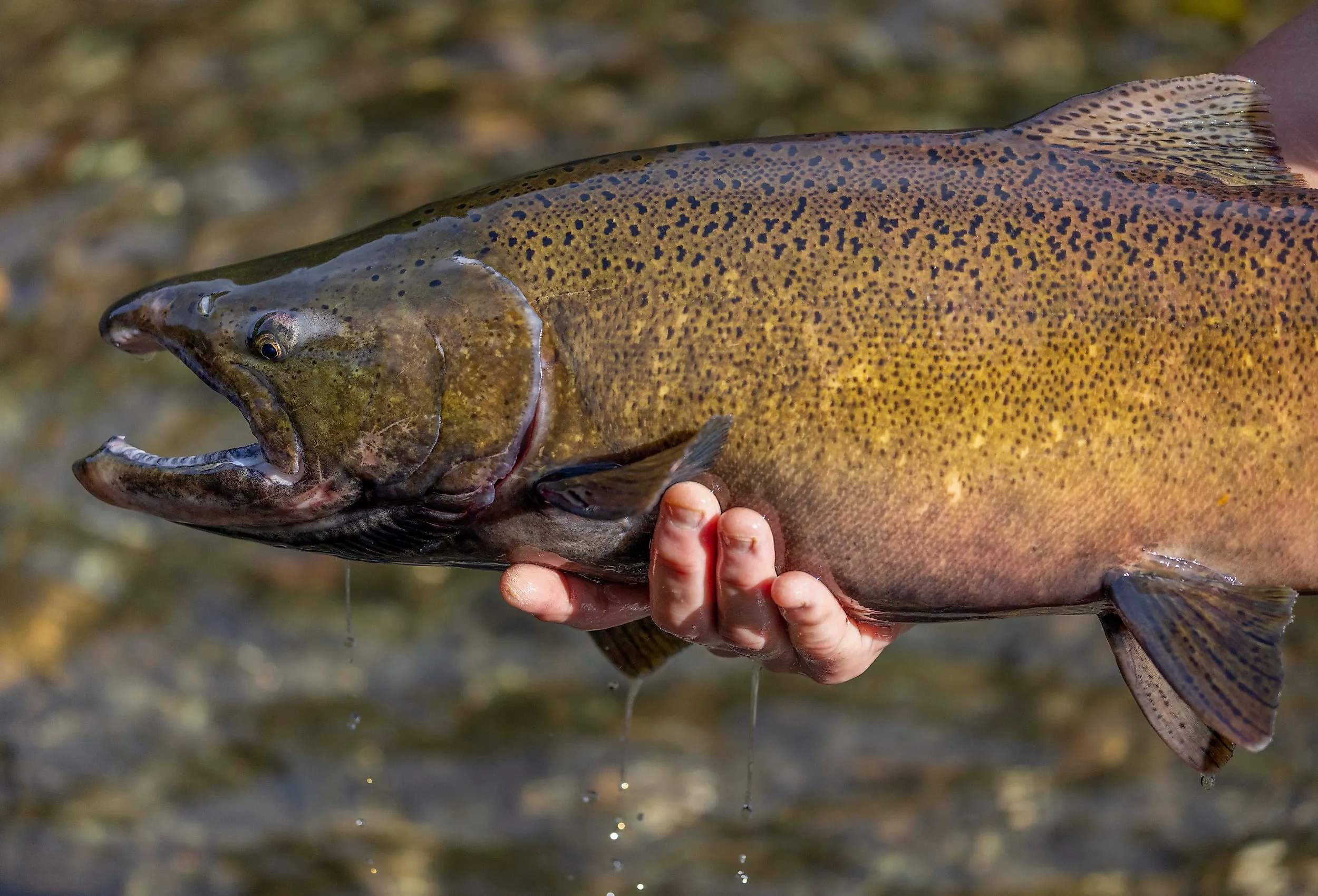
He believed the answer lay in introducing a predator capable of feeding on the abundant pelagic alewives. He believed he found it with coho and Chinook salmon, which were not only aggressive but could also thrive in freshwater.

The idea was very controversial at the time, as many argued that introducing a non-native species could have the same effect as the invaders. Tanner oversaw the first major coho stocking in Lake Michigan tributaries in 1966, followed in 1967 by Chinook salmon, a species that generally grows larger than coho.
Returning coho generated intense angling interest by 1967, while sustained salmon predation helped reduce Lake Michigan's alewife biomass to less than 20% of its historic high by the early 1980s. The fishing industry also gained two new fish to catch, especially the Chinook, which commonly exceeds 30 inches and can weigh more than 30 pounds.
Controlling Sea Lampreys

But this successful salmon introduction raises an important question: what about sea lampreys? After all, this program would have failed if sea lampreys were allowed to flourish and kill these introduced Pacific salmon.
Before Tanner took office, researchers working with the Great Lakes Fishery Commission searched for a lampricide that would kill larval sea lampreys while producing minimal effects on most non-target organisms at treatment concentrations.
In the mid to late 1950s, the Hammond Bay Biological Station tested out several lampricides, eventually settling on TFM in 1958. The Great Lakes Fishery Commission began applying this compound to tributaries where the larval sea lampreys live.
This compound interrupts the larvae's metabolism and kills them before they can transform into the toothed, parasitic adult stage. This program has proved very successful, killing off as much as 90% of the sea lamprey population in some parts of the Great Lakes by the early 1960s.
Salmon and Fish Stocking Today

Salmon stocking is still practiced in Lake Michigan today. Indiana DNR annually stocks Chinook salmon in Lake Michigan and its tributaries, with sites at East Chicago, the Little Calumet River, and Trail Creek.
Indiana’s 2023 Chinook Stocking Strategy explains why the state chose these three sites. Young Chinook imprint on the tributary or harbor where they are released, then feed throughout Lake Michigan until they reach sexual maturity, at which point they return to that same location in the fall to spawn. Stocking at accessible ports is meant to concentrate a fall fishery where the mature fish come back.
Managers now adjust salmon stocking according to the balance between predators and available prey. Stocking too many salmon could deplete alewives and weaken the salmon fishery, so agencies also account for naturally reproduced Chinook when setting stocking levels.
Other fish are also raised and released into Lake Michigan, including native lake trout. Although the Lake Superior population was declared fully restored across most of that lake in 2024, Lake Michigan still requires lake trout stocking.
The primary restoration goal is to establish genetically diverse, self-sustaining lake-trout populations in priority rehabilitation areas while also supporting fisheries. Stocking is concentrated in northern Lake Michigan and designated offshore refuges as well as selected fishery locations. Fish are marked with a fin clip and coded tag to track their movement, survival, and reproduction. The overall goal of the US Fish and Wildlife Service is for the lake trout population to recover to a point where no more stocking is needed.
Future Invasive Species?

Four fish collectively known as invasive carp (bighead, silver, grass, and black carp) pose differing threats to the Great Lakes. Bighead and silver carp are the principal concern in the Illinois Waterway because they consume large quantities of plankton and can grow to substantial sizes. If these carp became established in Lake Michigan, their feeding could disrupt the food webs that support native fish, trout, and salmon. In some infested waterways, invasive carp have accounted for more than 90% of the total fish biomass.
Currently, electrical barriers are used in the Chicago Sanitary and Ship Canal to discourage them from swimming up the Illinois River into Lake Michigan. Experiments indicate that small fish could become trapped in the water between moving barges and potentially be transported through the electric barriers, although researchers have not confirmed that invasive carp have crossed by this route. An isolated silver carp was captured nine miles from Lake Michigan in 2017, although investigators could not determine how it passed the barriers and found no reproducing population nearby. In August 2026, crews removed several hundred juvenile silver carp, each about four to six inches long, from the Marseilles Pool of the Illinois River, roughly 80 miles from the lake. They were the first fish that young recorded so far upstream since intensive monitoring of the river began in 2010.
Authorities are experimenting with several additional methods to keep invasive carp out, such as acoustic arrays, bubblers, and an automated barge clearing system. One such project is the Brandon Road Interbasin Project in Joliet, Illinois, that combines all of these elements. The US Army Corps of Engineers halted work on the Brandon Road project in late July 2026 pending an administrative review, then lifted the stop-work order on September 2 and authorized construction to resume.
The Delicate Balance of Lake Michigan
Lake Michigan is a delicate ecosystem that can be easily disrupted by invasive species. Stocked salmon did not rescue the lake alone, but they filled a crucial predator role when alewives dominated its open waters. Combined with lamprey control, native-fish restoration, harvest regulation, and pollution reduction, the program helped stabilize the fishery and prevent further ecological damage. The continuing threat from invasive carp shows why Lake Michigan will require careful management and continual vigilance for decades to come.