What Lies At The Bottom Of Lake Mead
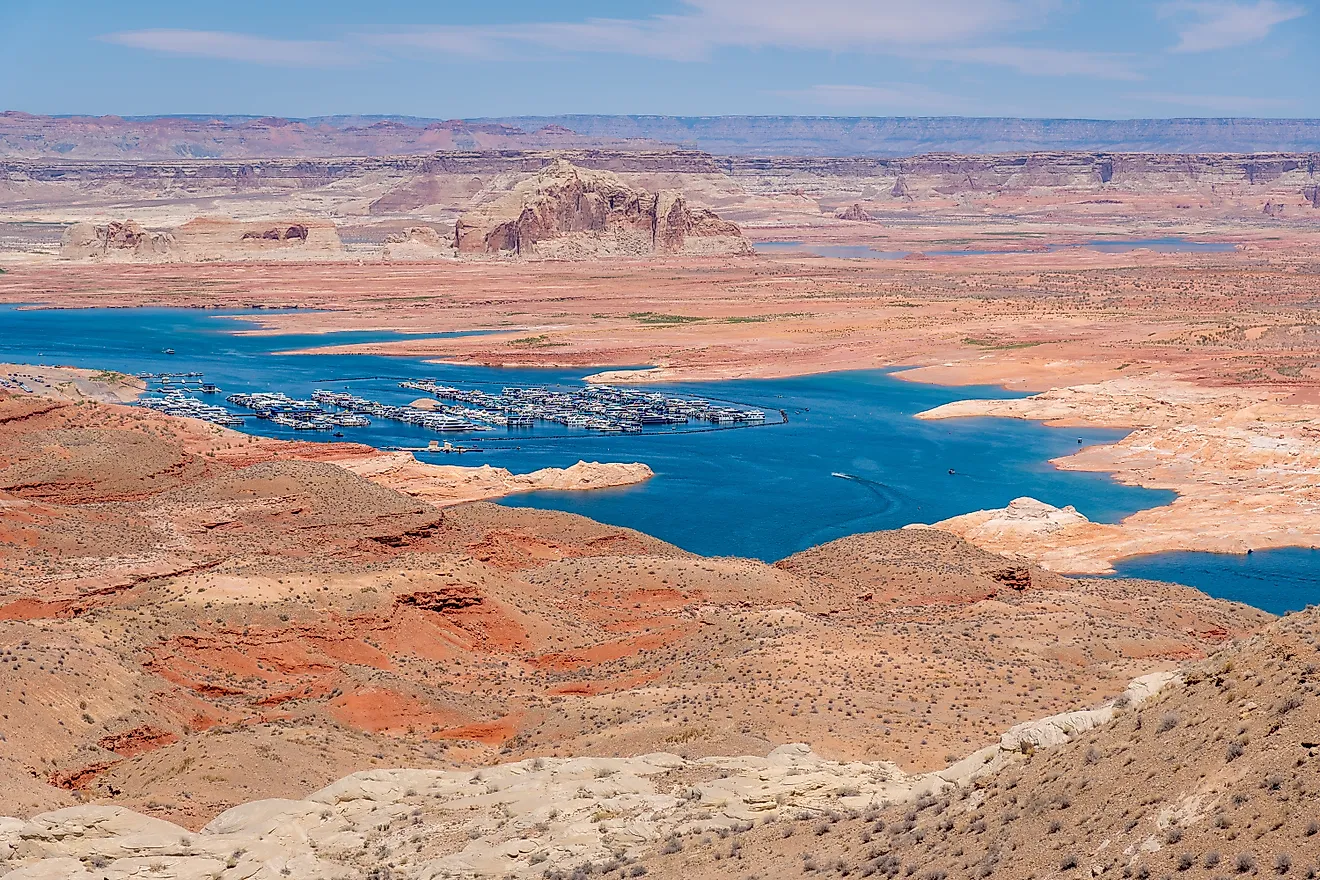
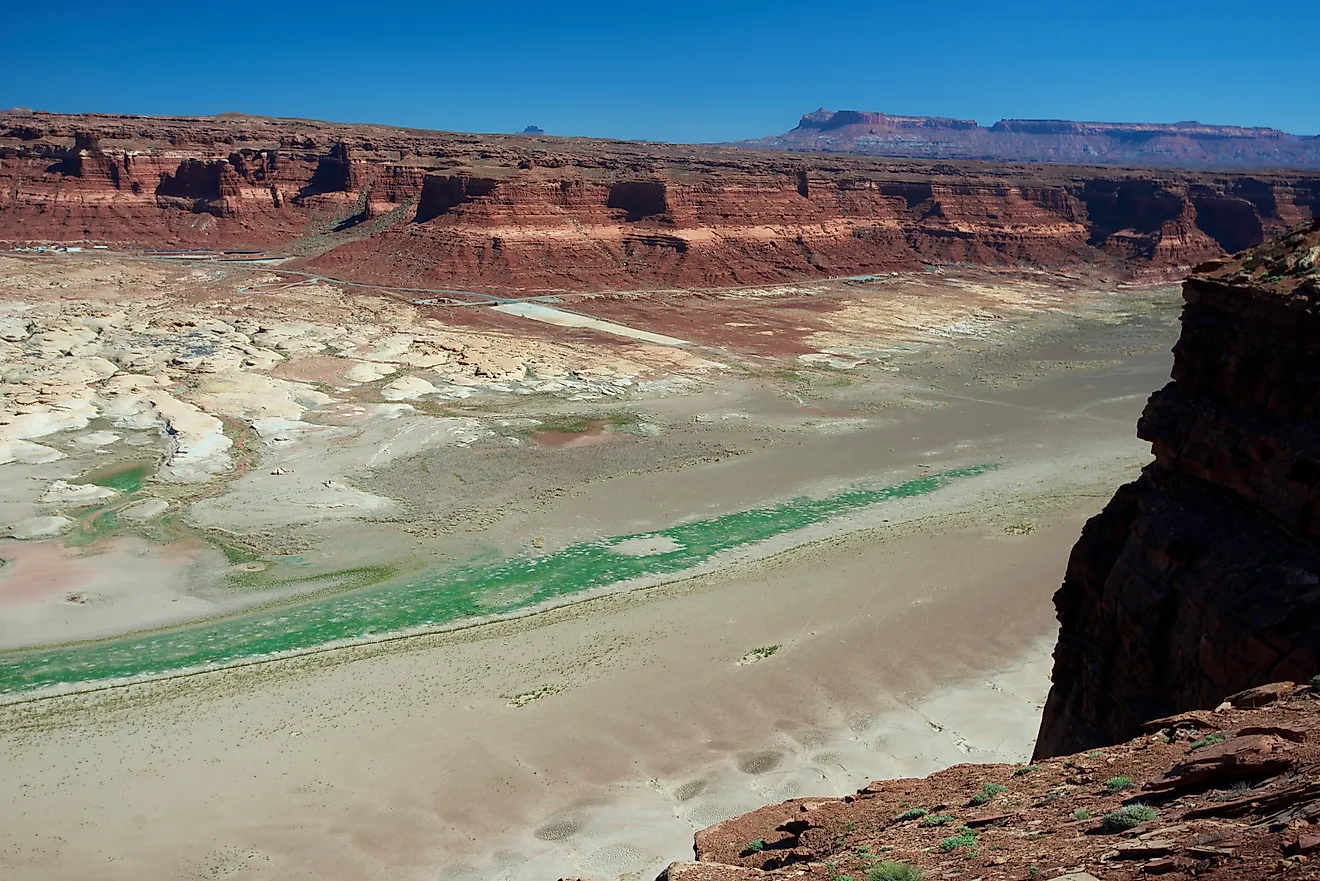
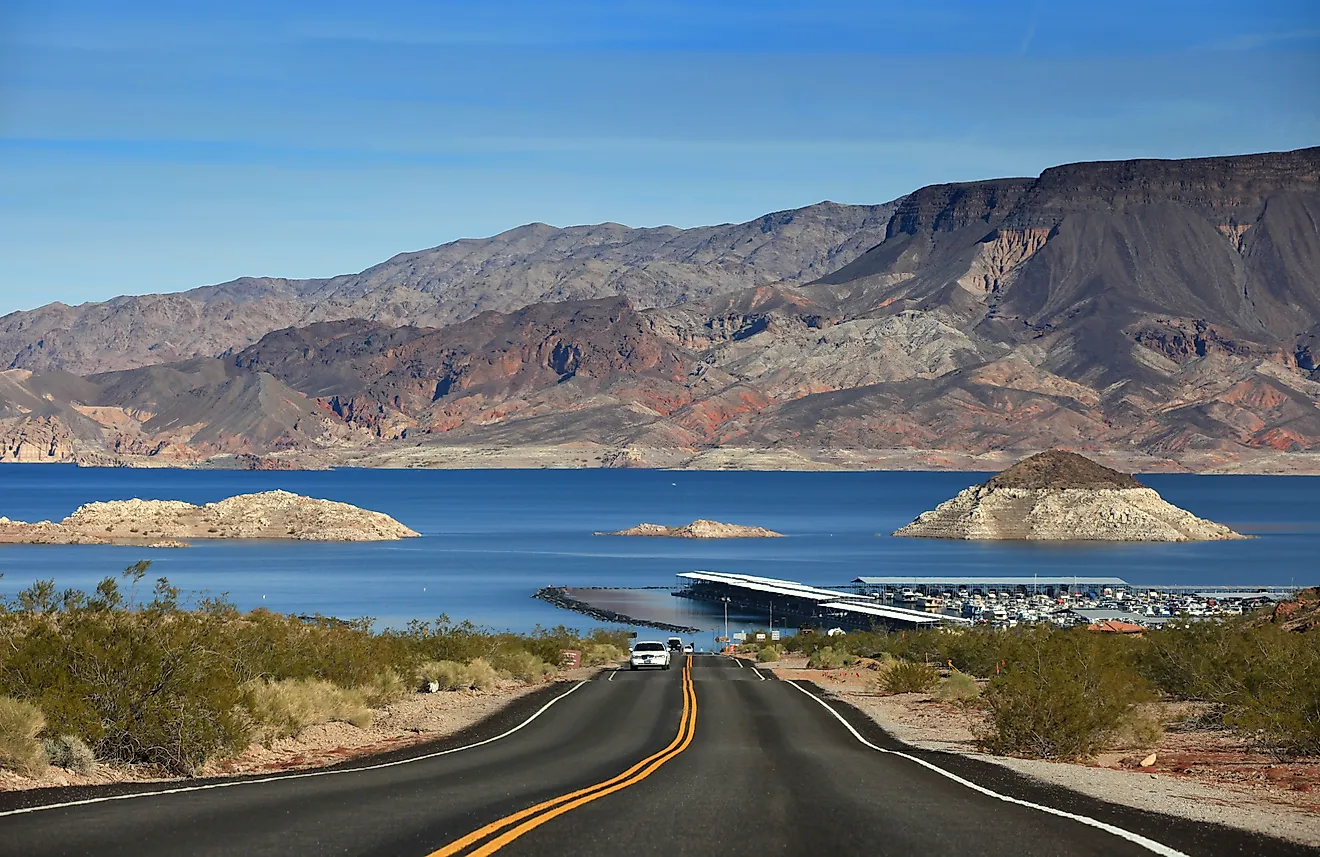
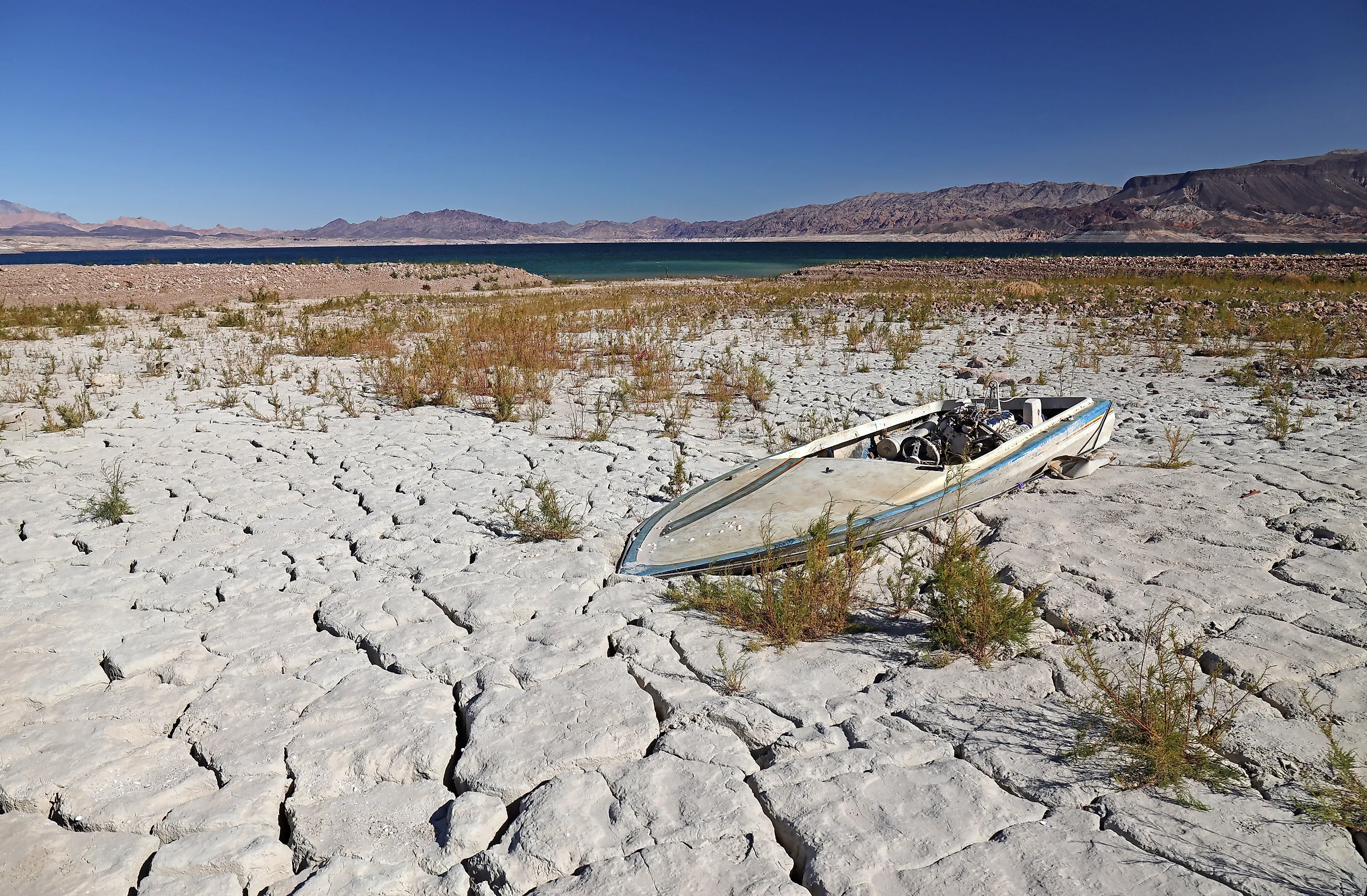
Lake Mead has dropped for four years toward record lows, and the lower it falls, the more of its old lakebed is left dry. By late 2026 the surface sat roughly 190 feet under full pool, the lowest since the lake began filling in 1935, and long stretches of the drowned Colorado River valley were out of the water for the first time in decades. The exposed ground holds a World War II bomber, the walkable ruins of a Mormon town, and the remains of several people, one of them shot and sealed in a barrel.
A B-29 Superfortress Lies in the Overton Arm

On July 21, 1948, a B-29 Superfortress left China Lake, California, for a test area near Lake Mead, where its crew was conducting high-altitude atmospheric research for Project 288, a program to measure the intensity of light at different heights. Around 12:30 p.m., flying low over the water with an altimeter that was reportedly off, the bomber struck the surface at about 230 miles per hour and skipped across it. The impact tore away three of its four engines and part of the tail, and the pilots ditched the plane on the lake before it sank. All five men aboard escaped, one of them with an arm broken against a bulkhead, and they were rescued hours later.
The wreck stayed lost for 53 years, until a private dive team using side-scan sonar located it in 2001. The site is much shallower now than it was at the time of the discovery because of falling lake levels, and the park describes the plane as fragile, with deteriorating metal. Under the park's current scuba rules, no part of it may be taken, and diving in the surrounding stretch of the lower Overton Arm is restricted to protect it. A second plane, a former Navy PBY Catalina flying boat converted for civilian use, crashed in Boulder Basin, closer to Hoover Dam, on October 24, 1949, about 15 months after the B-29 went down.
St. Thomas Is Back on Dry Ground

An unpaved road of about three miles leads to a parking area in the northern part of Lake Mead National Recreation Area, and a dirt trail continues on to the site of St. Thomas, beside the Muddy River near the northern end of the Overton Arm. The old town roads are walkable again and lined with exposed foundations, among them a set of steps that once led up to a house. Climbing on the foundations or moving artifacts is prohibited. When the lake was at its high-water mark, the town was submerged about 60 feet deep, and its ruins have come back into the open several times since 1938.
On June 11, 1938, Hugh Lord rowed away from his house as the water reached his front door, the last resident to leave as the reservoir rose behind Hoover Dam. The town dated to 1865, when Mormon settlers arrived near where the Muddy and Virgin rivers met, and at its peak about 500 people lived there, with a school, a post office, grocery stores, a church, a soda fountain, and several garages for the newly arrived automobile.
Callville Is Buried Under Colorado River Sediment

Most of the sediment carried by the Colorado, the source of about 98 percent of Lake Mead's inflow, settles along the floors of the old river and stream channels. The deposits are thickest in the deep part of Boulder Basin, the westernmost of the lake's basins and the one directly behind Hoover Dam, where more than 130 feet of sediment covers parts of the former Colorado riverbed.
Callville, in that same basin about 15 miles from Hoover Dam, went under some 400 feet of water and now lies beneath almost 80 feet of river sediment. A party that included Anson Call founded the settlement on December 2, 1864, as a landing for Colorado River steamboats and a warehouse site for the Latter-day Saints church, and for a time it was the southernmost outpost of Mormon settlement. The port was abandoned in 1869, once Callville proved too far upstream for steamboat navigation, though its warehouse was still standing in 1892. The marina and campground at Callville Bay take their name from it.
Human Remains Have Turned Up Along the Boulder Basin Shoreline

Edward "Buddy" Lelburian Jackson, originally from Arkansas, was in his mid-to-late 50s, investigators believe, when he was shot in the early 1980s. The barrel holding his body stayed under Lake Mead until May 1, 2022, when boaters found it on the receding shoreline at Hemenway Harbor. His death was dated partly through clothing and shoes sold at Kmart in the mid-to-late 1970s. The identification came through DNA and forensic investigative genealogy, with help from Oklahoma State University's forensic sciences program, and the Clark County coroner announced it on October 15, 2026, more than four years after the discovery. No tie between Jackson and Las Vegas has been found, and his killer has not been identified.
Two more sets of remains came from the Callville Bay area. Paddleboarders found the first on May 7, 2022, six days after the barrel, and DNA matched it to Thomas Erndt, who was 42 when he went missing in August 2002 after jumping from a boat and was presumed drowned. Remains found near the Callville Bay marina by contractors that October were later identified as Donald P. Smith, who drowned in April 1974.
Remains have also turned up twice at Boulder Beach, on the Boulder Basin shore near Hemenway Harbor. Those found there in the summer of 2022 were matched by DNA to Claude Russell Pensinger, missing since 1998, and possible human remains were reported at the same beach on August 16, 2026.
A World War II Landing Craft Surfaced Near Lake Mead Marina

A Higgins landing craft, the boat type that carried troops ashore at Normandy, sat nearly halfway out of the water in July 2022, less than a mile from Lake Mead Marina and Hemenway Harbor, in a spot where it had once lain about 185 feet down. At some point it was put into service on the lake, possibly to survey the Colorado River, and whether it sank by accident or was scuttled once it was no longer useful is unclear. It appears to have been partly salvaged before going down, and its engine is gone.
The Plant That Made Hoover Dam's Gravel Is Now a Dive Site

The Aggregate Classification Plant, set up in 1932 by Thomas M. Price and Six Companies, the group of firms behind Hoover Dam, supplied all of the sand and gravel for the dam and was left in Boulder Basin once the work was finished. Its ruins now spread across eight underwater acres, where divers pass concrete tunnels, the remains of conveyor belts, rail tracks, stairwells, the foundations of steel towers, and four piles of crushed aggregate. The site's depth is listed at about 115 feet, within reach of recreational divers.
Quagga Mussels Have Colonized the Wrecks

Invasive quagga mussels, shellfish about the size of a pistachio, have covered the B-29 so thoroughly that an estimated two tons or more now cling to the aircraft. When archaeologist Matthew Hanks inspected the bomber in 2015, he found no visible aluminum. By September 2021, its vertical stabilizer had broken and toppled, possibly because of the mussel buildup.
The species turned up in Lake Mead in 2007 at Las Vegas Boat Harbor, the harbor also known as Hemenway Harbor, and has spread through most of Lake Mead and Lake Mohave downstream. Quagga mussels survive as deep as 500 feet and attach to almost anything underwater, the lake's archaeological sites included. So far, effective antifouling paint is the only surface they have not colonized, and no economically feasible method exists to eradicate them from Lake Mead.
The order in which things reappear follows where each one sat on the old valley floor, measured against a lake that now stands about 190 feet below full pool. The Higgins boat near Hemenway Harbor, once about 185 feet down, was nearly halfway out of the water by July 2022, and the B-29 in the lower Overton Arm is still submerged. Callville, on the Colorado's main channel in what is now Boulder Basin, went under some 400 feet of water and then under the river's own sediment, and it remains far below the surface even with the lake near its record low. St. Thomas sat up the valley near where the Muddy and Virgin rivers met, under at most about 60 feet of water, and it is the one drowned town a visitor can walk today, at the end of a dirt road and a dirt trail near the northern end of the Overton Arm.