12 Crystal-Clear Lakes In The United States You Have To See
Some lakes are so clear the water barely seems to be there at all. You can count the stones on the bottom, watch fish hang in mid-water, or see the sky mirrored back without a ripple. That kind of clarity is not an accident: it comes from cold water, low nutrients, protected watersheds, and not much sediment washing in. The twelve lakes below are among the clearest and most striking in the United States, running from California to Maine, each worth the trip to see in person.
Lake Tahoe, California/Nevada

The most famous clear lake in the country straddles the California and Nevada border high in the Sierra Nevada, and its clarity is the stuff of decades of science: the water is often visible to depths of around 60 to 70 feet, and conservation groups have tracked that number closely since the 1960s. At about 1,645 feet deep, Tahoe is the second-deepest lake in the United States, and it holds an enormous volume of water, roughly 122 million acre-feet, enough that only a handful of lakes in the country are larger by volume. It is also one of the most accessible lakes on this list, ringed by beaches, trails, and ski resorts, so the clarity comes without the long hike.
Lake George, New York

Lake George stretches some 32 miles through the Adirondack Mountains of New York, dotted with more than 170 islands and long nicknamed the Queen of American Lakes. Fed largely by underground springs and mountain runoff in a heavily protected watershed, it stays remarkably clear, and the state has spent generations regulating development around it to keep it that way. The water is also full of life, with bass, walleye, panfish, northern pike, and lake trout all swimming its depths, which makes it as good for anglers as it is for the sightseers crowding its summer cruise boats.
Hanging Lake, Colorado

Hanging Lake looks like something invented for a postcard. Its green, nearly teal water sits on a shelf partway up Glenwood Canyon in Colorado, fed by waterfalls that spill over its lip. The shoreline is made of travertine, a delicate rock formed as dissolved limestone precipitates out of the water, which is why the lake is so fragile that visitors must stay on the boardwalk and out of the water. Reaching it means a steep 1.2-mile climb, and access is now limited by a permit system to protect the site, so plan ahead before making the hike.
Newfound Lake, New Hampshire

Newfound Lake in New Hampshire is one of the cleanest bodies of water in the Northeast, fed by springs and a protected watershed that keep pollutants out and the water exceptionally clear. It supports a healthy range of fish species and is lined with miles of shoreline and a few small islands reachable by boat or on foot. The water is cold and very clear, and the lake's relatively undeveloped surroundings are a big part of why it has stayed that way, drawing swimmers and paddlers looking for a quieter alternative to the state's busier lakes.
Flathead Lake, Montana

With more than 200 square miles of water and 185 miles of shoreline, Flathead Lake is the largest natural freshwater lake west of the Mississippi in the lower 48 states, set below the Swan and Mission mountain ranges in Montana. It is also genuinely clean and clear, regularly cited among the cleanest large lakes in the country. The lake holds several islands, the largest of which is Wild Horse Island, a state park reachable only by boat, home to a handful of wild horses along with a notable herd of bighorn sheep. The southern half of the lake lies within the Flathead Indian Reservation of the Confederated Salish and Kootenai Tribes, and a tribal recreation permit is required to use that part of the lake.
Torch Lake, Michigan

Torch Lake is often called the Caribbean of the North, and the comparison holds: its turquoise shallows and clear water look transplanted from somewhere far warmer than Michigan. At 19 miles long it is the state's longest inland lake and its largest by volume, plunging to nearly 300 feet at its deepest. Locals are fond of saying National Geographic once named it the third most beautiful lake in the world, a claim that turns up on bumper stickers across the region, though no one has ever managed to track down the actual article. What is beyond dispute is the water, so clear that boats over the sandbar appear to float on air, and a few well-known names, including filmmaker Michael Moore, have owned homes along its shores.
Lake Powell, Arizona/Utah

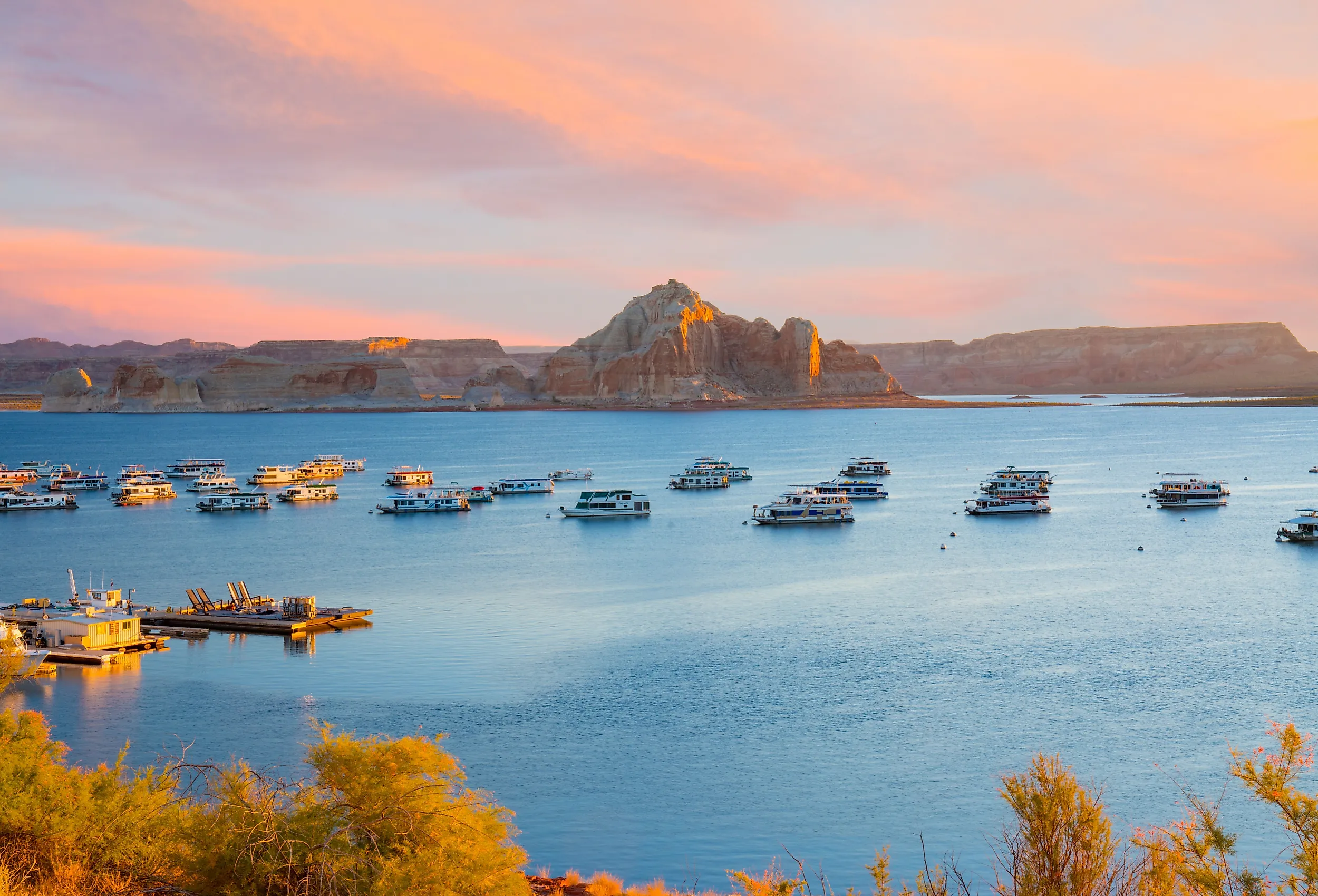
Lake Powell is a reservoir on the Colorado River, straddling the Arizona-Utah line within the Glen Canyon National Recreation Area. It is less a still alpine pool than a flooded desert canyon, and its appeal is the contrast: deep blue water winding between towering red sandstone walls and slot canyons. As a sediment-fed river reservoir its clarity varies, but on calm sunny days the water turns a vivid cobalt and mirrors the cliffs above. Mild weather most of the year keeps it swimmable across a long season, and it remains one of the most popular houseboating destinations in the country, prized more for its dramatic red-rock setting than for alpine-style transparency.
Lake of the Ozarks, Missouri

Missouri's most famous lake is a sprawling reservoir with more than 1,100 miles of shoreline, more coastline than the entire state of California. Its winding, serpentine shape earned it the nickname the Magic Dragon, which lives on in the annual Magic Dragon Street Meet car show. This is a busy recreational lake rather than an alpine one, and historically its water quality lagged, but sustained cleanup efforts led by the Lake of the Ozarks Watershed Alliance have improved it markedly, earning it a spot on recent rankings of the country's cleaner lakes. Coves, campsites, and waterside parks make it one of the Midwest's premier summer playgrounds.
Lake Murray, Oklahoma

One of Oklahoma's quiet standouts sits in the south-central part of the state near Ardmore: Lake Murray, centerpiece of the state's first and largest state park. Visitors and reviewers consistently single out its clean, clear, green-tinged water, unusually so for the region, and the lake is a favorite for swimming and camping. Overlooking it is Tucker Tower, a castle-like stone structure that began as a planned governor's retreat. The lake is named for Governor William "Alfalfa Bill" Murray and was built during the New Deal, creating work for Oklahomans during the Great Depression. Today it offers lodges, campsites, and even floating cabins.
Crater Lake, Oregon

Crater Lake is the headline act. Cradled in the collapsed caldera of an ancient volcano in Oregon, it is the deepest lake in the United States, reaching 1,943 feet according to the National Park Service. It is also one of the clearest large lakes on Earth, and for a simple reason: no rivers or streams flow into it. Every drop comes from rain and snow falling directly on the lake, with the level held steady by evaporation and seepage, so there is almost no sediment to cloud the water. The result is an almost unreal depth of blue, the color that draws visitors to stand at the rim and simply stare.
Norris Lake, Tennessee

Norris Lake is known for unusually clean, clear water for a Southern reservoir, which makes it a magnet for kayakers, paddleboarders, swimmers, and especially anglers chasing bass, crappie, catfish, and striped bass. It sits among the wooded ridges and valleys of eastern Tennessee, framed by mountains on nearly every side. The lake was formed by Norris Dam, the very first project undertaken by the Tennessee Valley Authority, built between 1933 and 1936 as part of President Franklin Roosevelt's New Deal to bring power and flood control to the region.
Lake Chelan, Washington

This long, narrow, glacier-carved lake in Washington is the third deepest in the United States, reaching about 1,486 feet, with its floor sitting roughly 436 feet below sea level. Its steep-sided shape qualifies it as a fjord, a landform usually carved by glaciers, and the deep, cold water is prized for its clarity. Because the lake sits on the dry eastern side of the Cascades, the surrounding area gets far more sun and far less rain than western Washington, which has made the town of Chelan a four-season getaway of wineries, beaches, and water sports.
Worth Seeing For Yourself
What ties these twelve together is water clear enough to change how a place feels, whether it is the unreal blue of Crater Lake, the Caribbean turquoise of Torch Lake, or the spring-fed depths of Lake George. A few, like Lake Powell and the Lake of the Ozarks, earn their place more through dramatic scenery and hard-won cleanup efforts than through alpine transparency, while others have stayed clear simply because they are cold, deep, and well protected. All of them reward the trip, and all of them make a strong case for protecting the watersheds that keep them clear in the first place.