What Happens To A Lake When Its Dam Is Removed
When engineers pull the plug on a dam, the lake behind it does not just quietly fade away. A reservoir is an artificial, still-water (lentic) system, and removing the barrier that holds it back triggers a rapid shift back into a flowing (lotic) river. Of course the water drains, often in hours rather than weeks, and then the real transformation begins as decades of trapped sediment, submerged tree stumps, and buried riverbed start to reappear. In the United States, more than 2,300 dams have come down since 1912, according to American Rivers, and dam removal has become a preferred tool for restoring rivers, reviving salmon runs, and, in some cases, returning drinking water and recreation to communities. The reasons vary from case to case, and can include aging infrastructure that has become too costly or unsafe to maintain, environmental restoration goals tied to fish passage and water quality, or reservoirs so filled with sediment that they no longer serve their original purpose at all. Below, the process is broken down step by step, illustrated with four of the country's largest and most closely studied dam removals.
The Lake Drains And The Old River Reappears

Dam removal rarely happens as a single bring-it-all-down explosion. Engineers usually lower the reservoir gradually through a low-level outlet or tunnel, as releasing too much water too fast can send a destructive wall of mud and debris crashing downstream. As the water level slowly drops, the river searches out its original channel, which is often still traceable beneath the sediment despite decades or even a century of burial. Within weeks to months, a new, meandering waterway carves through what used to be lakebed, exposing mudflats that were underwater for generations. Reservoirs also tend to develop thermal stratification, meaning warmer water sits near the surface while colder, oxygen-poor water settles at depth. Once the dam is gone, that layered structure collapses, and the stretch becomes a cooler, faster, well-oxygenated river again, more suitable for cold-water species like salmon and trout.
Decades Of Sediment Move Downstream

Where a dam stands, sediment that would normally travel to the ocean piles up behind it instead. When the barrier comes down, that backlog moves all at once, temporarily clouding the water and lowering oxygen levels immediately downstream. This "sediment pulse" is disruptive in the short term, since fine particles can clog the gravel beds that fish use for spawning, but it also rebuilds beaches, deltas, and gravel bars that had been starved of new material for decades. Engineers now carefully plan removals around fish migration windows specifically to limit harm to species trying to move through the murky water. For some projects they choose to leave the bulk of a reservoir's sediment in place rather than letting it wash downstream all at once, trading a faster ecological recovery for a gentler, more controlled release.
Wildlife And Vegetation Return, But Slowly
Once exposed, the former lakebed is typically barren, compacted silt with little nutritional value for plants, since fine reservoir sediment often lacks the organic matter and structure of a natural riverbank. Restoration crews often amend the soil and add native seed mixes to speed up revegetation. Grasses, cottonwoods, and shrubs can take hold within a growing season or two if conditions cooperate. Fish response can be far quicker. Migratory species have been documented moving into newly reopened habitat within days of a dam's final removal, since the biological drive to reach spawning grounds does not wait for the landscape to recover. The effects also ripple upstream, not just downstream. Above a former dam site, tributary streams that had been slack water gain current again, unlocking spawning and rearing habitat that had been effectively off-limits to river-dependent fish for as long as the dam stood, in some cases for over a hundred years.
The Elwha River, Washington

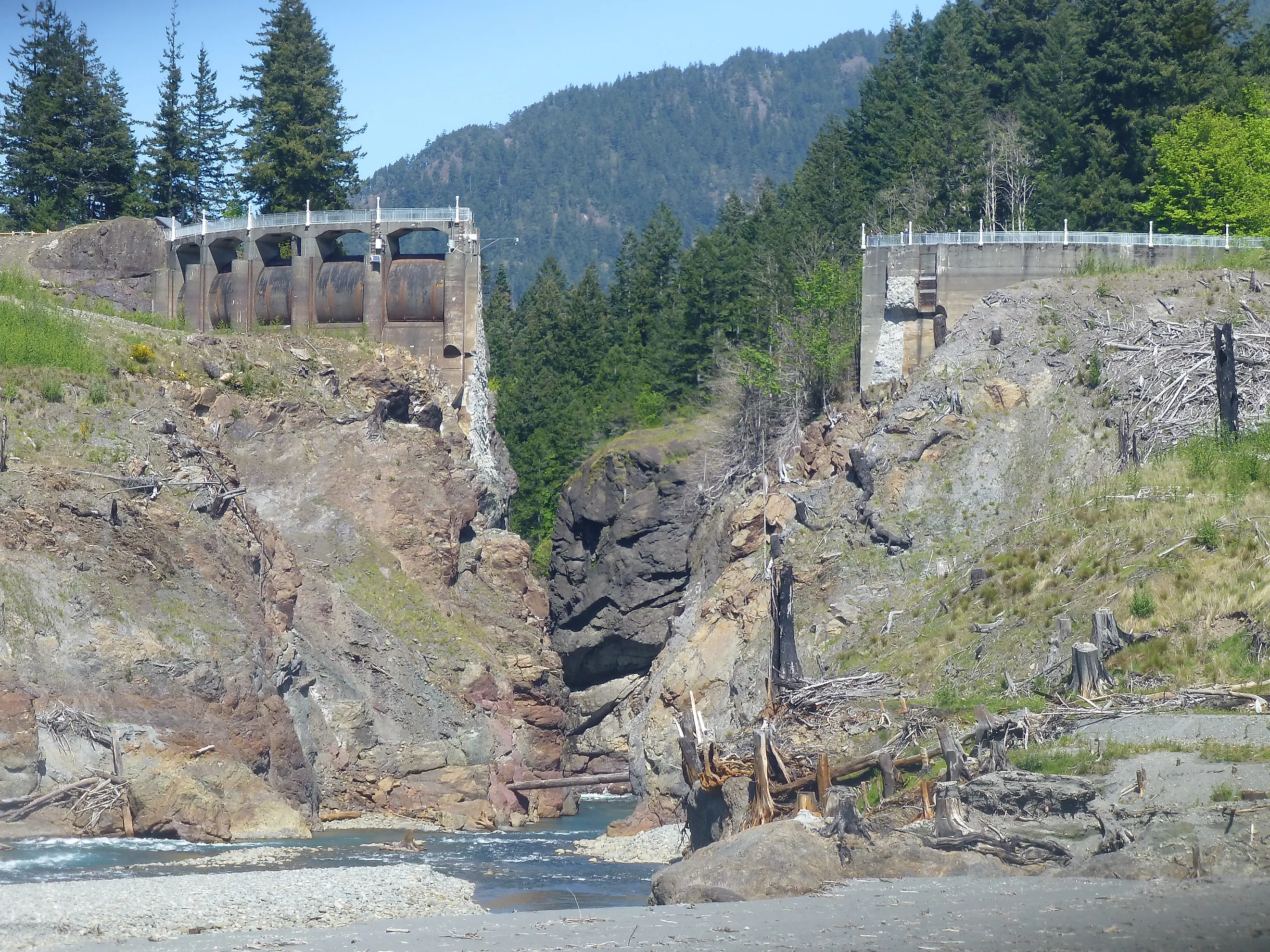
Between 2011 and 2014, the National Park Service carried out what was then the largest dam removal in U.S. history, taking down the Elwha Dam and Glines Canyon Dam inside Olympic National Park. Their reservoirs, Lake Aldwell and Lake Mills, together held back nearly a century's worth of sediment. Roughly 20 million tons of that material was released downstream once the dams came down, rebuilding beaches at the river's mouth on the Strait of Juan de Fuca and creating a new sand spit where fish and surfers now share the water. On land, draining the two reservoirs also exposed more than 700 acres of former lakebed, which the park has been actively revegetating to support elk and other wildlife. Within a few years, Chinook salmon spawning counts had climbed sharply, and by 2016 biologists documented steelhead swimming above the old dam sites for the first time in more than a century.
The Klamath River, California And Oregon

The Klamath River dam removal, completed in 2024, is now the largest in world history, surpassing even the Elwha project. Four hydroelectric dams, including Iron Gate Dam and Copco No. 1 Dam, were dismantled along the California-Oregon border, draining reservoirs such as Copco Lake and Iron Gate Reservoir and reopening more than 400 miles of habitat that had been blocked for over a century. The dams had disrupted the river's natural cooling pattern, acting like giant batteries that stored heat in summer and released it later, so their removal is expected to help restore colder water temperatures that salmon and steelhead depend on. Chinook salmon were observed migrating into newly accessible stretches of river within just ten days of the final in-water work at Iron Gate Dam, and restoration crews are now several years into revegetating roughly 2,200 acres of formerly submerged land across the four reservoir footprints.
The White Salmon River, Washington

In 2011, crews breached the 125-foot Condit Dam, and its reservoir, Northwestern Lake, drained in about 30 minutes instead of the six hours engineers had projected, releasing an estimated 2.3 million cubic yards of accumulated sediment downriver in the process. The White Salmon River, a tributary of the Columbia River, quickly re-established its channel across the old lakebed, though it took years of soil amendment and native planting before vegetation firmly took hold on the acidic, nutrient-poor sediment left behind. Salmon and steelhead began recolonizing the watershed soon after, and outfitters now run whitewater trips through a stretch of canyon that was underwater for a century. More than a decade later, cabins that once had lakefront views now overlook a forested river canyon, with only a faint bathtub-ring stain on the canyon walls marking where the old shoreline used to be.
The Carmel River, California

Not every lake disappears in a dramatic release of water and sediment. San Clemente Dam, built in 1921 on the Carmel River in Monterey County, California, spent decades quietly filling with sediment until its reservoir held almost no water at all, only silt. By the time California American Water removed the dam in 2015, the reservoir was more than 95 percent full of sediment and had already stopped functioning as a water source years earlier, while state inspectors had also flagged the aging structure as an earthquake risk to nearby homes. Rather than let millions of cubic yards of trapped sediment wash downstream at once, engineers took an unusual approach. They rerouted the Carmel River into an adjacent creek channel, leaving most of the reservoir's sediment safely in place on the old lakebed instead of releasing it. The project reopened more than 25 miles of habitat for threatened South-Central California Coast steelhead, and within just a few years of the dam's removal, biologists were already documenting steelhead swimming, spawning, and rearing young in river reaches they had been shut out of for nearly a century.
The Give and Take of a Dam
Dam removal is not without tradeoffs. Property owners can lose waterfront access, and short-term water quality often suffers before it improves. But as the Elwha, Klamath, White Salmon, and Carmel rivers show, the ecological rebound, particularly for migratory fish, can begin remarkably fast once a river is given its course back.