What Would We Find If We Drained The Great Lakes
If the Great Lakes were drained, you would find thousands of years of human activity and millions of years of geological activity. Of the latter, you would find Lake Superior's 1.1-billion-year-old tectonic rift where the continent began tearing itself apart, and most of the bottom of the lake is made up of dense, dark volcanic basalt and iron-rich granite. The other four Great Lakes sit on vast areas of Paleozoic sedimentary rock, over 350 million years old. The Great Lakes proper did not exist until the last Ice Age 20,000 years ago, and miles-thick glaciers carved deep gouges into the soft sedimentary rock basins, while the melting glaciers left behind till, a mixture of clay, sand, and giant boulders, onto the lake floors. More recent history finds ancient hunting complexes, industrial infrastructure from 19th-century logging, thousands of shipwrecks, downed airplanes, and human debris dumped into the lakes to be forgotten.
Shipwrecks

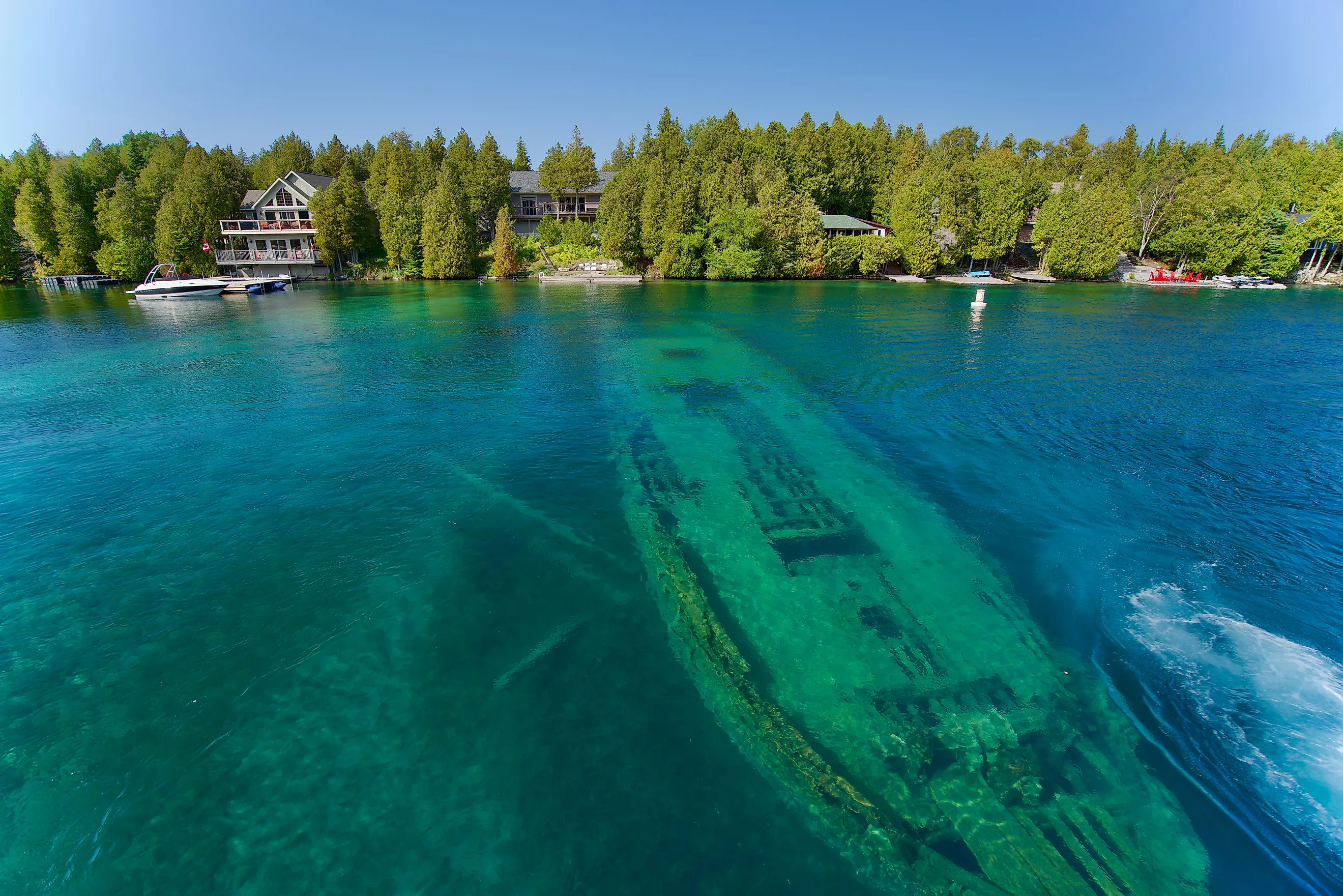
There are over 6,000 shipwrecks at the bottom of the Great Lakes, with more shipwrecks per square mile than any other body of water in the world. The oldest confirmed and discovered shipwreck is the HMS Ontario, lost in Lake Ontario in 1780. A British warship, it sank during the American Revolution and is the only known fully intact British warship in the Great Lakes. Le Griffon was the first full-sized sailing ship to sail the Great Lakes. Built between 1678 and 1679 near Niagara Falls, the ship vanished in September 1679 with all hands and cargo lost. Although the wreck of Le Griffon is lost to history, the ship is widely considered to be the oldest vessel lost on the Great Lakes.
Perhaps the most famous Great Lakes shipwreck is the SS Edmund Fitzgerald, an American freighter that sank with its crew of 29 in Lake Superior on November 10, 1975, at a depth of 530 feet in Canadian waters. Immortalized in the song "The Wreck of the Edmund Fitzgerald" by Canadian singer-songwriter Gordon Lightfoot, the sinking was a reminder of the power of the waves on Lake Superior. The Canadian package freighter SS Kamloops sank on Lake Superior during a blizzard on December 7, 1927. It was discovered in 1977 by sport divers near what is now named Kamloops Point, and is famous for its remarkable preservation in the freezing and dark waters. The preserved body of a crew member in the engine room has been spotted by divers over the years. The body has been dubbed Old Whitey because of the natural preservation process in the cold depths of a freshwater lake, which turns the body into a waxy, soap-like substance called adipocere.
Aircraft

Although shipwrecks on the Great Lakes are more well-known and incidents over the centuries are much higher, other human-made objects can be found, particularly aircraft. There are well over 130 sunken World War II military aircraft, mostly in Lake Michigan. During WWII, the US Navy trained over 15,000 pilots at the Naval Air Station Glenview, north of Chicago, and over Lake Michigan. Most of the crashes into the lake were due to engine failure and difficult landing approaches, particularly onto two paddle steamers, which were converted into inland aircraft carriers. Around 70 WWII military aircraft have been located, with 40 recovered and restored for museums. During WWII, the Army used Lake Huron for training the Tuskegee Airmen. There were several crashes into the lake. In 2014, the wreckage of a Bell P-39Q Airacobra flown by Tuskegee pilot Frank Moody was discovered on the lake bed. Moody perished in the crash, but his body was recovered at the time. Search efforts continue for other pilots who went down with their planes.
The Royal Canadian Air Force trained pilots at Lake Ontario. There is no official list available of the number of planes lost into the lake, but historical groups and researchers have documented several losses. In 1943, an Avro Anson trainer went missing during a nighttime navigation exercise. The location of the wreckage has never been determined. In 1944, a No. 31 Service Flying Training School Harvard II disappeared over the lake, with no known location. In the late 1950s, Canada's Avro Arrow program was scrapped for contentious political reasons, and with the sudden cancellation, the completed production aircraft, tooling blueprints, and assembly lines were deliberately dismantled and disposed of. Several large test models were rocket-fired over and into Lake Ontario, where they remain to this day.
Other Human Artefacts

With the cold water at the bottom of the five lakes, much of ancient and recent history has been preserved. Around 10,000 years ago, the water levels were far lower. There were vast stretches of dry land on what is now the basins of the lakes. Early indigenous groups lived in those areas that were eventually submerged by melting glaciers. At the bottom of Lake Huron, hunting complexes were discovered, including stone-lined corridors or trenches and hunting blinds. These were used to funnel and trap migrating herds of caribou. Small, sharp obsidian flakes from stone tools have been found. Chemical testing reveals these were from volcanic glass that originated 4,000 kilometers away in what is now Oregon, revealing a vast trade network across the continent. In 2007, a scanning expedition of Lake Michigan searching for shipwrecks uncovered a mile-long circular arrangement of massive stones resting 40 feet below the surface, which were clearly deliberately placed in that arrangement. A prehistoric rock carving of a mastodon was found on a scanner, but has not been authenticated. As the mastodon went extinct over 10,000 years ago, this would make it one of the earliest human-made objects ever found.
Across all the Great Lakes, entire petrified forests have been found, anchored in the soil and standing upright. In more recent history, in Lake Superior, 19th-century logging remnants have been found, including wooden structures filled with heavy stones that were dropped into the lake to construct temporary industrial piers. Other discarded remnants of the logging days that have been found include scaffolding, iron chains, saw-mill machinery, and thousands of perfectly preserved timber logs that were left behind when the logging mills closed. There are vast quantities of discarded human-made objects discovered from the last 150 years, including classified military waste barrels in Lake Superior, as well as parts of cluster bombs and toxic chemicals encased in concrete. After WWII, the Canadian military disposed of surplus arms. Over 150 tons of obsolete live ammunition was dumped into Dyer Bay, and thousands of unrecovered piles of shells and artillery boxes still sit at the bottom.
During the early 20th century, the thick ice on Lake Erie was used to dispose of large items such as early automobiles like the Model T. They were driven on the ice and left for the spring thaw for them to plunge into the lake. There were large numbers of brand-new vehicles at the bottom of the lakes due to shipping accidents. Other accidental dumping of cars would occur during the winter, when lakes such as Erie were used as roads. Many private vehicles went through the ice, including those of rumrunners during Prohibition, who would use Lake Erie's Middle Island as a stop while running illegal alcohol between Canada and the US.
What Would Happen if the Water Disappeared?
If the Great Lakes were suddenly drained of water, an immediate regional climate shift would take place, causing a widespread environmental disaster. The shipping and fishing economies of the region would collapse, with a rippling effect on the world economy. The loss of 20% of the world's surface fresh water would fundamentally change North America. Because of its massive volume of water, the loss of the Great Lakes would cause temperature extremes and air pollution from the fine sediment, silt, and accumulated industrial pollutants on the dry lakebeds, with dust storms spreading into the massive urban areas around the former lakes. Entire aquatic ecosystems would be wiped out, as well as dependent wildlife from the land. The Great Lakes serve many purposes, ecologically, economically, and culturally, and a sudden loss would impact the entire world.