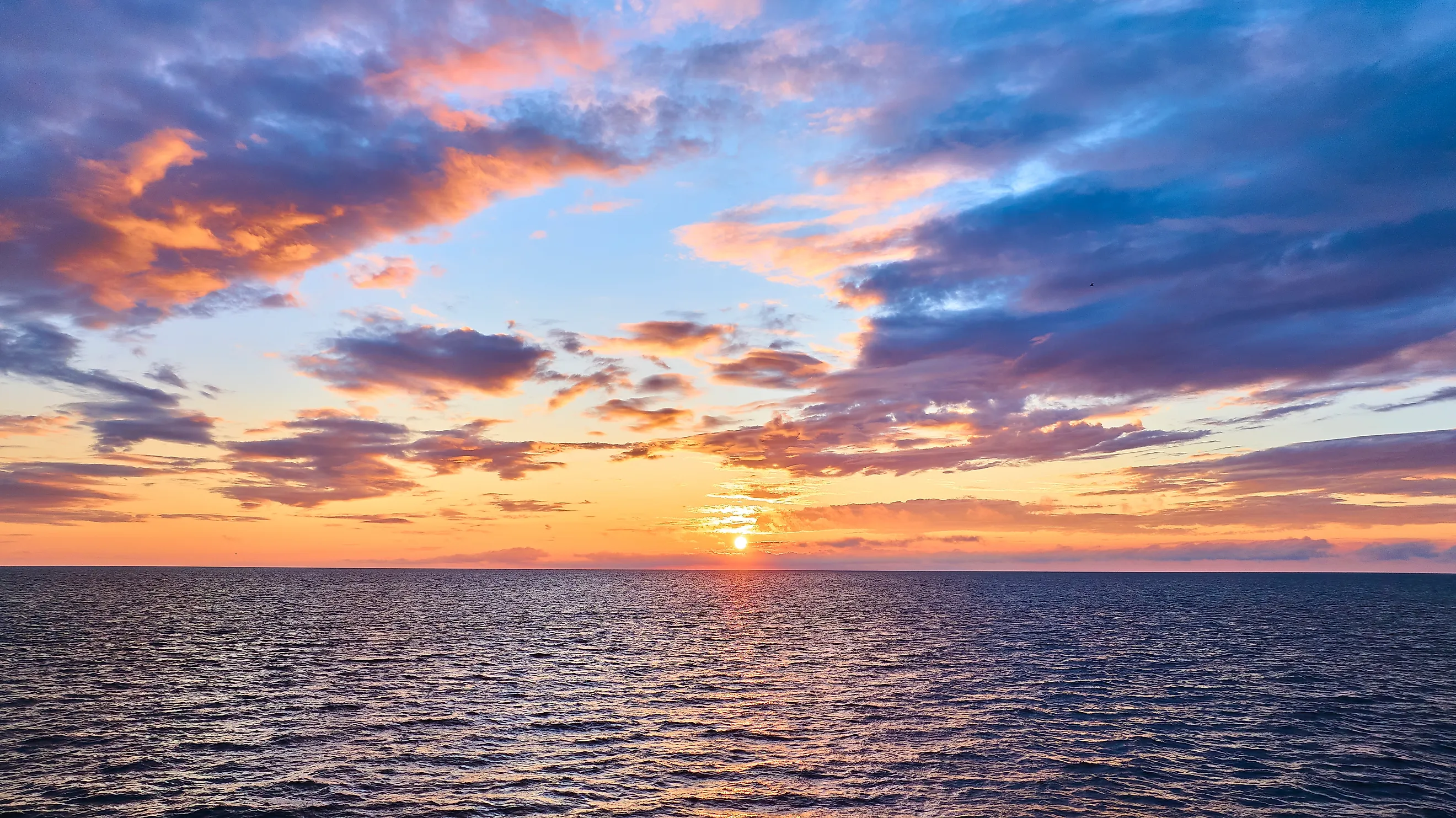
How Long Would It Take To Drain Lake Michigan?
It would take 99 years to drain Lake Michigan completely because its retention time is 99 years, which measures how long it takes for all of the water to flow out of it via its connection with Lake Huron. This data is backed up by multiple sources, including the EPA and Michigan State University. Its retention time is topped only by Lake Superior, which would take 191 years to drain completely. This long retention time is due to its size, water volume, and depth.
Lake Michigan dimensions and facts

Lake Michigan is the only one of the five Great Lakes that is contained entirely within the U.S., as all others are shared with Canada. It borders Michigan, Wisconsin, Illinois, and Indiana, and has the third-largest shoreline length at 1,638 miles, which includes islands.
By surface area, it is the third largest at 22,300 square miles, compared to Lake Huron at 23,000 square miles and Lake Superior at 31,700 square miles. Where Lake Michigan stands out is its water volume. It's the second largest of the Great Lakes by water volume at 1,180 cubic miles, topped by Lake Superior at 2,900 cubic miles and above Lake Huron at 850 cubic miles. This water volume is what gives the lake its depth, with an average depth of 279 feet and 923 feet at its deepest section in the Chippewa Basin.
The water here is of immeasurable importance to the more than 12 million people who live within its drainage basin, as it offers drinking water, recreational and commercial fishing, shipping, and many other commercial activities.
Lake Michigan's waters are cold, running from a low of 37.9 degrees Fahrenheit in the winter to 64.2 degrees in the summer.
The water in Lake Michigan primarily flows through Lake Huron via the Straits of Mackinac. This trench directly connects the two lakes, making the water levels the same on both sides. Although all the Great Lakes are connected in some manner via rivers or streams, Lake Michigan and Huron are unique in how they are connected hydrographically.
Lake Michigan is fed by precipitation and rivers including Fox-Wolf, Grand, and Kalamazoo River. It was previously fed by the Chicago and Calumet Rivers, but pollution from the growing city of Chicago was impacting the water quality of Lake Michigan, causing typhoid and cholera in the 19th century. To address this, Chicago constructed the Chicago Sanitary and Ship Canal, which redirected the flow of the Chicago River from Lake Michigan into the Mississippi River.
Shipwrecks

The Great Lakes have long been a dangerous place for ships. Due to their size, they are often more similar hydrographically to seas, creating dangerously large waves and weather conditions that can capsize ships. There are around 6,000 to 10,000 recorded shipwrecks in the Great Lakes, and Lake Michigan accounts for a larger percentage of them at around 600 to 1,500 shipwrecks.
The reason for this high number of shipwrecks is due to the shape of Lake Michigan and its location. Cold Canadian air comes down from the north while the waters are still relatively warm, which causes vast waves. Ice in turn can form as well, creating hazardous conditions for boats.
Many of these shipwrecks occur as boats are slammed into the shore. This is especially common on Lake Michigan as it runs north-south and has a maximum width of 118 miles. When storms hit the ocean, sailors can usually wait out the storm, but in Lake Michigan, powerful winds can blow ships onto the shore.
One such example is the Rouse Simmons, which left on Lake Michigan in November 1912 carrying Christmas trees. However, a storm came through, blowing the ship off course. The ship wasn't found until 1971 when a diver found it off the coast of Two Rivers, Wisconsin.
Some shipwrecks are caused simply due to collisions, such as the Silver Spray, which ran into a Morgan Shoal, a dolomite reef on July 15, 1914. Once it was stuck and unable to move, powerful waves slammed the ship into a rock where it broke apart and sank.
Divers often go down into the Manitou Passage Underwater Preserve in the North and South Manitou Islands to find shipwrecks. There are 14 documented shipwrecks in this preserve, dating from 1862 to 1960. These ships were mainly destroyed by storms that slammed them into the shoreline, such as the Francisco Morazan, which sank during a snowstorm on November 29, 1960, by striking rocks on South Manitou Island.
The dunes of Lake Michigan

One feature of Lake Michigan that is quite rare is its dunes. It has the largest number of freshwater dunes on Earth. These dunes formed around the same time as the Great Lakes at the end of the last Ice Age.
Melting glaciers left behind large amounts of sand. Rivers in turn moved this sand over to Lake Michigan. Lake Michigan's waves brought the sand onto the shoreline, and winds picked up the sand, gradually creating dunes.
The dunes can grow to large sizes, at up to 450 feet at the Sleeping Bear Dunes National Lakeshore, which visitors can climb on top of via the Dune Climb. Along the Dune Climb, one can find buried trees known as "ghost forests." The Indiana Dunes National Park is the only national park on Lake Michigan and is a prime example of Lake Michigan's dune habitat.
Several of its dunes are slowly moving, such as the 120-foot-tall Mount Baldy. It formed around 4,000 years ago from wind. Over time, it has shifted, moving up to 10.83 feet a year from 1965 to 1973. Its movement is directly influenced by weather conditions on Lake Michigan, as higher water levels, storms, and higher air and surface temperatures all contribute to conditions that shift the dune to the south.
Along the Indiana Dunes National Park are a series of other rare environments for that region of the U.S., such as bogs and a black oak savannah. Pinhook Bog, for example, was formed by a retreating glacier, which left behind a small block of ice, which melted and formed a kettle lake. Due to the lack of outlets, the water acidified, forming a bog where sphagnum moss can grow.
Lake Michigan isn't a normal lake
Calling Lake Michigan a lake is an understatement. After all, the vast majority of lakes in the US are quite small and certainly do not take close to 100 years to drain. This is why the Great Lakes are often referred to as an inland sea, as they are enclosed by land and are generally shallow compared to the oceans. In addition, few lakes can claim to have as many shipwrecks, dunes, or water volume as Lake Michigan. Perhaps the best word to refer to Lake Michigan is the original Ojibwe word "Michigami," which translates to a vast body of water.