The Invasive Plants Choking America's Lakes
A single broken stem no bigger than a finger can be enough to infest an entire lake. Invasive aquatic plants are non-native species that spread aggressively through lakes, rivers, and ponds, crowding out native vegetation until entire waterways become difficult to navigate and increasingly unable to support healthy ecosystems. Many invasive aquatic plants have established themselves in lakes across nearly every United States state. Invasive aquatic plants cost the U.S. economy hundreds of millions of dollars a year in control efforts alone, on top of billions more in lost property value, recreation revenue, and ecological damage. The seven species below are among the most widespread and economically damaging aquatic invaders in U.S. lakes.
Why Invasive Plants Are So Difficult to Control
Once an invasive plant takes hold in a lake, eliminating it is close to impossible. Most of these species spread from a single fragment, seed, or stem cutting carried on a boat trailer, propeller, or pair of waders. A national assessment found that non-native species introduced to the U.S. from 1906 to 1991 caused an estimated $97 billion in damages, with a worst-case estimate of $137 billion. Aquatic plants are a major contributor to that toll.
Between 1975 and 2020, invasive aquatic and semi-aquatic plants cost the global economy more than $32 billion, with costs concentrated in submerged and floating species and rising by roughly $700 million a year on average. In the U.S. specifically, federal and state agencies spend over $100 million annually on aquatic plant management in public waters alone. That figure doesn't include the cost to individual lakefront homeowners, whose property values can drop sharply once a lake becomes infested.
Hydrilla

Hydrilla is widely considered North America's most aggressive submerged invasive plant. It was introduced to Florida in the early 1950s and by the early 1990s had spread across about 140,000 acres of the state's public lakes and rivers. According to U.S. Army Corps of Engineers research, hydrilla is capable of growing about an inch a day under average conditions, and once the plant starts branching near the surface the total new growth it adds each day climbs steeply.
Once it nears the surface, it fans out into a dense canopy that blocks sunlight from every native plant beneath it. Florida's Orange Lake became one of the state's best-known hydrilla battlegrounds. When hydrilla coverage exceeded 80 percent of the lake in 1977, angler effort dropped by 85 percent almost overnight, turning a premier bass fishery into water most boaters couldn't reach.
Hydrilla has since spread far beyond Florida. It is established in New York's Cayuga Lake Inlet, the Erie Canal, ponds in Broome County, several lakes and ponds on Long Island, and the Croton River in Westchester County. In 2023 it turned up for the first time in Rhode Island's Worden Pond and Indian Lake. Part of its resilience comes from underground.
Even after intensive management brought Florida's infestation down to under 50,000 acres, hydrilla continued producing reproductive tubers by the millions per acre in the sediment. That means a lake can appear under control, even as millions of dormant tubers wait beneath the mud for the next growing season.
Hydrilla overwhelms lakes from below. The next invader never needs to touch the lakebed at all.
Water Hyacinth

Water hyacinth doesn't grow from the bottom of a lake. It floats on the surface, forming thick purple-flowered mats that can seal off an entire waterway. In Florida, water hyacinth populations can double in size in as little as two weeks. It does this by sending out short runner stems that sprout new "daughter" plants, turning a small patch into a pond-wide infestation in a single summer.
The plant was first introduced during the 1884 Cotton States Exposition in New Orleans. It was handed out as a gift to attendees who later planted it in their backyard ponds. Within a few decades it had reached Florida's largest lake. On Lake Okeechobee, unmanaged water hyacinth displaced native bulrush and shaded out the submerged plants that fish and waterfowl depend on.
It even interfered with the nesting habits of the endangered Everglades snail kite. Statewide, water hyacinth covered more than 120,000 acres of Florida's public lakes and rivers by the early 1960s. Decades of management brought it down to roughly 2,000 acres.
Floating mats are only one way to overtake a lake. The next one spreads every time a single stem breaks apart.
Eurasian Watermilfoil

Eurasian watermilfoil is likely the single most widespread invasive aquatic plant in the country. First detected in North America in the 1940s, it has since spread to more than 40 states and three Canadian provinces. Minnesota's Lake Minnetonka shows how one introduction can spiral. The plant was first discovered there in the fall of 1987, and it has never really left.
Eurasian watermilfoil infests 394 lakes across Minnesota, including 37 in just two counties, a scale that shows how a single infested lake decades ago can metastasize across an entire state's lake system. What makes milfoil almost impossible to eradicate is how it reproduces. A stem fragment just a few inches long is enough to start an entirely new plant, and mechanical removal often makes the problem worse.
Manual or mechanical harvesting can exacerbate an infestation, since chopping the plant simply creates more fragments capable of colonizing new areas. Boats are the main vector, catching stems in propellers, keels, and trailers before carrying them to the next lake down the road. That's how an infestation first spotted in a popular boating area like Excelsior Bay on Lake Minnetonka eventually spread to countless other lakes.
Some invasive plants threaten ecosystems. The next can also threaten people.
Water Chestnut

Few invasive lake plants pose a direct physical hazard to people, and water chestnut is one of them. Its seeds carry four half-inch barbed spines sharp enough to puncture a swimmer's foot if stepped on. Those spiky seed pods have even kept tourists off popular beaches in infested areas. Lake Champlain is the clearest example of how far the problem can spread.
Water chestnut has infested dozens of miles of shoreline between New York and Vermont, though the acreage rises and falls from year to year with how much harvesting gets funded. Decades of that work have pushed the dense mats back into the southern end of the lake. Controlling it has come at a steep cost. Vermont spent more than $14 million controlling water chestnut between 1982 and 2020.
The plant's floating leaf clusters form dense mats that block sunlight entirely, and its seeds can remain viable for up to 12 years after they sink to the lake bottom. Even after every visible plant is pulled from the water, thousands of buried seeds can restart the same infestation years later.
If water chestnut defends itself with barbed seeds, the next invader relies on explosive growth and can transform a lake in days.
Giant Salvinia

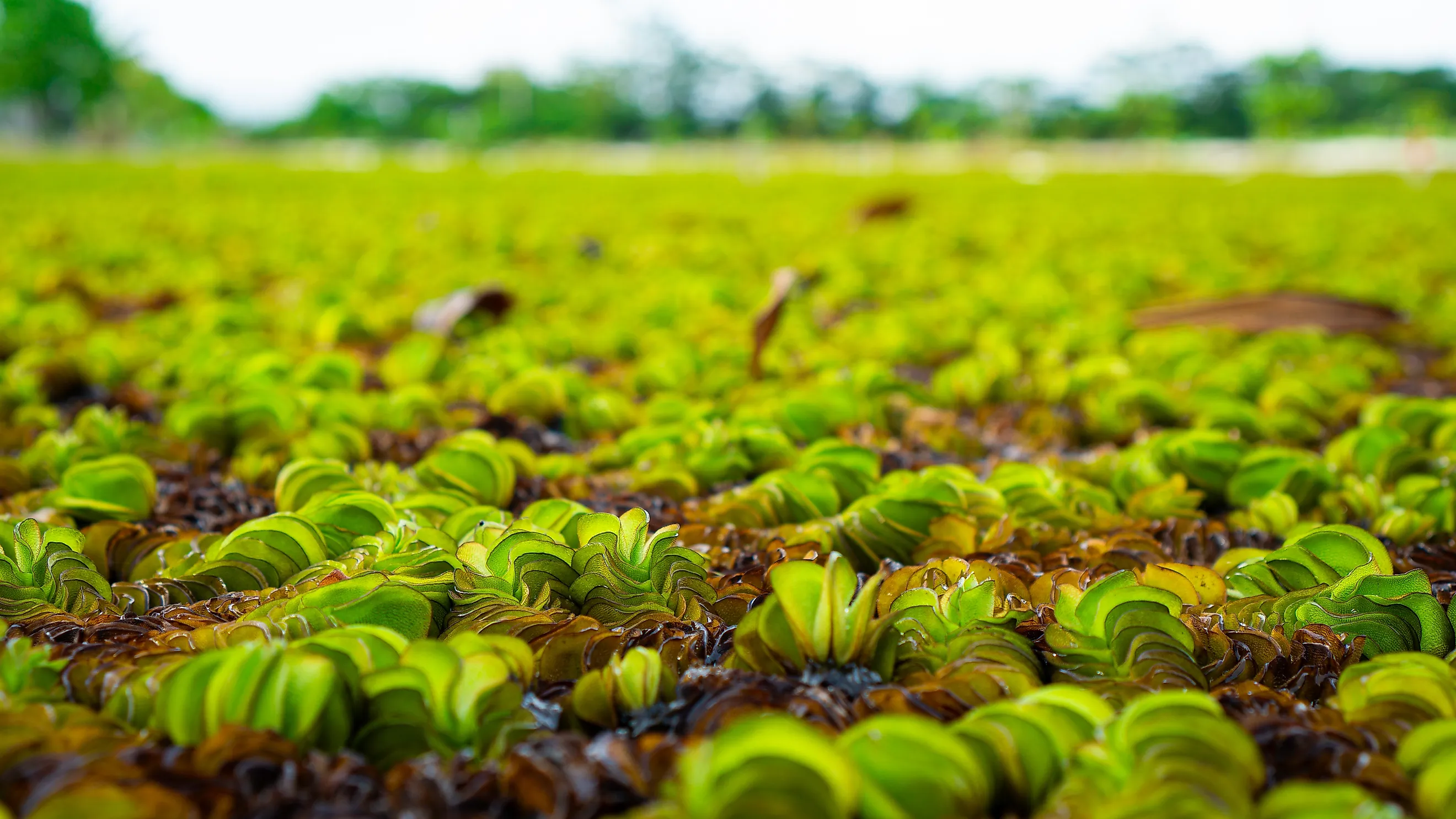
Native to southern Brazil, giant salvinia is a floating fern that has become one of the top invasive-species threats in Texas and Louisiana. Under ideal conditions it can double in size in as little as four days. Infested mats can eventually grow up to 3 feet thick. By late summer, they can turn entire bayous, ponds, and lakes into floating carpets.
Caddo Lake, on the Texas-Louisiana border, shows how far the damage can go. In 2017, salvinia covered more than 6,000 acres of the lake's Texas side, forming mats so thick they could only be navigated by airboat. The ecological fallout is severe. By sealing off the water's surface, dense mats restrict gas exchange with the atmosphere, starving the water of the oxygen native fish need to survive.
Once established, salvinia is nearly impossible to remove completely. One of the few effective ways to slow its spread is a South American weevil that feeds exclusively on the fern, making it one of the plant's few natural enemies outside its native range.
Not every invasive plant stays visible all season. The next one seems to disappear just as summer begins, but that disappearance creates problems of its own.
Curly-Leaf Pondweed

Curly-leaf pondweed is one of the most widespread invasive aquatic plants in the northern United States. Introduced from Europe in the 1800s as an aquarium plant, it has spread throughout the Midwest, Northeast, and parts of the West. Unlike most native aquatic plants, it begins growing beneath the ice during winter, giving it a head start over local vegetation each spring.
By early summer, dense underwater stands can interfere with boating, fishing, and swimming across entire lakes. Its life cycle makes it particularly difficult to control. Instead of relying mainly on seeds, curly-leaf pondweed produces hardy overwintering buds called turions. These settle into lake sediments and sprout again the following season. Curly-leaf pondweed has spread to hundreds of Minnesota lakes, where it is now classified as a prohibited invasive species.
Dense infestations require annual monitoring and management. Even after the visible plants die back in early summer, they release phosphorus into the water. That extra phosphorus can fuel blue-green algal blooms, creating a second wave of ecological problems long after the plants themselves have disappeared.
Some invaders disappear before most people notice them. The next one grows where everyone can see it, along the shoreline itself.
Flowering Rush

Despite its attractive pink flower clusters, flowering rush has become one of the most troublesome shoreline invaders in the United States. Native to Europe and Asia, it has spread through the Great Lakes region, the Upper Midwest, and parts of the Pacific Northwest. The plant forms dense stands along shallow shorelines, crowding out native vegetation and creating nearly impenetrable barriers for swimmers, anglers, and small boats.
Flowering rush spreads through underground rhizomes and small bulbils that easily break away and establish new colonies. In places like the Flathead Lake watershed in Montana and across parts of the Upper Mississippi River basin, even small fragments have let the plant colonize new shorelines. Once established, dense stands alter fish habitat and reduce biodiversity.
Managing them can require years of sustained effort and public funding. In Montana, the state's Aquatic Invasive Species Grant Program awards up to $50,000 per project from an annual pool of roughly $250,000 to help control flowering rush and other aquatic invasive species. The investment reflects how difficult these shoreline invasions can be to reverse once they become established.
Why Prevention Beats Removal
The greatest danger posed by these invasive plants isn't how quickly they spread, it's how difficult they are to undo. A single fragment, seed, or underground bud can set off years of ecological damage, turning open water into dense vegetation that alters fish habitat, disrupts recreation, and costs local communities millions of dollars. For many lakes, the best chance of restoration is to prevent an invasion before it begins.