Recent Archaeological Discoveries That Changed History
History likes to pretend it is settled. It is not. Every so often someone with a trowel and too much patience digs a hole in the ground and quietly detonates a chapter of the textbook you were made to memorize. The "facts" we treat as gospel are really just the best story we had until the next shovel hit something interesting. Here are seven finds that walked up to long-accepted history, tapped it on the shoulder, and said, "actually, about that."
Vikings In Canada

For centuries the story was tidy: Christopher Columbus got to the Americas first, in 1492, full stop. That tidy story got dismantled by a Norwegian couple who refused to take the sagas as mere bedtime stories. Helge Ingstad, an explorer and writer, and his wife Anne Stine Ingstad, a trained archaeologist, followed local tips to a set of grassy mounds in Newfoundland and Labrador that everyone had assumed were the remains of an old First Nations settlement. A resident named George Decker walked them right to it.
After years of digging and analysis in the 1960s, the verdict was in: this was a genuine Norse settlement, and they named it L'Anse aux Meadows. It was already known that the Vikings had colonized Iceland and Greenland, but any talk of them pushing farther west had been filed under myth. The clincher came much later. In 2021, a study in the journal Nature used a spike of cosmic radiation from a known solar storm, preserved in the wood's tree rings, to pin at least one year of Norse activity at the site to exactly 1021 AD.
The Vikings did not linger, clearing out and heading back to Greenland after a short stay. It is thought their ships may have nosed as far south as New Brunswick or Maine, and whether they ever met the region's Indigenous peoples remains an open question. The settlement never rippled across the globe the way Columbus's voyage did nearly five centuries later, but it settled the argument for good: Columbus was not the first European to reach the Americas, and the Vikings really were every bit the hardy blue-water sailors the legends claimed.
Skilled Laborers At The Pyramids

The Great Pyramids of Giza have attracted more conspiracy theories per square foot than almost any structure on Earth, and for a long time even the mainstream take was off. The assumption was simple and grim: only mass slavery could have muscled that much stone into place.
That assumption cracked wide open thanks to discoveries at the site, with a batch of workers' tombs first stumbled upon in 1990 and more announced to great fanfare in 2010. Archaeologists uncovered graves alongside the remains of what looked like a purpose-built workers' town. The dead were laid to rest with bread and beer for the afterlife and a few modest keepsakes, the kind of send-off nobody bothers giving to disposable labor.
The graves were far too humble to belong to the ruling class, yet far too dignified to belong to slaves. Egypt's own antiquities chief noted that workers buried in a place of honor beside their pharaohs' monuments were plainly not treated as chattel. As for the slave myth itself, the Greek historian Herodotus is the usual scapegoat, and it is only half his fault. He did describe the pyramids as the work of forced labor, but he visited Egypt around 450 BC, roughly two thousand years after the pyramids went up, so he was essentially repeating very old gossip. The specific "Jewish slaves" version people picture today is a later mashup drawn from the Book of Exodus and Hollywood, not from Herodotus at all.
The picture that has emerged instead is one of skilled, organized labor. These crews rotated through in shifts of about three months before being swapped out to rest, and the work, dragging colossal blocks in the desert heat, was punishing and dangerous enough to explain the wear on the bones. Grueling, yes. Enslaved, no.
Roman Incursions Into Arabia

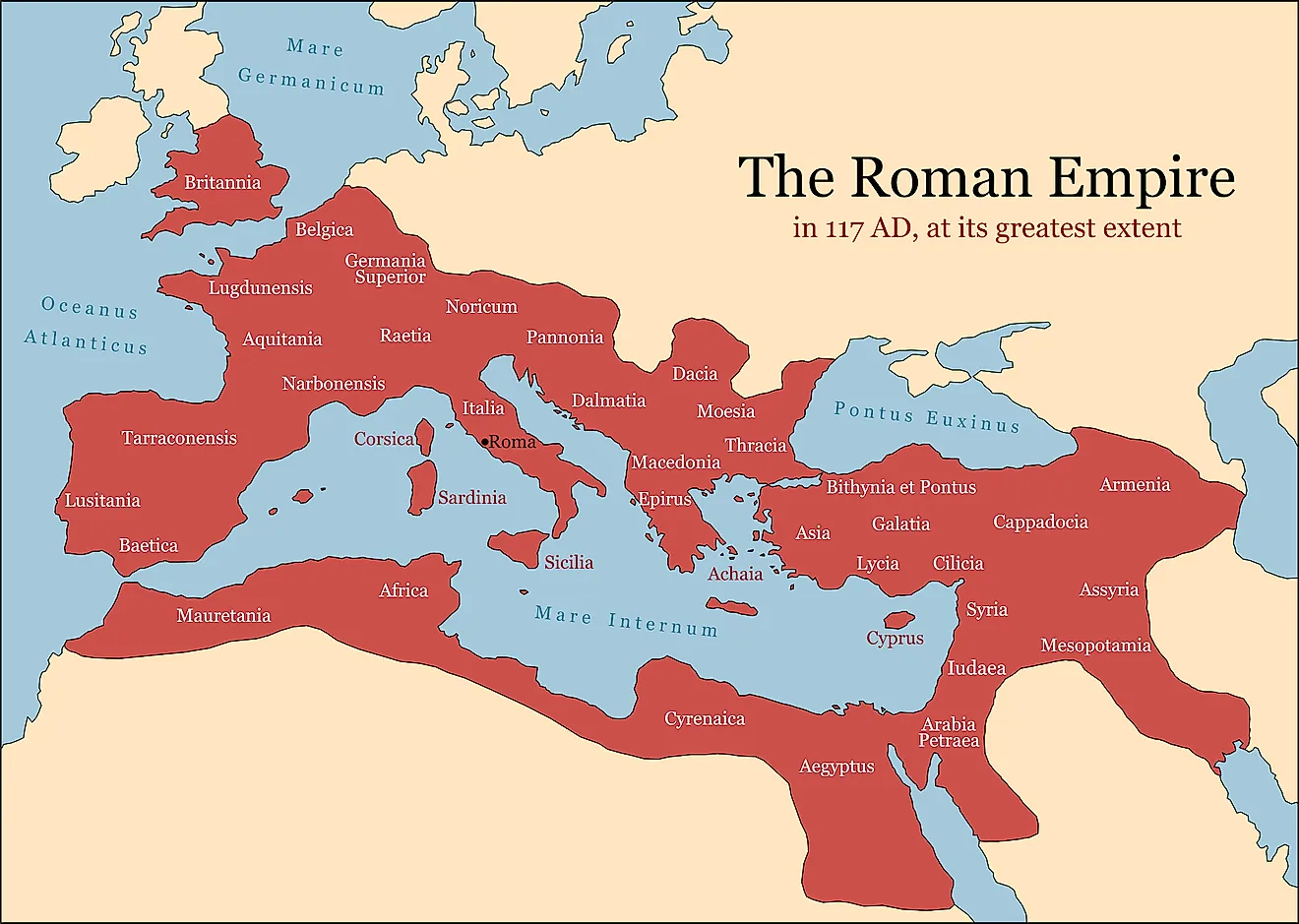
Rome did not become Rome by sending thank-you notes. The Roman Empire's borders stretched from Scotland to Iraq at its peak in the early 2nd century, and it got there through methodical, remorseless conquest. One region historians long assumed had dodged the legions was the desert interior of Arabia. Rome traded happily with the Arab world, the thinking went, but never tried to march in and take it.
A team from the University of Oxford may have poked a hole in that idea, and they did it without leaving their desks. Studying satellite imagery on Google Earth, researchers spotted three Roman camps strung along the border between Saudi Arabia and Jordan, published in the journal Antiquity in 2023.
The tell-tale outlines are hard to miss, with the distinctive "playing card" rectangle and opposing gateways that scream Roman army engineering. Their spacing points toward a march on the Nabataean kingdom, the desert-merchant civilization centered on the rock-cut city of Petra, and the leading theory ties them to Rome's annexation of that kingdom in 106 AD, an event the surviving histories politely describe as peaceful. Three military camps aimed at your capital suggest it may have been rather less polite. Only a proper excavation on the ground will confirm what these outposts were really up to, and deeper into the Arabian Peninsula may hold even more surprises.
The World's First Zoo

In 2009, archaeologists digging at the ancient Egyptian city of Hierakonpolis in Egypt unearthed what is widely credited as the world's first zoo, a menagerie dating back more than 5,000 years to around 3500 BC. Buried there were the remains of a startling cast of creatures, including elephants, hippos, baboons, wildcats, and hartebeest. The detail that turns a curiosity into a revelation is the bones: several animals had fractures that had healed, and bones only mend like that when something keeps the creature alive and tended long enough to recover, exactly what you would expect inside a captive collection rather than out in the wild.
Owning a live elephant or hippo was almost certainly the ancient equivalent of parking a supercar in the driveway, a flex of raw wealth and power by the city's elite. Whether Hierakonpolis was a one-off or the fashion caught on across early Egypt is still anybody's guess, and only future digs will tell whether other ancient cities kept private zoos of their own.
Advanced Tools In Prehistoric India

Most researchers accept that modern humans strolled out of Africa somewhere around 60,000 years ago. A dig in southern India has been quietly making that timeline sweat. In 2018, a study in Nature reported a trove of sophisticated stone tools from the site of Attirampakkam in Tamil Nadu, dated to roughly 385,000 years old, using the refined Levallois technique that marks the Middle Palaeolithic. That is more than a hundred thousand years earlier than anyone expected such technology to show up in India.
Here is the honest, and more interesting, catch: nobody knows who made them. The lead researchers stress that the toolmakers' identity is still unknown. One possibility is that archaic members of the human family reached India far earlier than thought and worked out these techniques on their own. Another is that early Homo sapiens got here far sooner than the standard "out of Africa" clock allows. Both options rewrite something, and neither involves the "advanced apes" of pulp imagination, just very clever human relatives. Fossil finds in Morocco and Israel that push our species back further only sharpen the mystery.
Oldest Buddhist Temple In Pakistan

In 2021, in the Swat region of Pakistan, an Italian-led team announced one of the oldest Buddhist temples ever found, set within the ancient region of Greater Gandhara. If your mental map files Buddhism strictly under East Asia, this is your reminder that the faith began in the Indian subcontinent and radiated outward in every direction, Pakistan very much included. The structure rose at the ancient city of Barikot, long known as a heavyweight center of Buddhist learning.
The built temple dates to the second half of the 2nd century BC, but its foundations may reach back into the Mauryan era of the 3rd century BC, around the time of the great Buddhist emperor Ashoka, pending carbon dating to say for certain. Barikot's importance to the faith was never in doubt; what the discovery adds is a hard early date, letting historians finally say with confidence how deep Buddhism's roots run in this corner of the world.
Mesopotamian City Planning

Nearly 6,000 years ago, the world's first true cities took shape in what is now Iraq. The Mesopotamians and Sumerians earned their title as history's first city dwellers, but they also got saddled with a reputation for building crude, haphazard settlements. Recent work suggests we owe them an apology.
The old view held that early Mesopotamian cities were dense tangles that simply sprawled outward from their temple-towers, the ziggurats, with no real plan. Then archaeologists took a hard look at the Sumerian city of Lagash and found the opposite of chaos.
According to a team from the University of Pennsylvania, the residents of Lagash carved their city into distinct districts using deliberate dividers like walls and waterways, urban planning far more intentional than anyone had credited them with. The insight was possible thanks to a quirk of the site's fate: Lagash was abandoned more than two millennia ago and never had a later city stacked on top of it, the kind of overwriting that ruins so many other digs. With the ancient street grid left undisturbed, further exploration may reveal even more about how these first urbanites actually lived.
Put it all together and the lesson is humbling. We learn a little more about our distant past every day, and the picture keeps sharpening, but the story is nowhere near finished. Plenty of what we call settled history is one lucky dig away from being rewritten.