The Richest Merchants of the Ancient World
The purple robe on a Roman senator started as slime scraped from a sea snail in Tyre. Someone had to harvest the snails. Someone had to ship the dye. Someone got rich doing it. Before 500 CE, the biggest ancient fortunes often skipped the throne room entirely. They belonged to traders who hauled precious cargo across hostile deserts and open sea. These merchants funded cities and bankrolled armies. Some outlasted the rulers they served.
The Phoenician Tycoons of Tyre

One color made Tyre rich. Tyrian purple came from the murex sea snail, and extracting it was miserable, slow work that used thousands of shells per batch. That difficulty was the point. The dye cost a fortune, so kings and priests wore it to show they could. Tyre's merchants had turned a coastal pest into the ancient world's ultimate status symbol.
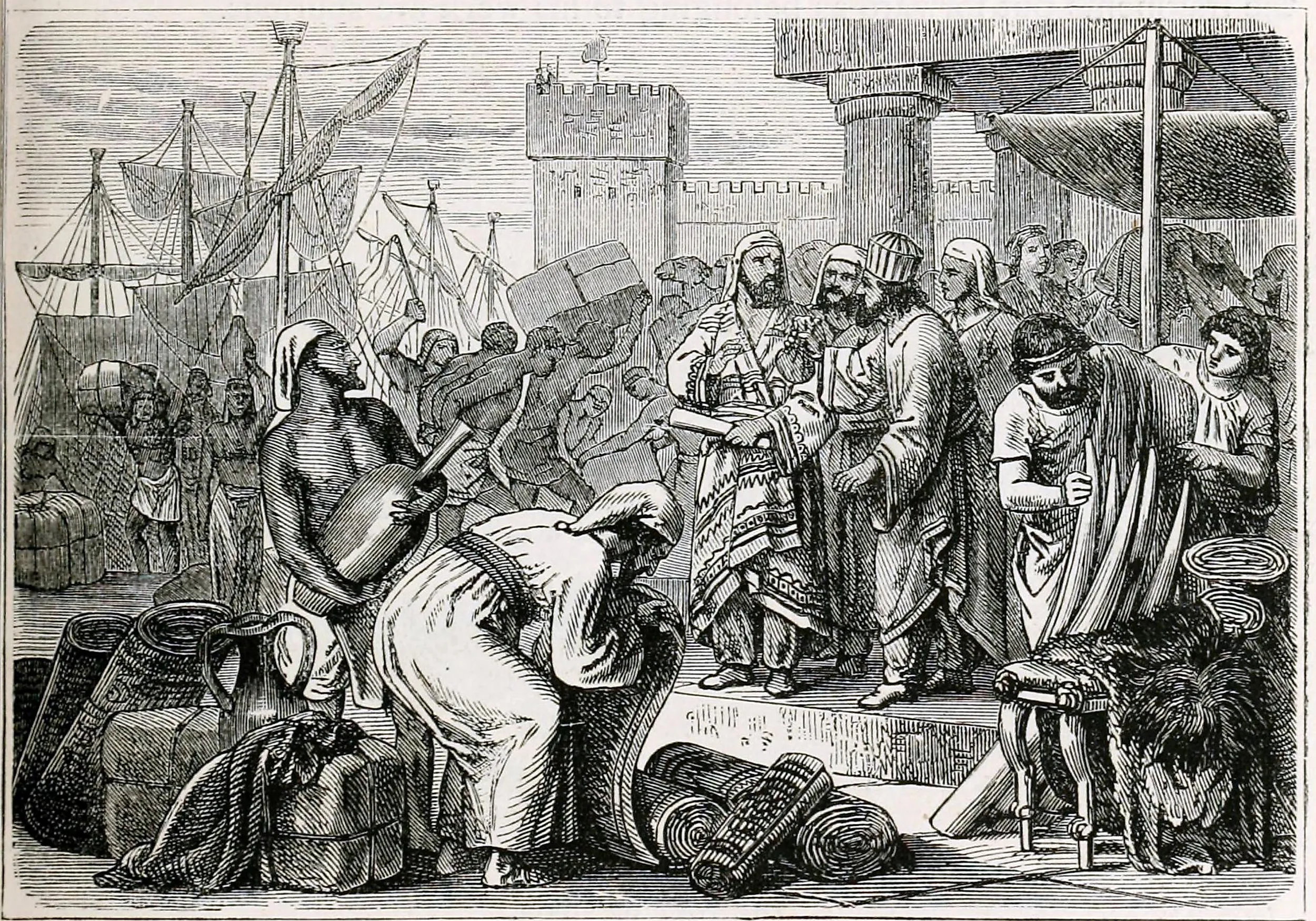
They did not stop at dye. Phoenician ships carried timber, worked metal, glass, and ivory across the Mediterranean during the 1st millennium BCE. Tyre sat on an island, which made it hard to besiege and easy to defend. Its traders linked the Levant with Cyprus, Egypt, Sicily, Sardinia, and the Iberian coast. Skilled textile and metalwork gave them goods no rival could match.
Running that network took paperwork. Phoenician merchants kept accounts and wrote letters, and the alphabet they spread across the Mediterranean grew out of that commercial habit. Trade, not conquest, carried their writing system to the wider world.
Tyre's reach outlived Tyre. Phoenician colonists founded Carthage in North Africa, and that outpost eventually became a Mediterranean superpower in its own right. Silver, tin, and timber kept flowing through the home port for centuries, which is exactly why Alexander the Great besieged it. A city gets fought over when a city is worth taking.
The Nabataean Incense Barons of Petra

The Nabataeans got rich on a desert nobody else could cross. Their capital, Petra, sat among the cliffs of what is now southern Jordan, on the routes tying southern Arabia to the Mediterranean. Rivals saw the desert as a wall. The Nabataeans saw a private toll road. They knew where every hidden cistern and well sat, and that knowledge let their caravans move where competitors died of thirst.
Their cargo was scent. Frankincense and myrrh grew in southern Arabia and the Horn of Africa, and temples and funerals across the Mediterranean burned through both constantly. Incense was light, precious, and always in demand. A single camel could carry a small fortune in resin, and the Nabataeans owned the camels and the water.
The real skill was logistics. A caravan needed watering stops, armed guards, storage depots, tolls, and contacts in distant markets. Petra supplied all of it. Goods arrived, got taxed and stored, then went out again toward Gaza, Alexandria, and Damascus. The city was a machine for turning movement into money.
That money is still carved into the rock. Al-Khazneh, the tomb facade tourists call the Treasury, was built with trade surplus, and its style borrows from Greek, Roman, and Near Eastern design because Petra saw traffic from all of them. The incense routes made a desert kingdom wealthy enough to negotiate with empires as an equal.
The Caravan Elites of Palmyra

Palmyra made its fortune on the border between enemies. The oasis city sat in the Syrian Desert between Rome and the Iranian empires to the east, first Parthia and later the Sasanians. Those powers spent centuries at war. Palmyra's merchants spent those same centuries moving goods across the frontier anyway, linking Roman markets to the Euphrates, the Persian Gulf, and the routes beyond. The caravan trade turned a watering hole into a city within the first century CE.
Moving a caravan was a whole enterprise. It ran on leaders, financiers, guards, pack animals, translators, and agents posted hundreds of miles from home. Silk, pearls, gemstones, and aromatics passed through Palmyrene hands. The city's traders reached all the way to Charax Spasinu, a Persian Gulf port where their overland routes met the ships coming in from India.
What set the Palmyrenes apart was nerve under political pressure. Rome and Parthia might be fighting, but the goods still had to cross, so Palmyrene merchants built the contacts, language skills, and armed protection to push cargo through a war zone. The city honored them for it. Surviving inscriptions praise caravan leaders by name, treating a successful trade run as a civic achievement.
The wealth went up in stone. Colonnaded streets, tower tombs, and the great Temple of Bel all rose on trade money. By the third century CE, Palmyra was rich and strong enough that its leaders Odaenathus and Zenobia felt able to defy Rome outright. For a few years, a caravan town became the capital of a breakaway empire before Rome crushed it.
The Sogdian Middlemen of the Silk Road

The Sogdians never built an empire. They built something more durable: a web of merchant colonies stretching across Asia. These Iranian-speaking traders came from around Samarkand, in modern Uzbekistan and Tajikistan, and their home sat astride the routes connecting China, India, Iran, and Rome. By the early fourth century CE they were already trading deep inside China. Within another century they ran the caravan business across Central Asia.
Their strength was the network itself. Sogdians settled far from home, married locally, lent money, and formed partnerships that reached across the continent. They hauled silk, musk, glassware, and horses. They also carried ideas. Buddhism, Zoroastrianism, and Manichaeism spread along the same roads that moved the silk and silver, riding with the merchants who traveled them.
We know their story partly by luck. A cache of letters written on paper around the early fourth century CE turned up near Dunhuang, penned by Sogdian traders and their families in western China. They name real places, Luoyang and Dunhuang and Jiuquan among them, and they give historians a rare direct look at merchant families keeping in touch across enormous distances. One letter is an angry note from a stranded wife.
The Sogdians made the Silk Road actually work. Almost nobody traveled its full length. Goods moved instead through a relay of regional markets and trusted contacts, changing hands many times, and Sogdian communities held those links together. Their profits built up Samarkand, and their language became the common tongue of the trade.
The Roman Grain Navicularii of Ostia

Some Roman fortunes came from luxury. This one came from bread. The navicularii were shipowners who moved bulk cargo across the empire, and their most important cargo was grain. Rome may have held a million people at its peak, more than any Western city would see again until the 1800s. A city that size cannot feed itself. It ate imported grain from Egypt, North Africa, and Sicily, or it did not eat.
All of it came ashore at Ostia and Portus, the twin harbor complex at the mouth of the Tiber. Grain ships crossed the Mediterranean, unloaded there, and kept the capital alive. The nearby farmland never came close to feeding Rome on its own, so the harbor was less a convenience than a lifeline.
The navicularii mattered because their private business was the state's survival. Storms sank ships and swallowed capital, and the risk fell on the owners. So Rome cut them a deal. Shipowners who kept grain flowing to the capital earned legal privileges, incentives, and official protection. It was not modern insurance, but it was the state absorbing private risk to keep the ships sailing.
You can still read the guild list. The Piazzale delle Corporazioni at Ostia is ringed with mosaics naming shippers and traders, decorated with ships, dolphins, and the lighthouse at Portus. Those floors advertise a trade that fed a million mouths. Strip out the fleets and contracts behind them, and Rome's public grain handouts and imperial image would have collapsed.
The Roman Indian Ocean Trade Magnates

When Rome took Egypt in 30 BCE, it inherited a doorway to India. Merchants working out of Alexandria, Berenike, and Myos Hormos now reached Arabia, East Africa, and the Indian coast by sea. The trick was the monsoon. Sailors timed their voyages to seasonal winds that carried them out and back, and a first-century handbook called the Periplus of the Erythraean Sea laid out the ports and cargoes in plain working detail.
The prize was Muziris, a pepper market on India's Malabar Coast. Ships came home loaded with pepper, pearls, ivory, diamonds, sapphires, and tortoiseshell. Pepper drove the whole trade. Romans treated it as flavoring, medicine, and status all at once, and unlike grain it fed no one. It fed appetite, which is where the real markup lives.
One document shows the stakes. The Muziris Papyrus, a second-century CE contract, records a cargo carried on a ship named the Hermapollon, and scholars read its numbers as a single shipment worth roughly 9 million sesterces. A Roman soldier earned a few hundred sesterces a year. That is why financiers gambled fortunes on a voyage that might sink: one cargo home could set a family up for life.
The trade rearranged economies on both ends. Roman gold and silver sailed east while pepper and gems flowed west, and the customs tax on it all fattened the imperial treasury. So much money left the empire that Pliny the Elder griped in print about Romans blowing their wealth on eastern luxuries. Private appetite had become a public complaint. These traders wired Rome into an Afro-Eurasian economy centuries before anyone called it globalization.
The Ironmasters of Shu

Not every fortune floated. In early imperial China, one family got rich enough on iron to make the emperor nervous. The historian Sima Qian devoted a chapter of his Records of the Grand Historian to money-makers, profiling merchants, miners, and ironmasters. His standout case was the Zhuo family, whose wealth poured out of the ironworks of Shu, in what is now Sichuan.
Their fortune started as exile. The Zhuo were resettled far from their home in Zhao, and while other displaced families scrambled for farmland, they looked at the mineral deposits near Linqiong instead. Everyone else saw remote mountains. The Zhuo saw ore. They built ironworks and cornered a product that farmers, builders, and soldiers all had to have.
They owned the whole chain. Mining, smelting, finished tools, distribution, all of it stayed in the family, and that vertical grip generated wealth no ordinary landlord could match. Iron plows opened new farmland while iron weapons armed the state. Sima Qian describes the Zhuo commanding a workforce large enough to live like royalty.
That kind of private wealth eventually became a political problem. Salt and iron barons grew rich enough to rival officials, and the Han court decided the situation was a threat to state security. Emperor Wu established state monopolies over both industries beginning around 119 BCE. Decades later, scholars staged the famous debate preserved as the Discourses on Salt and Iron, arguing over whether the state or private hands should run the mines. The Zhuo family had forced an empire to draw the line on how rich a private citizen could get.
The Architects of Ancient Commerce
No two of these merchant classes looked alike. Tyre sold a color. Petra sold scent. Palmyra sold safe passage through a war zone. The Sogdians sold reach, the Roman shipowners sold reliability, the Indian Ocean traders sold appetite, and the Zhuo family sold the metal that armed and fed an empire. Different products, different continents, different centuries.
The thread connecting them was organization. Each group had solved the same brutal problem: how to move something valuable across distance, risk, and hostile borders without losing it. That skill built temples, harbors, tombs, and whole cities, and it bent state policy from Rome's grain contracts to China's iron monopoly. Long before banks or corporations existed, these traders had already built the machinery that ties distant economies together. The ruins and contracts they left behind are the receipts.